Introduction
A Manufacturing Execution System (MES) is a comprehensive software solution that monitors, tracks, and controls the process of transforming raw materials into finished goods. It serves as the “single source of truth” for the factory floor, providing real-time visibility into production activities. By capturing data from machines, sensors, and human operators, an MES ensures that manufacturing processes are executed efficiently, according to schedule, and in full compliance with quality standards.
The importance of an MES lies in its ability to eliminate the “black hole” of information between the top floor and the shop floor. Key real-world use cases include electronic device assembly (where thousands of components must be traced), pharmaceutical manufacturing (where batch records are legally mandated), and automotive production (where just-in-time sequencing is critical). When evaluating these tools, users should prioritize scalability, interoperability with existing PLCs/SCADA, user interface simplicity, and out-of-the-box compliance modules for their specific industry.
Best for: Medium to large-scale manufacturers in discrete and process industries (automotive, aerospace, medical devices, pharma, F&B). It is ideal for production managers, quality assurance leads, and digital transformation officers who need granular control over throughput and quality.
Not ideal for: Small workshops with very simple, manual processes, or businesses that only handle distribution and retail. For these organizations, a basic ERP or a simple inventory management tool is often more cost-effective and less complex to maintain.
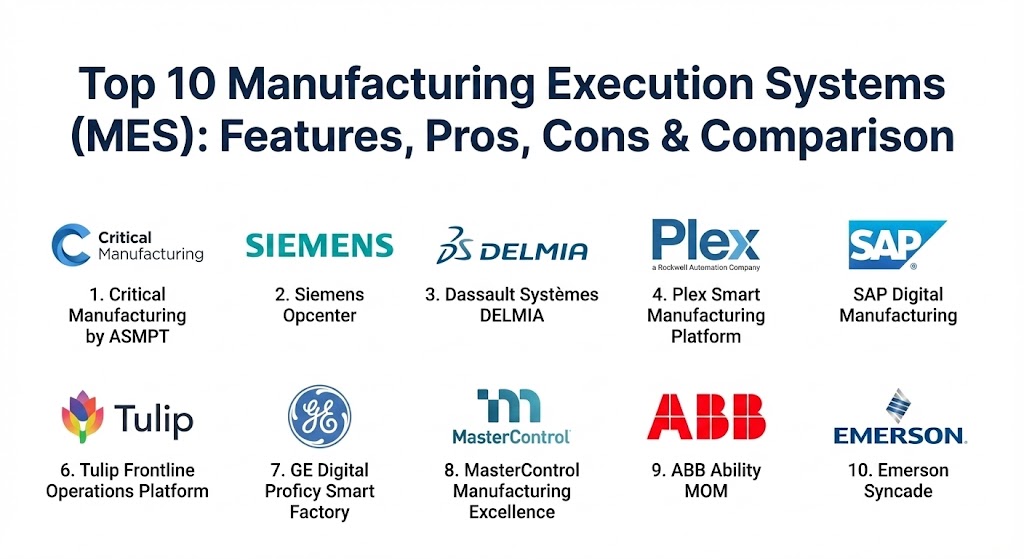
Top 10 Manufacturing Execution Systems (MES) Tools
1 — Critical Manufacturing (by ASMPT)
Critical Manufacturing is a modern, highly flexible MES designed specifically for high-tech industries such as semiconductors, electronics, and medical devices. It is recognized for its modular architecture and ability to handle extremely complex product configurations.
- Key features:
- State-of-the-Art Modeling: Allows for a “digital twin” of the production process with deep granularity.
- Equipment Integration: Native drivers for advanced automation and IoT connectivity.
- Context-Aware UI: Dashboards that adapt based on the role and location of the user.
- Integrated Quality Management: Statistical Process Control (SPC) and non-conformance tracking built-in.
- Advanced Scheduling: Dynamic rescheduling based on real-time shop floor events.
- Pros:
- Exceptionally scalable; it grows from a single line to a global enterprise seamlessly.
- The user interface is one of the most modern and intuitive in the heavy-industrial space.
- Cons:
- The high degree of customization can lead to longer initial implementation times.
- Primarily focused on high-tech; may be overkill for simple discrete manufacturing.
- Security & compliance: SOC 2 Type II, ISO 27001, GDPR, and 21 CFR Part 11 (for medical/pharma) support.
- Support & community: Strong global partner network, comprehensive online documentation, and dedicated enterprise support for 24/7 operations.
2 — Siemens Opcenter (formerly Camstar and Simatic IT)
As part of the Xcelerator portfolio, Siemens Opcenter is a heavyweight in the MES world. It offers specialized modules for both discrete and process manufacturing, leveraging Siemens’ deep expertise in factory automation.
- Key features:
- Industry-Specific Flavors: Dedicated modules for electronics, pharma, and automotive.
- Closed-Loop Manufacturing: Seamlessly connects PLM (design) to MES (execution).
- Labor Management: Tracking of operator certifications and work hours.
- Advanced Analytics: AI-driven insights into production bottlenecks and machine health.
- Native Automation Sync: Direct integration with Siemens TIA Portal and S7 controllers.
- Pros:
- Part of a massive ecosystem; if you use Siemens hardware, the integration is unmatched.
- Extremely robust for multi-plant global deployments.
- Cons:
- The modularity can lead to complex licensing and high total cost of ownership.
- Requires a significant amount of specialized training for administrators.
- Security & compliance: IEC 62443 (industrial cybersecurity), GDPR, HIPAA, and ISO 9001/13485 compliance.
- Support & community: Extensive global support network, Siemens specialized training centers, and a mature user community.
3 — Dassault Systèmes DELMIA
DELMIA is an MES solution that places a heavy emphasis on the “Digital Twin” concept. It allows companies to model, simulate, and execute their manufacturing processes in a single, unified virtual environment.
- Key features:
- Virtual Commissioning: Test production workflows in a 3D environment before going live.
- Global Operations Management: Centralized control over decentralized production sites.
- Lean Manufacturing Tools: Digital boards for Kaizen and 5S management.
- Complex Assembly Support: Step-by-step visual work instructions for intricate tasks.
- Traceability & Genealogy: End-to-end tracking from raw material to end consumer.
- Pros:
- The best choice for organizations that want a perfect sync between 3D design and 3D manufacturing.
- Highly effective at reducing waste through predictive simulation.
- Cons:
- Historically a “high-end” tool that may be priced out of reach for small-to-mid-sized plants.
- Steeper learning curve for users unfamiliar with the 3DEXPERIENCE platform.
- Security & compliance: ISO 27001, SOC 2, and rigorous data residency options for defense/aerospace.
- Support & community: Professional services available globally, active user groups, and extensive certification paths.
4 — Plex Smart Manufacturing Platform (by Rockwell Automation)
Plex is a pioneer in the cloud-native MES space. Recently acquired by Rockwell Automation, it provides a comprehensive platform that incorporates MES, ERP, and Quality management in a single SaaS offering.
- Key features:
- Cloud-First Architecture: No on-premise servers required; updates are pushed automatically.
- Integrated ERP/MES: Eliminates the need for a separate bridge between finance and the floor.
- Control Cross-Check: Ensures that production cannot proceed if quality checks are missed.
- Supply Chain Visibility: Real-time tracking of supplier performance and inventory.
- Mobile Accessibility: Native tablet and handheld support for floor operators.
- Pros:
- Fast deployment compared to traditional on-premise MES solutions.
- Subscription-based model makes it easier to manage as an operational expense (OpEx).
- Cons:
- Requires a constant, reliable internet connection (which can be a risk for some plants).
- Less flexible than “local” systems when it comes to millisecond-level machine logic.
- Security & compliance: SOC 1/2, ISO 27001, GDPR, and ITAR compliance for defense contractors.
- Support & community: Strong North American presence, active “Plex Community” forums, and 24/7 technical support.
5 — SAP Digital Manufacturing (DM)
SAP has transitioned from its legacy ME/MII solutions to a modern, cloud-native Digital Manufacturing suite. It is the go-to choice for companies that already run their entire business on SAP S/4HANA.
- Key features:
- Seamless ERP Sync: Native OData services for real-time synchronization with S/4HANA.
- Visual Manufacturing: Drag-and-drop tool for designing production layouts and flows.
- Sustainability Tracking: Monitoring of energy consumption and carbon footprint at the machine level.
- Resource Orchestration: Automated dispatching of work orders to available machines.
- Edge Computing Support: Local processing to ensure production continues if the cloud is down.
- Pros:
- Reduces “vendor sprawl” for existing SAP customers.
- Excellent global support and localization (languages/tax laws).
- Cons:
- Can be very expensive for companies not already using the SAP ecosystem.
- Implementation often requires expensive external consultants.
- Security & compliance: GDPR, HIPAA, SOC 2, and high-level enterprise encryption standards.
- Support & community: Massive global support network, SAP community blogs, and formal SAP Training.
6 — Tulip (Frontline Operations Platform)
Tulip is a “disruptor” in the MES space. It is a no-code platform that allows engineers to build their own manufacturing apps. It’s designed for the “Connected Worker” rather than just machine tracking.
- Key features:
- No-Code App Builder: Create custom interfaces for work instructions, checklists, and audits.
- Edge IO: Hardware that connects legacy machines to the cloud platform via simple sensors.
- Computer Vision: Native support for using cameras to detect assembly errors.
- Real-time Analytics: Instant dashboards created as users interact with the apps.
- API-First Design: Easily connects to ERPs, CRMs, and other business tools.
- Pros:
- Empowers process engineers to solve their own problems without waiting for IT.
- Extremely fast time-to-value; apps can be built and deployed in days.
- Cons:
- Lacks some of the “deep” heavy-industrial logic (like complex scheduling) found in Siemens or ABB.
- Being “no-code” can lead to a messy ecosystem if not governed properly.
- Security & compliance: SOC 2 Type II, GDPR, and support for GxP environments (pharma/medical).
- Support & community: Vibrant “Tulip Community” site, University of Tulip (free), and modern chat-based support.
7 — GE Digital Proficy Smart Factory
GE Digital’s Proficy suite focuses on efficiency and optimization. It is widely used in the food and beverage and consumer packaged goods (CPG) industries, where OEE (Overall Equipment Effectiveness) is king.
- Key features:
- OEE Tracking: Deep analytics on machine downtime, speed, and quality.
- Genealogy & Traceability: Strong focus on raw material lot tracking.
- Cloud-Hybrid Deployment: Choose where your data lives based on latency needs.
- Workflow Management: Digitized Standard Operating Procedures (SOPs).
- Integrated Batch Execution: Specialized for “recipe-based” manufacturing.
- Pros:
- Powerful analytics that help identify the root cause of production delays quickly.
- Excellent for process-heavy industries like liquid bottling or chemical mixing.
- Cons:
- The user interface can feel more “industrial” and less “modern” than Tulip or Critical.
- Upgrading from legacy GE systems can be a complex migration.
- Security & compliance: ISO 27001, GDPR, and FDA 21 CFR Part 11 readiness.
- Support & community: Professional support services, global GE Digital user groups, and extensive technical documentation.
8 — MasterControl Manufacturing Excellence
MasterControl is a specialist MES focused almost entirely on the life sciences industry. It is designed to replace “paper travelers” with electronic device history records (eDHR).
- Key features:
- Electronic Batch Records (EBR): Fully digital management of pharma production cycles.
- Compliance Automation: Automatic checks against FDA and EMA regulations.
- Error Prevention: Validation of data entry to ensure no “mistakes” are made on the line.
- Quality Integration: Direct link to CAPA (Corrective and Preventive Action) and change control.
- Document Control: Managed access to the latest versions of SOPs.
- Pros:
- If you are in Pharma or MedTech, the “out-of-the-box” compliance is unmatched.
- Reduces the time spent on “quality review” from weeks to minutes.
- Cons:
- Too niche for general manufacturing like automotive or electronics.
- Not designed for high-speed machine control or complex robotics integration.
- Security & compliance: HIPAA, GDPR, FDA 21 CFR Part 11, and SOC 2.
- Support & community: High-touch enterprise support, MasterControl University, and specialized user forums for life sciences.
9 — ABB Ability Manufacturing Operations Management (MOM)
ABB Ability MOM is designed for heavy industrial environments like mining, metals, and infrastructure. It provides a robust, high-availability platform for managing large-scale process data.
- Key features:
- Object-Oriented Design: Build a data model of the entire plant.
- Energy Management: Detailed monitoring of power usage to reduce carbon footprint.
- Maintenance Integration: Native links to Asset Management systems.
- High-Speed Data Collection: Capable of handling millions of tags with low latency.
- Cybersecurity Dashboard: Real-time visibility into the security health of the factory network.
- Pros:
- Built for “24/7/365” environments where downtime is millions of dollars per hour.
- Deep synergy with ABB’s hardware and power electronics ecosystem.
- Cons:
- Requires a high level of specialized knowledge to configure.
- Not as “agile” for smaller plants that change product lines frequently.
- Security & compliance: IEC 62443 certified, ISO 27001, and NERC CIP (for infrastructure).
- Support & community: Global 24/7 technical support, on-site consulting, and ABB University.
10 — Emerson Syncade
Emerson Syncade is another specialized MES for the life sciences sector, but with a deeper focus on the automation layer. It bridges the gap between the DCS (Distributed Control System) and the ERP.
- Key features:
- Recipe Management: Advanced controls for complex biological or chemical formulas.
- Resource Management: Real-time tracking of equipment state and material inventory.
- Electronic Signatures: Compliant sign-offs for every step of the production process.
- Equipment Calibration Tracking: Ensure all tools are within spec before use.
- Integrated Training Records: Prevents untrained personnel from starting a process.
- Pros:
- Exceptionally strong integration with Emerson’s DeltaV control system.
- Highly praised for its ability to handle “biotech” manufacturing complexity.
- Cons:
- High cost of ownership due to its specialized nature.
- Best suited only for the life sciences/specialty chemical space.
- Security & compliance: FDA 21 CFR Part 11, GDPR, and ISO 27001.
- Support & community: Mature enterprise support, professional services for validation, and a global user exchange.
Comparison Table
| Tool Name | Best For | Platform(s) Supported | Standout Feature | Rating (Gartner Peer Insights) |
| Critical Manufacturing | High-Tech / Semis | Windows, Linux, Web | IoT & Semiconductor Focus | 4.8 / 5 |
| Siemens Opcenter | Global Discrete Mfg | Windows, Web | Ecosystem Integration | 4.6 / 5 |
| DELMIA | Virtual-Real Sync | Cloud, Windows | 3D Simulation Engine | 4.4 / 5 |
| Plex | Cloud-Native / SMB-Mid | Pure SaaS | Integrated ERP/MES | 4.1 / 5 |
| SAP Digital Mfg | Existing SAP Users | SAP BTP (Cloud) | ERP Contextualization | 4.3 / 5 |
| Tulip | No-Code / Agile Shop | Cloud / Edge | Frontline App Builder | 4.7 / 5 |
| GE Proficy | F&B / CPG / OEE | Hybrid Cloud | OEE Analytics Depth | 4.2 / 5 |
| MasterControl | Pharma / MedTech | SaaS | eDHR Compliance | 4.5 / 5 |
| ABB Ability | Heavy Industrial | Windows, Web | Energy & Asset Tracking | 4.4 / 5 |
| Emerson Syncade | Life Sciences | Windows, Web | DeltaV Integration | 4.3 / 5 |
Evaluation & Scoring of Manufacturing Execution Systems (MES)
To help you decide, we have evaluated these tools based on a weighted rubric that reflects the modern manufacturing landscape.
| Category | Weight | Top Tool (Score) | Evaluation Notes |
| Core Features | 25% | Siemens Opcenter (9.5) | Breadth of modules and industrial-grade machine control. |
| Ease of Use | 15% | Tulip (10.0) | The no-code approach makes it the most user-friendly. |
| Integrations | 15% | SAP Digital Mfg (9.5) | Unbeatable if you are in the SAP ecosystem. |
| Security & Compliance | 10% | MasterControl (10.0) | Pure-play compliance for regulated industries. |
| Reliability | 10% | ABB Ability (9.5) | Designed for mission-critical heavy industry. |
| Support & Community | 10% | Siemens Opcenter (9.0) | Decades of global presence and documentation. |
| Price / Value | 15% | Plex (8.5) | Cloud model reduces upfront CapEx significantly. |
Which Manufacturing Execution Systems (MES) Tool Is Right for You?
Selecting an MES is a decade-long commitment. The “best” tool for a semiconductor plant is rarely the best for a bakery.
- Solo Users vs SMB vs Mid-market vs Enterprise:
- SMBs: Look at Tulip or Plex. Tulip allows you to start small with a single app and scale as you learn. Plex provides a “business in a box” with its integrated ERP.
- Mid-market: Critical Manufacturing or GE Digital offer the power needed for expansion without the extreme complexity of a massive Siemens or SAP rollout.
- Enterprise: Siemens Opcenter and Dassault DELMIA are built for the complexity of global multi-plant management where standardizing a design-to-make process is the goal.
- Budget-conscious vs Premium Solutions:
- Budget-conscious: While no MES is “cheap,” Tulip offers a lower entry barrier. By starting with free training and a few IoT sensors, you can prove ROI before a large investment.
- Premium: SAP and Siemens are premium investments. You aren’t just buying software; you are buying a long-term industrial infrastructure.
- Industry-Specific Requirements:
- Life Sciences: If you are regulated by the FDA, MasterControl and Emerson Syncade are non-negotiable. Don’t try to “bend” a general MES to meet pharmaceutical laws.
- Discrete High-Tech: Critical Manufacturing has specific logic for lots, wafers, and complex carriers that other tools struggle with.
Frequently Asked Questions (FAQs)
1. What is the difference between ERP and MES?
ERP (Enterprise Resource Planning) handles business logic like finances, sales orders, and high-level scheduling. MES (Manufacturing Execution System) handles shop floor logic like machine state, quality checks, and real-time operator instructions.
2. Can an MES work without an ERP?
Yes, but it is rare. An MES is most powerful when it receives “work orders” from an ERP and returns “finished goods” and “material usage” data to keep the company’s books accurate.
3. Does MES software require specialized hardware?
Most modern MES systems can run on standard servers or the cloud. However, you will need “Edge” hardware (like PLCs or IoT gateways) to bridge the gap between your machines and the software.
4. How long does a typical MES implementation take?
For a no-code system like Tulip, you can have results in days. For an enterprise-wide Siemens or SAP rollout, implementation typically takes 6 to 18 months per plant.
5. What is OEE, and why is it in every MES?
OEE stands for Overall Equipment Effectiveness. It is a score (Availability x Performance x Quality) that tells you how well your machines are being utilized. Most MES systems calculate this automatically.
6. Is cloud-based MES safe for my data?
Yes, provided you choose a vendor with SOC 2 or ISO 27001 certifications. Many manufacturers now use “Hybrid” models where data is processed locally for speed but stored in the cloud for analysis.
7. Who should manage the MES in my company?
It is usually a joint effort between the IT department (infrastructure) and the OT (Operations Technology) or Engineering department (the actual production logic).
8. Can I use an MES for manual assembly?
Absolutely. In manual environments, an MES acts as a digital supervisor, showing operators visual instructions and using sensors (like barcode scanners) to ensure the right part is picked.
9. What is “Sim-to-Real” in MES?
Advanced systems like DELMIA allow you to simulate the factory floor virtually. Once you find the most efficient layout, the MES “pushes” that configuration to the real factory.
10. How do I justify the cost of an MES to my board?
Focus on ROI: reduced scrap, lower inventory levels, 100% compliance/no fines, and higher machine uptime. Most companies see an MES pay for itself within 12 to 24 months.
Conclusion
The selection of a Manufacturing Execution System is a pivotal moment in any company’s digital journey. In 2026, the market has bifurcated into high-end industrial giants like Siemens and ABB, and agile, no-code disruptors like Tulip.
The “best” tool depends on your specific manufacturing constraints. If you prioritize compliance in life sciences, MasterControl is your partner. If you need a digital twin for complex aerospace projects, DELMIA is the choice. Ultimately, an MES is not just software; it is a commitment to transparency on the shop floor. By choosing the right tool, you move from “guessing” what happened on the line to “knowing” exactly how to make your next product better.