Introduction
Batch Processing Frameworks are specialized software environments designed to execute high-volume, repetitive data jobs without manual intervention. Unlike stream processing, which handles data as it arrives, batch processing collects data over a period (the “batch window”) and processes it all at once. This method is exceptionally efficient for tasks that require deep analysis of historical data or massive computational power that would otherwise overwhelm real-time systems.
The importance of these frameworks lies in their ability to provide fault tolerance, scalability, and resource optimization. Without a dedicated framework, a single server failure during an 8-hour payroll run could corrupt an entire database. A modern framework ensures that if a node fails, the job resumes from the last successful checkpoint. Key real-world use cases include financial end-of-day reconciliations, ETL (Extract, Transform, Load) pipelines for data warehouses, and large-scale AI model training. When evaluating tools, users should look for horizontal scalability, ease of monitoring, integration with cloud storage, and robust error-handling mechanisms.
Best for: Data engineers, backend developers, and IT operations teams in mid-to-large enterprises. It is essential for industries like finance, healthcare, and telecommunications where data integrity and volume are paramount.
Not ideal for: Early-stage startups with tiny datasets where a simple Python script or a cron job would suffice, or applications requiring sub-second latency (where stream processing frameworks like Kafka Streams are preferred).
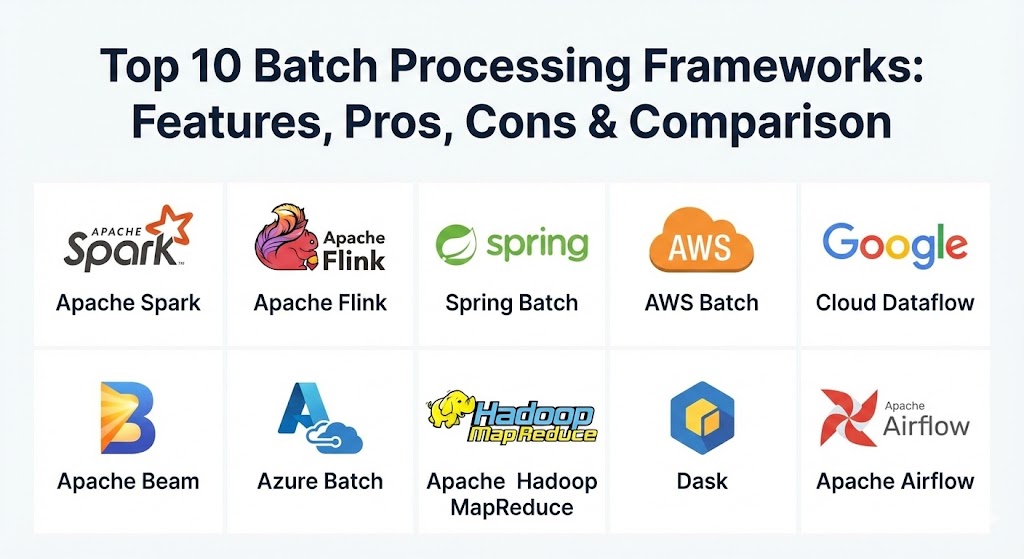
Top 10 Batch Processing Frameworks
1 — Apache Spark
Apache Spark is the undisputed heavyweight champion of the big data world in 2026. Originally designed to overcome the limitations of Hadoop MapReduce, Spark uses in-memory processing to deliver speeds up to 100x faster for certain workloads.
- Key features:
- In-Memory Computing: Massive performance gains by keeping data in RAM rather than writing to disk between steps.
- Unified Engine: Supports batch, streaming, SQL analytics, and Machine Learning (MLlib) in one platform.
- Lazy Evaluation: Optimizes the entire execution plan before any data actually moves.
- Rich Ecosystem: Deep integrations with HDFS, S3, Azure Data Lake, and Kubernetes.
- Multi-Language Support: APIs available in Python (PySpark), Scala, Java, and R.
- Pros:
- Industry-standard tool with the largest talent pool and documentation library.
- Exceptionally versatile; one framework can handle almost any data engineering task.
- Cons:
- Extremely memory-intensive; poorly tuned jobs can quickly balloon infrastructure costs.
- High complexity in performance tuning (garbage collection, shuffle partitions).
- Security & compliance: Supports Kerberos authentication, TLS/SSL encryption, and integrates with Ranger/Atlas for GDPR/HIPAA compliance.
- Support & community: Massive open-source community; premium enterprise support available via Databricks and Cloudera.
2 — Apache Flink
While Flink is often hailed as the king of stream processing, its “Batch-as-a-special-case-of-streaming” philosophy makes it a world-class batch framework for unified data architectures.
- Key features:
- Unified API: Use the same code for both real-time streams and historical batches.
- Custom Memory Manager: Avoids Java Garbage Collection issues by managing its own memory off-heap.
- Query Optimizer: Similar to a relational database, it optimizes join strategies and data distribution.
- Lightweight Checkpointing: Provides exactly-once processing guarantees even during hardware failures.
- Adaptive Batch Execution: Dynamically adjusts parallelism based on data size during runtime.
- Pros:
- Better resource efficiency than Spark for many complex, multi-stage joins.
- True “write once, run anywhere” capability for both batch and stream.
- Cons:
- Steep learning curve compared to Spark, especially for those unfamiliar with DataStream APIs.
- Smaller ecosystem of third-party connectors compared to the Spark/Hadoop world.
- Security & compliance: SOC 2, HIPAA, and GDPR compliant when run on managed platforms like Confluent or Ververica.
- Support & community: Growing rapidly; excellent documentation and strong support from the Apache Software Foundation.
3 — Spring Batch
For Java-centric enterprises, Spring Batch is the gold standard. It isn’t a “Big Data” engine like Spark; rather, it is a lightweight framework for “Business Logic” batching within traditional application stacks.
- Key features:
- Chunk-Based Processing: Processes data in small, manageable transactions (Read-Process-Write).
- Restart/Skip Logic: Built-in ability to restart a failed job from the exact record it stopped on.
- Declarative I/O: Hundreds of pre-built readers/writers for databases, XML, JSON, and Flat Files.
- Transaction Management: Seamlessly integrates with Spring’s powerful transaction handling.
- Remote Partitioning: Can scale out to multiple workers for higher throughput.
- Pros:
- The perfect choice for Java developers; fits naturally into Spring Boot microservices.
- Highly predictable and reliable for critical business tasks like payroll or billing.
- Cons:
- Not designed for distributed “Big Data” analytics (petabyte scale).
- Tied strictly to the Java/JVM ecosystem.
- Security & compliance: Leverages Spring Security for SSO and encryption; widely used in HIPAA and PCI-compliant environments.
- Support & community: Extensive documentation; backed by VMware and a massive Java community.
4 — AWS Batch
AWS Batch is a fully managed service that dynamically provisions the optimal quantity and type of compute resources based on the volume and specific requirements of your batch jobs.
- Key features:
- Serverless Execution: No servers to manage; AWS handles the underlying EC2 or Fargate clusters.
- Spot Instance Integration: Automatically uses discounted “Spot” capacity to save up to 90% on costs.
- Container-Native: Jobs are defined as Docker containers, making them portable and consistent.
- Prioritized Queuing: Define multiple queues with different priorities for urgent vs. background tasks.
- AWS Ecosystem Integration: Native links to S3, DynamoDB, and Step Functions for orchestration.
- Pros:
- Zero operational overhead for infrastructure management.
- Massive scalability—can launch 100,000+ vCPUs in minutes.
- Cons:
- Total vendor lock-in to the Amazon Web Services ecosystem.
- Debugging “black box” resource allocation can be frustrating when jobs fail.
- Security & compliance: FedRAMP, SOC, HIPAA, GDPR, and ISO 27001; uses IAM for granular access control.
- Support & community: Enterprise-grade support from AWS; massive library of CloudFormation/Terraform templates.
5 — Google Cloud Dataflow
Dataflow is Google’s fully managed service for executing Apache Beam pipelines. It is highly automated and provides a “NoOps” experience for unified batch and stream processing.
- Key features:
- Dynamic Work Rebalancing: Automatically shifts tasks from “straggler” nodes to faster ones during a job.
- Horizontal Autoscaling: Scales the number of workers up and down in real-time based on backlog.
- Confidential VMs: Supports encrypted-in-use data processing for highly sensitive workloads.
- Built-in Templates: Deploy common ETL patterns with a single click or API call.
- Unified Batch/Stream: Seamlessly switch between processing historical data and live feeds.
- Pros:
- The most advanced autoscaling and resource management in the cloud market.
- Simplified pricing; you pay only for the compute and memory consumed.
- Cons:
- Requires learning the Apache Beam programming model.
- Primarily optimized for the Google Cloud ecosystem.
- Security & compliance: HIPAA, GDPR, SOC 2, and VPC Service Controls for network isolation.
- Support & community: High-quality documentation; premium support through Google Cloud.
6 — Apache Beam
Apache Beam is not an engine itself, but a unified programming model. You write your batch or stream logic once in Python, Java, or Go, and “run” it on Spark, Flink, or Dataflow.
- Key features:
- The “Runner” Model: Decouples your business logic from the underlying execution engine.
- Windowing & Triggers: Powerful primitives for handling late-arriving data in batch/stream.
- PCollection Abstraction: Treats all data as a distributed collection, regardless of source.
- Cross-Language Pipelines: Mix Python and Java steps in the same data pipeline.
- Extensible IO: Support for hundreds of sources from BigQuery to Kafka to local files.
- Pros:
- Future-proofs your code; you can switch from Spark to Flink without a rewrite.
- Excellent for complex, multi-step ETL logic that needs to be portable.
- Cons:
- The abstraction layer can sometimes make debugging underlying engine errors harder.
- Some advanced features of specific runners (like Spark-specific tuning) are hidden.
- Security & compliance: Varies by runner (inherits security of Spark/Flink/Dataflow).
- Support & community: Growing community; strong backing from Google and LinkedIn.
7 — Azure Batch
Azure Batch is Microsoft’s answer to high-performance computing (HPC) and large-scale batch processing. It is ideal for compute-intensive tasks like rendering, simulations, and data transformation.
- Key features:
- Low-Priority VMs: Significant cost savings by using Azure’s excess capacity.
- Custom Images: Run batch jobs using your own custom Windows or Linux VM images.
- Parallel Task Execution: Run multiple tasks simultaneously on a single compute node.
- Visual Studio Integration: Develop and debug batch jobs directly within the MS ecosystem.
- Application Packages: Automatically deploy your binary and its dependencies to every node.
- Pros:
- Deeply integrated with Azure Active Directory and Azure Data Factory.
- Exceptional support for legacy Windows-based batch applications.
- Cons:
- Interface can be more complex than AWS Batch for simple containerized jobs.
- Primarily designed for compute-heavy “HPC” tasks rather than just simple ETL.
- Security & compliance: ISO, SOC, HIPAA, GDPR, and integration with Azure Key Vault.
- Support & community: Comprehensive Microsoft enterprise support and extensive Azure documentation.
8 — Apache Hadoop MapReduce
While often called “legacy,” Hadoop MapReduce remains the foundation of many global banking and government systems due to its rock-solid reliability on cheap hardware.
- Key features:
- Disk-Based Processing: Writes data to disk at every step, making it nearly impossible to “crash” due to memory limits.
- Data Locality: Moves the computation to where the data is stored (on HDFS nodes) to save bandwidth.
- Massive Parallelism: Proven to scale to tens of thousands of nodes in a single cluster.
- Fault Tolerance: If a node dies, the task is simply re-run on another node without losing progress.
- Pros:
- Extremely stable for massive, days-long “heroic” batch jobs.
- Highly cost-effective on older, commodity hardware with lots of disk but little RAM.
- Cons:
- Significantly slower than Spark for iterative algorithms or small jobs.
- The programming model is verbose and difficult for modern developers to master.
- Security & compliance: Kerberos, Ranger, and Atlas integration; proven in highly regulated sectors.
- Support & community: Mature ecosystem; long-term support available through Cloudera.
9 — Dask
For Python developers who find Spark too “Java-heavy,” Dask is the answer. It is a flexible library for parallel computing in Python that integrates seamlessly with NumPy, Pandas, and Scikit-Learn.
- Key features:
- Native Python: Built from the ground up for the Python ecosystem; no JVM required.
- Dynamic Task Scheduling: Optimized for complex, non-linear computations (unlike Spark’s strict DAGs).
- Scalable DataFrames: Parallelize your Pandas code across a cluster with minimal changes.
- Lightweight: Can run on a single laptop or scale to a thousand-node cluster.
- Pros:
- Lowest barrier to entry for Data Scientists and Python engineers.
- Exceptional for Machine Learning and scientific research (HPC) workflows.
- Cons:
- Not as mature as Spark for traditional “Enterprise ETL” with complex SQL joins.
- Smaller enterprise support ecosystem compared to the Apache big data giants.
- Security & compliance: Supports TLS/SSL and basic authentication; SOC 2 via managed providers like Coiled.
- Support & community: Rapidly growing community in the Python Data Science space.
10 — Apache Airflow
While technically an orchestrator, Airflow is the framework most companies use to define, schedule, and monitor their batch processing pipelines in 2026.
- Key features:
- Workflows as Code: Define your batch pipelines in Python for version control and testing.
- Extensible Providers: Thousands of “Operators” to trigger jobs in Spark, AWS, Snowflake, etc.
- Rich UI: Deep visibility into job history, logs, and Gantt charts of execution times.
- Dynamic Pipeline Generation: Use Python logic to create tasks based on external metadata.
- Scalable Architecture: Uses Celery or Kubernetes executors to run thousands of tasks.
- Pros:
- The industry standard for coordinating multi-step batch processes.
- Prevents “silent failures” through robust alerting and retry logic.
- Cons:
- Not a data processing engine itself (you must trigger an external tool like Spark).
- Can be complex to manage and scale the Airflow webserver and database.
- Security & compliance: Role-Based Access Control (RBAC), SSO integration, and secret masking.
- Support & community: Massive community; managed versions available via Astronomer and AWS (MWAA).
Comparison Table
| Tool Name | Best For | Platform(s) Supported | Standout Feature | Rating (Gartner / TrueReview) |
| Apache Spark | Large-scale Big Data / ML | Linux, Windows, K8s, Cloud | In-Memory Speed | 4.7 / 5 |
| Apache Flink | Unified Batch & Stream | Linux, K8s, Cloud | Exact Memory Management | 4.5 / 5 |
| Spring Batch | Java Enterprise / Billing | JVM, Spring Boot | Chunk-based Reliability | N/A (Standard) |
| AWS Batch | Serverless Cloud Jobs | AWS Native | Spot Instance Savings | 4.4 / 5 |
| Google Dataflow | Google Cloud / NoOps | GCP Native | Dynamic Work Rebalancing | 4.6 / 5 |
| Apache Beam | Portable ETL Logic | Spark, Flink, Dataflow | Engine Agnostic Model | 4.3 / 5 |
| Azure Batch | Windows Legacy / HPC | Azure Native | Low-Priority VM Pricing | 4.4 / 5 |
| Hadoop MapReduce | Massive Legacy Jobs | Linux (On-Prem) | Disk-based Reliability | 4.2 / 5 |
| Dask | Python Data Science | Python Ecosystem | Scalable Pandas/NumPy | 4.5 / 5 |
| Apache Airflow | Batch Orchestration | Multi-Cloud, K8s | Python-based DAGs | 4.6 / 5 |
Evaluation & Scoring of Batch Processing Frameworks
When selecting a framework, we evaluate them across seven weighted categories to ensure they meet modern enterprise standards.
| Category | Weight | Evaluation Criteria |
| Core Features | 25% | Fault tolerance, scalability, and built-in library support. |
| Ease of Use | 15% | Development experience, API clarity, and local testing. |
| Integrations | 15% | Connectors for modern databases, clouds, and orchestrators. |
| Security & Compliance | 10% | Encryption, SSO, and adherence to industry standards. |
| Performance | 10% | Resource efficiency (RAM/CPU) and processing throughput. |
| Support & Community | 10% | Vendor backing, documentation quality, and talent availability. |
| Price / Value | 15% | Licensing fees vs. infrastructure and maintenance costs. |
Which Batch Processing Framework Tool Is Right for You?
Solo Users vs SMB vs Enterprise
- Solo Users: If you are a Python developer, stick to Dask. It’s easy to run on your laptop and scales if you need it. Java devs should use Spring Batch.
- SMBs: Look at AWS Batch or Google Dataflow. Managing a Spark cluster is a full-time job; serverless options allow you to focus on code instead of infrastructure.
- Enterprise: Apache Spark is the standard. It provides the performance and the talent pool needed for massive operations. Use Apache Airflow to tie it all together.
Budget-conscious vs Premium
- Budget: Hadoop MapReduce on old hardware or AWS Batch using Spot instances. Dask is also excellent as it doesn’t require expensive JVM-tuned instances.
- Premium: Databricks (Spark) or Confluent (Flink). You pay a premium for the platform, but you save significantly on engineering time and “headache” costs.
Integration and Scalability
If your company is “All-In” on a cloud provider, use their native batch tool (AWS Batch / Azure Batch / Dataflow). If you are multi-cloud or hybrid, Apache Beam is essential to avoid being trapped with one vendor.
Frequently Asked Questions (FAQs)
1. Is batch processing obsolete in 2026?
No. While real-time streaming is popular, batch processing is more cost-effective and reliable for high-volume tasks that don’t require immediate results, such as monthly billing or model training.
2. What is a “Batch Window”?
The batch window is the time period (often off-peak hours) allocated for a batch job to run so that it doesn’t interfere with the performance of live, customer-facing applications.
3. Spark vs. Flink: Which is better for batch?
Historically Spark was better for batch and Flink for stream. Today, they are very similar. Spark still has a better ecosystem for ML, while Flink is often more memory-efficient for complex joins.
4. Can I run batch jobs on Kubernetes?
Yes. Most modern frameworks (Spark, Flink, Dask, Airflow) have native Kubernetes operators, allowing you to treat batch jobs as ephemeral pods that vanish once the task is done.
5. How do I handle data errors in a 10-million-row batch?
Frameworks like Spring Batch allow you to define “Skip” policies. For example, if 0.1% of records are malformed, the job will log them and continue rather than failing the entire 8-hour run.
6. What is the difference between an orchestrator and a framework?
A framework (like Spark) does the actual heavy lifting (the “math”). An orchestrator (like Airflow) tells the framework when to start and ensures the previous steps are finished first.
7. Why is “Fault Tolerance” so important in batch?
In a distributed system, hardware fails. If you are 90% through a 12-hour job and a server dies, a fault-tolerant framework ensures the job finishes using other servers without starting over.
8. Is Dask better than PySpark?
Dask is better if you want a “Pure Python” experience that mimics Pandas. PySpark is better if you need to integrate into a legacy big data ecosystem or need massive enterprise scale.
9. What is “Exactly-Once” processing?
It is a guarantee that even if a system fails and restarts, every piece of data is processed exactly one time—preventing issues like charging a customer twice during a billing batch.
10. How much does batch processing cost in the cloud?
It depends on the resource usage. However, using “Spot Instances” or “Low-Priority VMs” can reduce costs by up to 90% compared to standard on-demand pricing.
Conclusion
The “best” batch processing framework is rarely about raw speed alone; it is about how well it fits into your existing ecosystem. If you are a Java shop, Spring Batch is your best friend. If you are managing petabytes of data on the cloud, Spark or Dataflow are the heavy hitters. As we move deeper into 2026, the trend is clear: the boundaries between batch and stream are fading, and the focus is shifting toward NoOps and unified models. Choose a framework that doesn’t just process your data today, but scales with your ambitions tomorrow.