Introduction
Stream processing frameworks are specialized software platforms designed to ingest, transform, and analyze continuous flows of data as they are produced. Unlike traditional “batch processing,” which collects data over hours or days before analyzing it in bulk, stream processing treats data as an “unbounded” set of events. These frameworks allow developers to write logic that reacts to individual messages, aggregates them over time-based “windows,” and maintains state across the entire life of the stream.
The importance of these tools lies in their ability to collapse the “time-to-insight” from hours to milliseconds. Key real-world use cases include monitoring IoT sensor telemetry for predictive maintenance, tracking real-time inventory levels across global supply chains, and power-predictive analytics for ride-sharing apps like Uber or Lyft. When evaluating these frameworks, users typically look for three core criteria: latency (how fast can it process?), exactly-once semantics (can it ensure no data is lost or duplicated?), and scalability (can it handle millions of events per second?).
Best for: Data engineers, software architects, and DevOps teams at mid-sized to large enterprises who need to build responsive, event-driven applications. It is particularly critical for industries like Fintech, E-commerce, Logistics, and Cybersecurity where immediate reaction to data translates directly into profit or safety.
Not ideal for: Organizations with low data volumes where simple batch scripts are sufficient, or small startups with no real-time requirements. For traditional reporting (e.g., quarterly financial statements), a standard SQL database or data warehouse remains a better, less complex alternative.
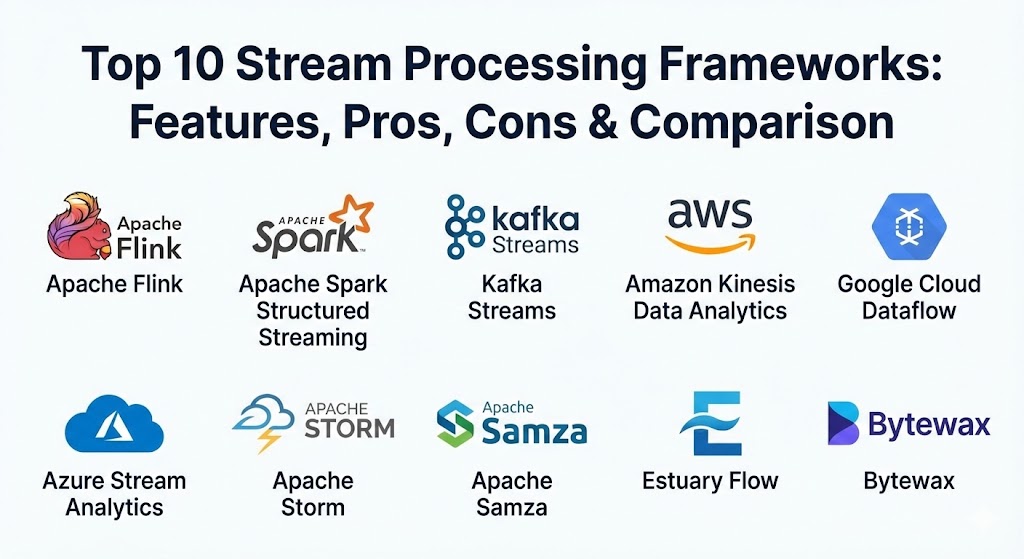
Top 10 Stream Processing Frameworks
1 — Apache Flink
Apache Flink has cemented its position as the industry leader for stateful stream processing in 2026. It is a distributed processing engine designed to handle both unbounded (stream) and bounded (batch) data sets with true “event-at-a-time” processing logic.
- Key features:
- True streaming engine (not micro-batching) providing millisecond-level latency.
- Sophisticated state management with “exactly-once” processing guarantees.
- Powerful Windowing API (tumbling, sliding, session windows).
- Integrated “Stream SQL” and Table API for unified batch/stream development.
- Native support for Event-Time processing and Watermarks to handle late data.
- Savepoints feature allowing for seamless application updates and migration.
- Robust fault tolerance through distributed snapshots and checkpointing.
- Pros:
- The most feature-complete framework for complex, high-throughput streaming.
- Excellent horizontal scalability; powers some of the world’s largest data pipelines (e.g., at Alibaba and Netflix).
- Cons:
- High operational complexity; managing a Flink cluster requires specialized expertise.
- The learning curve for the DataStream API can be quite steep for beginners.
- Security & compliance: Supports Kerberos, SSL/TLS encryption, and granular RBAC. Compliance depends on the deployment environment (e.g., SOC 2 via managed providers).
- Support & community: Massive open-source community; commercial support available via Ververica and Confluent.
2 — Apache Spark Structured Streaming
Spark remains the king of data processing market share, and its Structured Streaming module is the preferred choice for organizations already invested in the Spark ecosystem. It uses a micro-batch model to provide a unified API for batch and streaming.
- Key features:
- Unified API: Write a batch query, and it runs as a streaming query with minimal changes.
- Exactly-once fault tolerance using checkpointing and Write-Ahead Logs.
- Deep integration with the broader Spark ecosystem (MLlib, GraphX).
- Support for multiple programming languages (Scala, Java, Python, R).
- Native connectivity to Delta Lake for building robust “Lakehouse” architectures.
- Continuous Processing mode for lower latency (experimental but evolving).
- Pros:
- The easiest “on-ramp” for data analysts already familiar with Spark SQL or DataFrames.
- Exceptional community support and a massive library of third-party connectors.
- Cons:
- Higher latency than Flink due to its inherent micro-batching architecture.
- State management is less flexible than Flink for very complex windowing logic.
- Security & compliance: FIPS 140-2 (via Databricks), HIPAA, SOC 2, and LDAP/AD integration.
- Support & community: World-class documentation and global enterprise support from Databricks and Cloudera.
3 — Apache Kafka Streams
Kafka Streams is not a “cluster” in the traditional sense, but a lightweight library that runs within your own Java/Kotlin applications. It is the de-facto choice for developers whose data already lives in Kafka.
- Key features:
- No separate processing cluster required; runs as a library in your app.
- Exactly-once processing via Kafka’s transactional API.
- Local state stores (RocksDB) for high-performance stateful aggregations.
- Interactive Queries: Query the state of your application directly via an API.
- Native windowing, joins, and aggregations for Kafka topics.
- Support for KTables (state) and KStreams (events) for stream-table duality.
- Pros:
- Incredibly low operational overhead; if you can deploy a microservice, you can deploy Kafka Streams.
- Tightest possible integration with Kafka, ensuring maximum efficiency.
- Cons:
- Strictly tied to Apache Kafka; you cannot use it with Pulsar or other message brokers.
- Limited to the JVM (Java, Scala, Kotlin); no native Python support.
- Security & compliance: Inherits Kafka’s security features (SASL/SSL, ACLs).
- Support & community: Extremely active community; enterprise support provided by Confluent.
4 — Amazon Kinesis Data Analytics
For AWS-centric organizations, Kinesis Data Analytics provides a fully managed service to run Apache Flink applications without the headache of managing servers or clusters.
- Key features:
- Serverless execution of Flink or SQL-based streaming logic.
- Automatic scaling of compute resources (KPUs) based on data throughput.
- Deep integration with AWS services (S3, Lambda, Redshift, DynamoDB).
- Built-in monitoring and logging through Amazon CloudWatch.
- Pay-as-you-go pricing model based on resource consumption.
- Supports custom Flink code or a simplified “Studio” notebook experience.
- Pros:
- Eliminates the “ops” from Flink; AWS handles the patching, scaling, and availability.
- Quick setup for developers already using Kinesis Data Streams as their ingestion layer.
- Cons:
- Vendor lock-in; moving these pipelines to another cloud is difficult.
- Can be more expensive than self-hosting for very high, steady-state workloads.
- Security & compliance: HIPAA, SOC 1/2/3, PCI DSS, FedRAMP, and IAM-based security.
- Support & community: Backed by AWS premium support and extensive cloud documentation.
5 — Google Cloud Dataflow
Based on the Apache Beam model, Dataflow is Google’s premier streaming service. It is designed to be a unified, serverless engine that handles both batch and stream processing with equal elegance.
- Key features:
- Serverless, auto-scaling architecture that manages all worker provisioning.
- Built on Apache Beam, providing engine-portability (run on Flink, Spark, or Dataflow).
- Advanced “Liquid Sharding” for dynamic work rebalancing.
- Strong event-time semantics and windowing abstractions.
- “Snapshots” for easy pipeline state capture and restoration.
- Native integration with BigQuery and Pub/Sub for a complete GCP data stack.
- Pros:
- Arguably the best auto-scaling in the industry; it reacts to spikes almost instantly.
- Beam’s “Write Once, Run Anywhere” model protects you from future framework shifts.
- Cons:
- Heavy reliance on Google Cloud infrastructure.
- Debugging complex Beam pipelines can be challenging due to the abstraction layers.
- Security & compliance: SOC 1/2/3, HIPAA, GDPR, ISO 27001, and VPC Service Controls.
- Support & community: Robust Google Cloud support and a strong Beam developer community.
6 — Azure Stream Analytics
Microsoft’s answer to real-time processing, Azure Stream Analytics, focuses on ease of use through a SQL-like language, making it accessible to a wider range of analysts.
- Key features:
- SQL-based language (Stream Analytics Query Language) for rapid development.
- Fully managed, serverless architecture with high availability by default.
- Native “reference data” joins for enriching streams with static data.
- Integration with Power BI for real-time dashboarding.
- Machine learning integration via simple SQL function calls.
- Support for custom code via C# or JavaScript UDFs (User Defined Functions).
- Pros:
- The lowest “time-to-insight” for teams who already know SQL.
- Seamlessly connects the entire Microsoft “Modern Data Stack” (Event Hubs to Synapse).
- Cons:
- Less flexible than Flink or Spark for highly complex, low-level logic.
- Not suitable for high-frequency trading or ultra-low latency scenarios (latency is in seconds).
- Security & compliance: Azure Active Directory, VNET support, HIPAA, and GDPR.
- Support & community: Extensive Microsoft documentation and Azure enterprise support.
7 — Apache Storm
The pioneer of the industry, Apache Storm, remains a choice for specific legacy applications and developers who prioritize a simple “spouts and bolts” architecture for distributed computation.
- Key features:
- Distributed real-time computation system using Topologies.
- Simple programming model: Spouts (data sources) and Bolts (processors).
- Support for multiple programming languages via a Thrift-based protocol.
- Guaranteed data processing through an “at-least-once” model (standard) or Trident (exactly-once).
- Low-level control over parallel processing and task distribution.
- Pros:
- Very low latency; it was designed for speed before “exactly-once” became the standard.
- Simple, easy-to-understand architecture for basic transformation pipelines.
- Cons:
- Lacks the sophisticated state management and windowing features of Flink.
- The ecosystem has largely moved toward Spark and Flink; community growth has stalled.
- Security & compliance: Supports Kerberos and basic transport security. Compliance is “Varies.”
- Support & community: Mature but shrinking community; documentation is dated compared to rivals.
8 — Apache Samza
Originally developed at LinkedIn, Samza is built to work seamlessly with Apache Kafka and Hadoop YARN. It is known for its extreme horizontal scalability and efficient local state handling.
- Key features:
- Uses Kafka for messaging and YARN for fault tolerance and resource management.
- High-performance local state management with RocksDB.
- Support for “side-band” data—easily joining streams with local database snapshots.
- Multi-stage processing pipelines with independent scaling for each stage.
- Unified API for both Samza (streaming) and Beam (portable) logic.
- Pros:
- Extremely stable and resilient for massive-scale, stateful operations.
- Decouples the processing logic from the storage, making it very flexible for heavy-state jobs.
- Cons:
- Traditionally required Hadoop YARN, though “Samza as a Library” has improved this.
- Not as widely adopted outside of very large tech companies.
- Security & compliance: Kerberos, ACLs via Kafka/YARN. Compliance is “Varies.”
- Support & community: Maintained by the Apache Foundation; active but smaller community than Flink.
9 — Estuary Flow
Estuary Flow is a modern, DataOps-focused platform that simplifies the creation of real-time data pipelines. It is designed to bridge the gap between “batch” ETL and “streaming” processing.
- Key features:
- Managed Change Data Capture (CDC) to stream data from databases in real-time.
- Streaming SQL and TypeScript transformations for data enrichment.
- Millisecond-latency syncing between diverse sources and sinks.
- Built-in schema validation and data governance.
- Integrated cloud storage for data durability and replayability.
- Pros:
- Much easier to set up than Flink or Spark; perfect for “Real-time ETL” use cases.
- Handles the complexities of “backfilling” historical data into new streams automatically.
- Cons:
- Less powerful for “Complex Event Processing” (CEP) than low-level frameworks.
- Newer platform with a smaller community and fewer advanced tuning options.
- Security & compliance: SOC 2 Type II, HIPAA (Enterprise), and SSO support.
- Support & community: Responsive support via Slack and email; excellent tutorial documentation.
10 — Bytewax
Bytewax is the rising star for the Python community in 2026. It is a Rust-powered streaming engine that allows data scientists and engineers to write Python code for high-performance dataflows.
- Key features:
- Python-native API; no need for a JVM or Java/Scala knowledge.
- Powered by a high-performance Timely Dataflow engine written in Rust.
- Support for exactly-once processing and stateful aggregations.
- Easy integration with Python’s AI/ML ecosystem (PyTorch, Scikit-learn).
- Cloud-native and container-friendly; easy to deploy on Kubernetes.
- Pros:
- The best choice for data scientists who want to deploy streaming models without learning Java.
- Extremely lightweight and fast compared to traditional heavy-duty frameworks.
- Cons:
- Still maturing; does not yet have the vast connector library of Spark or Flink.
- Not designed for the multi-petabyte-scale “general purpose” workloads of Flink.
- Security & compliance: Supports standard encryption and IAM integrations. Compliance is “Varies.”
- Support & community: Rapidly growing community; active Discord and commercial support available.
Comparison Table
| Tool Name | Best For | Platform(s) Supported | Standout Feature | Rating (Gartner / TrueReview) |
| Apache Flink | Complex/Large Scale | Linux, Cloud, K8s | Exact-at-a-time / Stateful | 4.7 / 5 |
| Spark Streaming | Spark Ecosystem | Linux, Cloud, K8s | Unified Batch/Stream API | 4.5 / 5 |
| Kafka Streams | Kafka Users | JVM (Library) | No separate cluster needed | 4.6 / 5 |
| AWS Kinesis | AWS Users | AWS (Managed) | Fully Serverless Flink | 4.4 / 5 |
| Google Dataflow | GCP / Portability | GCP (Managed) | Apache Beam / Auto-scaling | 4.6 / 5 |
| Azure Stream | SQL-savvy teams | Azure (Managed) | SQL for Stream Analytics | 4.3 / 5 |
| Apache Storm | Simple / Legacy | Linux, K8s | Spout & Bolt Simplicity | 4.1 / 5 |
| Apache Samza | LinkedIn-scale jobs | Linux, YARN, K8s | Efficient Local State | 4.2 / 5 |
| Estuary Flow | Real-time ETL / CDC | Cloud (SaaS) | Managed CDC + SQL Trans | 4.6 / 5 |
| Bytewax | Python / AI Apps | Linux, K8s, Cloud | Rust-powered Python API | 4.8 / 5 |
Evaluation & Scoring of Stream Processing Frameworks
The following rubric breaks down how we evaluate these frameworks based on the needs of a modern, data-driven enterprise.
| Category | Weight | Evaluation Criteria |
| Core Features | 25% | Exactly-once guarantees, windowing, and state management depth. |
| Ease of Use | 15% | Development velocity, UI/UX of dashboards, and language support. |
| Integrations | 15% | Breadth of connectors (S3, Kafka, Postgres, Snowflake) and ecosystem. |
| Security | 10% | Encryption, RBAC, SSO, and compliance with GDPR/HIPAA. |
| Performance | 10% | Latency, throughput, and efficiency of resource consumption. |
| Support | 10% | Quality of documentation, community activity, and enterprise SLAs. |
| Price / Value | 15% | Licensing cost vs. developer hours saved and infrastructure efficiency. |
Which Stream Processing Framework Tool Is Right for You?
The “best” tool is the one that fits your existing technical debt and your future scalability goals.
- Solo Users & Data Scientists: If you want to put a Python model into production without managing a Java cluster, Bytewax is the modern winner. If you need simple dashboarding, Azure Stream Analytics or Looker Studio integrations are great.
- Small to Medium Businesses (SMBs): Avoid managing your own clusters. Estuary Flow or AWS Kinesis Data Analytics provide the power of streaming without requiring a dedicated “data platform” team.
- Mid-Market & Enterprises: If you are already a “Spark shop,” stick with Spark Structured Streaming. However, if your business depends on millisecond reactions (e.g., fraud or trading), migrating to Apache Flink is almost certainly worth the investment.
- Budget-Conscious Teams: Apache Kafka Streams is the most cost-effective choice for developers. Because it’s a library, you don’t pay for “idle cluster” time; you only pay for the compute your application actually uses.
- High-Security Environments: Managed services like Google Dataflow or Amazon Kinesis are the easiest way to achieve compliance (HIPAA, SOC 2) because the cloud provider handles the physical and network security layers for you.
Frequently Asked Questions (FAQs)
1. What is the difference between Batch and Stream processing?
Batch processing analyzes data in large chunks after it has been collected. Stream processing analyzes data continuously as it arrives, usually within milliseconds or seconds of the event occurring.
2. Can I use SQL for stream processing?
Yes. Most modern frameworks (Flink, Spark, Azure Stream Analytics, Estuary) now support a version of “Streaming SQL,” allowing you to write queries that run continuously over moving data.
3. What are “Exactly-Once” semantics?
This is a guarantee that even if a system fails, the end result of the data processing will be as if every message was processed exactly once—no data is lost, and nothing is counted twice.
4. Do I need Apache Kafka to do streaming?
No, but it is the most common “source” for streaming data. You can also use AWS Kinesis, Azure Event Hubs, Google Pub/Sub, or even raw TCP sockets and database logs (CDC).
5. How much does a stream processing framework cost?
Open-source frameworks are free, but the “hidden cost” is in infrastructure and developer time. Managed cloud services usually charge based on the volume of data processed or the compute hours used.
6. Is Apache Flink better than Spark Streaming?
It depends on your latency needs. Flink is better for true real-time, low-latency, and complex stateful jobs. Spark is better for “near-real-time” analytics and teams already comfortable with the Spark ecosystem.
7. What is Backpressure?
Backpressure is a signal that a downstream system is overwhelmed and cannot keep up with incoming data. Good frameworks (like Flink) handle this automatically by slowing down the data source.
8. Can I do Machine Learning on streaming data?
Yes. Frameworks like Spark Streaming and Bytewax are specifically designed to allow ML models to “score” data as it passes through the pipeline.
9. What is a “Window” in streaming?
Since a stream is infinite, you can’t calculate a “total average” easily. Instead, you define a window (e.g., “the average over the last 5 minutes”) to perform aggregations.
10. What is the biggest mistake when starting with streaming?
The biggest mistake is over-engineering. Many teams jump into a complex Flink cluster when a simple Kafka Streams library or a managed SQL service would have been faster and cheaper to deploy.
Conclusion
In 2026, the data streaming market has matured from an experimental frontier into a robust ecosystem of specialized tools. Choosing a framework is no longer a matter of “which is the fastest,” but “which fits my environment?” If you are built on AWS, Kinesis is your friend; if you are a Python wizard, Bytewax is your gateway; and if you are building the next global finance engine, Apache Flink remains the undisputed king. What matters most is that you choose a tool that allows your business to move as fast as the data it generates.