Introduction
Master Data Management (MDM) is a comprehensive method of enabling an enterprise to link all of its critical data to one file, called a master file, which provides a common point of reference. MDM tools are specialized software platforms that facilitate this by identifying, cleansing, and synchronizing data from across the enterprise.
The importance of MDM cannot be overstated in an era of AI and advanced analytics. Without clean master data, an AI model will produce “hallucinations” based on duplicate or incorrect records, and customer experience will suffer from disjointed interactions. Key real-world use cases include Customer 360 (unifying customer touchpoints), Supplier Management (optimizing the supply chain), and Product Information Management (ensuring consistent product data across e-commerce channels).
When choosing an MDM tool, users should evaluate platforms based on their multi-domain capabilities, the strength of their matching and merging algorithms, the flexibility of their data modeling, and the robustness of their data governance and stewardship workflows.
Best for: Large enterprises with complex data landscapes, multi-national corporations, and industries like healthcare, finance, and retail where accurate “entity resolution” (identifying unique customers or products) is vital. It is also essential for organizations undergoing digital transformation or preparing for large-scale AI implementations.
Not ideal for: Small startups or businesses with a very simple, single-source data architecture. For these entities, the high cost and implementation complexity of a full-scale MDM platform may be overkill; simpler data quality or integration tools (like basic ETL or CRM-native deduplication) may suffice.
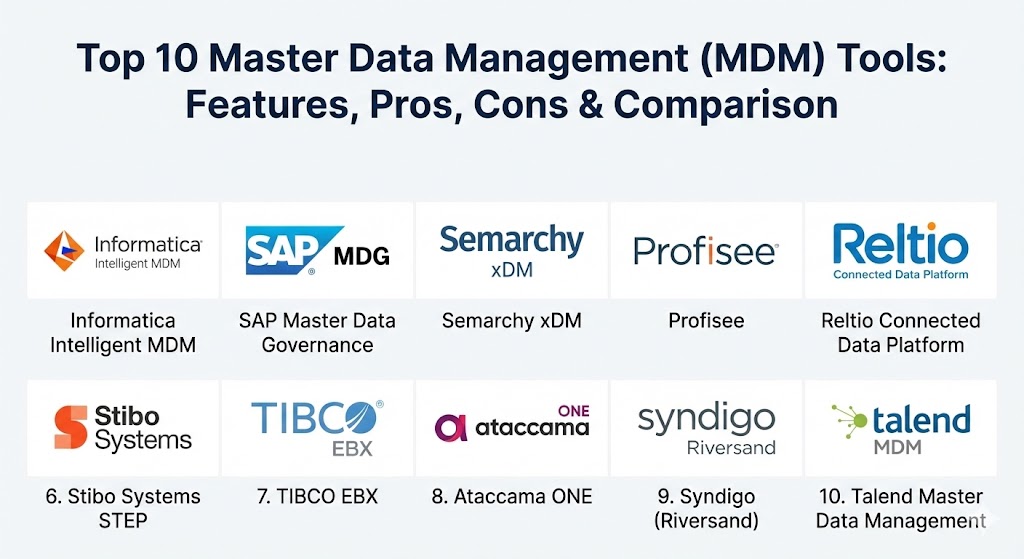
Top 10 Master Data Management (MDM) Tools
1 — Informatica Intelligent MDM
Informatica is a long-standing leader in the MDM space. Its Intelligent MDM, part of the Intelligent Data Management Cloud (IDMC), is an AI-powered platform that manages the entire data lifecycle across multi-cloud and on-premises environments.
- Key features:
- CLAIRE AI Engine: Uses AI/ML to automate data discovery, matching, and governance.
- Multi-Domain Support: Manages customer, product, supplier, employee, and location data in one place.
- End-to-End Governance: Integrated data quality, privacy, and cataloging.
- Pre-built Accelerators: Industry-specific templates to speed up deployment.
- Cloud-Native Architecture: Scalable microservices built for modern cloud ecosystems.
- Stewardship Dashboard: Intuitive UI for data stewards to resolve exceptions manually.
- Pros:
- Deeply integrated with Informatica’s industry-leading ETL and data quality tools.
- Highly scalable for the world’s largest and most complex data sets.
- Cons:
- Implementation is notoriously complex and can take many months.
- High total cost of ownership (TCO), including licensing and specialized consulting.
- Security & compliance: SOC 2 Type II, HIPAA, GDPR, AES-256 encryption at rest, and TLS 1.2+ in transit.
- Support & community: Extensive documentation, Informatica University training, and a massive global network of partners and user groups.
2 — SAP Master Data Governance (MDG)
SAP MDG is a state-of-the-art solution specifically designed for organizations heavily invested in the SAP ecosystem. It focuses on the governance of master data at the point of creation, ensuring high-quality data enters the system.
- Key features:
- Domain-Specific Content: Out-of-the-box data models for Finance, Material, Supplier, and Customer.
- Central Governance: Consolidates master data and distributes it to both SAP and non-SAP systems.
- Mass Processing: High-speed data cleansing and enrichment for large volumes.
- Integrated Data Quality: Real-time validation against business rules.
- Process Analytics: Monitor governance KPIs and identify bottlenecks in approval workflows.
- Pros:
- Unrivaled integration with SAP S/4HANA and other SAP applications.
- Strong “governance-first” approach that prevents data issues before they occur.
- Cons:
- Less intuitive for organizations that do not primarily use SAP.
- The user interface can feel dated compared to modern cloud-native rivals.
- Security & compliance: ISO 27001, SOC 1/2, GDPR, and robust role-based access controls (RBAC).
- Support & community: Backed by SAP’s global support infrastructure and the SAP Community Network (SCN).
3 — Semarchy xDM
Semarchy xDM is known as the “Intelligent Data Hub.” It is a platform-agnostic, multi-domain MDM solution that prioritizes agility and a “business-first” approach to data management.
- Key features:
- Iterative Modeling: Allows for quick, evolutionary data modeling rather than rigid up-front design.
- Unified UX: Consistent interface for data stewards, business users, and developers.
- Zero-Install Deployment: 100% web-based architecture.
- Comprehensive Integration: REST APIs for real-time and batch integration.
- Built-in Quality & Matching: Native deduplication and cleansing within the hub.
- Pros:
- Faster time-to-value; often cited as having quicker implementation cycles than legacy vendors.
- Extremely flexible; can start with one domain and scale to many effortlessly.
- Cons:
- Documentation is sometimes noted as being less comprehensive than major competitors.
- Lacks some of the pre-built industry “accelerators” found in Informatica.
- Security & compliance: SOC 2, GDPR, HIPAA, and advanced data masking capabilities.
- Support & community: Strong emphasis on customer success with high ratings for technical support responsiveness.
4 — Profisee
Profisee is a high-growth MDM platform that focuses on making MDM affordable and accessible. It is particularly well-integrated with the Microsoft data stack (Azure, Power BI, and Purview).
- Key features:
- Aisey AI Assistant: Natural language interface for building rules and managing data.
- FastApp Designer: Create custom data management apps for business users without coding.
- Native Microsoft Integration: Seamless connection with Microsoft Fabric and Azure OpenAI.
- Golden Record Management: Advanced matching and survivorship logic.
- Bidirectional Sync: Real-time updates across operational systems.
- Pros:
- Excellent value-to-cost ratio, making it a favorite for the mid-market and up.
- Highly intuitive stewardship UI that reduces the learning curve for non-IT users.
- Cons:
- Heavily biased toward the Microsoft ecosystem (though it supports others).
- Some advanced enterprise workflow features are not as deep as those in IBM or SAP.
- Security & compliance: SOC 2, HIPAA, GDPR, and FIPS 140-2 compatibility.
- Support & community: Known for excellent onboarding and the “CDO Matters” community for data leaders.
5 — Reltio Connected Data Platform
Reltio is a cloud-native, SaaS-only MDM that uses a unique graph-database foundation. This allows it to manage not just the data, but the complex relationships between data entities.
- Key features:
- Graph Technology: Uncovers hidden relationships between customers, products, and locations.
- Elastic Scaling: Horizontally scalable microservices that handle massive transaction volumes.
- Real-time Entity Resolution: Machine learning-driven matching that happens in milliseconds.
- Pre-built Velocity Packs: Industry-specific data models (e.g., Life Sciences, Finance).
- D&B Integration: Native enrichment with Dun & Bradstreet firmographic data.
- Pros:
- Truly modern, SaaS-only experience—no upgrades or infrastructure to manage.
- The best choice for managing complex hierarchies and affiliations.
- Cons:
- “Always cloud” may not be suitable for companies with strict on-premise requirements.
- Pricing can be high and is often based on “managed profiles” (entities).
- Security & compliance: HITRUST, SOC 2 Type II, HIPAA, PCI DSS, and ISO 27001.
- Support & community: Good documentation and a dedicated “Reltio Academy” for certification.
6 — Stibo Systems STEP
Stibo Systems focuses on the intersection of MDM and Product Information Management (PIM). Its STEP platform is ideal for organizations where product data is as critical as customer data.
- Key features:
- Multi-Domain Master: Seamlessly links Customer, Product, Supplier, and Asset data.
- In-Memory Database: High-speed data processing and export capabilities.
- Digital Shelf Analytics: Insights into how product data is performing across retail channels.
- Sophisticated Workflows: Advanced business rules and approval processes.
- Sustainability Tracking: Tools to manage ESG (Environmental, Social, and Governance) data.
- Pros:
- Industry leader for Retail, CPG, and Manufacturing sectors.
- Very robust and stable platform that rarely encounters bugs in core logic.
- Cons:
- The “Workbench” administrative interface is powerful but has a steep learning curve.
- Implementation typically requires specialized external consultants.
- Security & compliance: ISO 27001, GDPR, and detailed audit trails for every data change.
- Support & community: Professional support, though some users report long lead times for complex tickets.
7 — TIBCO EBX (by Cloud Software Group)
TIBCO EBX is a pioneer in the “all-in-one” MDM approach. It manages master data, reference data, and metadata in a single, unified package.
- Key features:
- Unified Modeling: No separate tools needed for different data domains or metadata.
- Reference Data Management: Best-in-class tools for managing codes, hierarchies, and mappings.
- Collaborative Data Authoring: Allows business users to create data directly in the hub with governance.
- Versioning & Timelines: Detailed “time-travel” to see what data looked like at any point in history.
- Integrated Data Quality: Profiling and cleansing without third-party add-ons.
- Pros:
- One of the most feature-complete tools out of the box.
- Flexible enough to model virtually any complex business scenario.
- Cons:
- High barrier to entry in terms of both cost and technical setup.
- The company’s shifting corporate structure (acquisitions) has caused concern for some users.
- Security & compliance: SOC 2, GDPR, and strong role-based security.
- Support & community: Formal support and a long-standing user community, though training can be expensive.
8 — Ataccama ONE
Ataccama ONE is a highly automated platform that blends MDM with data quality and a data catalog into a single “Self-Driving” data management experience.
- Key features:
- Self-Driving Data Management: AI-driven automation for data profiling and cleansing.
- Integrated Catalog: Central repository for all data assets, not just master data.
- Microservices Architecture: Cloud-native and ready for Kubernetes deployment.
- Data Quality Monitoring: Continuous automated checks on master data health.
- Self-Service Portals: Empowers business users to find and understand data.
- Pros:
- Great “modern feel” with a focus on ease of use and visualization.
- Provides a holistic view of the data ecosystem beyond just the master data hub.
- Cons:
- As a unified platform, it may feel “over-engineered” if you strictly only need MDM.
- Pricing is enterprise-grade and can be prohibitive for mid-sized firms.
- Security & compliance: SOC 2, HIPAA, GDPR, and ISO 27001 certifications.
- Support & community: Very responsive support; often noted for listening to user-suggested enhancements.
9 — Syndigo (Riversand)
Riversand, now part of Syndigo, offers a cloud-native multi-domain MDM that is particularly strong in the retail and supply chain sectors.
- Key features:
- NoSQL Graph Foundation: Fast discovery and flexible data modeling.
- Product Experience Cloud: Integrates MDM with PIM and syndication to retailers.
- Extensible Platform: Easily add custom “apps” to the MDM hub.
- High-Scale Processing: Designed to handle millions of SKUs and product variants.
- Collaboration Tools: Native features for staff co-working on data records.
- Pros:
- Excellent for companies that need to manage high-velocity product data.
- Business-friendly interface that promotes self-service for non-technical users.
- Cons:
- Can be complex to set up for domains outside of Product or Supplier.
- The transition from Riversand to Syndigo has resulted in some evolving product paths.
- Security & compliance: SOC 2, GDPR, and encryption for data in transit.
- Support & community: Decent documentation and strong presence in the retail industry support network.
10 — Talend Master Data Management
Talend (recently acquired by Qlik) provides an open-source-based MDM solution that is highly favored by developers and teams that prefer a low-code, visual approach.
- Key features:
- Data Fabric Integration: Part of a broader suite that includes ETL and Data Prep.
- Open Source Roots: A robust free version is available for testing and small projects.
- Visual Pipeline Designer: Drag-and-drop tool for creating data workflows.
- Trust Score: Real-time indicator of data reliability and health.
- Self-Service Ingestion: Fast onboarding of data from 100+ SaaS connectors.
- Pros:
- Very developer-friendly; highly customizable and extensible.
- More cost-effective than Informatica or IBM for companies with existing Talend skills.
- Cons:
- Community support is good, but advanced features are locked behind the paid “Fabric” editions.
- Documentation for niche MDM scenarios can be lacking.
- Security & compliance: SOC 2, HIPAA, and GDPR compliant (paid versions).
- Support & community: Large, active community on GitHub and Talend Exchange; tiered enterprise support.
Comparison Table
| Tool Name | Best For | Platform(s) Supported | Standout Feature | Rating (Gartner/TrueReview) |
| Informatica Intelligent MDM | Large Multi-Cloud Enterprises | Cloud, Hybrid | CLAIRE AI Engine | 4.2 / 5 |
| SAP MDG | SAP-Centric Organizations | On-Prem, Private Cloud | SAP S/4HANA Integration | 4.1 / 5 |
| Semarchy xDM | Agility & Rapid Deployment | Cloud, Hybrid, On-Prem | Iterative Data Modeling | 4.7 / 5 |
| Profisee | Microsoft Ecosystem | Azure, Cloud, On-Prem | Aisey AI Assistant | 4.6 / 5 |
| Reltio | Relationship & Graph MDM | SaaS (AWS/Azure/GCP) | Graph Database Core | 4.5 / 5 |
| Stibo Systems STEP | Retail & PIM/MDM Mix | Cloud, On-Prem | Digital Shelf Analytics | 4.3 / 5 |
| TIBCO EBX | All-in-One Data Hub | Cloud, Hybrid, On-Prem | Reference Data Mgmt | 4.5 / 5 |
| Ataccama ONE | Automated Data Quality | Cloud, Hybrid | Self-Driving Data Mgmt | 4.6 / 5 |
| Syndigo (Riversand) | Retail & Product Scaling | Cloud-Native | NoSQL Graph Discovery | 4.4 / 5 |
| Talend MDM | Developer-Led Teams | Cloud, On-Prem | Talend Trust Score | 4.1 / 5 |
Evaluation & Scoring of MDM Tools
To provide an objective perspective, we have evaluated the market leaders based on a weighted scoring rubric that reflects the priorities of a modern IT department.
| Category | Weight | Evaluation Criteria |
| Core Features | 25% | Multi-domain support, matching/merging, and golden record creation. |
| Ease of Use | 15% | Intuitiveness of stewardship UI and business user accessibility. |
| Integrations | 15% | Pre-built connectors to ERP/CRM and API robustness. |
| Security & Compliance | 10% | Encryption, audit logs, and regulatory certifications (HIPAA/GDPR). |
| Performance | 10% | Scalability to millions of records and real-time processing speed. |
| Support | 10% | Quality of training, documentation, and technical support response. |
| Price / Value | 15% | Transparency of pricing and total cost of implementation. |
Which MDM Tool Is Right for You?
Selecting the right platform is a strategic decision that will impact your organization for years. Follow this guide to narrow down your choices:
Solo Users vs SMB vs Mid-Market vs Enterprise
- Solo Users: MDM is not designed for individuals. Solo users should focus on basic data cleansing tools or Excel plugins.
- SMB: Look at Profisee or the open-source version of Talend. These offer lower entry costs and faster deployment.
- Enterprise: Informatica, SAP, and TIBCO EBX are the heavyweights that can handle the massive complexity and governance needs of a Global 2000 firm.
Budget-Conscious vs Premium Solutions
- Budget-Conscious: Semarchy xDM and Profisee often win on cost without sacrificing critical multi-domain features.
- Premium: Informatica and Reltio are premium investments that offer the most advanced AI and cloud-native features available on the market.
Feature Depth vs Ease of Use
- Feature Depth: If you need the most powerful reference data and hierarchy management, TIBCO EBX and SAP MDG are unbeatable.
- Ease of Use: If you want your business users to actually use the tool without a month of training, Semarchy and Ataccama provide the most modern interfaces.
Integration and Scalability Needs
- SAP Shops: Do not ignore SAP MDG. The native integration saves millions in custom integration costs.
- Microsoft Shops: Profisee is the natural choice for organizations leveraging Azure and Power BI.
- High-Growth Retailers: Syndigo (Riversand) or Stibo Systems are designed for the high-volume, high-complexity world of e-commerce and supply chains.
Frequently Asked Questions (FAQs)
1. What is the difference between MDM and Data Governance?
Data Governance is the set of policies and rules; MDM is the technology that enforces those rules on your most important data domains. You need governance to tell the MDM tool how to handle the data.
2. How long does a typical MDM implementation take?
Implementation can range from 3 months (for a single domain in a cloud tool like Reltio) to 18+ months (for an enterprise-wide rollout in a legacy tool like Informatica).
3. Is MDM only for Customer data?
No. While “Customer 360” is the most popular use case, multi-domain MDM handles Product, Supplier, Asset, Employee, and Financial data as well.
4. Can MDM tools help with GDPR compliance?
Yes. By creating a single “golden record,” you can easily track where a customer’s data is stored, making it much easier to fulfill “Right to be Forgotten” requests.
5. What is “Fuzzy Matching”?
It is an algorithm used to identify records that are similar but not identical (e.g., “Jon Smith” and “Jonathan Smith”). MDM tools use this to prevent duplicate profiles.
6. Do MDM tools require a lot of custom coding?
Modern platforms like Semarchy and Profisee are “low-code.” However, legacy tools often require significant Java or SQL scripting for complex business logic.
7. Can I build my own MDM solution?
Many try, but most fail. Building a custom matching engine and stewardship UI that scales is incredibly difficult and expensive compared to buying a specialized tool.
8. What is a “Golden Record”?
It is the single, accurate, and complete version of a data entity that has been cleansed, deduplicated, and enriched from multiple source systems.
9. How does AI improve MDM?
AI (like CLAIRE in Informatica) can automatically suggest matching rules, identify anomalous data, and even predict which records are likely duplicates before a human ever sees them.
10. Is MDM better in the cloud or on-premise?
Cloud MDM (SaaS) offers faster updates and lower maintenance. On-premise or Private Cloud is often preferred by highly regulated industries like banking that need total control over data residency.
Conclusion
Choosing an MDM tool is a balance between technical capability and organizational fit. There is no one-size-fits-all winner. Informatica and SAP remain the titans of the industry for a reason, but challengers like Semarchy, Profisee, and Reltio are rapidly winning market share by offering faster deployment and more modern user experiences.
What matters most is that you don’t treat MDM as just another IT project. It is a business initiative that requires leadership buy-in and clear governance. With the right tool, you can transform your data from a liability into your company’s greatest strategic asset.