Introduction
A Graph Database Platform is a specialized type of NoSQL database that uses graph structures for semantic queries. Instead of tables, rows, and columns, data is stored as nodes (entities), edges (relationships), and properties (attributes). This architecture allows for “index-free adjacency,” meaning that traversing from one piece of data to another is a constant-time operation, regardless of the total size of the database.
The importance of graph technology has surged alongside the rise of artificial intelligence and machine learning. In 2026, graph databases are essential for providing the “context” that Large Language Models (LLMs) need to avoid hallucinations, a technique often referred to as GraphRAG. Key real-world use cases include fraud detection in banking (finding circular payment paths), personalized recommendation engines, identity and access management, and knowledge graphs that power search engines. When evaluating these tools, users should look for query language support (like Cypher or Gremlin), scalability (horizontal vs. vertical), the robustness of the visualization tools, and the maturity of the underlying storage engine.
Best for: Data scientists, security analysts, and developers at mid-to-large enterprises who need to manage highly interconnected data. It is particularly beneficial for industries like finance (anti-money laundering), logistics (route optimization), and social media (network analysis).
Not ideal for: Simple applications with flat data structures or bulk data processing that requires heavy numerical aggregation without relationship-based queries. If your data is essentially a collection of independent logs or simple accounting ledgers, a standard SQL or columnar database will be more efficient and cost-effective.
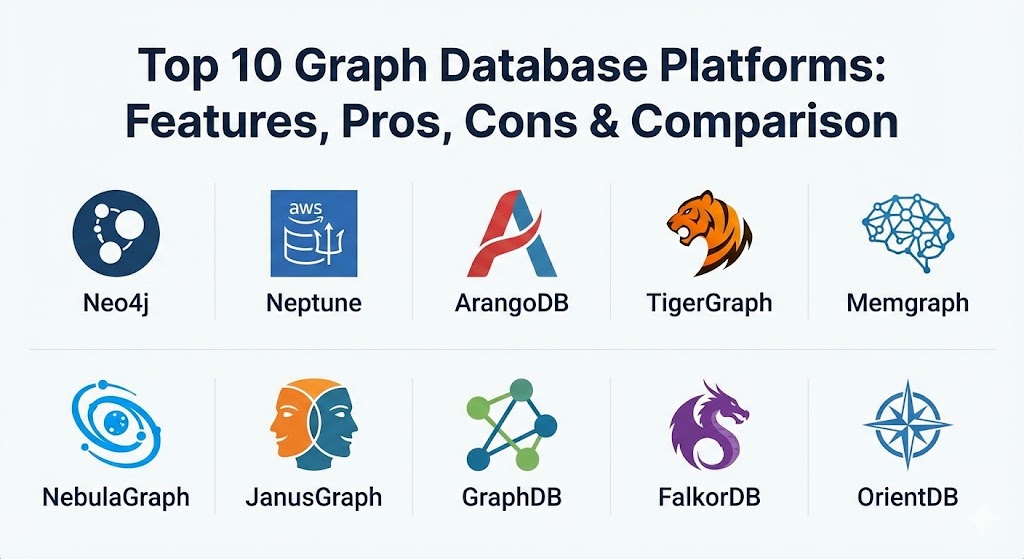
Top 10 Graph Database Platforms
1 — Neo4j
As the pioneer of the modern graph database market, Neo4j remains the most popular choice globally. It is a native graph database, meaning it was built from the ground up to store and process graph data, rather than layering a graph interface on top of a relational or document store.
- Key features:
- Cypher Query Language: An intuitive, ASCII-art-like language that is widely considered the industry standard.
- Native Graph Engine: Optimized storage and processing for index-free adjacency.
- Graph Data Science (GDS) Library: Over 65 pre-tuned algorithms for pathfinding, centrality, and community detection.
- AuraDB: A fully managed cloud service that handles scaling, patching, and backups automatically.
- Bloom Visualization: An easy-to-use tool for non-technical users to explore data patterns visually.
- Multi-Database Support: Allows running multiple isolated databases within a single instance.
- Pros:
- Massive community support and a wealth of educational resources.
- Exceptional performance for deep, many-hop relationship queries.
- Cons:
- The enterprise license can be significantly expensive for smaller organizations.
- Vertical scaling limitations in the community edition can lead to bottlenecks.
- Security & compliance: SOC 2 Type II, ISO 27001, HIPAA, GDPR, and robust RBAC (Role-Based Access Control).
- Support & community: World-class documentation, 24/7 enterprise support, and a huge global community with frequent meetups and developer forums.
2 — Amazon Neptune
Amazon Neptune is a fast, reliable, fully managed graph database service that makes it easy to build and run applications that work with highly connected datasets. It is designed for high availability and durability within the AWS ecosystem.
- Key features:
- Multi-Model Support: Supports both Property Graph (Gremlin) and W3C’s RDF (SPARQL).
- Serverless Option: Automatically scales compute capacity up or down based on workload.
- High Availability: Automatically replicates data across three Availability Zones.
- Fast Failover: Integrated with Amazon RDS-style management for 99.9% uptime.
- Neptune ML: Built-in machine learning capabilities powered by Graph Neural Networks (GNNs).
- Security Integration: Direct integration with AWS IAM and KMS for encryption.
- Pros:
- “Zero-management” for teams already embedded in the AWS ecosystem.
- Support for multiple query languages allows for greater developer flexibility.
- Cons:
- Strict vendor lock-in to AWS; not suitable for multi-cloud strategies.
- Performance can sometimes lag behind native-storage graph databases for extremely deep traversals.
- Security & compliance: FedRAMP, HIPAA, PCI DSS, SOC 1/2/3, and ISO compliance.
- Support & community: Backed by AWS enterprise support; extensive technical whitepapers and AWS re:Invent sessions.
3 — ArangoDB
ArangoDB is a unique “multi-model” database that supports graphs, documents, and key-value pairs in a single core. This allows developers to combine different data models without the need to manage multiple database systems.
- Key features:
- AQL (ArangoDB Query Language): A unified language for querying documents and graphs together.
- SmartGraphs: Optimizes graph data distribution across a cluster to minimize network hops.
- Integrated Search Engine: Native full-text search (ArangoSearch) for complex data retrieval.
- Pregel Suite: A distributed graph processing framework for massive analytics.
- ArangoGraph Insights Platform: A managed cloud service for hybrid multi-cloud deployments.
- Pros:
- Reduces “polyglot persistence” complexity by handling multiple data types in one engine.
- Highly flexible schema-less design is perfect for rapidly evolving startups.
- Cons:
- Because it is multi-model, it may not be as highly optimized for “pure” graph operations as Neo4j.
- The administrative UI, while functional, is less polished than competitors.
- Security & compliance: GDPR, HIPAA, and SOC 2 compliance available through their cloud platform.
- Support & community: Strong open-source roots; responsive community Slack and professional enterprise support packages.
4 — TigerGraph
TigerGraph is a “third-generation” graph database known for its extreme performance and ability to handle massive datasets. It is built using C++ and utilizes Massively Parallel Processing (MPP) architecture.
- Key features:
- GSQL Language: A powerful, Turing-complete query language that allows for complex logic within queries.
- MPP Architecture: Distributes query execution across all cores and nodes for maximum speed.
- Deep Link Analytics: Capable of traversing 10+ hops in real-time across billions of vertices.
- Native Compression: High data density allows for storing more data in less memory.
- TigerGraph Insights: A low-code tool for building visual graph dashboards.
- Pros:
- The fastest choice for big data analytics and real-time fraud detection.
- Scales horizontally with ease, making it ideal for petabyte-scale graph data.
- Cons:
- GSQL has a steeper learning curve compared to Cypher.
- Setup and maintenance can be complex due to its high-performance architecture.
- Security & compliance: SOC 2, ISO 27001, HIPAA, and GDPR.
- Support & community: Excellent documentation and “TigerGraph Academy” for training; robust enterprise-level support.
5 — Memgraph
Memgraph is an in-memory graph database designed for real-time streaming and low-latency applications. It is particularly popular among Python developers due to its native integrations.
- Key features:
- In-Memory Storage: Ensures the lowest possible latency for read and write operations.
- Cypher Compatibility: Uses the familiar Cypher query language.
- MAGE (Memgraph Advanced Graph Extensions): An open-source library for streaming graph algorithms.
- Real-Time Streaming: Direct ingestion from Kafka, Pulsar, and Redpanda.
- Python Integration: Deep integration with GQLAlchemy for Python-based development.
- Pros:
- Exceptional performance for real-time applications like cybersecurity and recommendation engines.
- Lightweight enough to run on local machines or edge devices.
- Cons:
- Limited by physical RAM capacity, which can be expensive for massive datasets.
- Smaller community ecosystem compared to the big players like Neo4j.
- Security & compliance: SSO integration, SSL/TLS encryption, and audit logs; SOC 2 (managed version).
- Support & community: Very active Discord community and fast-responding core engineering team.
6 — NebulaGraph
NebulaGraph is an open-source, distributed graph database specifically designed for massive-scale graphs with billions of vertices and trillions of edges. It is favored by large tech companies for high-concurrency needs.
- Key features:
- Shared-Nothing Architecture: Ensures high availability and linear scalability.
- nGQL Language: A SQL-like query language designed for graph traversals.
- Storage and Compute Separation: Allows scaling storage and compute resources independently.
- NebulaGraph Explorer: A powerful visualization tool for data discovery.
- Snapshots and Backups: Robust tools for data consistency in large-scale clusters.
- Pros:
- Built for high concurrency; handles thousands of simultaneous queries without breaking.
- Open-source core provides great flexibility for DevOps teams.
- Cons:
- The query language (nGQL) can feel unfamiliar to those used to Cypher or Gremlin.
- Documentation can occasionally be inconsistent between versions.
- Security & compliance: RBAC, LDAP, and ISO compliance; GDPR ready.
- Support & community: Large user base in Asia and growing globally; active GitHub and community forums.
7 — JanusGraph
JanusGraph is a scalable, open-source graph database that is part of the Linux Foundation. It is a “pluggable” system, meaning it relies on external storage and indexing backends.
- Key features:
- Pluggable Storage: Use Cassandra, HBase, ScyllaDB, or Google Bigtable as the backend.
- Pluggable Indexing: Integration with Elasticsearch, Solr, or Lucene.
- Gremlin Support: Fully compatible with the Apache TinkerPop graph traversal language.
- Distributed Architecture: Designed for clusters spanning multiple data centers.
- Hadoop Integration: Direct support for big data analytics pipelines.
- Pros:
- No vendor lock-in; you can switch your storage or indexing backend at any time.
- Highly customizable for complex IT infrastructures.
- Cons:
- High “assembly” cost; you must manage the graph layer plus the storage and index layers.
- Performance tuning is difficult because there are so many moving parts.
- Security & compliance: Varies based on chosen storage/indexing backend; supports standard encryption.
- Support & community: Strong community-driven support via the JanusGraph steering committee and Google Groups.
8 — GraphDB (by Ontotext)
GraphDB is an enterprise-grade Semantic Graph Database (RDF) that focuses on the “meaning” behind data. It is widely used for building knowledge graphs and handling linked open data.
- Key features:
- RDF/SPARQL Support: Built specifically for the W3C standards of the semantic web.
- Inference Engine: Automatically discovers new facts based on existing data and rules.
- Quality Constraints: Uses SHACL to ensure data integrity and validation.
- Text Mining Integration: Connects unstructured text to graph nodes.
- Workbench UI: A comprehensive tool for managing repositories and executing queries.
- Pros:
- The best choice for academic research, government data, and complex knowledge modeling.
- Powerful reasoning capabilities that other property graphs lack.
- Cons:
- SPARQL is generally harder to learn and write than Cypher.
- Not optimized for the high-speed “traversal-style” queries found in property graphs.
- Security & compliance: ISO 27001, GDPR, and robust enterprise security features (LDAP, Kerberos).
- Support & community: Exceptional professional services and deep academic roots.
9 — FalkorDB (formerly RedisGraph successor)
FalkorDB is a high-performance graph database built on the foundations of the now-discontinued RedisGraph. It focuses on low latency and utilizing linear algebra for graph operations.
- Key features:
- Linear Algebra Engine: Uses sparse matrix multiplication for extremely fast traversals.
- Cypher Support: Maintains compatibility with the Cypher query language.
- In-Memory Architecture: Leverages RAM for ultra-low response times.
- Low Resource Footprint: Designed to run efficiently without requiring massive server clusters.
- Redis-Ready: Designed to integrate seamlessly with Redis-based architectures.
- Pros:
- One of the fastest graph databases for simple to medium complexity queries.
- Excellent for developers who want a “plug-and-play” high-speed graph.
- Cons:
- Still a relatively new platform compared to veterans like Neo4j.
- Feature depth for complex graph analytics is still catching up.
- Security & compliance: Encryption in transit and at rest; RBAC support.
- Support & community: Growing community of former RedisGraph users; active GitHub development.
10 — OrientDB
OrientDB is a multi-model database that supports Graph, Document, Key/Value, and Object models. It was one of the first to combine a document database with graph capabilities.
- Key features:
- Multi-Model Core: No need for joins; relationships are managed through direct links.
- SQL-Like Query Language: Makes it very easy for traditional database admins to transition.
- Distributed Architecture: Supports multi-master replication for high availability.
- Teleporter Tool: Automatically migrates relational databases into OrientDB graphs.
- Full-Text Indexing: Native integration with Lucene for text search.
- Pros:
- Extremely versatile; can act as the primary database for an entire organization.
- The SQL-like syntax lowers the barrier to entry significantly.
- Cons:
- The open-source community has slowed down since its acquisition by SAP.
- Can be prone to performance degradation in very large, complex clusters.
- Security & compliance: Standard enterprise security including audit logs and encryption.
- Support & community: Enterprise support provided through SAP and its partner network.
Comparison Table
| Tool Name | Best For | Platform(s) Supported | Standout Feature | Rating (Gartner) |
| Neo4j | Enterprise General Purpose | Multi-Cloud, On-Prem | Cypher Standard | 4.7 / 5 |
| Amazon Neptune | AWS Ecosystem | AWS Managed Only | Serverless & Multi-Model | 4.4 / 5 |
| ArangoDB | Multi-Model Apps | Multi-Cloud, On-Prem | AQL (Unified Language) | 4.5 / 5 |
| TigerGraph | Massive Scale Analytics | Multi-Cloud, On-Prem | MPP Performance | 4.6 / 5 |
| Memgraph | Real-time Streaming | Linux, Docker, MacOS | Python / Kafka Native | 4.8 / 5 |
| NebulaGraph | High Concurrency | Linux, Kubernetes | Shared-Nothing Scale | 4.3 / 5 |
| JanusGraph | Open-Source Customization | Pluggable Backends | Storage Agnostic | N/A |
| GraphDB | Semantic Web / Knowledge | Java-based, Cloud | Inference & Reasoning | 4.5 / 5 |
| FalkorDB | Low-Latency Queries | Linux, Cloud | Matrix-based Speed | N/A |
| OrientDB | SQL Users / Legacy | Multi-Platform | SQL-like Graph Querying | 4.1 / 5 |
Evaluation & Scoring of Graph Database Platforms
We evaluated these platforms using a weighted scoring rubric designed for modern IT requirements.
| Category | Weight | Evaluation Criteria |
| Core Features | 25% | Query language power, native storage, and algorithm support. |
| Ease of Use | 15% | Developer experience, documentation, and visualization tools. |
| Integrations | 15% | Compatibility with BI tools, cloud providers, and AI frameworks. |
| Security | 10% | Encryption, compliance (SOC2/HIPAA), and access control. |
| Performance | 10% | Latency, throughput, and horizontal scalability. |
| Support | 10% | Vendor responsiveness and community activity. |
| Price / Value | 15% | TCO (Total Cost of Ownership) versus performance gains. |
Which Graph Database Platforms Tool Is Right for You?
Selecting the right graph database depends on your technical debt, your budget, and the specific “shape” of your data.
- Solo Users & Bootstrappers: If you are just starting, Neo4j AuraDB (Free Tier) is the best way to learn. If you are a Python developer, Memgraph is incredibly easy to get running on a laptop for local prototyping.
- Small to Medium Businesses (SMBs): ArangoDB is a fantastic choice because it can replace both your document database and your graph database, saving you money on infrastructure and management.
- Mid-Market Enterprises: If you are already on AWS, Amazon Neptune is the path of least resistance. It handles all the “dirty work” of database administration so you can focus on building features.
- Large Enterprises & Big Data: For use cases involving trillions of relationships or real-time fraud detection at a global scale, TigerGraph or NebulaGraph are the high-performance engines you need.
- Academic & Research: If your project involves the semantic web, linked data, or complex ontology modeling, GraphDB (Ontotext) is the gold standard for RDF/SPARQL.
Frequently Asked Questions (FAQs)
1. What is the difference between a Property Graph and an RDF Graph?
Property graphs (like Neo4j) are designed for speed and traversal, allowing you to attach properties directly to nodes and edges. RDF graphs (like GraphDB) are designed for data exchange and semantic meaning, often used in academia and knowledge modeling.
2. Can I use SQL to query a graph database?
While some databases like OrientDB offer a SQL-like syntax, most use specialized languages like Cypher or Gremlin. These languages are designed to describe “patterns” in data, which is much more efficient for graphs than SQL’s table-based logic.
3. Is a graph database faster than a relational database?
For queries involving multiple “hops” (relationships), yes. In a relational database, each hop requires a “JOIN,” which gets exponentially slower as the database grows. In a graph database, the performance is constant regardless of size.
4. Do I need to learn a new query language?
Most likely, yes. Cypher is the most popular and easiest to learn, while Gremlin is more powerful but has a steeper learning curve. However, if you know SQL, you will pick up these languages quickly.
5. How do graph databases help with AI and LLMs?
Graph databases power “GraphRAG,” where an LLM can query a knowledge graph to find factual relationships, reducing hallucinations and providing more accurate, context-aware answers.
6. Are graph databases only for social networks?
No. While social networks were an early use case, they are now vital for cybersecurity (network mapping), retail (recommendations), pharma (drug discovery), and finance (fraud detection).
7. Can I run a graph database on my own server?
Yes, most of these tools (except for cloud-only ones like Neptune) offer on-premises versions or Docker images that you can run in your own data center.
8. What is “Index-Free Adjacency”?
This is the core concept of native graph databases. It means that each node physically stores a pointer to its neighboring nodes, so the database doesn’t have to look up an index to find the next step in a relationship.
9. Is it difficult to migrate from a relational database to a graph?
The challenge isn’t just moving the data, but “re-modeling” it. You have to stop thinking in tables and start thinking in entities and relationships. Tools like OrientDB’s Teleporter or Neo4j’s Data Importer can help.
10. Why are graph databases considered “NoSQL”?
They are NoSQL because they do not use the relational model. However, unlike document or key-value stores, they are specifically optimized for data that is highly interconnected.
Conclusion
The era of siloed, tabular data is giving way to a more holistic, connected approach to information. Choosing the right Graph Database Platform is no longer a niche technical decision; it is a strategic one that determines how quickly your organization can find the “hidden patterns” in its data. Whether you choose the industry-standard ease of Neo4j, the multi-model flexibility of ArangoDB, or the raw power of TigerGraph, the transition to graph technology is a move toward a more intelligent and responsive data future. Remember that the “best” tool is the one that maps most naturally to the real-world connections you are trying to understand.