Introduction
Recruiting Platforms are comprehensive software solutions designed to manage the end-to-end process of identifying, attracting, and engaging potential employees. While often confused with Applicant Tracking Systems (ATS), modern recruiting platforms are broader in scope. They don’t just “track” an applicant once they apply; they help recruiters proactively source passive talent, manage complex outreach campaigns via Recruitment CRM (Candidate Relationship Management), and use Artificial Intelligence to match skill sets to open roles. Essentially, they serve as the bridge between a company’s employer brand and the global talent pool.
The importance of these platforms cannot be overstated. In an era where 70% of the workforce is comprised of “passive” candidates—those not actively looking for work but open to the right offer—proactive outreach is essential. Real-world use cases include a tech firm using AI to find engineers with specific niche certifications, a healthcare provider managing a vast database of traveling nurses, or a retail giant automating the screening of 50,000 seasonal applicants. When choosing a platform, users should evaluate sourcing depth, automation capabilities, candidate experience metrics, and integration with existing HR stacks.
Best for: Talent acquisition teams, third-party recruiters, and HR leaders in industries where competition for talent is fierce, such as Technology, Healthcare, Finance, and Engineering. It is indispensable for companies that need to build long-term talent pipelines rather than just filling immediate “one-off” vacancies.
Not ideal for: Very small businesses with extremely low turnover (e.g., hiring once every two years) or micro-companies that can manage their hiring through a simple personal network or a free job board posting. For these users, the financial and administrative overhead of a full-scale recruiting platform would far outweigh the benefits.
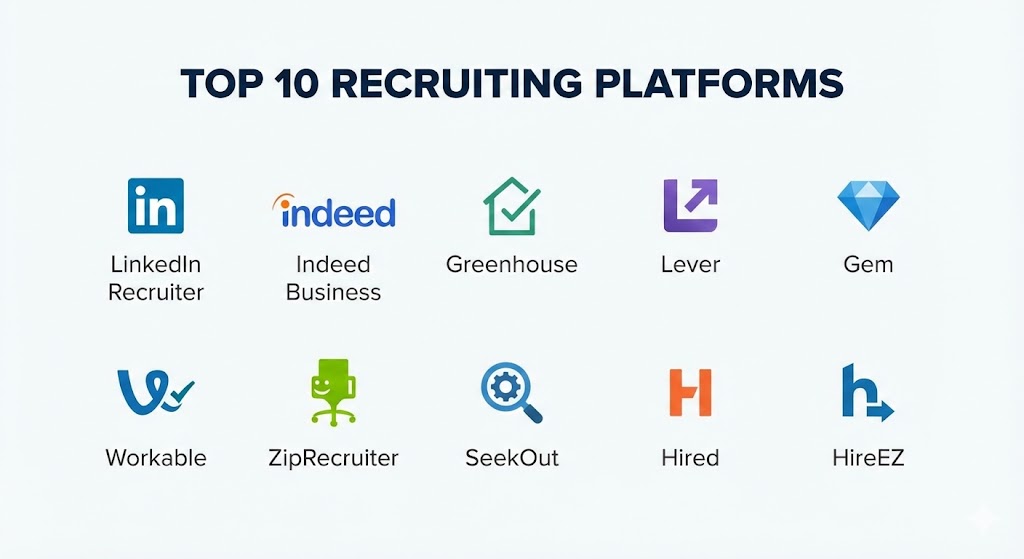
Top 10 Recruiting Platforms Tools
1 — LinkedIn Recruiter
LinkedIn Recruiter is the undisputed king of sourcing. Built directly on top of the world’s largest professional network, it gives recruiters unparalleled access to over a billion profiles, making it the primary tool for identifying passive talent across almost every industry.
- Key features:
- Advanced Search Filters: Filter by skills, “Open to Work” status, years of experience, and past companies.
- InMail Messaging: Direct, professional messaging that bypasses traditional email filters.
- Spotlight Feature: Highlights candidates who are most likely to engage based on their activity on the platform.
- Talent Pipeline Management: Organize candidates into folders and projects for long-term tracking.
- Collaborative Tools: Share candidate profiles and InMail history with hiring managers for instant feedback.
- Recommended Matches: AI-driven suggestions based on your search behavior and successful hires.
- Pros:
- Access to the largest and most up-to-date professional database on the planet.
- High response rates compared to cold emails due to the “trusted” nature of the platform.
- Cons:
- The license cost is among the highest in the industry, which can be prohibitive for small teams.
- Can lead to “recruiter fatigue” for top-tier talent who get bombarded with InMails.
- Security & compliance: SOC 2, GDPR compliant, and features robust SSO and encryption protocols.
- Support & community: Extensive LinkedIn Learning courses, 24/7 technical support, and a massive global community of recruiters.
2 — Indeed for Business
Indeed is the most visited job site in the world, and its business platform focuses on high-volume candidate attraction. It is a powerhouse for “active” recruiting, where the goal is to get your job description in front of as many eyes as possible.
- Key features:
- Indeed Apply: A streamlined, mobile-friendly application process that reduces candidate drop-off.
- Sponsored Jobs: Targeted advertising to ensure your roles appear at the top of relevant search results.
- Indeed Resume: A database of millions of searchable resumes for proactive sourcing.
- Hiring Events: Tools to manage virtual and in-person career fairs and “instant” interviews.
- Smart Sourcing: AI that matches job requirements to the resumes of active seekers.
- Integrated Messaging: Chat with candidates directly within the platform.
- Pros:
- Unmatched for generating a high volume of applicants quickly.
- The “pay-per-result” or “pay-per-click” models offer flexibility for different budget types.
- Cons:
- The high volume of applicants can sometimes lead to lower “quality-of-hire” if screening is not rigorous.
- The interface can feel a bit industrial and less “premium” than high-end CRMs.
- Security & compliance: GDPR compliant and features standard data encryption and secure payment processing.
- Support & community: Localized support teams, a massive help center, and regular webinars on hiring trends.
3 — Greenhouse
Greenhouse is a leader in the “Structured Hiring” space. It focuses on the internal workflow of recruiting, helping teams make data-driven decisions through scorecards and standardized interview processes.
- Key features:
- Structured Interviewing: Tools to create consistent interview kits and scorecards for every role.
- Diversity & Inclusion Suite: Features to reduce bias, such as “anonymized” resume review.
- Automated Task Management: Triggers reminders for interviewers to submit feedback.
- Massive Integration Marketplace: Connects with over 400 third-party tools (Slack, Zoom, etc.).
- Predictive Analytics: Reports that show which sourcing channels are actually producing hires.
- Candidate CRM: Manage and nurture talent pools for future openings.
- Pros:
- Encourages a highly disciplined hiring process that leads to better long-term retention.
- Exceptional data visibility that allows you to identify exactly where the “bottlenecks” are in your funnel.
- Cons:
- The setup is complex and requires a significant time investment to get right.
- The platform’s rigidity can be frustrating for managers who prefer a more informal hiring style.
- Security & compliance: SOC 2 Type II, ISO 27001, and GDPR compliant. Advanced SSO support.
- Support & community: High-touch technical onboarding, “Greenhouse Open” community events, and 24/5 support.
4 — Lever
Lever is famous for its “LeverTRM” platform, which bridges the gap between a traditional ATS and a modern CRM. It is designed for teams that treat recruiting like a sales process, prioritizing relationship building and pipeline management.
- Key features:
- Unified Pipeline: See both “active” applicants and “sourced” candidates in a single view.
- Automated Nurture: Send personalized email sequences to passive talent over several weeks.
- Easy Book: A scheduling tool that allows candidates to pick their own interview times based on the team’s calendar.
- Chrome Extension: Clip profiles from LinkedIn, GitHub, or AngelList directly into your pipeline.
- Visual Dashboards: High-level views of pipeline health and recruiter productivity.
- Diversity Insights: Real-time data on the demographic makeup of your candidate pool.
- Pros:
- One of the most intuitive and visually pleasing interfaces in the recruiting world.
- Exceptional for “active sourcing” where the recruiter is the one reaching out first.
- Cons:
- The reporting engine, while visual, can be less customizable than Greenhouse’s for complex needs.
- Advanced automation features are often locked behind the highest-priced tiers.
- Security & compliance: SOC 2 Type II, GDPR, and ISO 27001 compliant. Strong focus on data privacy.
- Support & community: Comprehensive “Lever Academy” for training, 24/5 support, and a dedicated success manager for enterprise.
5 — Gem
Gem is a specialized recruiting platform that sits on top of LinkedIn and your email. It focuses purely on the “top of the funnel”—sourcing, outreach, and talent CRM—allowing recruiters to be incredibly efficient with their messaging.
- Key features:
- Automated Outreach: Create multi-stage email sequences that stop automatically when a candidate replies.
- Talent CRM: A centralized database of every person your team has ever contacted.
- Pipeline Analytics: Deep data on open rates, reply rates, and conversion through the funnel.
- Diversity Sourcing: Tools to help identify and engage underrepresented talent.
- Project Collaboration: Share “talent maps” with hiring managers to align on candidate profiles.
- Email Tracking: Know exactly when a candidate opens your message or clicks a link.
- Pros:
- Dramatically increases the efficiency of passive talent outreach.
- The data it provides on “outreach ROI” is the best in the industry for sourcing teams.
- Cons:
- It is not a full ATS; it needs to be paired with another tool (like Greenhouse) to manage the actual hiring.
- The cost is high for a tool that only handles the “sourcing” part of the journey.
- Security & compliance: SOC 2 Type II and GDPR compliant. Secure SSO and API integrations.
- Support & community: High-touch onboarding, a dedicated Slack community for users, and fast response times.
6 — Workable
Workable is the “all-in-one” solution for mid-sized companies. It is designed to be powerful yet simple enough for a team without a dedicated IT or HR Operations department to manage.
- Key features:
- One-Click Job Posting: Automatically post to over 200 job boards simultaneously.
- AI Sourcing Tool: Automatically suggests candidates who match your job description from a database of millions.
- Mobile App: A fully functional mobile app that allows you to manage candidates and move them through stages on the go.
- Integrated Assessments: Built-in cognitive and personality tests to screen candidates early.
- Video Interviews: Native support for one-way and live video interviews.
- Automated Referrals: A portal that makes it easy for current employees to refer talent.
- Pros:
- The fastest “time-to-value” of any platform; you can be up and running in a single day.
- The AI sourcing feature is a huge benefit for small teams without a dedicated “sourcer.”
- Cons:
- Customization options are more limited than enterprise-grade tools like Workday or Greenhouse.
- Reporting can feel a bit basic for organizations that need to do deep data-mining.
- Security & compliance: SOC 2 Type II and GDPR compliant. Features 256-bit SSL encryption.
- Support & community: 24/7 email and phone support, a massive knowledge base, and regular recruitment webinars.
7 — ZipRecruiter
ZipRecruiter has transformed from a job board aggregator into a sophisticated “matching” platform. It uses its AI assistant, “Phil,” to help both employers and job seekers find the perfect fit through smart recommendations.
- Key features:
- One-Tap Posting: Send your job to 100+ job boards with a single click.
- Smart Matching: AI that learns your preferences and invites the best-fit candidates to apply.
- Candidate Alerts: Phil notifies you the moment a highly qualified candidate joins the platform.
- Customizable Screeners: Create “deal-breaker” questions to filter out unqualified applicants automatically.
- Easy Apply: A high-speed application experience that increases the volume of resumes.
- Candidate CRM: Re-engage with past applicants for new roles.
- Pros:
- The best tool for businesses that need to fill roles quickly and don’t have time for manual sourcing.
- The AI does a lot of the “pre-screening” work for you, saving hours of resume review.
- Cons:
- The “volume-first” approach can sometimes feel a bit transactional for high-level executive roles.
- Not suitable for businesses that need a complex, multi-stage “structured” interview flow.
- Security & compliance: GDPR compliant and uses standard enterprise-grade data security measures.
- Support & community: Excellent 24/7 customer support via phone, email, and chat.
8 — SeekOut
SeekOut is a specialist sourcing platform that focuses on “hard-to-find” talent, such as software engineers, diversity hires, and individuals with specific security clearances. It is a favorite for high-growth tech firms.
- Key features:
- Deep Search Engine: Searches over 800 million profiles across LinkedIn, GitHub, and Stack Overflow.
- Diversity Sourcing: Industry-leading filters to find underrepresented talent without bias.
- Tech-Specific Insights: See a candidate’s actual code contributions and technical expertise.
- Talent Maps: Visualize the talent landscape for specific roles to inform hiring strategy.
- Automated Outreach: Integrated messaging sequences similar to Gem.
- Referral Mining: Tool to scan your team’s networks for high-potential candidates.
- Pros:
- The “Google Search” of talent; its ability to find niche technical candidates is unrivaled.
- Exceptional data on “diversity pools” that helps companies meet their DEI goals.
- Cons:
- The interface is quite technical and can be intimidating for non-technical recruiters.
- It is a sourcing-only tool, meaning you still need an ATS to manage the actual hiring process.
- Security & compliance: SOC 2 Type II and GDPR compliant. Features secure data handling and audit logs.
- Support & community: High-touch technical support and a community of “Sourcing Ninjas.”
9 — Hired
Hired is a “curated marketplace” that flips the traditional recruiting model on its head. Instead of you searching for candidates, high-quality talent applies to the platform, and you apply to them.
- Key features:
- Curated Talent Pools: Every candidate on the platform is pre-vetted by Hired’s team.
- Transparent Salary Data: See the candidate’s salary expectations upfront before you reach out.
- Bias-Reduction Tools: Hide candidate photos and names during the initial review phase.
- Direct Interview Requests: Skip the “sourcing” phase and send interview requests immediately.
- Placement Guarantee: Most plans include a credit if a hire doesn’t work out within a specific period.
- Specialized for Tech/Sales: Focuses purely on high-demand roles like SWE, Data Science, and Account Executives.
- Pros:
- Saves an incredible amount of time by eliminating the “search” phase entirely.
- High-quality talent that is actually “ready to interview” right now.
- Cons:
- The candidate pool is smaller and very specific to Tech and Sales.
- The cost is often based on a “per-hire” fee, which can be expensive for high-growth teams.
- Security & compliance: GDPR compliant and follows strict data privacy rules for candidate information.
- Support & community: Dedicated account managers for every company and a highly responsive support team.
10 — HireEZ (formerly Hiretual)
HireEZ is an AI-powered outbound recruiting platform that focuses on “intelligence-led” sourcing. It is designed for large recruiting teams that need to find talent across the entire open web, not just LinkedIn.
- Key features:
- AI Sourcing: Aggregates data from 45+ open web platforms to build comprehensive candidate profiles.
- Email Finding: One of the most accurate tools for finding personal and work email addresses.
- Sequence Automation: Multi-channel outreach via email and social media.
- Market Insights: Real-time data on labor market trends for specific roles and locations.
- Enterprise Security: Built for the world’s largest companies with strict governance needs.
- CRM for Sourcing: Manage millions of candidate records with advanced tagging and search.
- Pros:
- Finds talent that “traditional” platforms like LinkedIn often miss.
- The market intelligence features are invaluable for recruiters who need to advise hiring managers on strategy.
- Cons:
- The sheer amount of data can be overwhelming for a small recruiting shop.
- Some of the AI matching can require “fine-tuning” to get perfectly accurate results.
- Security & compliance: SOC 2 Type II, ISO 27001, and GDPR compliant. FedRAMP ready for government use.
- Support & community: Global 24/7 support and a massive training academy for “Outbound Recruitment.”
Comparison Table
| Tool Name | Best For | Platform(s) Supported | Standout Feature | Rating (Gartner) |
| LinkedIn Recruiter | Sourcing Passive Talent | Web, iOS, Android | Access to 1B+ Profiles | 4.7 / 5 |
| Indeed Business | High-Volume Hiring | Web, iOS, Android | Indeed Apply Flow | 4.5 / 5 |
| Greenhouse | Structured Hiring | Web, iOS, Android | Interview Scorecards | 4.8 / 5 |
| Lever | Relationship Recruiting | Web, iOS, Android | Unified CRM/ATS Pipeline | 4.7 / 5 |
| Gem | Outreach Efficiency | Web (Chrome Extension) | Automated Sequences | 4.8 / 5 |
| Workable | All-in-One SMBs | Web, iOS, Android | AI Sourcing Engine | 4.6 / 5 |
| ZipRecruiter | Speed & AI Matching | Web, iOS, Android | “Phil” AI Assistant | 4.5 / 5 |
| SeekOut | Technical/Diversity | Web, Mobile | Tech Contribution Search | 4.7 / 5 |
| Hired | Curated Tech Talent | Web | Reverse Marketplace | 4.4 / 5 |
| HireEZ | Outbound Intelligence | Web, Chrome Extension | Open-Web Data Aggregator | 4.6 / 5 |
Evaluation & Scoring of Recruiting Platforms
To help you make an objective choice, we have evaluated the market leaders against a weighted scoring rubric. The scores below reflect the performance of a high-tier platform (like Greenhouse) as the benchmark.
| Criteria | Weight | Evaluation Rationale |
| Core Features | 25% | Presence of sourcing, CRM, and interview management. |
| Ease of Use | 15% | Intuitiveness for recruiters and adoption for hiring managers. |
| Integrations | 15% | Native connectivity with Slack, Zoom, and other HRIS tools. |
| Security & Compliance | 10% | Adherence to GDPR, SOC 2, and data encryption. |
| Performance | 10% | Speed of profile loading and mobile app stability. |
| Support & Community | 10% | Quality of documentation and availability of live help. |
| Price / Value | 15% | ROI based on time-to-hire and cost-per-hire savings. |
Which Recruiting Platforms Tool Is Right for You?
Solo Users vs SMB vs Mid-market vs Enterprise
If you are a solo recruiter or a small startup, Workable or ZipRecruiter are the winners. They give you the most “power” for the least amount of setup. Mid-market companies (100–500 employees) should look at Lever or Greenhouse to build a professional, scalable process. For the Enterprise, LinkedIn Recruiter, HireEZ, and Workday Recruiting are the only platforms with the governance and global scale necessary to handle thousands of hires.
Budget-conscious vs Premium Solutions
For those on a strict budget, the “pay-as-you-go” models of Indeed and ZipRecruiter are ideal. If you are looking for a Premium solution where quality-of-hire is more important than software cost, Greenhouse and Gem are the investments that pay for themselves through reduced turnover and faster sourcing.
Feature Depth vs Ease of Use
If you prioritize Ease of Use for your hiring managers, Workable and Indeed are your best bets. If you need Feature Depth—specifically for things like “Source Attribution” and “Pipeline Bottleneck Analysis”—you must accept the steeper learning curve of Greenhouse or Ashby.
Integration and Scalability Needs
If you already use an HRIS like BambooHR or Workday, using their native recruiting modules is the path of least resistance. However, if you are a “best-of-breed” company that wants to connect the best sourcing, assessment, and background check tools, Greenhouse has the most robust marketplace in the world.
Frequently Asked Questions (FAQs)
1. What is the difference between an ATS and a Recruiting Platform?
An ATS (Applicant Tracking System) is a database for managing people who have already applied. A Recruiting Platform is broader, including tools to find people (Sourcing) and build relationships (CRM) before they apply.
2. Can I use these platforms for remote hiring?
Yes. In 2026, almost all platforms (especially Workable and Jobvite) have native video interviewing and digital offer letter signing built-in specifically for remote-first companies.
3. Is LinkedIn Recruiter worth the high cost?
If your industry relies on passive talent (like Tech or Finance), yes. It is the only tool that gives you a “live” view of the professional workforce. If you hire mostly active seekers, Indeed is a better value.
4. How does AI help in recruiting?
AI helps by “reading” resumes to match them to job descriptions, predicting which candidates are likely to leave their current jobs, and automating the initial screening chat via bots.
5. How long does it take to implement a new platform?
For small tools like Workable, 24 hours. For enterprise suites like Greenhouse or HireEZ, expect 4 to 8 weeks for data migration and team training.
6. Do I need an internal IT team to manage these?
For mid-market tools like Lever or Workable, no—they are designed for HR managers. For enterprise platforms like Workday Recruiting, you will likely need IT support for integrations.
7. Is candidate data secure on these platforms?
Yes, reputable vendors use AES-256 encryption and follow strict GDPR/SOC 2 standards. Always check where the vendor’s data centers are located to ensure compliance with local laws.
8. Can I track diversity metrics with these tools?
Yes. Tools like SeekOut and Greenhouse have specialized modules to help you track diversity at every stage of the funnel while maintaining legal compliance.
9. What is a “Nurture Sequence”?
It is a series of automated emails sent to a candidate over several weeks. If they don’t reply to the first email, the system automatically sends a follow-up, significantly increasing the chance of a response.
10. Can I move my data from an old platform to a new one?
Yes, most premium platforms offer “Data Migration” services. However, be aware that “cleaning” messy data from old systems is often a manual task.
Conclusion
The “best” recruiting platform in 2026 is the one that your team will actually use. If the platform is too complex, your recruiters will revert to spreadsheets. If it’s too simple, you’ll lose out on the data necessary to improve your strategy.
For absolute sourcing power, LinkedIn Recruiter is the standard. For building a structured, elite hiring machine, Greenhouse and Ashby lead the way. And for mid-sized teams that need an all-in-one partner that “just works,” Workable and Indeed are the most reliable choices. Recruiting is about the human connection—choose the platform that automates the paperwork so you can focus on the people.