Introduction
An Enterprise Service Bus (ESB) is a specialized middleware architecture designed to facilitate communication between mutually interacting software applications in a Service-Oriented Architecture (SOA). Unlike point-to-point integration, which creates a tangled “spaghetti” of connections, an ESB acts as a centralized bus where any application can connect once and communicate with any other. It handles the heavy lifting of message routing, protocol translation (e.g., converting SOAP to REST), and data transformation (e.g., mapping XML to JSON). By decoupling the “service provider” from the “service consumer,” the ESB allows IT teams to update or replace individual components without breaking the entire system.
In 2026, ESBs have evolved significantly. They are no longer just heavy, on-premises installations; they now feature AI-driven mapping, automated scaling, and deep integration with cloud-native technologies like Kubernetes. Key real-world use cases include legacy system modernization (bridging a 20-year-old mainframe to a modern mobile app), complex transaction processing in banking, and omnichannel inventory management in retail. When evaluating an ESB platform, users should prioritize connector depth, latency overhead, AI-assisted mapping capabilities, and the robustness of the governance tools.
Best for: Large-scale enterprises, government agencies, and global financial institutions that manage high-volume, mission-critical data across diverse IT environments. It is ideal for roles like Integration Architects, CTOs, and Senior DevOps Engineers who need to maintain strict data governance and centralized control.
Not ideal for: Early-stage startups or small businesses that operate almost exclusively in the cloud with modern REST APIs. In these scenarios, a lightweight Integration Platform as a Service (iPaaS) or simple webhooks are typically more agile and cost-effective alternatives to the heavy lifting of a traditional ESB.
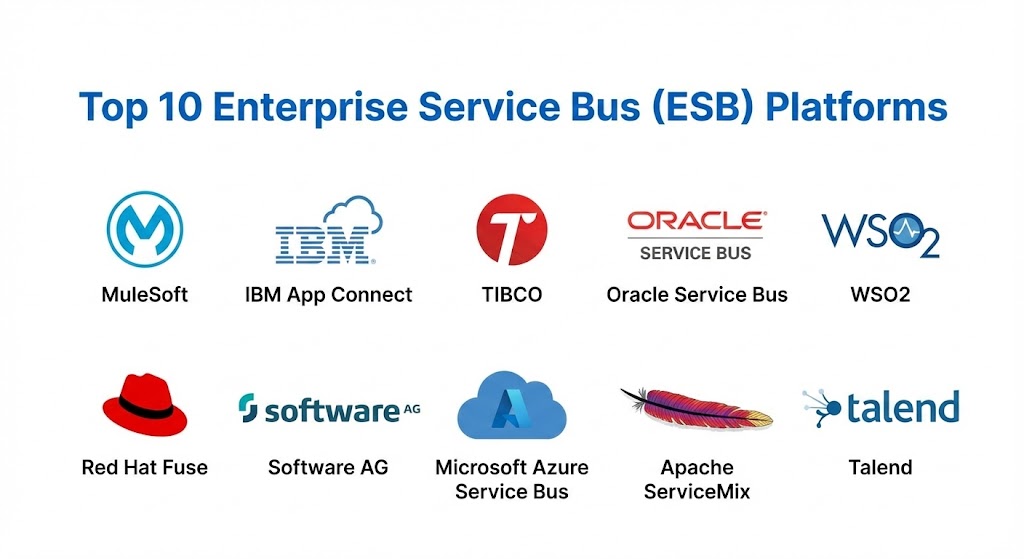
Top 10 Enterprise Service Bus (ESB) Platforms Tools
1 — MuleSoft Anypoint Platform (Mule ESB)
MuleSoft is the current market leader, having successfully transitioned from a pure Java-based ESB to a comprehensive, cloud-native integration platform. It is designed for companies that view integration as a strategic advantage rather than a technical chore.
- Key features:
- AnyPoint Exchange: A massive marketplace of pre-built connectors and APIs for SAP, Oracle, and Salesforce.
- DataWeave: A powerful, functional language for complex data transformation and mapping.
- Anypoint Runtime Fabric: Allows deployment on public clouds, private clouds, or on-premises using containers.
- API-Led Connectivity: A structured methodology for building reusable integration assets.
- MuleSoft Composer: A no-code interface for business users to build simple bus connections.
- Universal API Management: Unified control over APIs regardless of where they are built or hosted.
- MuleSoft Agent Fabric: Integrated AI for automating integration workflows.
- Pros:
- Unmatched library of connectors makes it the fastest way to connect to major SaaS tools.
- The emphasis on “reusability” significantly reduces long-term maintenance costs.
- Cons:
- One of the most expensive platforms on the market; licensing is often prohibitive for smaller firms.
- Steep learning curve for developers not familiar with the MuleSoft ecosystem.
- Security & compliance: SOC 2 Type II, ISO 27001, GDPR, HIPAA, and PCI DSS compliant.
- Support & community: Extensive documentation, a global “MuleSoft University” for training, and 24/7 enterprise support.
2 — IBM App Connect Enterprise
Formerly known as IBM Integration Bus (IIB), this platform is a veteran in the space, built for high-performance, high-volume transactions. It is a staple in the banking and insurance sectors.
- Key features:
- AI-Powered Mapping: Uses IBM Watson to suggest field mappings and data transformations.
- Hybrid Integration: Native support for connecting IBM Z mainframes with modern AWS/Azure clouds.
- Managed Connectors: Robust, hardened connectors for enterprise ERP and CRM systems.
- App Connect Designer: A visual, browser-based tool for non-developers to build flows.
- Policy-Driven Security: Centralized enforcement of authentication and encryption standards.
- Toolkit for Developers: Eclipse-based environment for complex, code-heavy integrations.
- Pros:
- Incredible stability and performance for managing millions of messages per hour.
- Best-in-class support for legacy protocols (COBOL, MQ, CICS) alongside modern REST.
- Cons:
- The interface can feel dated and overly complex compared to modern “low-code” competitors.
- Upgrading between major versions has historically been a difficult, multi-month project.
- Security & compliance: FIPS 140-2, SOC 2, HIPAA, and GDPR compliant; industry-leading encryption.
- Support & community: Professional enterprise support from IBM and a massive global network of certified consultants.
3 — TIBCO BusinessWorks
TIBCO is a specialist in real-time data and event-driven architectures. Its ESB is designed for high-throughput scenarios where every millisecond counts, such as algorithmic trading or logistics tracking.
- Key features:
- Zero-Code Design: A fully visual environment for building complex integration logic.
- Event-Driven Core: Optimized for asynchronous messaging and real-time streaming data.
- Deployment Flexibility: Can run natively on Kubernetes or as a serverless function.
- TIBCO Flogo: A lightweight, Go-based engine for building microservices-style integrations.
- BusinessWorks Container Edition: Specifically tuned for Docker and cloud-native environments.
- Advanced Error Handling: Sophisticated “Try/Catch” and compensation logic for reliable transactions.
- Pros:
- Exceptional performance and reliability for mission-critical, high-concurrency workloads.
- Proven track record in highly complex, large-scale enterprise environments.
- Cons:
- TIBCO has historically lacked a unified “single pane of glass” for all its disparate products.
- Recent corporate shifts have led to some concerns regarding the roadmap for legacy versions.
- Security & compliance: ISO 27001, SOC 2, and GDPR compliant; features advanced identity management.
- Support & community: Solid technical support, though user communities are more fragmented than MuleSoft.
4 — Oracle Service Bus (OSB)
The “glue” of the Oracle ecosystem, OSB is the standard choice for organizations heavily invested in Oracle Database, E-Business Suite, or PeopleSoft.
- Key features:
- Deep Oracle Integration: Native, optimized adapters for every major Oracle application.
- Service Virtualization: Allows developers to mock services and hide the complexity of the backend.
- Message Throttling: Protects backend Oracle systems from being overwhelmed by traffic spikes.
- Standard-Based Integration: Strong adherence to WS-Security, SOAP, and JCA standards.
- Web-Based Console: Centralized management of routing, transformation, and security policies.
- Pros:
- Seamless performance when working within the Oracle stack; reduces “integration friction.”
- Excellent governance tools for managing the lifecycle of services in an SOA.
- Cons:
- Not ideal for connecting to non-Oracle cloud services compared to specialized iPaaS.
- Can be a “heavy” solution if you only need simple point-to-point links.
- Security & compliance: SOC 2, ISO 27001, and HIPAA compliant via Oracle’s global infrastructure.
- Support & community: Backed by Oracle Premier Support and an extensive library of Oracle University content.
5 — WSO2 Enterprise Integrator
WSO2 is the leading open-source ESB, providing an agile, developer-centric approach to integration without the “tax” of proprietary software.
- Key features:
- Integration Studio: A visual, drag-and-drop tool that generates clean, human-readable XML.
- Lightweight Runtime: A small-footprint engine that can be deployed in sidecars or microservices.
- Support for 150+ Connectors: Extensive library for both enterprise and SaaS applications.
- Message Brokering: Built-in support for reliable messaging and persistence.
- Analytics and Observability: Comprehensive dashboards for tracking message latency and errors.
- Pros:
- Open-source core provides transparency and eliminates vendor lock-in.
- Highly flexible and customizable; great for teams that want to “tinker” with the underlying bus.
- Cons:
- Requires more manual configuration and technical expertise than “packaged” commercial solutions.
- Professional support is necessary for enterprise stability and can be costly.
- Security & compliance: SOC 2 Type II, GDPR, and HIPAA compliant for the managed cloud version.
- Support & community: Active GitHub community, professional commercial support, and extensive public wikis.
6 — Red Hat Fuse
Built on the popular Apache Camel project, Red Hat Fuse is a lightweight, distributed integration platform that offers a highly flexible, code-centric experience.
- Key features:
- Apache Camel Core: Leverages 300+ components and industry-standard integration patterns.
- Cloud-Native Integration: Built to run on OpenShift (Kubernetes), ensuring high availability.
- Fuse Online: A low-code browser experience for building integrations quickly.
- Containerized Deployment: Perfect for microservices “bus” patterns.
- Visual Mapping: Drag-and-drop data mapper for complex object transformations.
- Pros:
- Ideal for organizations already using the Red Hat/Linux ecosystem.
- Extremely lightweight; can be deployed as a small micro-integration service.
- Cons:
- Can be intimidating for non-developers; “Camel DSL” has a significant learning curve.
- Managing a distributed set of Fuse instances requires strong DevOps matureness.
- Security & compliance: ISO 27001, SOC 2, and GDPR compliant via Red Hat’s enterprise hardening.
- Support & community: World-class support from Red Hat and a massive open-source community around Apache Camel.
7 — Software AG webMethods
webMethods is a long-standing leader in the B2B and IoT integration space. It is designed for companies that need to connect not just apps, but physical devices and external partners.
- Key features:
- Universal Messaging: A single platform for all styles of enterprise messaging (Pub/Sub, Request/Response).
- Microservices Runtime: A small-footprint ESB engine for containerized apps.
- API Gateway Integration: Seamlessly expose bus services as secure, managed APIs.
- B2B Integration: Market-leading support for EDI (Electronic Data Interchange) and partner communication.
- Terracotta In-Memory Data: Blazing fast data access for high-speed integrations.
- Pros:
- Exceptional for supply chain and manufacturing companies that rely on EDI and IoT.
- Highly reliable and stable; some of the world’s largest logistics firms run on webMethods.
- Cons:
- Licensing can be very expensive and complex to navigate.
- The platform is massive and can feel “bloated” for simple internal integrations.
- Security & compliance: SOC 2, HIPAA, and GDPR compliant; features strong threat protection and audit logs.
- Support & community: Professional enterprise support and a dedicated user community through the Software AG Tech Community.
8 — Microsoft Azure Service Bus
While often categorized as a messaging service, Azure Service Bus provides the essential cloud-native ESB capabilities for the modern Microsoft-centric enterprise.
- Key features:
- FIFO Messaging: Ensures that messages are processed in the exact order they were received.
- Dead-letter Queues: Automatically isolates messages that cannot be processed for later inspection.
- Scheduled Delivery: Allows you to delay message processing for specific business logic.
- Transactions: Support for atomic transactions across multiple queues or topics.
- Logic Apps Integration: Seamlessly connect to 1,000+ apps via the Azure Logic Apps visual builder.
- Pros:
- Best-in-class integration for companies already using Azure, Office 365, and Dynamics.
- Highly cost-effective; pay-as-you-go pricing eliminates massive upfront license fees.
- Cons:
- Lacks the deep “protocol translation” and legacy mainframe support of IBM or TIBCO.
- Primarily limited to the Azure cloud environment; not ideal for pure “on-prem” or multi-cloud.
- Security & compliance: ISO, SOC, HIPAA, FedRAMP, and GDPR compliant via Azure infrastructure.
- Support & community: Backed by Microsoft’s global support network and a massive library of Azure documentation.
9 — Apache ServiceMix
Apache ServiceMix is a pure open-source ESB that combines the power of Apache Camel, ActiveMQ, and CXF into a single OSGi-based container.
- Key features:
- OSGi Container: Allows for hot-swapping services without restarting the entire bus.
- Protocol Support: Native handling of HTTP, FTP, JMS, and SOAP.
- Lightweight Messaging: Leverages ActiveMQ for high-performance message brokering.
- Apache Camel Integration: Uses the most popular open-source integration framework for routing.
- Modular Architecture: You only deploy the components you actually need.
- Pros:
- Zero license cost; perfect for research projects or companies with deep Java expertise.
- Total control over every line of the integration stack.
- Cons:
- No official “support” line; you are dependent on the community and your own engineers.
- Lacks a modern, visual management console; everything is managed via config files or CLI.
- Security & compliance: Varies / N/A; depends entirely on how it is implemented and hosted.
- Support & community: Community-led via mailing lists and GitHub; no official enterprise support.
10 — Talend ESB
Talend is unique because it combines Big Data, Data Integration, and ESB into a single platform. It is designed for companies where “Data” is the primary thing being moved and transformed.
- Key features:
- Talend Studio: A unified environment for data integration and service orchestration.
- Apache Camel Core: Uses the familiar Camel engine for its ESB runtime.
- Data Quality Tools: Built-in profiling and cleaning tools to ensure data is accurate as it moves.
- Service Repository: A centralized location to manage and govern all integration services.
- Microservices Export: One-click ability to export integration flows as Docker containers.
- Pros:
- Excellent if your ESB needs to handle “heavy” data lifting (ETL) alongside messaging.
- Visual designer is very powerful and relatively easy to learn for data professionals.
- Cons:
- The ESB component can feel like a “second-class citizen” to the Data Integration features.
- Performance for real-time, low-latency messaging isn’t as high as TIBCO or Kong.
- Security & compliance: SOC 2, HIPAA, and GDPR compliant for the Talend Cloud version.
- Support & community: Professional support tiers and a large community of data professionals.
Comparison Table
| Tool Name | Best For | Platform(s) Supported | Standout Feature | Rating (Gartner) |
| MuleSoft | API-Led Connectivity | Multi-cloud, Hybrid | Anypoint Exchange | 4.6 / 5 |
| IBM App Connect | High-Volume Enterprise | Hybrid, On-prem | Watson AI Mapping | 4.4 / 5 |
| TIBCO BW | Real-time / Event-driven | Cloud-native, Hybrid | High-throughput Core | 4.4 / 5 |
| Oracle Service Bus | Oracle Ecosystem | Cloud, On-prem | Native Oracle Adapters | 4.2 / 5 |
| WSO2 Integrator | Open-source Agile | Kubernetes, Hybrid | Zero Vendor Lock-in | 4.5 / 5 |
| Red Hat Fuse1 | Developer Flexibility | OpenShift, Cloud | Apache Camel Core | 4.3 / 5 |
| Software AG | B2B / IoT / EDI | Cloud, On-prem | Universal Messaging | 4.4 / 5 |
| Azure Service Bus | Microsoft Cloud | Azure Only | Serverless Messaging | 4.5 / 5 |
| Apache ServiceMix | DIY Open Source | On-prem, Self-hosted | OSGi Hot-swapping | N/A |
| Talend ESB | Data-heavy Integration | Cloud, Hybrid | Unified Data/Service | 4.1 / 5 |
Evaluation & Scoring of Enterprise Service Bus Platforms
To provide a standard for evaluation, we have scored the overall category using a weighted rubric. This reflects the priorities of a modern IT organization in 2026.
| Criteria | Weight | Evaluation Rationale |
| Core Features | 25% | Routing, transformation, protocol translation, and error handling. |
| Ease of Use | 15% | Intuitiveness of the visual builder and quality of the documentation. |
| Integrations | 15% | Depth of the connector library and support for legacy protocols. |
| Security & Compliance | 10% | Encryption, SSO, audit logs, and regulatory certifications (HIPAA). |
| Performance | 10% | Latency, message throughput, and stability under heavy load. |
| Support & Community | 10% | Availability of certified talent and responsive vendor support. |
| Price / Value | 15% | Total cost of ownership (TCO) vs. the features provided. |
Which Enterprise Service Bus Platform Is Right for You?
Solo Users vs SMB vs Mid-market vs Enterprise
If you are a solo user or a small startup, you should generally avoid a traditional ESB. These platforms are architecturally “heavy” and will slow you down. For the Mid-market, WSO2 or Red Hat Fuse offer the right balance of technical power and cost-effectiveness. Enterprises with multi-decade legacies and high regulatory requirements should stick to the “Big Three”: MuleSoft, IBM, or TIBCO.
Budget-conscious vs Premium Solutions
If budget is the primary driver, WSO2 and Apache ServiceMix offer the lowest entry costs, though you will pay more in “engineer hours.” If you are looking for a Premium solution where the platform handles the complexity for you, MuleSoft and Software AG are the industry benchmarks, albeit with premium price tags.
Feature Depth vs Ease of Use
If you need Feature Depth (e.g., transforming a binary mainframe message into a modern JSON object), IBM App Connect and Oracle Service Bus are unrivaled. If you prioritize Ease of Use and want to empower your DevOps team to build integrations without months of training, Microsoft Azure Service Bus or MuleSoft Anypoint provide the most intuitive visual tools.
Integration and Scalability Needs
For Scalability, particularly in event-driven scenarios, TIBCO and MuleSoft are designed to handle millions of concurrent messages. For Integration Needs that are heavily focused on internal Microsoft or Oracle products, the native bus solutions from those respective vendors will provide the best out-of-the-box experience.
Frequently Asked Questions (FAQs)
1. Is an ESB different from an API Gateway?
Yes. An API Gateway focuses on the “North-South” traffic (outside users coming into your network). An ESB focuses on “East-West” traffic (applications talking to each other inside your network).
2. Is ESB a dying technology in the age of Microservices?
No, but it is changing. Instead of a single “giant” bus for the whole company, teams are now using “Micro-ESBs” (like Red Hat Fuse or WSO2) to manage integration within specific departments.
3. What is the difference between ESB and iPaaS?
ESBs are typically hosted by you (on-prem or in your own VPC) and handle complex protocol translations. iPaaS is hosted by the vendor (SaaS) and focuses on connecting cloud applications quickly.
4. How much do these platforms cost?
Open-source options are free for the software but require support contracts ($20k-$50k/year). Enterprise platforms like MuleSoft or IBM can easily exceed $100,000 per year in licensing alone.
5. Do I need an ESB if I only have 5 applications?
Probably not. Point-to-point integration or a simple “low-code” tool like Zapier is more efficient for very small environments. You need an ESB when your connection count exceeds 10-15 apps.
6. Can an ESB handle IoT data?
Yes, particularly Software AG webMethods and TIBCO, which have specialized protocols for handling high-frequency, low-bandwidth data from physical devices.
7. Does an ESB add latency to my system?
Yes. Every time a message passes through a bus for transformation or routing, it adds a few milliseconds. High-performance buses like TIBCO minimize this, but it is a factor to consider.
8. Is my data secure while traveling through the ESB?
Yes. Modern ESBs use “Defense in Depth,” with encrypted data transport, message-level security, and strict access controls at every junction.
9. Can I use an ESB to connect cloud apps like Salesforce?
Absolutely. Platforms like MuleSoft have specialized “Cloud Hubs” specifically designed to bridge your on-prem bus with external cloud APIs.
10. What is the biggest mistake people make with ESBs?
The “Single Point of Failure” mistake. If you build one giant bus for the entire company and it goes down, everything stops. Modern best practice is to use a distributed, containerized bus architecture.
Conclusion
Selecting the right Enterprise Service Bus is a foundational decision that will impact your organization’s agility for the next decade. In 2026, the best choice is no longer just about “which tool has the most features,” but rather “which tool fits my specific cloud and legacy footprint.”
If you are pursuing an API-first digital transformation, MuleSoft is your winner. If you are protecting a high-volume legacy environment, IBM App Connect is your ally. And if you are building a modern, cloud-native future on Kubernetes, WSO2 or Red Hat Fuse offer the flexibility you need. Ultimately, the “best” ESB is the one that turns your complex IT environment into a clean, manageable, and scalable application network.