Introduction
An API Gateway is a management tool that sits between a client and a collection of backend services. Its primary role is to act as a reverse proxy, accepting all Application Programming Interface (API) calls, aggregating the various services required to fulfill them, and returning the appropriate result. Beyond simple routing, a gateway handles cross-cutting concerns that would otherwise bloat individual services: authentication, authorization, rate limiting, load balancing, and telemetry. Essentially, it decouples the client-facing interface from the internal microservices architecture, allowing developers to update backends without disrupting the user experience.
The importance of an API Gateway lies in its ability to provide a “single source of truth” for security and traffic policies. Real-world use cases include Mobile App Backends (where the gateway aggregates multiple service calls to save battery life), Legacy System Modernization (masking old SOAP services with modern RESTful interfaces), and B2B Integrations (providing a secure, metered portal for partners). When choosing a tool, users should evaluate latency overhead, extensibility via plugins, Kubernetes-native support, and the ease of configuration management (GitOps compatibility).
Best for: Infrastructure engineers, DevOps teams, and backend architects in mid-to-large enterprises or high-growth startups. It is essential for any organization utilizing a microservices architecture, especially those operating in regulated industries like Fintech or Healthcare where centralized auditing and security are non-negotiable.
Not ideal for: Simple, monolithic applications where all logic resides in a single codebase. Small projects with limited traffic and a handful of endpoints may find the added latency and operational overhead of an API Gateway unnecessary. In such cases, a simple load balancer or a direct-to-service connection is often more efficient.
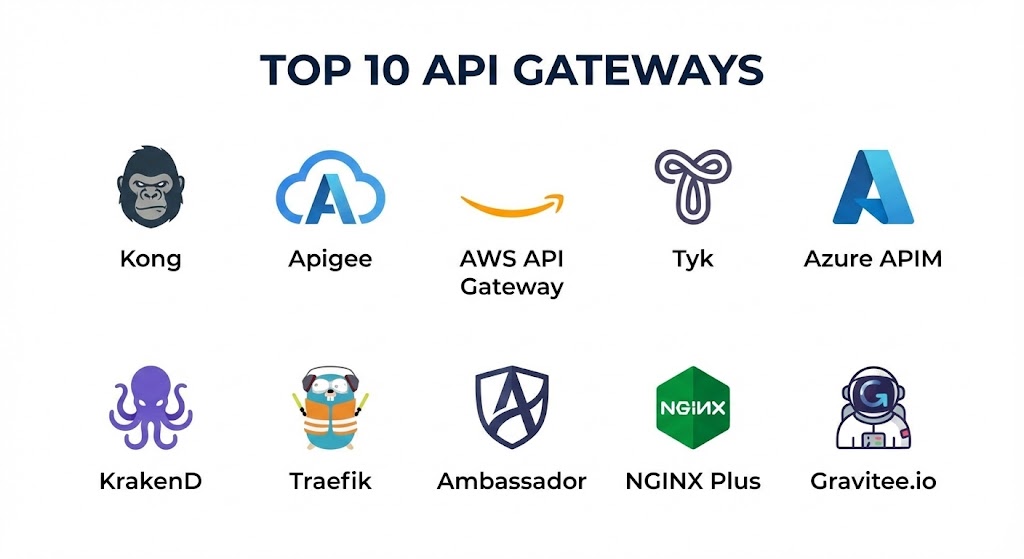
Top 10 API Gateways Tools
1 — Kong Gateway
Kong is arguably the most famous name in the API gateway space. Built on top of NGINX, it is an open-source, cloud-native gateway designed for high performance and extensibility. It has evolved into a full-scale service connectivity platform but remains at its core a lightning-fast proxy.
- Key features:
- Plugin Architecture: Over 100+ official and community plugins for auth, logging, and traffic control.
- Declarative Configuration: Supports “decK” and YAML-based configurations for GitOps workflows.
- Service Mesh Integration: Seamlessly transitions into a service mesh using Kong Mesh (Kuma).
- Multi-Cloud/Hybrid Support: Run across AWS, Azure, GCP, and on-premises seamlessly.
- gRPC and GraphQL Support: Advanced routing and transformation for modern protocols.
- Enterprise Control Plane: A centralized UI for managing decentralized gateway instances.
- Dynamic Load Balancing: Intelligent traffic distribution across healthy upstream services.
- Pros:
- Exceptional performance with sub-millisecond latency overhead.
- Massive community support ensures a plugin exists for almost any use case.
- Cons:
- The open-source version lacks a GUI, making it difficult for beginners to manage.
- Advanced features like OIDC and detailed analytics are gated behind a high-priced enterprise tier.
- Security & compliance: SOC 2 Type II, ISO 27001, GDPR compliant. Supports OIDC, OAuth 2.0, and mTLS.
- Support & community: Extensive GitHub community, 24/7 enterprise support, and a massive library of documentation and tutorials.
2 — Apigee (Google Cloud)
Apigee is the heavyweight champion of enterprise API management. While it is a full-lifecycle platform, its gateway component is highly sophisticated, focusing on business-level insights and advanced security for large-scale operations.
- Key features:
- AI-Powered Anomaly Detection: Uses machine learning to identify and block suspicious traffic patterns.
- Advanced API Security: Native protection against OWASP API Top 10 threats.
- Developer Portal: A self-service “storefront” for developers to consume your APIs.
- Monetization Engine: Tools to package, price, and sell your API data.
- Hybrid Deployment: Run the gateway in your own data center while managing it from the Google Cloud.
- Flow Hooks: Centrally manage logic that must execute across all APIs.
- Pros:
- Deepest analytics and business intelligence capabilities in the market.
- Robust security features that are pre-configured for high-compliance environments.
- Cons:
- Extremely high cost; not suitable for startups or small projects.
- The platform is very complex and usually requires a dedicated administrator.
- Security & compliance: FedRAMP, HIPAA, PCI DSS, SOC 2, and ISO 27001 compliant.
- Support & community: Google Cloud enterprise support, extensive certification programs, and a global partner network.
3 — AWS API Gateway
AWS API Gateway is a fully managed service that makes it easy for developers to create, publish, maintain, and secure APIs at any scale. It is the natural choice for organizations already living within the Amazon Web Services ecosystem.
- Key features:
- Serverless Integration: Native “one-click” integration with AWS Lambda and DynamoDB.
- WebSocket Support: Manage persistent connections for real-time applications.
- Canary Deployments: Safely roll out new API versions to a subset of users.
- CloudWatch Integration: Deep monitoring and alerting out of the box.
- Usage Plans and API Keys: Easily manage quotas and throttling for third-party consumers.
- CORS Support: Integrated handling of Cross-Origin Resource Sharing.
- Pros:
- No infrastructure to manage; AWS handles all scaling and patching.
- Very low barrier to entry for existing AWS users.
- Cons:
- Significant vendor lock-in; moving away from it requires a complete architectural rethink.
- Latency can be higher compared to specialized gateways like Kong or KrakenD.
- Security & compliance: GDPR, HIPAA, PCI DSS, and SOC 1/2/3 compliant. Integrates with AWS WAF and IAM.
- Support & community: Standard AWS support plans and a nearly infinite amount of community-generated content.
4 — Tyk
Tyk is a modern, open-source API gateway written in Go. It distinguishes itself by offering a “battery-included” experience where the dashboard, gateway, and developer portal are built to work together seamlessly from day one.
- Key features:
- Universal Data Graph: A built-in GraphQL engine that can stitch together multiple REST/GraphQL backends.
- Zero-Dependency Core: The gateway itself is lightweight and highly concurrent.
- Tyk Dashboard: One of the most intuitive and powerful management UIs in the industry.
- Multi-Data Center Bridge: Synchronize configurations across global clusters.
- Hardcoded Performance: Written in Go to handle high throughput with minimal resource usage.
- No-Code API Creation: Build simple proxy layers without writing any configuration files.
- Pros:
- The visual dashboard is excellent, making management accessible to less technical users.
- Very fast performance due to the Go-based architecture.
- Cons:
- The open-source license has specific restrictions that may require a paid plan earlier than Kong.
- Plugin development (in Go or JavaScript) can be more restrictive than Kong’s Lua approach.
- Security & compliance: GDPR and SOC 2 compliant. Supports Mutual TLS, OAuth2, and OIDC.
- Support & community: Responsive community forum, engineering-led support, and high-quality onboarding.
5 — Azure API Management (APIM)
Azure APIM is Microsoft’s answer to the gateway challenge. It acts as a comprehensive solution for publishing APIs to external, partner, and internal developers, deeply integrated into the Azure cloud.
- Key features:
- Self-Hosted Gateway: A containerized version of the gateway that can run on-premises or in other clouds.
- Developer Portal: A customizable CMS for documenting and testing APIs.
- Azure AD Integration: Native support for managing access via Microsoft Entra ID.
- Policy Expressions: Use C#-based logic to transform requests and responses on the fly.
- Git Integration: Manage your API configurations via a Git repository.
- Visual Studio Code Extension: Manage your entire API lifecycle from your IDE.
- Pros:
- The best integration for companies using the Microsoft stack (Active Directory, Azure Functions).
- Excellent developer portal out of the box.
- Cons:
- The “Premium” tier required for many enterprise features is very expensive.
- Configuration can sometimes feel “clunky” compared to modern CLI-first gateways.
- Security & compliance: ISO 27001, HIPAA, FedRAMP, and SOC 2 compliant.
- Support & community: Integrated Azure support, Microsoft Learn documentation, and a massive corporate user base.
6 — KrakenD
KrakenD is a stateless, ultra-high-performance API gateway. Unlike many other gateways that rely on a database for configuration, KrakenD is purely configuration-driven, making it ideal for immutable infrastructure.
- Key features:
- Stateless Architecture: No database required; it runs entirely on local configuration files.
- Aggregator/BFF: Merge multiple backend responses into a single client response.
- Linear Scalability: Since it’s stateless, you can scale horizontally with zero coordination overhead.
- Flexible Middleware: Over 60 components for security, caching, and transformation.
- Powerful Designer: A visual tool to generate the JSON configuration files.
- Sub-millisecond Performance: Often touted as the fastest gateway in benchmarks.
- Pros:
- Extremely lightweight; can run on very small instances.
- Perfect for modern “GitOps” and CI/CD pipelines.
- Cons:
- No built-in developer portal or dynamic UI for managing APIs at runtime.
- Steeper learning curve for those who prefer a “point-and-click” interface.
- Security & compliance: GDPR and SOC 2 ready. Supports JWT validation, OAuth2, and rate limiting.
- Support & community: Very fast-growing GitHub community and professional support from the KrakenD team.
7 — Traefik Proxy
Traefik is the cloud-native edge router of choice for containerized environments. It is famous for its “auto-discovery” features, where it detects new services as they are deployed and configures the gateway automatically.
- Key features:
- Auto-Discovery: Automatically scans Docker, Kubernetes, and Consul to find services.
- Let’s Encrypt Integration: Automatic SSL/TLS certificate management and renewal.
- Middlewares: Chainable components for auth, headers, and rate limiting.
- Live Dashboard: A visual overview of all routes and entry points.
- Circuit Breakers: Prevent cascading failures in your microservices.
- Metrics Export: Native integration with Prometheus and Datadog.
- Pros:
- The easiest gateway to set up in a Kubernetes or Docker environment.
- Dynamic configuration means zero downtime for routing changes.
- Cons:
- Documentation can be difficult to navigate for complex, non-containerized setups.
- Not as feature-rich in terms of “API Management” (portals, monetization) as Apigee or Tyk.
- Security & compliance: SOC 2 compliant. Supports LDAP, OAuth2, and custom auth headers.
- Support & community: Massive Discord and GitHub community; enterprise support via Traefik Labs.
8 — Ambassador (Emissary-ingress)
Ambassador is a Kubernetes-native API gateway built on the powerful Envoy Proxy. It is designed specifically for teams that want to manage their gateway configuration using Kubernetes Custom Resource Definitions (CRDs).
- Key features:
- Envoy-Based: Inherits the high performance and resilience of the Envoy proxy.
- Self-Service for Devs: Developers can manage their own routing via K8s manifests.
- Progressive Delivery: Integrated support for Canary and Blue/Green deployments.
- Service Mesh Ready: Works seamlessly with Istio and Linkerd.
- Automatic HTTPS: Native ACME/Let’s Encrypt support.
- Pros:
- Excellent for organizations that have “standardized” on Kubernetes.
- Empowering for developers who already use
kubectl.
- Cons:
- Primarily limited to Kubernetes; not ideal for hybrid or legacy environments.
- Can have a significant memory footprint compared to KrakenD or Kong.
- Security & compliance: GDPR and SOC 2 compliant. Integrated with Keycloak and Auth0.
- Support & community: Active Slack channel, high-quality documentation, and enterprise support from Datawire.
9 — NGINX Plus (as a Gateway)
While standard NGINX is a web server, NGINX Plus is an enterprise-grade load balancer and API gateway. It is the “battle-tested” choice for organizations that value stability and familiarity.
- Key features:
- High-Performance Proxy: The industry standard for speed and reliability.
- Active Health Checks: Automatically routes traffic away from failing servers.
- JWT Validation: Native support for verifying JSON Web Tokens.
- Real-time Monitoring: Detailed metrics and an interactive dashboard.
- App Protect: An integrated WAF to protect against web attacks.
- Pros:
- Extremely reliable; powers a huge percentage of the world’s top websites.
- You likely already have NGINX expertise in your organization.
- Cons:
- Not “cloud-native” by default; configuration management in K8s can be manual without an ingress controller.
- Lacks modern API management features like a developer portal.
- Security & compliance: FIPS 140-2, PCI DSS, and SOC 2 compliant.
- Support & community: World-class 24/7 support from F5 and a decades-old community.
10 — Gravitee.io
Gravitee is the “Event-Driven” gateway. While most gateways focus on synchronous REST calls, Gravitee is built to handle the modern world of streaming data, WebSockets, and asynchronous APIs.
- Key features:
- Kafka and MQTT Support: Manage event-driven architectures as easily as REST.
- Policy Studio: A visual “drag-and-drop” editor for creating API policies.
- Cockpit: A centralized tool for managing multiple environments (Dev, Test, Prod).
- Alert Engine: Real-time monitoring and alerting for service health.
- Monetization: Built-in tools to bill users for API consumption.
- Pros:
- The best choice for IoT and real-time data streaming projects.
- Very modern and user-friendly interface.
- Cons:
- Smaller community and ecosystem compared to Kong or AWS.
- Some of the most advanced features are restricted to the enterprise version.
- Security & compliance: GDPR and SOC 2 compliant. Supports OAuth2 and OIDC.
- Support & community: Responsive GitHub and Discord presence; tiered commercial support.
Comparison Table
| Tool Name | Best For | Platform(s) Supported | Standout Feature | Rating (Gartner) |
| Kong | High-Performance Multi-Cloud | K8s, Cloud, On-Prem | 100+ Plugin Ecosystem | 4.6 / 5 |
| Apigee | Large Enterprise Analytics | GCP, Hybrid | AI Anomaly Detection | 4.8 / 5 |
| AWS API Gateway | Serverless / AWS Native | AWS Only | Native Lambda Triggers | 4.4 / 5 |
| Tyk | Hybrid with Visual UI | K8s, Cloud, On-Prem | Universal Data Graph | 4.5 / 5 |
| Azure APIM | Microsoft-centric Orgs | Azure, Hybrid | C# Policy Expressions | 4.3 / 5 |
| KrakenD | Ultra-speed Stateless | Any (Go binary) | Stateless / No DB | 4.7 / 5 |
| Traefik | Container Auto-Discovery | Docker, K8s, ECS | Automatic Route Sync | 4.6 / 5 |
| Ambassador | K8s-Native Workflows | Kubernetes Only | Envoy-Based CRDs | 4.4 / 5 |
| NGINX Plus | Battle-tested Stability | Linux, K8s | Native WAF Integration | 4.5 / 5 |
| Gravitee.io | Event-Driven / Streaming | K8s, Cloud, On-Prem | Kafka / MQTT Gateway | 4.6 / 5 |
Evaluation & Scoring of API Gateways
Selecting an API Gateway is a long-term commitment. To assist in your evaluation, we have scored the general market based on a weighted rubric that reflects modern architectural priorities.
| Criteria | Weight | Evaluation Rationale |
| Core Features | 25% | Routing, rate limiting, load balancing, and plugin depth. |
| Ease of Use | 15% | Time to “Hello World,” CLI quality, and dashboard intuitiveness. |
| Integrations | 15% | Connectivity with CI/CD, K8s, and observability tools (Prometheus). |
| Security & Compliance | 10% | Encryption standards, OIDC support, and regulatory certifications. |
| Performance | 10% | Latency overhead (P99) and resource consumption. |
| Support & Community | 10% | Documentation quality and the availability of external talent. |
| Price / Value | 15% | ROI for a startup vs. enterprise-tier licensing. |
Which API Gateways Tool Is Right for You?
Solo Users vs SMB vs Mid-market vs Enterprise
If you are a solo user or building a small project on AWS, AWS API Gateway is the path of least resistance. For SMBs that need a visual dashboard and fast setup, Tyk or Traefik are excellent choices. Mid-market organizations that have standardized on Kubernetes will find Ambassador or Kong to be highly scalable. Enterprises with complex compliance and global traffic needs should look exclusively at Apigee, Azure APIM, or Kong Enterprise.
Budget-conscious vs Premium Solutions
For those on a tight budget, KrakenD and the open-source version of Kong provide immense power for zero license cost. If you are looking for a Premium experience where the vendor handles security updates, AI-driven monitoring, and provides 24/7 “on-call” support, the investment in Apigee or NGINX Plus is easily justified.
Feature Depth vs Ease of Use
If you need Feature Depth (e.g., you want to monetize your API and provide a beautiful developer portal), Apigee and Tyk are the leaders. If you prioritize Ease of Use and want the gateway to “just work” as you add services to Docker, Traefik is the hands-down winner.
Integration and Scalability Needs
If your primary concern is Performance and Scalability at the absolute edge, KrakenD and Kong are the gold standard. For those building Event-Driven architectures with Kafka, Gravitee.io is the only tool on this list specifically architected for that purpose.
Frequently Asked Questions (FAQs)
1. Is an API Gateway the same as a Load Balancer?
Not exactly. A Load Balancer only distributes traffic. An API Gateway does that plus security, request transformation, rate limiting, and business-level routing.
2. How much latency does an API Gateway add?
Modern gateways like Kong or KrakenD add less than 1ms. Enterprise gateways with heavy security checks (like Apigee) may add 10-30ms.
3. Do I need a Service Mesh AND an API Gateway?
Usually, yes. An API Gateway handles North-South traffic (outside to inside). A Service Mesh handles East-West traffic (service to service inside your network).
4. Can an API Gateway handle GraphQL?
Yes. Tools like Tyk and Apollo (not on this list) are specialists, but Kong and KrakenD have excellent GraphQL support.
5. What is the difference between Open Source and Enterprise versions?
Generally, Open Source gives you the gateway engine. Enterprise adds the “Management” layer: UIs, portals, advanced security, and 24/7 support.
6. Can I host an API Gateway on my own servers?
Yes, most gateways (Kong, Tyk, NGINX) are designed to be run anywhere. Only cloud-native services like AWS or Azure are restricted to their platforms.
7. Is an API Gateway a security risk?
If misconfigured, yes. However, it is generally a security benefit because it centralizes security logic in one place rather than having it scattered across services.
8. Can I use an API Gateway for legacy SOAP services?
Yes, many gateways (especially Apigee and Tyk) have “transformation” policies that can turn a JSON request into a SOAP XML request for the backend.
9. What is “GitOps” for API Gateways?
It is the practice of managing gateway configuration via code (YAML/JSON) in a Git repository, ensuring every change is reviewed and versioned.
10. How do I monitor my API Gateway?
Most gateways export metrics to Prometheus or Datadog. This allows you to see error rates, latency, and throughput in real-time.
Conclusion
The API Gateway is the heartbeat of your digital infrastructure. In 2026, choosing a gateway is no longer just a technical decision—it is a strategic one. The right tool will not only protect your services but also accelerate your developers’ ability to ship new features without worrying about infrastructure.
If you are a high-speed Kubernetes team, Traefik or Ambassador will empower you. If you are a global enterprise looking for business insights, Apigee is the standard. And if you are a performance-obsessed architect, Kong or KrakenD are your best allies. Ultimately, the “best” gateway is the one that fits your current cloud footprint while providing the scalability to meet your future ambitions.