Introduction
An API Management Platform is a suite of tools that allows organizations to design, deploy, secure, monitor, and monetize their APIs. Think of it as a sophisticated gatekeeper and concierge. It handles the “heavy lifting” of traffic management, authentication (ensuring only the right people get in), rate limiting (preventing your servers from being overwhelmed), and analytics (understanding how your data is being used). Without these platforms, developers would have to manually code security and monitoring for every single service—a recipe for inconsistency and security vulnerabilities.
The importance of these platforms lies in their ability to provide a unified layer across hybrid and multi-cloud environments. Key real-world use cases include legacy modernization (wrapping old databases in modern REST or GraphQL interfaces), partner ecosystems (allowing third parties to build on your data securely), and mobile backends. When evaluating tools, users should look for gateway performance (latency), developer portal quality, security depth (OIDC/OAuth support), and multi-cloud flexibility.
Best for: Enterprise architects, DevOps teams, and CTOs in industries like Fintech, Healthcare, and SaaS. It is vital for companies moving toward microservices architectures or those looking to monetize their data assets.
Not ideal for: Small, monolithic applications with only one or two internal endpoints, or simple static websites. If your “API” is just a single internal script that never faces the public internet or partners, the overhead of a full management platform may outweigh the benefits.
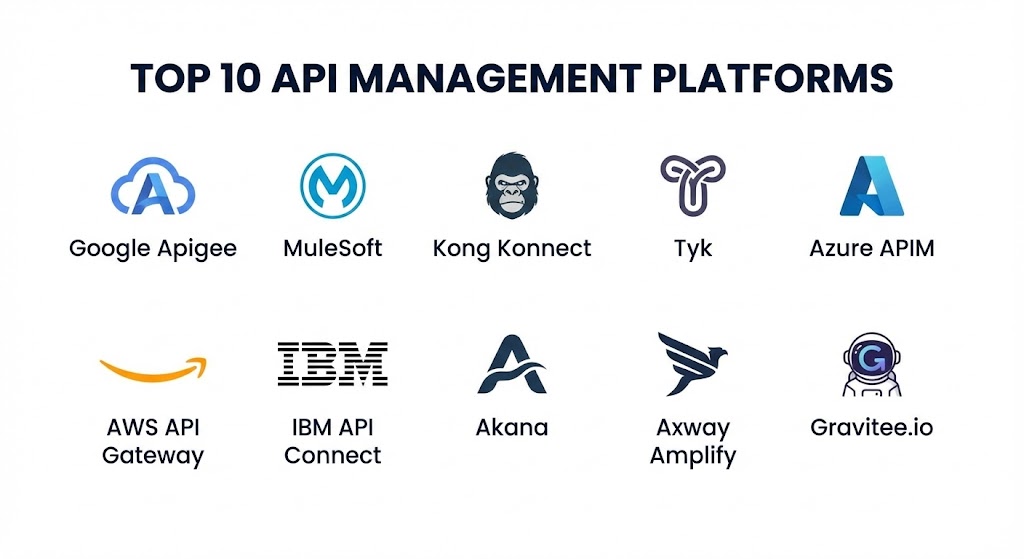
Top 10 API Management Platforms Tools
1 — Google Apigee
Apigee, acquired by Google Cloud, is widely considered the “gold standard” for enterprise-grade API management. It is designed for large organizations that require deep analytics, advanced security, and a robust developer portal to manage high volumes of traffic.
- Key features:
- AI-Powered Analytics: Uses machine learning to detect anomalies and predict traffic patterns.
- Advanced API Security: Automated protection against bot attacks and specialized OWASP API threats.
- Developer Portal: A customizable “storefront” for your APIs to encourage third-party adoption.
- Monetization Engine: Sophisticated billing models to charge developers for API usage.
- Multi-Cloud Support: Can manage APIs residing on-premises, on AWS, or within Google Cloud.
- Microgateway: A lightweight gateway for localized traffic management in microservices.
- Pros:
- Unrivaled analytics and business intelligence capabilities.
- Highly scalable, handling trillions of calls for some of the world’s largest retailers.
- Cons:
- Extremely high cost of entry, putting it out of reach for most SMBs.
- Steep learning curve due to the complexity of the platform.
- Security & compliance: SOC 2 Type II, ISO 27001, HIPAA, GDPR, PCI DSS, and FIPS 140-2.
- Support & community: Extensive documentation, Google Cloud professional services, and a massive global user community.
2 — MuleSoft Anypoint Platform (Salesforce)
MuleSoft is a holistic integration platform that treats API management as part of a broader “connectivity” strategy. It is built for companies that need to bridge the gap between hundreds of different SaaS applications and legacy systems.
- Key features:
- Exchange: A marketplace of pre-built connectors and templates to accelerate integration.
- API Designer: A visual environment for modeling APIs using RAML or OAS.
- Anypoint Runtime Fabric: Deploy APIs across any cloud or on-premises data center.
- DataWeave: A powerful data transformation engine for mapping complex datasets.
- API Governance: Automated enforcement of best practices and security standards.
- Pros:
- The best tool for complex “Integration-Platform-as-a-Service” (iPaaS) requirements.
- Deep integration with the Salesforce ecosystem.
- Cons:
- Heavy footprint; requires significant infrastructure resources to run efficiently.
- Pricing is complex and based on “vCores,” which can become expensive as you scale.
- Security & compliance: FedRAMP, SOC 2, HIPAA, GDPR, and ISO 27001.
- Support & community: High-tier enterprise support, “MuleSoft University” for training, and a global partner network.
3 — Kong Konnect
Kong is the world’s most popular open-source API gateway, built for speed and cloud-native environments. The Konnect platform is their SaaS offering that provides a centralized control plane for managing Kong gateways anywhere.
- Key features:
- Lightweight Gateway: Built on NGINX, offering sub-millisecond latency.
- Plugin Hub: Over 100 plugins for authentication, logging, and traffic control.
- Service Mesh Integration: Seamlessly connects with Kong Mesh for internal microservices.
- Insomnia Integration: Built-in tool for API testing and debugging.
- Universal Service Directory: A centralized view of every service across your architecture.
- Pros:
- The best performance and lowest latency in the industry.
- Flexible deployment—works perfectly in Kubernetes and Docker environments.
- Cons:
- The open-source version lacks many essential enterprise features (like a portal).
- Configuring complex policies via the CLI/Admin API can be intimidating for beginners.
- Security & compliance: GDPR, SOC 2, and FIPS 140-2 compliant.
- Support & community: Massive open-source community, active GitHub, and tiered enterprise support levels.
4 — Tyk Technologies
Tyk is a modern, Go-based API management platform that prides itself on being “unopinionated.” It offers a flexible, open-source core with a powerful dashboard for enterprise users.
- Key features:
- No-Code Dashboard: Manage the entire API lifecycle without writing configuration files.
- Universal Data Graph: A built-in GraphQL engine that can stitch together REST and GraphQL backends.
- Hybrid Cloud: Manage local gateways from a central cloud-based control plane.
- Multi-Data Center: Synchronize API configurations across global regions automatically.
- Developer Portal: Included by default, even in many lower-tier plans.
- Pros:
- Very easy to install and get running compared to Apigee or MuleSoft.
- Written in Go, making it highly concurrent and efficient.
- Cons:
- Smaller third-party plugin ecosystem than Kong.
- Documentation can sometimes lag behind new feature releases.
- Security & compliance: GDPR, SOC 2 Type II, and ISO 27001.
- Support & community: Highly responsive engineering-led support and a very active community forum.
5 — Microsoft Azure API Management
For organizations already invested in the Microsoft ecosystem, Azure API Management (APIM) is the logical choice. It offers seamless integration with Azure Functions, Logic Apps, and Active Directory.
- Key features:
- Self-Hosted Gateway: Deploy a lightweight version of the gateway in any cloud or on-prem.
- Azure AD Integration: Native support for managing API access via Entra ID (formerly Azure AD).
- Policy Expressions: Powerful C#-based logic for transforming requests and responses.
- Developer Portal: Automatically generated documentation and testing console.
- Visual Studio Code Extension: Manage your APIs directly from your IDE.
- Pros:
- The most cost-effective option for current Azure customers.
- Excellent developer experience for those familiar with the Microsoft stack.
- Cons:
- Gateway performance can be slower than Kong or Tyk in certain configurations.
- Customizing the developer portal is more restrictive than competitors.
- Security & compliance: FedRAMP, HIPAA, SOC 2, GDPR, and ISO 27001.
- Support & community: Integrated into Azure Support plans; massive library of Microsoft Learn content.
6 — AWS API Gateway
AWS API Gateway is a fully managed service that makes it easy for developers to create, publish, and secure APIs at any scale. It is the backbone of “serverless” architectures on AWS.
- Key features:
- Lambda Integration: Built-in triggers for AWS Lambda functions.
- WebSocket Support: Manage persistent connections for real-time apps (chat, dashboards).
- Canary Deployments: Safely roll out new API versions to a small percentage of traffic.
- Usage Plans: Define API keys and quotas for different tiers of users.
- CloudWatch Logging: Granular monitoring and alerting integrated into AWS.
- Pros:
- True “pay-as-you-go” pricing makes it ideal for startups.
- Zero server management; AWS handles all scaling and patching.
- Cons:
- Significant “vendor lock-in” to the AWS ecosystem.
- Lacks a sophisticated, built-in developer portal compared to Apigee.
- Security & compliance: SOC 1/2/3, PCI DSS, HIPAA, GDPR, and FedRAMP.
- Support & community: Standard AWS support tiers and an infinite supply of community tutorials.
7 — IBM API Connect
IBM API Connect is an enterprise-grade solution that focuses on the “Full Lifecycle” of API management. It is designed for highly regulated industries like banking and insurance that require strict governance.
- Key features:
- Automated API Testing: Uses AI to generate test cases based on your API definitions.
- Microservices Mesh: Integrated support for managing APIs in Istio/Service Mesh.
- Intuitive Assembly: Drag-and-drop tool for creating complex API logic and transformations.
- Multi-Cloud Deployment: Consistent management across IBM Cloud, AWS, and Azure.
- Pros:
- Exceptional security and governance features for large, complex organizations.
- The “API Designer” is one of the most user-friendly tools for architecting APIs.
- Cons:
- The licensing costs are high and geared toward large-scale enterprise contracts.
- Can feel “heavy” and slow to deploy in agile, fast-moving startup environments.
- Security & compliance: FIPS 140-2, SOC 2, ISO 27001, and GDPR.
- Support & community: IBM Global Support and a dedicated “IBM Developer” community.
8 — Akana (by Perforce)
Akana provides an end-to-end API management solution that excels in security and lifecycle management. It is often chosen by organizations that need to manage a mix of SOAP (legacy) and REST (modern) APIs.
- Key features:
- Lifecycle Management: Track an API from planning and design to retirement.
- Security Mediation: Convert between different security protocols (e.g., SOAP to OAuth).
- Predictive Analytics: Identify potential performance bottlenecks before they affect users.
- Enterprise Portal: Sophisticated workflows for API approvals and documentation.
- Pros:
- Strongest tool for “SOAP-to-REST” transformation and legacy integration.
- Highly stable and reliable for mission-critical financial services.
- Cons:
- The interface feels a bit dated compared to modern tools like Kong or Framer.
- Smaller community and fewer public plugins than the market leaders.
- Security & compliance: SOC 2, HIPAA, GDPR, and ISO 27001.
- Support & community: Professional Perforce support and dedicated account management.
9 — Axway Amplify
Axway Amplify is a “Universal API Management” platform. Its differentiator is that it can manage and govern APIs that are actually running on other gateways (like AWS or Azure).
- Key features:
- Universal Catalog: A single place to discover all APIs across the entire enterprise.
- Amplify Agents: Lightweight observers that watch traffic on third-party gateways.
- Governance Plane: Centralized policy management for a fragmented API landscape.
- Marketplace: Build a branded marketplace to sell your API products.
- Pros:
- The best solution for companies with “Gateway Sprawl” (using multiple different vendors).
- Excellent for large-scale digital transformation initiatives.
- Cons:
- Does not provide as deep “low-level” gateway control as Kong or Tyk.
- Complex to set up the “Universal” monitoring across multiple clouds.
- Security & compliance: GDPR, ISO 27001, and SOC 2 compliant.
- Support & community: Global Axway support and professional services.
10 — Gravitee.io
Gravitee is the “Event-Driven” specialist. While other tools focus on request/response (REST), Gravitee is built from the ground up to manage streaming data and asynchronous APIs.
- Key features:
- Kafka & MQTT Support: Manage streaming data as if it were a standard API.
- Alert Engine: Real-time monitoring and alerting for streaming data health.
- Cockpit: A centralized management tool for multi-instance deployments.
- Policy Studio: A visual editor for applying security and transformation rules.
- Pros:
- The undisputed leader for IoT and real-time data streaming management.
- Very lightweight and modern architecture.
- Cons:
- Smaller user base than the “Big Three” (Google, MuleSoft, Kong).
- Some enterprise features require a proprietary license.
- Security & compliance: GDPR and SOC 2 compliant.
- Support & community: Very active community on GitHub and responsive commercial support.
Comparison Table
| Tool Name | Best For | Platform(s) Supported | Standout Feature | Rating (Gartner) |
| Apigee | Large Enterprise | Multi-Cloud / SaaS | AI-Driven Security | 4.8 / 5 |
| MuleSoft | Complex Integration | Multi-Cloud / SaaS | Anypoint Exchange | 4.7 / 5 |
| Kong Konnect | Performance & K8s | Cloud Native / SaaS | Sub-ms Latency | 4.5 / 5 |
| Tyk | Hybrid Cloud | Multi-Cloud / Self-Host | Universal Data Graph | 4.6 / 5 |
| Azure APIM | Microsoft Ecosystem | Azure / Hybrid | Native Azure Sync | 4.4 / 5 |
| AWS Gateway | Serverless / Startups | AWS Only | Lambda Native Sync | 4.3 / 5 |
| IBM Connect | Strict Governance | Multi-Cloud / Hybrid | AI-Automated Testing | 4.5 / 5 |
| Axway Amplify | Universal Management | Multi-Cloud | Managing Other Gateways | 4.4 / 5 |
| Akana | Legacy / SOAP | Hybrid | Security Mediation | 4.2 / 5 |
| Gravitee.io | Event-Driven / IoT | Cloud Native | Kafka/MQTT Management | 4.6 / 5 |
Evaluation & Scoring of API Management Platforms
To help you choose, we have evaluated the overall market based on the following weighted scoring rubric. This represents the priorities of a modern IT organization in 2026.
| Criteria | Weight | Evaluation Rationale |
| Core Features | 25% | Gateway, Portal, Analytics, and Monetization capabilities. |
| Ease of Use | 15% | Time to “Hello World” and dashboard intuitiveness. |
| Integrations | 15% | Connectivity with CI/CD, K8s, and third-party clouds. |
| Security & Compliance | 10% | Breadth of certifications (HIPAA, FedRAMP, etc.). |
| Performance | 10% | Latency under high load and resource consumption. |
| Support & Community | 10% | Quality of docs and availability of external talent. |
| Price / Value | 15% | Total cost of ownership (TCO) vs. feature depth. |
For a specific platform score, use the formula:
$$Score = \sum (Criterion \times Weight)$$
Which API Management Platform Is Right for You?
Solo Users vs SMB vs Mid-market vs Enterprise
- Solo Users/Developers: AWS API Gateway or the open-source version of Kong is best. They offer a “Free Tier” that allows you to experiment without financial commitment.
- SMBs: Tyk or Azure APIM provide the best balance of a professional dashboard and manageable pricing.
- Mid-market: Kong Konnect or Gravitee.io are excellent for growing teams that need high performance but aren’t ready for the “MuleSoft price tag.”
- Enterprise: Apigee or MuleSoft are the required choices for organizations with thousands of APIs, hundreds of developers, and strict monetization needs.
Budget-conscious vs Premium Solutions
If budget is the primary driver, Tyk and Kong (Open Source) offer the most power for zero dollars—though you will spend more on “human time” managing them. For Premium solutions where you want “white-glove” support and every possible feature (like AI-driven anomaly detection), Apigee is the investment that pays dividends in security and uptime.
Feature Depth vs Ease of Use
If you need Feature Depth (e.g., stiching 50 REST APIs into one GraphQL endpoint), Tyk is the winner. If you prioritize Ease of Use and want your marketing team to be able to look at API analytics, the Apigee or Azure dashboards are the most approachable.
Integration and Scalability Needs
For those building “Serverless” apps on AWS, don’t look elsewhere—AWS API Gateway is too deeply integrated to ignore. If you have a fragmented landscape with some APIs on AWS and some on-prem, Axway Amplify or MuleSoft provide the “Universal” view necessary to keep the organization sane.
Frequently Asked Questions (FAQs)
1. Do I really need an API Management platform for internal APIs?
While not mandatory, it is highly recommended. Internal API management provides “consistency.” It ensures that every developer uses the same authentication method and gives IT a central view of which internal services are failing or overused.
2. What is an API Gateway?
The gateway is the “traffic cop” part of the platform. It is the actual server that sits in front of your APIs, checking keys, limiting traffic, and routing requests. The “Platform” is the management layer that controls the gateway.
3. What is the difference between REST and GraphQL management?
REST is traditional request/response. GraphQL allows clients to ask for exactly what they need. Modern platforms like Tyk and Kong can manage both, but they require different security and rate-limiting logic for GraphQL.
4. How much do these platforms cost?
Cloud-native gateways like AWS are “Pay-as-you-go” (cents per million calls). Enterprise platforms like Apigee or MuleSoft typically start at $25,000–$50,000 per year and go up into the millions.
5. Can these platforms handle “Streaming” data?
Most can handle WebSockets, but for true event-driven data (like Kafka), specialized tools like Gravitee.io are significantly better than traditional gateways.
6. What is a Developer Portal?
It is a website where developers can go to get their API keys, read the documentation (Swagger/OAS), and test endpoints in a sandbox. It is critical for “external-facing” API strategies.
7. Does an API gateway add latency to my requests?
Yes, but minimal. A high-performance gateway like Kong adds less than 1ms. An enterprise gateway like Apigee may add 10–30ms due to the advanced security checks it performs.
8. Can I host these platforms on my own servers?
Yes. Kong, Tyk, and IBM API Connect offer robust “On-Premises” or “Hybrid” options. AWS and Azure are primarily cloud-only (though they offer limited edge-gateway options).
9. What is API Monetization?
It is the ability to charge for your data. The platform tracks how many calls a user makes and integrates with Stripe or other billing tools to invoice them based on usage tiers.
10. What is “Universal API Management”?
It is the 2026 trend of managing APIs regardless of where they are hosted. For example, using Axway to manage an API that is actually running on a Kong gateway in a different data center.
Conclusion
The “best” API management platform is the one that aligns with your specific cloud strategy and the technical maturity of your team. In 2026, you cannot afford to have “naked” APIs facing the internet without protection and observability.
If you are a high-speed startup, the performance of Kong or Tyk will serve you best. If you are a global enterprise with a decade of legacy data, the “connectivity” power of MuleSoft or Apigee is worth the investment. Ultimately, these platforms are about more than just security; they are about turning your code into a scalable business asset. Choose the one that doesn’t just manage your traffic, but enables your growth.