Introduction
AdTech Platforms comprise a suite of software tools and technologies used by advertisers, agencies, and publishers to manage, deliver, and optimize digital advertising campaigns. The category includes Demand-Side Platforms (DSPs), Supply-Side Platforms (SSPs), Ad Servers, and Data Management Platforms (DMPs). In essence, AdTech bridges the gap between a brand’s budget and the publisher’s available screen space. By using programmatic algorithms, these platforms automate the bidding process, ensuring that ad spend is allocated efficiently based on real-time data rather than guesswork.
The importance of AdTech lies in its ability to drive ROI through precision. In a world of “banner blindness,” AdTech allows for hyper-relevance. Key real-world use cases include retargeting (showing a product to someone who recently viewed it), contextual targeting (placing ads next to relevant articles), and cross-device attribution (tracking a user from a mobile click to a desktop purchase). When evaluating these tools, decision-makers should look for transparency in fees, inventory quality, identity resolution capabilities (especially in a post-cookie world), and fraud prevention measures.
Best for: Large-scale digital agencies, enterprise-level marketing departments, and high-growth e-commerce brands. It is essential for organizations spending upwards of five figures monthly on digital media who require granular control over their audience targeting and campaign performance.
Not ideal for: Local “mom-and-pop” businesses or very small startups with limited budgets. For these users, the native “walled gardens” of social media platforms (like simple Facebook or Instagram boosted posts) offer a much lower barrier to entry and a simpler interface without the need for complex programmatic knowledge.
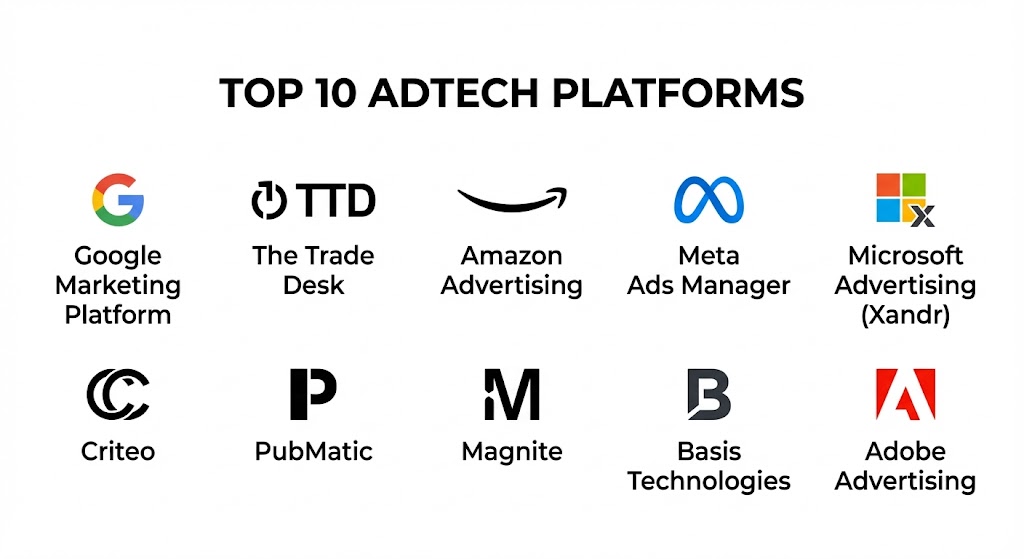
Top 10 AdTech Platforms Tools
1 — Google Marketing Platform (Display & Video 360)
As the titan of the industry, Google’s Display & Video 360 (DV360) is the enterprise-grade Demand-Side Platform that offers end-to-end campaign management. It is designed for large advertisers who want to leverage Google’s vast ecosystem and first-party data.
- Key features:
- Unified Workflow: Integration with Analytics 360 and Search Ads 360 for a holistic view.
- Automated Bidding: Sophisticated machine learning algorithms to optimize for specific KPIs.
- Audience Management: Direct access to Google’s high-intent audience segments.
- Inventory Quality: Rigorous brand safety controls and access to premium Google-owned inventory.
- Creative Studio: Tools to build and manage dynamic, data-driven creatives at scale.
- Marketplace: A discovery tool for premium publishers and curated deals.
- Pros:
- Unrivaled scale and access to inventory across the entire web and YouTube.
- Deepest integration with the most widely used analytics suite in the world.
- Cons:
- Often criticized for being a “black box” regarding data transparency.
- The platform can be overwhelmingly complex for mid-market users.
- Security & compliance: ISO 27001, SOC 2, GDPR, and CCPA compliant. Offers advanced SSO and audit logs.
- Support & community: Extensive documentation via Google Skillshop, a global network of certified partners, and enterprise-level support.
2 — The Trade Desk
The Trade Desk is the leading independent Demand-Side Platform. It is famous for its “objectivity,” as it does not own its own content or inventory, theoretically eliminating the conflict of interest found in platforms like Google or Meta.
- Key features:
- Unified ID 2.0: A leading open-source identity solution designed for the post-cookie era.
- Koa™ AI: An AI engine that analyzes billions of impressions to suggest optimizations.
- Omnichannel Reach: Seamless buying across Connected TV (CTV), Mobile, Audio, and Display.
- Planner Tool: Data-driven insights to help build a media plan before spending a dollar.
- Data Marketplace: Access to third-party data from hundreds of providers.
- Transparency: Detailed reporting on where every cent of ad spend is going.
- Pros:
- Excellent for Connected TV (CTV) and high-end programmatic strategies.
- Known for a highly intuitive UI that simplifies complex programmatic bidding.
- Cons:
- Requires a significant minimum monthly spend, making it exclusive to larger players.
- Being independent means it lacks the “built-in” audience data that Google or Amazon possess.
- Security & compliance: SOC 2 Type II, GDPR, and ISO 27001 compliant.
- Support & community: “The Trade Desk Edge Academy” provides industry-leading certifications and training.
3 — Amazon Advertising
Amazon has rapidly become the third pillar of digital advertising. Its AdTech platform allows brands to reach shoppers based on their actual purchase history and intent, which is arguably the most valuable data in the industry.
- Key features:
- Amazon DSP: Access to Amazon-owned sites (IMDb, Twitch) and the broader web.
- First-Party Purchase Data: Targeting based on what users actually buy, not just what they browse.
- Amazon Marketing Cloud (AMC): A “clean room” for advanced data analysis and attribution.
- Video & Audio Ads: Highly effective placements on Fire TV and Amazon Music.
- Self-Service Tools: Range of options from basic sponsored products to complex programmatic.
- Closed-Loop Attribution: Direct visibility into how ads drive sales on the Amazon platform.
- Pros:
- Unmatched intent-based targeting; it is the “bottom of the funnel” king.
- Excellent for e-commerce brands looking to drive immediate sales.
- Cons:
- High “tax” in terms of platform fees and the competitive nature of the bidding.
- The reporting is heavily focused on the Amazon ecosystem, making it harder to track off-platform impact.
- Security & compliance: Standard AWS-level security, GDPR, and CCPA compliant.
- Support & community: Comprehensive learning console, webinars, and dedicated account managers for large spenders.
4 — Meta Ads Manager
While often viewed as a “social tool,” Meta’s AdTech infrastructure is one of the most advanced in the world. It excels at visual storytelling and algorithmic optimization for direct-response marketing.
- Key features:
- Advantage+ Campaigns: Highly automated AI-driven campaign setup and optimization.
- Pixel & Conversions API: Robust tracking that bypasses many browser-based cookie blocks.
- Lookalike Audiences: Finds new customers who “look like” your best existing ones.
- Dynamic Creative: Automatically tests different combinations of images and text.
- Instagram & WhatsApp Integration: Unified buying across the world’s most popular apps.
- Commerce Manager: Direct integration with on-platform shops and catalogs.
- Pros:
- The most effective tool for mobile-first, visual, and social-driven commerce.
- Very accessible UI compared to traditional programmatic DSPs.
- Cons:
- Vulnerable to privacy changes like Apple’s ATT (App Tracking Transparency).
- Can suffer from ad fatigue quickly due to the high frequency of social browsing.
- Security & compliance: SOC 2, GDPR, and CCPA compliant. Standard 2FA and encryption.
- Support & community: Massive Meta Blueprint training portal and a global community of marketers.
5 — Microsoft Advertising (Xandr)
Since the acquisition of Xandr, Microsoft has become a formidable force in AdTech. It combines search intent from Bing with the professional data of LinkedIn and the programmatic power of a world-class DSP/SSP.
- Key features:
- Microsoft Invest: An enterprise DSP designed for strategic programmatic buying.
- LinkedIn Profile Targeting: Target users based on job title, company, and industry on the web.
- Connected TV (CTV): Strong partnerships, including being the exclusive ad partner for Netflix.
- Retail Media: Specialized tools for retailers to build their own ad networks.
- Curated Marketplaces: Access to premium, brand-safe inventory with pre-negotiated rates.
- Bing Search Integration: Combine search and display data for better attribution.
- Pros:
- The only way to target B2B audiences using LinkedIn data outside of LinkedIn itself.
- Rapidly growing CTV inventory through exclusive, high-value partnerships.
- Cons:
- Search volume is still significantly lower than Google.
- The transition from legacy systems to the new unified platform can be confusing.
- Security & compliance: ISO 27001, SOC 2, HIPAA, and GDPR compliant.
- Support & community: Extensive Microsoft Advertising Learning Lab and dedicated enterprise support.
6 — Criteo (Commerce Media Platform)
Criteo is the leader in “Commerce Media.” While once known primarily for retargeting, it has evolved into a massive network that connects brands with retail inventory across the world’s largest merchant sites.
- Key features:
- Commerce Data Collective: Anonymous data from thousands of retailers to understand shopper intent.
- Dynamic Retargeting: Personalized ad creation in real-time based on specific user products.
- Retail Media: Allows brands to buy “Digital Shelf Space” on sites like Target or Best Buy.
- Predictive Bidding: AI that calculates the precise value of an impression based on purchase likelihood.
- Contextual Advertising: AI that understands the commerce “intent” of a web page.
- Omnichannel Measurement: Linking online ads to offline (in-store) sales.
- Pros:
- Exceptionally high conversion rates for retail and e-commerce brands.
- Best-in-class retargeting technology that actually drives incremental sales.
- Cons:
- Can be viewed as intrusive by some consumers if not managed carefully.
- Implementation of the Criteo OneTag can be technically demanding.
- Security & compliance: SOC 2 Type II, GDPR, and CCPA compliant.
- Support & community: Localized support teams, Criteo Academy, and a strong presence in the retail industry.
7 — PubMatic
PubMatic is a leading Supply-Side Platform (SSP). While most tools on this list are for buyers (DSPs), PubMatic is critical for publishers who want to sell their inventory and for advertisers who want “Supply Path Optimization.”
- Key features:
- OpenWrap: A header bidding solution for web, mobile, and CTV.
- Identity Hub: Manages multiple identity solutions (UID 2.0, ID5) in one place.
- Connect: A tool for advertisers to access audience-rich segments directly on the supply side.
- Fraud Protection: Real-time screening with specialized third-party integrations.
- Programmatic Guaranteed: Allows for direct deals with publishers through a programmatic interface.
- Auction Packages: Pre-built, curated inventory groups based on specific themes (e.g., Luxury, Sports).
- Pros:
- Essential for publishers looking to maximize their “Yield Management.”
- Known for high transparency and excellent “Supply Path Optimization” (SPO).
- Cons:
- Not a standalone tool for advertisers; it must be used in conjunction with a DSP.
- The interface is designed for technical yield managers, not creative marketers.
- Security & compliance: ISO 27001, SOC 2, and GDPR compliant.
- Support & community: Deep technical documentation and global publisher support teams.
8 — Magnite
Magnite is the world’s largest independent sell-side advertising platform. Formed by the merger of Rubicon Project and Telaria, it is a powerhouse in the Connected TV (CTV) and video space.
- Key features:
- Magnite Streaming: Specialized SSP for high-end video and CTV inventory.
- Demand Manager: A header bidding management tool for large publishers.
- Direct Access: Streamlined buying paths for agencies to reduce “middleman” fees.
- Real-time Reporting: Granular data on bid density, win rates, and CPMs.
- PMP Management: Private Marketplace tools to manage exclusive deals between buyers and sellers.
- Identity Solutions: Native support for the industry’s leading post-cookie IDs.
- Pros:
- The undisputed leader for publishers and buyers focused on the future of television (CTV).
- Massive global scale with high-quality, brand-safe video inventory.
- Cons:
- Technical setup for CTV header bidding is highly complex.
- Primarily focused on large-scale media companies and publishers.
- Security & compliance: ISO 27001, SOC 2 Type II, and GDPR compliant.
- Support & community: High-touch technical support and a specialized CTV education series.
9 — Basis Technologies
Basis (formerly Centro) is unique because it focuses on “Workflow Automation.” It combines a top-tier DSP with a comprehensive media management system, aimed at reducing the manual labor of digital advertising.
- Key features:
- Basis DSP: Integrated programmatic buying with AI-driven optimization.
- Universal Messaging: Centralized communication between teams and vendors.
- Business Intelligence: Automated reporting across every channel (not just programmatic).
- Unified Search & Social: Manage Google and Meta ads alongside programmatic in one dashboard.
- Media Planning: Tools to build budgets and RFP vendors within the platform.
- Financial Integration: Streamlined invoicing and reconciliation for agencies.
- Pros:
- The best tool for agencies looking to increase their profit margins through efficiency.
- Bridges the gap between “Ad Ops” and “Business Operations” better than any other platform.
- Cons:
- The all-in-one nature means it might lack the “deep-dive” features of a specialized niche DSP.
- Pricing is generally geared toward agencies rather than individual small brands.
- Security & compliance: SOC 2 Type II and GDPR compliant.
- Support & community: Award-winning customer service and extensive “Basis University” training.
10 — Adobe Advertising
Adobe Advertising (part of the Adobe Experience Cloud) is the choice for large enterprises that want to unify their creative, data, and media strategies under one roof.
- Key features:
- Adobe Sensei AI: Powers predictive bidding and automated budget allocation.
- Creative Cloud Integration: Direct workflow from Photoshop/Premiere to the ad server.
- Cross-Cloud Data: Use data from Adobe Analytics and Adobe Real-Time CDP for targeting.
- Omnichannel Buying: Unified buying for Search, Social, Display, and Video.
- Inventory Transparency: Deep reporting on viewability and brand safety.
- Simulation Tools: Predict campaign performance before spending your budget.
- Pros:
- Perfect for organizations that already live in the Adobe ecosystem.
- Exceptional at managing the “Creative-to-Media” pipeline.
- Cons:
- Very high cost of entry; typically requires a larger Adobe Experience Cloud contract.
- The platform can be slower to navigate than leaner, specialized DSPs.
- Security & compliance: ISO 27001, SOC 2, HIPAA, and GDPR compliant.
- Support & community: Adobe Experience League training and 24/7 global enterprise support.
Comparison Table
| Tool Name | Best For | Platform(s) Supported | Standout Feature | Rating (Gartner) |
| Google DV360 | Google Ecosystem Users | Web, Video, Audio | Deep Google Analytics Sync | 4.6 / 5 |
| The Trade Desk | Independent Programmatic | CTV, Mobile, Audio | Unified ID 2.0 Leadership | 4.8 / 5 |
| Amazon Advertising | E-commerce / Retail | Web, Fire TV, Twitch | First-Party Purchase Data | 4.5 / 5 |
| Meta Ads Manager | Social & Visual | FB, IG, WA | Advantage+ AI Bidding | 4.7 / 5 |
| Microsoft Ads | B2B & Netflix | Bing, LinkedIn, CTV | Professional Profile Target | 4.4 / 5 |
| Criteo | Retargeting & Retail | Retail Media, Web | Commerce Data Collective | 4.5 / 5 |
| PubMatic | Publishers & SPO | Web, Mobile, CTV | OpenWrap Header Bidding | 4.3 / 5 |
| Magnite | CTV & Video Supply | CTV, Streaming | Streaming Video Dominance | 4.2 / 5 |
| Basis Technologies | Agency Workflow | Programmatic, Social | Integrated Media Ops | 4.6 / 5 |
| Adobe Advertising | Enterprise MarTech | Search, Display, Social | Creative Cloud Sync | 4.1 / 5 |
Evaluation & Scoring of AdTech Platforms
To provide an objective perspective, we have evaluated the AdTech category using a weighted scoring rubric. This represents the priorities of a modern digital strategy team in 2025.
| Criteria | Weight | Evaluation Rationale |
| Core Features | 25% | Presence of AI bidding, cross-device reach, and identity solutions. |
| Ease of Use | 15% | The learning curve for Ad Ops and the quality of the UI. |
| Integrations | 15% | Ability to connect with Analytics, CDP, and creative tools. |
| Security & Compliance | 10% | GDPR/CCPA readiness and anti-fraud certifications. |
| Performance | 10% | Latency in bidding and overall campaign reach. |
| Support & Community | 10% | Documentation quality and accessibility of technical help. |
| Price / Value | 15% | Transparency in fees and ROI potential relative to spend. |
To calculate a score for a tool, we use a simple weighted average:
$$Score = \sum (Criterion Score \times Weight)$$
Which AdTech Platforms Tool Is Right for You?
Solo Users vs SMB vs Mid-market vs Enterprise
If you are a solo user or a small business, Meta Ads Manager or Amazon (Sponsored Products) are the best entry points. For mid-market companies spending $20k–$50k monthly, Basis Technologies offers excellent workflow benefits. Enterprises and large agencies spending millions must choose between the scale of Google DV360, the independence of The Trade Desk, or the ecosystem of Adobe.
Budget-conscious vs Premium Solutions
If budget is the primary driver, stick to the “Self-serve” portions of Amazon or Microsoft Ads. If you are looking for a Premium solution where every impression is scrutinized for quality, the investment in a dedicated DSP like The Trade Desk is justified by the reduction in “Ad Waste.”
Feature Depth vs Ease of Use
If you need Feature Depth (e.g., building custom algorithms via API), The Trade Desk and Google DV360 are the leaders. If you prioritize Ease of Use and want a “done-for-you” feel, Meta’s Advantage+ campaigns are the most user-friendly.
Integration and Scalability Needs
For those heavily invested in the Adobe or Salesforce ecosystem, Adobe Advertising is the natural choice. If you are a Publisher trying to scale your revenue, the combination of PubMatic and Magnite provides the most robust supply-side infrastructure.
Frequently Asked Questions (FAQs)
1. What is a DSP vs. an SSP?
A Demand-Side Platform (DSP) is a tool for buyers (advertisers) to purchase ads. A Supply-Side Platform (SSP) is a tool for sellers (publishers) to manage and sell their ad space.
2. How will AdTech work without third-party cookies?
The industry is moving toward Identity Solutions (like UID 2.0), Privacy Sandboxes, and a renewed focus on Contextual Targeting and First-Party Data (like Amazon’s purchase history).
3. What is “Programmatic Advertising”?
It is the automated buying and selling of online advertising. Instead of human negotiation, software uses AI and real-time bidding to purchase ad space in milliseconds.
4. How much do AdTech platforms typically cost?
Most DSPs take a “Platform Fee” which is a percentage of your total ad spend (typically 10% to 20%). Many also require a minimum monthly spend (often $10,000 to $100,000).
5. What is “Connected TV” (CTV) advertising?
CTV refers to ads shown on televisions connected to the internet, such as through smart TVs or devices like Roku and Apple TV. It is currently the fastest-growing sector of AdTech.
6. Is Ad Fraud a serious problem?
Yes. “Invalid Traffic” (bots) can waste up to 20% of a budget if not managed. Top platforms use integrations with companies like DoubleVerify or IAS to block fraudulent impressions.
7. Can I use these tools for B2B?
Yes. Microsoft Advertising (using LinkedIn data) and specialized B2B segments in The Trade Desk are highly effective for reaching professional decision-makers.
8. What is “Retail Media”?
Retail Media is the practice of brands buying ads on a retailer’s website (like Walmart.com or Target.com). It is highly effective because it reaches consumers while they are in “shopping mode.”
9. Do I need an agency to use these platforms?
For the “Big Three” (Google, Meta, Amazon), you can do it yourself. For enterprise programmatic platforms like The Trade Desk, many brands use an agency because of the technical complexity and high minimum spends.
10. What is “Supply Path Optimization” (SPO)?
SPO is a strategy where advertisers try to find the most direct and cost-effective path to a publisher’s inventory, cutting out unnecessary intermediaries and fees.
Conclusion
The future of digital growth is inextricably linked to the sophistication of your AdTech Platform. In 2025, a successful strategy is no longer just about the “creative”—it’s about the “data infrastructure” that allows that creative to be seen.
If you are a retail giant, the power of Amazon Advertising and Criteo is essential. If you are an agency looking to scale efficiently, Basis Technologies is a game-changer. And for the global brand looking for a cookieless future, The Trade Desk remains the beacon of transparency. The “best” tool is the one that aligns with your specific audience’s journey. Before you buy, audit your data. An AdTech platform is an engine; first-party data is the fuel.