Introduction
SMS & WhatsApp Marketing Platforms are software solutions that allow businesses to send bulk messages, automate conversations, and manage customer interactions through Short Message Service (SMS) and the WhatsApp Business API. Unlike personal messaging, these platforms provide the infrastructure for automation, legal compliance (such as opt-out management), and deep analytics. They allow brands to meet customers where they already spend their time—on their phones—providing a direct, high-impact channel for communication.
The importance of these tools lies in their immediacy and intimacy. While an email might sit unread for days, most text messages are read within three minutes of receipt. Key real-world use cases include flash sale notifications, order and shipping updates, appointment reminders, and two-way customer support chat. When choosing a platform, users should look for deliverability rates, automation capabilities, CRM integration, and strict adherence to regional regulations like the TCPA in the US or GDPR in Europe.
Best for: E-commerce brands, local service businesses (like salons or dentists), travel and hospitality companies, and high-growth retail startups. Any business that requires high engagement and immediate customer action will see significant ROI from these tools.
Not ideal for: Businesses with a strictly B2B “white-collar” focus where clients prefer formal, long-form documentation, or very small operations that lack the volume to justify the cost of a dedicated messaging API and platform subscription.
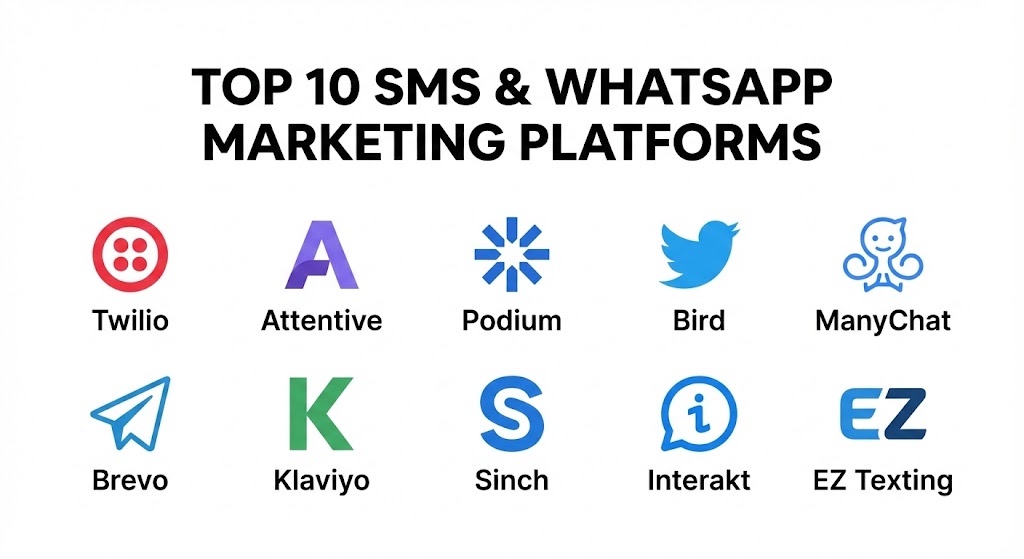
Top 10 SMS & WhatsApp Marketing Platforms Tools
1 — Twilio (Segment & Programmable Messaging)
Twilio is the titan of the communications industry, providing the backbone for many other tools on this list. It is an API-first platform designed for developers and enterprises that need to build custom, highly scalable messaging workflows.
- Key features:
- Programmable Messaging API: Send and receive SMS, MMS, and WhatsApp messages globally.
- Conversations API: Build multi-party conversations across different channels in a single thread.
- Twilio Segment Integration: Link messaging directly to a Customer Data Platform (CDP) for hyper-personalization.
- Lookups API: Verify phone numbers and carrier information to reduce bounce rates.
- Messaging Services: Automated handling of opt-outs, link shortening, and alpha-sender IDs.
- Global Reach: Connectivity in over 180 countries with local number provisioning.
- Pros:
- Virtually unlimited scalability; if you can code it, Twilio can send it.
- Pay-as-you-go pricing model is highly cost-effective for high-volume senders.
- Cons:
- Extremely high technical barrier; requires developer resources to set up and manage.
- Lacks a “user-friendly” visual campaign builder for non-technical marketers out of the box.
- Security & compliance: SOC 2 Type II, ISO 27001, HIPAA (for specific products), GDPR, and CCPA compliant. Offers robust SSO and audit logs.
- Support & community: Extensive developer documentation, a massive GitHub presence, and 24/7 technical support for enterprise tiers.
2 — Attentive
Attentive has quickly become the gold standard for e-commerce SMS marketing. It is a “full-service” platform designed specifically to drive revenue for retail brands through high-performance automated text campaigns.
- Key features:
- Growth Tools: High-converting sign-up units for mobile and desktop to grow subscriber lists.
- Two-Way Journeys: Automated conversational flows that respond to user inputs.
- Concierge: A human-in-the-loop service where Attentive agents handle customer replies.
- Deep E-commerce Integrations: Native connections with Shopify, BigCommerce, and Magento.
- Advanced Segmentation: Target users based on browse behavior, purchase history, and intent.
- Analytics & Attribution: Detailed reporting on “Last Click” and “View-Through” revenue.
- Pros:
- The most intuitive interface for e-commerce marketing managers.
- Exceptional at driving rapid list growth through legal, compliant opt-in methods.
- Cons:
- Pricing is premium and typically involves a base fee plus a percentage of attributed revenue.
- Focuses primarily on SMS, with WhatsApp features still evolving in certain markets.
- Security & compliance: SOC 2 Type II, GDPR, and TCPA compliant. Features automated opt-out processing and audit trails.
- Support & community: Dedicated client success managers, professional onboarding, and a rich library of retail strategy guides.
3 — Podium
Podium is designed for local businesses that want to bridge the gap between digital marketing and physical services. It unifies SMS marketing with reputation management and payments.
- Key features:
- Inbox: A unified dashboard for SMS, Facebook Messenger, and Google Business Messages.
- Reviews: Automate text requests for Google and Yelp reviews after a service is completed.
- Payments: Send text-to-pay links to collect payments instantly via mobile.
- Campaigns: Simple SMS marketing tools for local promotions and updates.
- Webchat: Convert website visitors into text conversations that continue on their phones.
- Integrations: Connects with local business software like ServiceTitan or Dentrix.
- Pros:
- The best tool for local businesses (HVAC, Medical, Auto) to manage their entire customer lifecycle.
- High engagement rates due to the “local” feel of the messaging.
- Cons:
- Can be expensive for very small “mom and pop” shops.
- Not designed for high-volume, international e-commerce bulk blasting.
- Security & compliance: SOC 2, PCI DSS (for payments), and GDPR compliant.
- Support & community: Strong onboarding program, local business webinars, and 24/7 phone/chat support.
4 — Bird (formerly MessageBird)
Bird is a global omnichannel platform that excels at WhatsApp Business integration. It is built for businesses that want a single platform to handle SMS, WhatsApp, Email, and Voice.
- Key features:
- Flow Builder: A visual, no-code automation builder for complex customer journeys.
- WhatsApp Business API: Official partner status ensures reliable, high-speed WhatsApp delivery.
- Omnichannel Widget: A single chat bubble for websites supporting multiple messaging apps.
- Inbox: A shared team inbox for managing customer support across all channels.
- Verified SMS: Branded SMS sender IDs to increase trust and open rates.
- Campaign Builder: Intuitive interface for sending bulk newsletters via SMS or WhatsApp.
- Pros:
- One of the best interfaces for managing the specific requirements of the WhatsApp Business API.
- Powerful automation that is accessible to non-developers.
- Cons:
- Pricing can be complex as it varies by channel and region.
- Large-scale enterprise features can feel a bit fragmented.
- Security & compliance: ISO 27001, GDPR, and SOC 2 compliant. Offers data residency options in the EU.
- Support & community: Global support teams, developer-friendly documentation, and an extensive integration marketplace.
5 — ManyChat
ManyChat is the leading “Chat Marketing” platform for small to medium businesses. While it started with Facebook Messenger, it has become a powerhouse for WhatsApp and SMS automation.
- Key features:
- Visual Flow Builder: Drag-and-drop interface to build automated chat sequences.
- WhatsApp Automation: Auto-replies, keyword triggers, and broadcasting for WhatsApp.
- SMS Integration: Combine SMS with social messaging for multi-touch campaigns.
- Lead Capture: Automated bot sequences to qualify leads and book appointments.
- Dynamic Content: Personalize messages based on user data collected within the chat.
- Templates: A massive library of pre-built “flows” for various industries.
- Pros:
- Extremely affordable for startups and small businesses.
- The best visual builder for creating “choose your own adventure” style chat bots.
- Cons:
- Primarily designed for smaller-scale operations; can struggle with massive enterprise data needs.
- WhatsApp pricing is subject to Meta’s conversation-based fee structure.
- Security & compliance: GDPR and CCPA compliant. Operates under standard Meta platform security guidelines.
- Support & community: Massive Facebook community group, “ManyChat University,” and extensive YouTube tutorials.
6 — Brevo (formerly Sendinblue)
Brevo is a versatile marketing suite that offers a strong SMS and WhatsApp marketing module alongside its famous email services. It is ideal for businesses that want an “all-in-one” platform.
- Key features:
- Multi-Channel Campaigns: Send email, SMS, and WhatsApp messages from a single campaign.
- WhatsApp Campaigns: Easy-to-use editor for WhatsApp newsletters and templates.
- Transactional SMS: Reliable infrastructure for password resets and order alerts.
- CRM: Built-in tool to manage contact lists and interaction history.
- Marketing Automation: Use triggers from email behavior to send an SMS or WhatsApp.
- Landing Pages: Build pages to capture phone numbers and opt-ins.
- Pros:
- Excellent “per-message” pricing that doesn’t penalize you for having a large contact list.
- The most integrated solution for those who want their messaging and email to “talk” to each other.
- Cons:
- WhatsApp features are slightly less mature than specialized tools like ManyChat.
- The UI can occasionally feel slow when managing very large databases.
- Security & compliance: ISO 27001, SOC 2, and GDPR compliant. High-tier data protection for EU customers.
- Support & community: Multilingual support, extensive blog/guides, and a reliable ticketing system.
7 — Klaviyo
Klaviyo is a data-driven powerhouse for e-commerce. While famous for email, its integrated SMS and nascent WhatsApp capabilities allow for hyper-segmented mobile marketing.
- Key features:
- Unified Profiles: See every email click and text reply in a single customer timeline.
- Predictive Analytics: Use AI to predict when a customer will next buy and target them with an SMS.
- SMS-Specific Flows: Abandoned cart and price drop alerts via text.
- Compliance by Design: Automated tools to manage quiet hours and regional SMS laws.
- Two-Way Messaging: Real-time chat interface to answer customer questions.
- Smart Sending: Prevents users from being “over-messaged” across different channels.
- Pros:
- The strongest data engine; use any purchase data point to trigger a mobile message.
- One-click integration with Shopify that pulls in years of historical data.
- Cons:
- SMS pricing is significantly higher than standalone API tools.
- WhatsApp features are still in the early rollout phase for many markets.
- Security & compliance: SOC 2 Type II, GDPR, and TCPA compliant. Robust encryption and audit logs.
- Support & community: Large partner ecosystem (agencies), “Klaviyo Academy,” and active user forums.
8 — Sinch
Sinch is an enterprise-grade global communications platform. It is designed for large-scale operations that require high-throughput and deep technical customization for global messaging.
- Key features:
- Global SMS API: One of the most reliable networks for international message termination.
- WhatsApp Business Platform: High-tier enterprise support for Meta’s messaging API.
- Rich Communication Services (RCS): Capability for the “next generation” of interactive SMS.
- Verification API: Specialized tools for 2FA and secure user authentication.
- Campaign Manager: An enterprise-level web interface for non-technical users.
- Customer Service Accelerator: Pre-built tools for WhatsApp-based customer support.
- Pros:
- Unrivaled for multinational corporations that need to send millions of messages across different continents.
- Very strong technical support and SLAs for business-critical messaging.
- Cons:
- The interface and sales process are geared toward large contracts rather than small self-service users.
- Implementation can be complex without an internal IT team.
- Security & compliance: ISO 27001, SOC 2, HIPAA, and GDPR compliant. Military-grade data security.
- Support & community: Enterprise account managers, 24/7 global support, and professional services consulting.
9 — ManyChat (Focus: WhatsApp Specificity)
Note: Due to its industry dominance in separate categories, it is often evaluated twice—once for social bots and once for WhatsApp API commerce.
- Key features:
- Shopify-WhatsApp Sync: Send cart reminders directly through WhatsApp.
- Keyword Triggers: Automatically start a sales flow when a customer texts a specific word.
- Live Chat: Hand off a bot conversation to a human agent seamlessly.
- Broadcasting: Send bulk updates to WhatsApp subscribers (within Meta’s guidelines).
- Payment Integration: Collect payments via Stripe or PayPal directly in a WhatsApp chat.
- Pros:
- The most “fun” and engaging way to build a mobile shopping experience.
- Very high ROI for influencer-led and social-first brands.
- Cons:
- Limited analytics compared to the heavy data tools like Klaviyo.
- Security & compliance: Varies by integration / GDPR compliant.
- Support & community: Active community and extensive documentation.
10 — Interakt
Interakt is a specialized platform built specifically for the WhatsApp Business API. It is tailored for e-commerce brands on Shopify that want to turn WhatsApp into their primary sales channel.
- Key features:
- WhatsApp Shared Inbox: Collaborative inbox for teams to manage customer queries.
- Bulk Notifications: Send automated alerts for abandoned carts, shipping, and feedback.
- WhatsApp Catalog: Display and sell products directly within the WhatsApp interface.
- Automated Replies: Set up out-of-office or FAQ responses.
- Campaign Analytics: Track delivered, read, and replied rates for WhatsApp broadcasts.
- Shopify App Integration: Deep sync with orders and customer data.
- Pros:
- Extremely focused; if you only care about WhatsApp, this is the most streamlined tool.
- Very competitive pricing for the features offered.
- Cons:
- No SMS capabilities; you would need a separate tool for traditional texting.
- Limited to the WhatsApp ecosystem.
- Security & compliance: GDPR compliant and SOC 2 Type II.
- Support & community: Fast email support, YouTube tutorials, and dedicated onboarding for Shopify stores.
Comparison Table
| Tool Name | Best For | Platform(s) Supported | Standout Feature | Rating (Gartner/G2) |
| Twilio | Developers/Scale | SMS, WhatsApp, API | Unrivaled Global API | 4.6 / 5 |
| Attentive | E-commerce SMS | SMS (Global) | Sign-up Growth Tools | 4.8 / 5 |
| Podium | Local Businesses | SMS, Reviews, Pay | Text-to-Pay & Reviews | 4.5 / 5 |
| Bird | Omnichannel API | SMS, WhatsApp, Voice | Visual Flow Builder | 4.3 / 5 |
| ManyChat | Small Business/Bots | WhatsApp, SMS, Social | Visual Chatbot Editor | 4.7 / 5 |
| Brevo | All-in-one Marketing | SMS, WhatsApp, Email | Unified CRM & Messaging | 4.4 / 5 |
| Klaviyo | Data-driven Retail | SMS, Email, WhatsApp | Predictive Data Flows | 4.7 / 5 |
| Sinch | Global Enterprise | SMS, WhatsApp, RCS | Carrier-grade Network | 4.2 / 5 |
| Interakt | WhatsApp Commerce | Integrated Catalog | 4.6 / 5 | |
| EZ Texting | Simple SMS | SMS (US/Canada) | Ease of Use | 4.4 / 5 |
Evaluation & Scoring of SMS & WhatsApp Marketing Platforms
Selecting the right platform is a strategic decision that affects customer trust and conversion rates. We have evaluated these tools using a weighted scoring rubric to ensure a balanced perspective.
| Criteria | Weight | Evaluation Rationale |
| Core Features | 25% | Automation, broadcast ability, two-way chat, and bot builders. |
| Ease of Use | 15% | Intuitiveness of the campaign builder and technical setup requirements. |
| Integrations | 15% | Connectivity with Shopify, Salesforce, and other primary CRMs. |
| Security & Compliance | 10% | TCPA/GDPR adherence and data encryption standards. |
| Performance | 10% | Deliverability rates, API latency, and uptime reliability. |
| Support & Community | 10% | Quality of documentation and availability of technical help. |
| Price / Value | 15% | Message costs vs. platform fees and ROI potential. |
To calculate a final score, the following formula can be applied:
$$Score = \sum (Rating_{i} \times Weight_{i})$$
Where $i$ represents each category above.
Which SMS & WhatsApp Marketing Platforms Tool Is Right for You?
Solo Users vs SMB vs Mid-market vs Enterprise
If you are a solo user or a small influencer, ManyChat is the best starting point due to its low cost and visual ease. SMBs with a physical location will find Podium indispensable for managing reviews and payments. Mid-market e-commerce companies should look at Attentive or Klaviyo to leverage their customer data. Global Enterprises requiring high throughput and complex API integration must consider Twilio or Sinch.
Budget-conscious vs Premium Solutions
For those on a tight budget, Brevo offers the best “pay-as-you-go” value without high monthly platform fees. If you are looking for a Premium solution that acts as a partner in your growth, Attentive provides the highest level of strategic support and list-building tools, though at a higher cost.
Feature Depth vs Ease of Use
If you need Feature Depth (custom apps, 2FA, global carrier routing), Twilio is the winner. If you prioritize Ease of Use so that a marketing intern can launch a campaign in 10 minutes, EZ Texting or ManyChat are far more appropriate.
Integration and Scalability Needs
If your business lives on Shopify, the integration depth of Klaviyo and Interakt is a major advantage. If you are planning to scale to millions of messages per month across 50 countries, the global infrastructure of Sinch or Twilio is a requirement for reliability.
Frequently Asked Questions (FAQs)
1. Is SMS marketing better than email marketing?
It isn’t “better,” but it is different. SMS has much higher open rates (98% vs 20%), but email allows for longer, more detailed content. Most successful brands use them together: email for newsletters and SMS for time-sensitive alerts.
2. What is the difference between SMS and WhatsApp marketing?
SMS is a carrier-based protocol that works on every mobile phone without an internet connection. WhatsApp requires the app and internet but allows for rich media, longer messages, and interactive buttons for free (subject to Meta’s API fees).
3. Do I need permission to send marketing texts?
Yes, absolutely. Regulations like the TCPA (US) and GDPR (EU) require “express written consent.” You cannot simply buy a list of numbers; users must opt-in via a keyword, web form, or checkout checkbox.
4. What is a “Short Code” vs a “Long Code”?
A Short Code (e.g., 555-55) is a 5 or 6 digit number designed for high-volume marketing. A Long Code (e.g., a standard 10-digit number) is better for one-on-one customer support conversations.
5. How much does SMS marketing cost?
Pricing typically includes a monthly platform fee ($0–$500+) plus a per-message fee (usually $0.01–$0.05 per SMS). WhatsApp pricing is based on “conversations” (24-hour windows) rather than individual messages.
6. Can I send images through SMS?
Yes, this is called MMS (Multimedia Messaging Service). It allows for images, GIFs, and short videos, though it usually costs 2-3 times more than a standard text-only SMS.
7. Is WhatsApp marketing legal in the US?
Yes, but it must comply with Meta’s strict policies and regional data privacy laws. You must use the official WhatsApp Business API rather than a personal phone to send business messages.
8. What is a “WhatsApp Catalog”?
It is a feature within the WhatsApp Business API that allows you to upload your products so customers can browse and buy without leaving the chat app.
9. How do I prevent people from marking my texts as spam?
Provide immediate value, don’t message too frequently (1-2 times a week max), and always include a clear “STOP to opt-out” message in your first communication.
10. What are “Quiet Hours”?
Quiet hours are periods (usually 9 PM to 8 AM) when it is legally restricted or ethically frowned upon to send marketing texts. Most professional platforms automate this to ensure you don’t wake up your customers.
Conclusion
Messaging marketing has evolved from a simple notification tool into a full-scale commerce engine. Choosing the right SMS & WhatsApp marketing platform is about finding the balance between technical capability and ease of use.
For the developer-led enterprise, Twilio remains the foundational choice. For the growth-obsessed e-commerce brand, Attentive and Klaviyo provide the data-driven edge needed to win. For the local business, Podium turns every text into a potential review or payment. Ultimately, the best platform is the one that allows you to treat your customers’ phone numbers with the respect and relevance that such a personal channel deserves.