Introduction
A Digital Experience Platform (DXP) is more than just a content management system; it is a holistic solution that combines content management, marketing automation, e-commerce, and analytics into a single architectural framework. By unifying these disparate tools, a DXP allows businesses to speak with a consistent voice across every digital screen. It captures data at every touchpoint to build a 360-degree view of the customer, enabling deep personalization that was previously impossible.
The importance of a DXP lies in its ability to foster long-term customer loyalty through relevance. Key real-world use cases include omnichannel retail (where a cart started on mobile is updated on desktop), personalized banking portals that offer specific financial advice based on spending habits, and integrated patient portals in healthcare. When evaluating a DXP, users should prioritize API-first architecture, scalability, AI-driven personalization, and low-code development capabilities.
Best for: Large enterprises, multi-national corporations, and high-growth mid-market companies in sectors like Retail, Finance, Healthcare, and Travel. It is ideal for Chief Marketing Officers (CMOs) and Chief Technology Officers (CTOs) who need to harmonize global digital operations.
Not ideal for: Small businesses, solo entrepreneurs, or companies with a single, static web presence. For these users, a traditional CMS or a simple website builder like WordPress or Wix would be far more cost-effective and easier to manage.
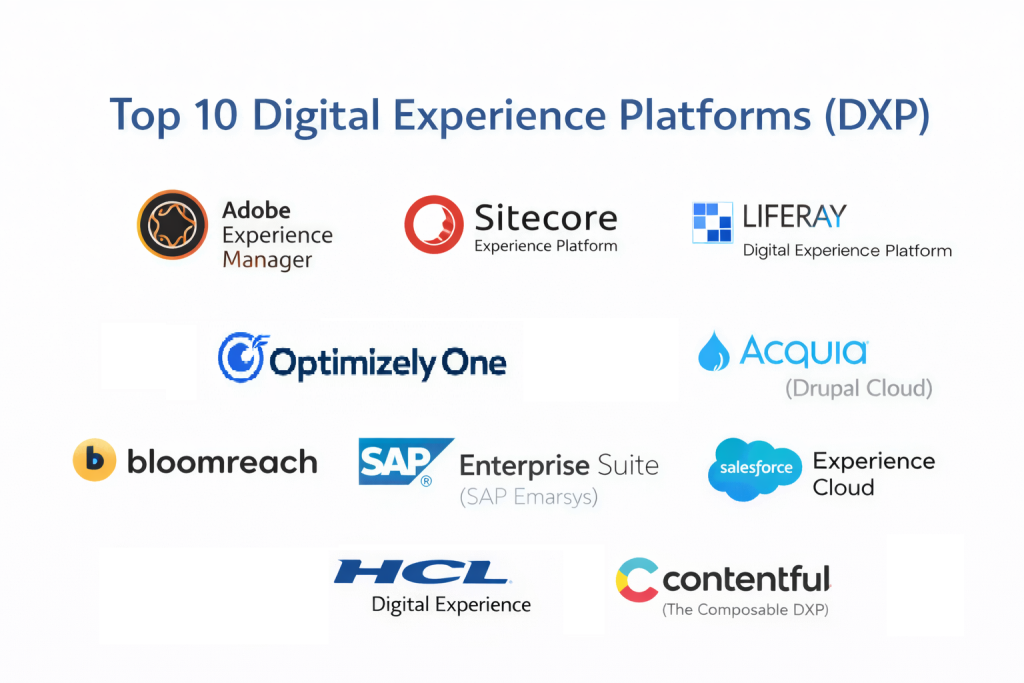
Top 10 Digital Experience Platforms (DXP) Tools
1 — Adobe Experience Manager (AEM)
Adobe Experience Manager is widely considered the industry benchmark for high-end DXPs. It is a comprehensive solution that combines digital asset management with a powerful content delivery system, favored by Fortune 500 companies.
- Key features:
- Cloud-Native Architecture: Offers automatic scaling and high availability.
- Adobe Sensei AI: Automates content tagging, cropping, and personalized delivery.
- Fluid Experiences: Allows for headless content delivery to apps and IoT devices.
- Integrated DAM: A world-class Digital Asset Management system for high-res media.
- Multi-site Manager: Centralized control over hundreds of localized global sites.
- In-context Editing: A visual, drag-and-drop interface for marketers.
- Pros:
- Unmatched integration with the Adobe Creative Cloud and Analytics suite.
- Extremely powerful for managing complex, global brand assets.
- Cons:
- One of the most expensive solutions on the market.
- Requires specialized, high-cost developers and consultants for implementation.
- Security & compliance: SSO, 256-bit encryption, SOC 2, HIPAA, GDPR, and ISO 27001 compliant.
- Support & community: 24/7 global enterprise support, dedicated account managers, and a massive community of certified experts.
2 — Sitecore Experience Platform
Sitecore is a leader in data-driven personalization. It is designed for organizations that want to use deep customer insights to drive 1:1 marketing at scale.
- Key features:
- Sitecore XP: Core platform for content, personalization, and marketing automation.
- Experience Edge: Headless delivery for high-performance Jamstack architectures.
- Cortex AI: Machine learning that identifies trends and automates segmentation.
- Experience Database (xDB): Collects and connects real-time customer data.
- Omnichannel Automation: Consistent messaging across social, email, and web.
- Sitecore Send: Integrated email marketing and automation.
- Pros:
- Superior 1:1 personalization capabilities compared to almost any rival.
- Strongest data analytics for understanding the “path to purchase.”
- Cons:
- Historically complex to upgrade; moving to the cloud-native version requires effort.
- Significant total cost of ownership (TCO) including licensing and hosting.
- Security & compliance: ISO 27001, SOC 2, HIPAA, and GDPR compliant.
- Support & community: Extensive developer network, annual “Symposium” events, and robust documentation.
3 — Liferay Digital Experience Platform
Liferay is a flexible, open-source-based DXP that excels in building complex portals, intranets, and B2B customer experiences. It is favored by technical teams for its modularity.
- Key features:
- Modular Architecture: Build exactly what you need using OSGi modules.
- Low-Code Tools: Objects and App Builder for rapid internal tool development.
- B2B Commerce: Specifically designed for complex B2B buying cycles.
- Segment-Based Personalization: Deliver different content based on user roles.
- Search & Indexing: Advanced Elasticsearch integration for massive data sets.
- Self-Service Portals: Best-in-class tools for customer support and partner sites.
- Pros:
- More cost-effective than Adobe or Sitecore for many enterprises.
- Exceptional for authenticated user experiences (portals and intranets).
- Cons:
- The interface for marketers is not as “slick” as consumer-focused DXPs.
- Requires a strong internal Java development team.
- Security & compliance: SSO, audit logs, GDPR, HIPAA, and SOC 2 compliant.
- Support & community: Active open-source community plus professional Hyland/Liferay enterprise support.
4 — Optimizely One
Optimizely (formerly Episerver) has transformed into a “Content Graph” powered DXP. It is built on a foundation of experimentation and A/B testing, making it a favorite for conversion-focused teams.
- Key features:
- Visual Editor: High-quality drag-and-drop editing for non-technical staff.
- Integrated Experimentation: Built-in A/B testing at the core of the CMS.
- Content Graph: A multi-tenant, GraphQL-based content delivery network.
- Product Recommendations: AI-driven commerce suggestions.
- Collaboration Suite: Tools for managing the entire marketing creative workflow.
- Fully Managed Cloud: Leverages Microsoft Azure for extreme reliability.
- Pros:
- Best-in-class experimentation and optimization tools out of the box.
- Faster “time to value” than most enterprise DXPs.
- Cons:
- Integration with non-Azure ecosystems can occasionally be complex.
- Some features require separate modules that can add up in cost.
- Security & compliance: SOC 2 Type II, ISO 27001, GDPR, and HIPAA compliant.
- Support & community: Dedicated customer success, active user groups, and extensive online training.
5 — Acquia (Drupal Cloud)
Acquia is built on the open-source Drupal CMS. It provides an enterprise-grade cloud environment for Drupal, adding a suite of marketing and data tools to create a full DXP.
- Key features:
- Acquia Cloud: High-performance, secure hosting for Drupal applications.
- Site Studio: Low-code, visual site builder for Drupal.
- Customer Data Platform (CDP): Real-time data unification for personalization.
- Personalization Engine: Uses “Lift” to target content based on behavior.
- DAM Integration: Built-in Widen DAM for asset management.
- Campaign Factory: Tools for managing hundreds of Drupal sites at once.
- Pros:
- Leverages the power and security of the Drupal open-source community.
- Avoids the “vendor lock-in” of proprietary platforms.
- Cons:
- Drupal has a steep learning curve for developers.
- Can be resource-heavy for smaller, less complex projects.
- Security & compliance: FedRAMP, HIPAA, SOC 2, and GDPR compliant.
- Support & community: 24/7 technical support and access to the massive Drupal developer base.
6 — Bloomreach
Bloomreach is a “Commerce Experience Cloud.” It is highly specialized for retail and e-commerce companies that need to connect content to products with AI precision.
- Key features:
- Discovery (AI Search): Sophisticated search and merchandising algorithms.
- Content (Headless CMS): API-first content delivery for fast frontends.
- Engagement (CDP & Email): Real-time marketing automation.
- Personalized Merchandising: Automatically adjusts product ranking for users.
- SEO Automation: Built-in tools for maintaining high search rankings.
- Multi-language Support: Global commerce capabilities.
- Pros:
- The absolute best DXP for retail-specific ROI and search optimization.
- Modern, headless-first approach is perfect for “composable” tech stacks.
- Cons:
- Less effective for non-commerce use cases (like corporate intranets).
- Can be complex to integrate with legacy, on-premise ERP systems.
- Security & compliance: ISO 27001, SOC 2, and GDPR compliant.
- Support & community: Expert onboarding, professional services, and a focused retail community.
7 — SAP Enterprise Suite (SAP Emarsys)
SAP’s DXP offering is deeply embedded in its massive ERP ecosystem. It is designed for businesses that want to bridge the gap between back-office operations and front-office customer experience.
- Key features:
- SAP Commerce Cloud: Enterprise-grade e-commerce for B2B and B2C.
- Emarsys Customer Engagement: Sophisticated marketing automation.
- SAP Customer Data Cloud: Manages identity, consent, and profile data.
- ERP Integration: Direct links to SAP S/4HANA for inventory and pricing.
- Spartacus Frontend: A headless, Angular-based storefront.
- Pros:
- Unrivaled for companies already running their business on SAP ERP.
- Strongest B2B capabilities for complex supply chain and pricing logic.
- Cons:
- Very high complexity; requires a specialized SAP-certified workforce.
- Can feel less “agile” than newer, cloud-native startups.
- Security & compliance: ISO, SOC 1/2/3, GDPR, and HIPAA compliant.
- Support & community: Global SAP support infrastructure and massive partner ecosystem.
8 — Salesforce Experience Cloud
Salesforce Experience Cloud allows companies to build beautiful, branded portals and communities that are directly connected to their CRM data.
- Key features:
- Lightning Bolt: Pre-built industry solutions for rapid deployment.
- Direct CRM Integration: Real-time access to Leads, Opportunities, and Cases.
- Einstein AI: Predictive content and community recommendations.
- Mobile Publisher: Turn your digital experience into a native mobile app.
- Knowledge Base: Integrated self-service help centers.
- Personalized Profiles: Custom views based on Salesforce user records.
- Pros:
- The best choice for organizations where CRM data is the center of the business.
- Very easy to set up “Communities” for partners or customers.
- Cons:
- Not as strong for “brand storytelling” as Adobe or Optimizely.
- Licensing can become expensive as user counts in the community grow.
- Security & compliance: FedRAMP, HIPAA, SOC 2, and GDPR compliant.
- Support & community: Trailhead training, massive community forums, and global support.
9 — HCL Digital Experience
HCL (formerly IBM WebSphere Portal) is an industrial-strength DXP built for the highest levels of security and uptime. It is often used by banks and government entities.
- Key features:
- Cloud-Native (Kubernetes): Can be deployed in any cloud or on-premise.
- HCL Leap: Low-code form and application builder.
- Digital Asset Management: Integrated media handling for large teams.
- Robust Security Layer: Designed for highly regulated industries.
- Multi-tenancy: Run multiple isolated sites on a single installation.
- Script Applications: Allows for flexible frontend development.
- Pros:
- Extreme reliability and security for mission-critical operations.
- Flexible deployment options (Hybrid, Private Cloud, On-Premise).
- Cons:
- The interface and developer experience feel more “legacy” than modern SaaS.
- Can be slow to implement and customize.
- Security & compliance: FIPS 140-2, SOC 2, HIPAA, and GDPR compliant.
- Support & community: Professional HCL support and a loyal base of enterprise customers.
10 — Contentful (The Composable DXP)
Contentful is often labeled as a “headless CMS,” but in 2025, it serves as the core of a “Composable DXP.” It allows teams to build a custom DXP by picking the best tools for each function.
- Key features:
- API-First Architecture: Delivers content to any device via REST or GraphQL.
- App Framework: Deep integrations with BigCommerce, Algolia, and Marketo.
- Content Modeling: Highly flexible data structures defined by the user.
- Compose & Launch: Tools for marketers to build pages in a headless world.
- Workflows: Custom approval chains for content governance.
- Pros:
- The most agile and modern approach to building a digital experience.
- Developers love the “DX” (Developer Experience) and documentation.
- Cons:
- You have to “build” the DXP by integrating other tools; it’s not all-in-one.
- Requires a very modern, frontend-savvy development team.
- Security & compliance: ISO 27001, SOC 2 Type II, GDPR, and HIPAA compliant.
- Support & community: Active Discord, extensive training, and enterprise-grade SLAs.
Comparison Table
| Tool Name | Best For | Platform(s) Supported | Standout Feature | Rating (Gartner) |
| Adobe AEM | Global Brands | Cloud / Hybrid | Adobe Sensei AI | 4.6 / 5 |
| Sitecore | 1:1 Personalization | Cloud (Azure) | Experience Database | 4.4 / 5 |
| Liferay | Portals & B2B | Cloud / On-Prem | Modular Open Source | 4.5 / 5 |
| Optimizely | Conversion/Testing | Cloud (Azure) | Visual Experimentation | 4.5 / 5 |
| Acquia | Drupal Enthusiasts | Cloud (AWS) | Site Studio Builder | 4.3 / 5 |
| Bloomreach | E-commerce | Cloud (SaaS) | AI Search/Discovery | 4.6 / 5 |
| SAP Suite | SAP Enterprises | Cloud / Hybrid | Back-office Integration | 4.1 / 5 |
| Salesforce | CRM-led Teams | Cloud (SaaS) | CRM Connection | 4.4 / 5 |
| HCL DX | High Regulation | Cloud / On-Prem | Security & Stability | 4.2 / 5 |
| Contentful | Composable Stack | Cloud (SaaS) | API-First Agility | 4.7 / 5 |
Evaluation & Scoring of Digital Experience Platforms (DXP)
To help you objectively compare these giants, we have evaluated them against a weighted scoring rubric. This reflects the reality of 2025: features are important, but the ability to integrate and the ease of use for marketing teams often determine the success of the investment.
| Criteria | Weight | Evaluation Rationale |
| Core Features | 25% | Multi-channel delivery, DAM, and personalization depth. |
| Ease of Use | 15% | Marketer-friendly UI and low-code capabilities. |
| Integrations | 15% | API quality and breadth of the pre-built marketplace. |
| Security & Compliance | 10% | Industry certifications and encryption standards. |
| Performance | 10% | Speed of delivery (CDN) and system uptime. |
| Support & Community | 10% | Training quality, documentation, and user forums. |
| Price / Value | 15% | Licensing cost vs. ROI and total cost of ownership. |
Which Digital Experience Platforms (DXP) Tool Is Right for You?
Solo Users vs SMB vs Mid-Market vs Enterprise
If you are a solo user or a small business, you should avoid DXPs. They are too complex and expensive. For mid-market companies, Optimizely or Contentful offer the best path to growth without the enterprise bloat. Enterprises with global footprints should choose Adobe AEM, Sitecore, or SAP based on their existing infrastructure.
Budget-Conscious vs Premium Solutions
If budget is a concern, Liferay or Acquia (Drupal) provide the most “bang for your buck” due to their open-source roots. If you are looking for a Premium solution where the software does the heavy lifting of AI and data management, Adobe and Sitecore are the leaders.
Feature Depth vs Ease of Use
If you need extreme feature depth (e.g., managing a global supply chain within your DXP), SAP or Liferay are the choices. If you want ease of use for your marketing team to launch campaigns in hours, Optimizely or Salesforce will be much more popular with your internal users.
Frequently Asked Questions (FAQs)
1. What is the difference between a CMS and a DXP?
A CMS focuses primarily on managing content for a website. A DXP is an evolution that integrates content, commerce, data analytics, and marketing automation to manage the entire customer journey across all channels.
2. Is a DXP worth the high cost?
For large organizations, yes. It eliminates “data silos” and reduces the time spent managing multiple disconnected tools, often paying for itself through increased customer conversion and lower IT maintenance.
3. How long does it take to implement a DXP?
Typically, 6 to 18 months. Unlike a simple website, a DXP requires data migration, integration with other business systems, and training for multiple departments.
4. Can a DXP work with my existing tools?
Yes. Modern DXPs like Contentful and Bloomreach are designed to be “composable,” meaning they can connect to your existing CRM, ERP, or analytics tools via APIs.
5. Do I need a developer to run a DXP?
While DXPs offer “low-code” tools for marketers, you will absolutely need a development team for the initial setup, integrations, and high-level customizations.
6. Which DXP is best for SEO?
Optimizely and Bloomreach have particularly strong reputations for SEO due to their focus on page performance, site structure automation, and fast delivery speeds.
7. Is a DXP secure?
Yes. Enterprise DXPs are built to satisfy the security requirements of global banks and government agencies, offering high-level encryption and SSO.
8. What is a “Headless” DXP?
A headless DXP delivers content through an API without a fixed frontend. This allows developers to use any technology (like React or Vue) to display content on any device.
9. Why is Adobe AEM so expensive?
You are paying for a massive ecosystem. AEM integrates every part of the marketing process—from creative design in Photoshop to deep data analytics—into one workflow.
10. Can I build a DXP myself?
Technically, yes. This is called a “Composable DXP.” You pick a headless CMS, an e-commerce engine, and an analytics tool and connect them yourself. Contentful is the best starting point for this.
Conclusion
The “best” Digital Experience Platform in 2025 is not the one with the most features; it is the one that your team will actually use to drive customer engagement. For the global powerhouse that requires absolute control and AI automation, Adobe Experience Manager remains the gold standard. For those who prioritize data-driven personalization and testing, Sitecore and Optimizely are the clear winners.
Choosing a DXP is a long-term commitment that defines your digital strategy for the next decade. Before committing, perform a deep audit of your current “tech stack” and your team’s skills. The right tool should feel like a bridge to your customers, not a barrier for your employees.