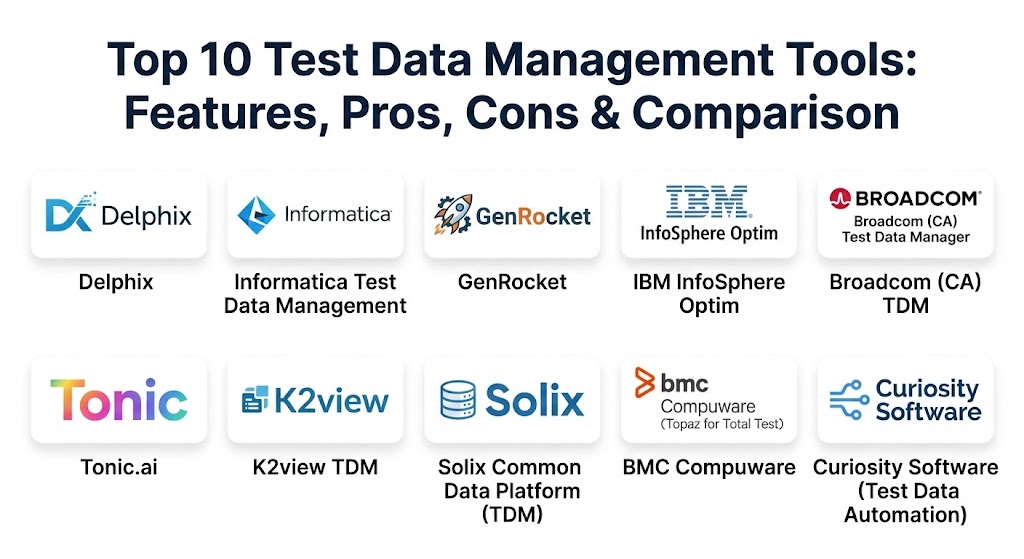
Introduction
Test Data Management (TDM) is the process of planning, creating, protecting, and provisioning non-production data for software testing. Instead of simply copying a production database (which is risky and often too large), TDM tools allow organizations to create high-fidelity, smaller “subsets” of data, mask sensitive information to protect privacy, and even generate entirely synthetic data that looks and behaves like the real thing. By automating these workflows, TDM tools ensure that testing teams have exactly what they need, when they need it, without compromising security.
The importance of TDM lies in its ability to provide “quality data at speed.” Key real-world use cases include protecting personally identifiable information (PII) during offshore testing, creating specific edge-case scenarios that don’t exist in production, and reducing storage costs by eliminating duplicate multi-terabyte test environments. When evaluating these tools, you should look for masking speed, self-service provisioning, synthetic data capabilities, and integration with CI/CD pipelines. In 2026, the focus has shifted heavily toward “Synthetic TDM,” where data is generated using AI models to bypass privacy concerns entirely.
Best for: Large enterprises in highly regulated industries (Finance, Healthcare, Government), DevOps teams looking to automate their pipelines, and organizations managing complex, multi-layered data architectures.
Not ideal for: Very small startups with simple applications that do not handle sensitive user data, or teams where the test data is public information and does not require masking or complex subsetting.
Top 10 Test Data Management Tools
1 — Delphix (by Perforce)
Delphix is often considered the pioneer of “Data Virtualization.” It treats data like code, allowing teams to “branch,” “snapshot,” and “bookmark” databases. It is designed for large-scale enterprises that need to provision massive environments in minutes rather than days.
- Key features:
- Data Virtualization: Provision full-size virtual copies of databases with minimal storage overhead.
- Self-Service: Developers can refresh or rewind their own data via a simple UI or API.
- Integrated Masking: Automatically identify and mask PII across virtual copies.
- Data Versioning: Bookmark data at a specific point in time to reproduce bugs easily.
- Ecosystem Support: Works with Oracle, SQL Server, SAP, and modern cloud databases.
- API-First Design: Full automation for CI/CD integration.
- Pros:
- Drastic reduction in storage costs due to virtualization technology.
- Empowers developers to be self-sufficient, removing the “DBA bottleneck.”
- Cons:
- Higher initial setup complexity and cost compared to lightweight tools.
- Requires a significant mindset shift in how infrastructure is managed.
- Security & compliance: SOC 2 Type II, GDPR, HIPAA, and PCI DSS compliant. Features robust encryption and role-based access control (RBAC).
- Support & community: High-quality enterprise support with 24/7 availability; extensive technical documentation and a mature user community.
2 — Informatica Test Data Management
Informatica is a heavyweight in the data world, and its TDM suite is a powerhouse for enterprise-grade data masking and subsetting. It is particularly strong for organizations that are already using the Informatica PowerCenter ecosystem.
- Key features:
- Sensitive Data Discovery: AI-powered scanning to find PII in unexpected places.
- Persistent Masking: High-speed masking for large-scale data warehouses.
- Complex Subsetting: Create small, referentially intact slices of data.
- Data Generation: Rules-based creation of synthetic data for new features.
- Cloud-Native Integration: Strong support for Azure, AWS, and Snowflake.
- Workflow Orchestration: Integrated approvals and data request management.
- Pros:
- Exceptional at handling massive, heterogeneous data environments.
- The most robust data discovery engine in the market.
- Cons:
- Can feel “heavy” and traditional to teams born in the cloud.
- Licensing can be expensive and complex.
- Security & compliance: ISO 27001, SOC 2, HIPAA, and GDPR. Advanced audit logging for compliance verification.
- Support & community: World-class enterprise support; vast network of certified consultants and training resources.
3 — GenRocket
GenRocket takes a different approach by focusing almost entirely on Synthetic Data Generation. Instead of starting with production data, GenRocket uses a “component-based” approach to generate any data scenario you can imagine from scratch.
- Key features:
- Model-Based Generation: Define data structures and relationships as reusable components.
- Speed: Capable of generating millions of rows of data in seconds.
- Dynamic Data: Generate data based on real-time test execution requirements.
- Condition-Based Logic: Easily create edge cases (e.g., users with specific credit scores).
- Low Cost: Since no production data is used, storage and privacy risks are minimized.
- Self-Service Portal: Simple interface for testers to request specific data sets.
- Pros:
- Completely eliminates privacy risks because no real data is ever touched.
- Ideal for “shifting left” where testing happens before production data even exists.
- Cons:
- Requires a “design-first” approach that may be a hurdle for teams used to cloning DBs.
- Less effective for testing complex “dirty” data patterns found in 20-year-old legacy systems.
- Security & compliance: GDPR and HIPAA compliant by default (as data is synthetic). Support for SSO and encrypted transmission.
- Support & community: Very responsive support team; excellent video tutorials and a focused knowledge base.
4 — IBM InfoSphere Optim
IBM Optim is a veteran in the TDM space, known for its rock-solid stability and its ability to handle both modern databases and legacy mainframes. It is a favorite for banks and insurance companies.
- Key features:
- Subsetting & Archive: Move data across tiers while maintaining referential integrity.
- Data Privacy: Sophisticated masking algorithms including shuffling and encryption.
- Mainframe Support: Exceptional handling of DB2 on z/OS and other legacy formats.
- Compliance Reporting: Out-of-the-box reports for GDPR and PCI audits.
- Heterogeneous Support: Manage data across Oracle, Sybase, Informix, and SQL Server.
- Pros:
- Unmatched reliability for mission-critical, high-compliance environments.
- One of the few tools that handles legacy systems as well as it handles modern ones.
- Cons:
- The user interface can feel dated compared to newer SaaS rivals.
- Implementation typically requires specialized IBM consulting.
- Security & compliance: FIPS 140-2, Common Criteria, GDPR, and HIPAA.
- Support & community: Backed by IBM’s global enterprise support infrastructure and a massive base of certified professionals.
5 — Broadcom (CA) Test Data Manager
Formerly CA Test Data Manager, this tool is part of the Broadcom Agile operations suite. It is highly valued for its ability to integrate TDM directly into the requirements and testing phase using a model-based approach.
- Key features:
- Visual Flow Designer: Create data generation logic using a graphical interface.
- Data Reservation: Allow testers to “check out” data so no two people use the same record.
- Synthetic Data Creation: Comprehensive rules engine for data synthesis.
- In-Flight Masking: Mask data as it moves between environments.
- Self-Service Catalog: A “shopping cart” experience for test data.
- Pros:
- Excellent integration with Agile management tools like Rally.
- Strong “data reservation” features prevent test collisions in shared environments.
- Cons:
- Can be complex to configure for multi-layered microservices.
- Resource-intensive installation and management.
- Security & compliance: SOC 2, GDPR, HIPAA, and PCI DSS.
- Support & community: Dedicated enterprise support; strong presence in large-scale corporate IT departments.
6 — Tonic.ai
Tonic.ai is the modern, developer-friendly challenger in the TDM space. It focuses on Structural Data Mimicking, creating a synthetic version of your production database that maintains all its statistical properties.
- Key features:
- Smart De-identification: Automatically maps production relationships to synthetic output.
- Consistency: Ensures that “User A” in the database always looks like “User A” across all tables.
- Subset & Filter: Quickly generate a 1% or 10% slice of a database.
- Snapshotting: Integrate with cloud-native workflows for rapid environment teardowns.
- Support for Modern Stacks: Built for Postgres, MySQL, Snowflake, and BigQuery.
- Pros:
- The best UI in the category; feels like a modern SaaS product.
- Very fast time-to-value; often up and running in a single day.
- Cons:
- Less focus on legacy mainframe systems compared to IBM or Broadcom.
- Synthetic mimicking can sometimes struggle with extremely high-cardinality custom fields.
- Security & compliance: SOC 2 Type II, HIPAA, and GDPR compliant. Local or cloud hosting options.
- Support & community: High-touch customer success; active Slack community and clear documentation.
7 — K2view TDM
K2view takes a unique “Entity-Based” approach. Instead of managing tables, it manages “Business Entities” (like a Customer, a Credit Card, or a Policy). This makes it much easier to move and mask data for specific test cases.
- Key features:
- Micro-Database Architecture: Every entity is stored in its own virtual micro-DB.
- Real-Time Provisioning: Pull and mask data on-demand in seconds.
- Entity-Based Masking: Ensure a customer’s data is consistent across 50 different systems.
- Synthetic Entity Generation: Create brand new customers based on entity rules.
- Cross-System Integrity: Guarantees that data remains synced across disparate apps.
- Pros:
- Solves the “referential integrity” nightmare for massive, siloed organizations.
- Very fast provisioning speeds compared to traditional ETL-based TDM.
- Cons:
- Requires a different architectural approach that can be a learning curve.
- Most effective when managing the entire data fabric, not just a single DB.
- Security & compliance: SOC 2, HIPAA, GDPR, and ISO 27001.
- Support & community: Professional enterprise support with a focus on large-scale digital transformation.
8 — Solix Common Data Platform (TDM)
Solix is known for its data-tiering and archiving, but its TDM module is a robust choice for companies that want a unified platform for archiving, privacy, and testing.
- Key features:
- Discovery & Classification: Automatically tag sensitive data across the entire enterprise.
- Persistent & Dynamic Masking: Mask data at rest or on-the-fly.
- Enterprise Subsetting: Rules-based slicing for complex ERP systems (SAP, Oracle EBS).
- Self-Service Portal: Role-based access for testers and developers.
- Cloud & On-Prem Support: Flexible deployment for hybrid environments.
- Pros:
- Great “all-in-one” value for companies looking to solve data archiving and TDM together.
- Particularly strong support for enterprise applications like SAP.
- Cons:
- Feature set for synthetic generation is not as deep as GenRocket.
- The interface is more functional than beautiful.
- Security & compliance: GDPR, HIPAA, PCI, and SOC 2.
- Support & community: Global support network; extensive experience in large-scale data management projects.
9 — BMC Compuware (Topaz for Total Test)
For organizations where the Mainframe is still the heart of the business, BMC Compuware is the gold standard. It focuses on making mainframe testing feel like modern DevOps testing.
- Key features:
- Data Privacy for z/OS: High-performance masking for DB2, IMS, and VSAM.
- Visual Data Editor: Edit mainframe data files without needing specialized green-screen skills.
- Automated Data Provisioning: Integrate mainframe data into modern CI/CD pipelines.
- Data Extraction & Subsetting: Create manageable slices of massive mainframe files.
- Integration with Topaz: Part of a broader suite for modernizing mainframe development.
- Pros:
- Unrivaled expertise in mainframe data structures.
- Bridging the gap between legacy systems and modern DevOps teams.
- Cons:
- Limited relevance if your organization does not use a mainframe.
- Premium pricing reflecting its niche, high-value specialty.
- Security & compliance: FIPS compliant, GDPR, and HIPAA.
- Support & community: Top-tier enterprise support; decades of institutional knowledge in mainframe systems.
10 — Curiosity Software (Test Data Automation)
Curiosity focuses on “Model-Based Testing.” Their TDM tool is designed to generate data specifically to satisfy the requirements of a visual flow model of the software’s behavior.
- Key features:
- Model-to-Data: Automatically generate data based on a flowchart of the app’s logic.
- In-Sprint TDM: Create data for features that are still being built.
- Integration with Open Source: Works seamlessly with JMeter, Selenium, and Playwright.
- Visual Subsetting: Select and move data using a graphical interface.
- Data Comparison: Identify shifts in data structures between releases.
- Pros:
- The best choice for teams using Model-Based Testing (MBT) methodologies.
- Ensures 100% data coverage for every possible logical path in a test.
- Cons:
- Requires a high degree of maturity in test modeling to get the most value.
- Can be “over-engineering” for simple testing teams.
- Security & compliance: GDPR and HIPAA compliant. Supports SSO and audit logs.
- Support & community: Highly technical support; great webinars and academic resources on testing theory.
Comparison Table
| Tool Name | Best For | Platform(s) Supported | Standout Feature | Rating (Gartner) |
| Delphix | Hybrid Cloud Scale | Multi-Cloud, On-Prem | Data Virtualization | 4.7 / 5 |
| Informatica | Huge Enterprise | Cloud, On-Prem | AI Data Discovery | 4.6 / 5 |
| GenRocket | Synthetic Generation | SaaS, Win, Lin, Mac | Component-Based Synthesis | 4.8 / 5 |
| IBM Optim | Legacy + Modern | Mainframe, Multi-DB | Mainframe Subsetting | 4.4 / 5 |
| Broadcom TDM | Agile Teams | Win, Lin, Cloud | Data Reservation | 4.5 / 5 |
| Tonic.ai | Developers & SaaS | SaaS, K8s, Cloud | Database Mimicking | 4.8 / 5 |
| K2view | Data Fabric / Silos | Cloud, On-Prem | Entity-Based Micro-DBs | 4.6 / 5 |
| Solix CDP | ERP & Archiving | Cloud, On-Prem | Integrated CDP Suite | 4.3 / 5 |
| BMC Compuware | Mainframe Devs | z/OS Mainframe | Green-Screen to DevOps | 4.4 / 5 |
| Curiosity | Model-Based Testing | Win, Lin, Cloud | Visual Logic to Data | 4.5 / 5 |
Evaluation & Scoring of Test Data Management Tools
Choosing a TDM tool is a long-term commitment. To help you decide, we’ve evaluated these tools against a standardized rubric that reflects the priorities of 2026 IT leaders.
| Category | Weight | Evaluation Criteria |
| Core Features | 25% | Masking, Subsetting, Synthetic Generation, and Virtualization depth. |
| Ease of Use | 15% | UI intuitiveness, self-service capabilities, and learning curve. |
| Integrations | 15% | CI/CD support, API availability, and database connector range. |
| Security & Compliance | 10% | Discovery of PII, encryption, audit trails, and certifications. |
| Performance | 10% | Time to provision environments and masking throughput. |
| Support & Community | 10% | Documentation, enterprise SLAs, and user forum activity. |
| Price / Value | 15% | TCO vs. reduction in storage, bug remediation, and time-to-market. |
Which Test Data Management Tools Tool Is Right for You?
The “best” tool is the one that fits your current technical debt and future cloud goals.
- Solo Users vs SMBs: Honestly, most solo users don’t need these. For SMBs, Tonic.ai or GenRocket are the winners because they offer quick setup and lower infrastructure overhead.
- Budget-Conscious vs Premium: GenRocket offers high value because it generates data rather than moving it (lowering storage costs). Delphix and Informatica are premium solutions but pay for themselves in massive enterprise environments.
- Feature Depth vs Ease of Use: If you need the deepest possible legacy features, go with IBM or Broadcom. If you want a tool that your developers will actually enjoy using without a 6-month training course, Tonic.ai is the clear choice.
- Integration and Scalability Needs: If you are a DevOps-first shop, look for tools with robust APIs like Delphix or Curiosity Software. They integrate into your Jenkins or GitHub Actions pipelines seamlessly.
- Security and Compliance Requirements: If your primary concern is an upcoming GDPR or HIPAA audit, Informatica‘s AI-powered data discovery is the best insurance policy against “hidden” PII that you didn’t know existed.
Frequently Asked Questions (FAQs)
1. Why shouldn’t I just use a copy of production data for testing?
Privacy and security are the main reasons. Copying production data often exposes sensitive information to testers who don’t have security clearance. Additionally, production databases are often too large to be efficiently used in every test environment.
2. What is the difference between Data Masking and Data Synthesis?
Data masking takes real data and changes it (e.g., replacing “John Doe” with “Michael Smith”). Data synthesis generates entirely new data from scratch using mathematical rules or AI models.
3. Does TDM really speed up software releases?
Yes. By allowing developers to provision their own data via self-service, you eliminate the “wait time” for DBAs. Some companies report reducing environment setup from weeks to minutes.
4. What is “Referential Integrity” in TDM?
This ensures that if you subset a customer, you also get their orders, addresses, and history across all tables. If this isn’t maintained, the application will crash during testing.
5. How does TDM help with storage costs?
Tools like Delphix use data virtualization to share blocks of data between environments. This allows you to have 10 test environments that only take up slightly more space than one production database.
6. Can TDM tools handle NoSQL databases?
Most modern tools like Tonic.ai and GenRocket support NoSQL (MongoDB, Cassandra). Older legacy tools may require specialized connectors or have limited support.
7. Is synthetic data as good as real data for testing?
For 90% of cases, yes. However, for complex performance testing or troubleshooting specific “real-world” data corruption, a masked version of real data is often still superior.
8. What is “Data Reservation”?
In shared test environments, two testers might try to use the same record. Data reservation “locks” a record to a specific tester so their tests don’t interfere with each other.
9. How do I start a TDM project?
Start with Data Discovery. You can’t manage what you don’t know exists. Find where your sensitive data lives first, then choose a tool for masking and subsetting.
10. Is TDM expensive?
Enterprise licenses can be high, but the ROI comes from avoided data breach fines, reduced cloud storage bills, and faster developer productivity.
Conclusion
Test Data Management is the silent engine of the modern DevOps factory. In 2026, the shift is clearly moving away from “copying data” toward “generating data.” If you are a modern, cloud-native team, Tonic.ai and GenRocket represent the future of agile data. If you are a global enterprise managing decades of data across mainframes and clouds, Delphix and Informatica remain the standard-bearers.
Choosing the right tool is about balancing the need for speed with the absolute requirement for privacy. By investing in TDM, you aren’t just buying software; you are buying the ability to test with confidence, release with speed, and sleep soundly knowing your customers’ data is safe.