Introduction
A service mesh is a dedicated infrastructure layer built directly into an application’s network. It is designed to handle service-to-service communication, ensuring that the “handshakes” between different microservices are fast, reliable, and secure. Traditionally, developers had to bake logic for retries, encryption, and monitoring directly into each service’s code. A service mesh abstracts this complexity, moving it into a “sidecar” proxy or directly into the kernel, allowing developers to focus purely on business logic.
The importance of a service mesh lies in its ability to provide three pillars: Observability (seeing who is talking to whom), Security (encrypting all traffic by default), and Traffic Management (controlling the flow of data). Real-world use cases include zero-trust networking in healthcare, canary deployments in e-commerce to test new features without crashing the site, and deep performance tracing in high-frequency trading.
When choosing a platform, organizations must evaluate latency overhead, ease of installation, multi-cloud capabilities, and whether the tool requires a “sidecar” proxy or uses more modern “sidecar-less” architectures like eBPF.
Best for: Large-scale enterprises with complex microservice architectures, DevOps teams requiring high visibility into network traffic, and organizations in highly regulated sectors (finance, healthcare, government) that need mandated zero-trust security.
Not ideal for: Startups with a handful of services or monolith applications. If your application fits on a single server or a small cluster, the operational complexity of a service mesh will likely outweigh its benefits.
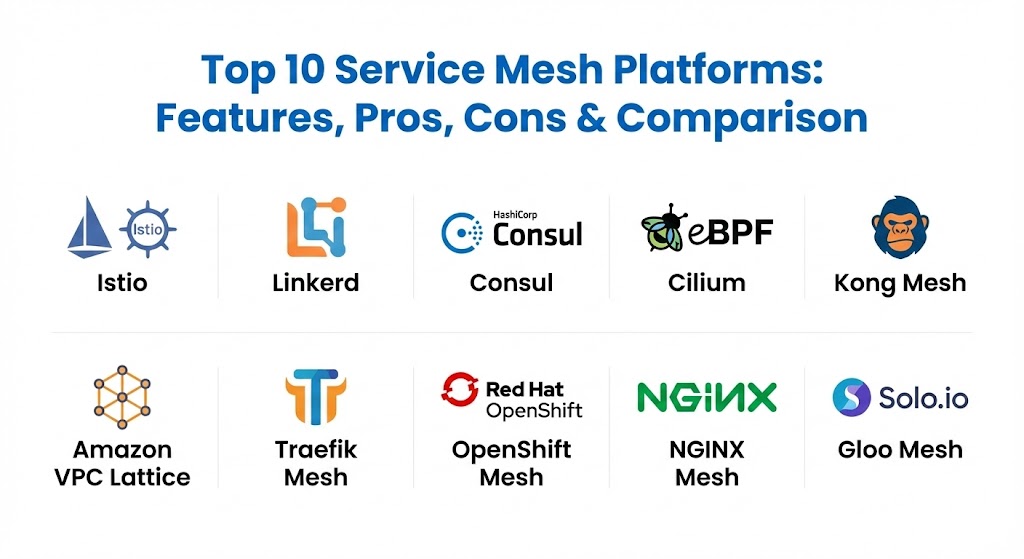
Top 10 Service Mesh Platforms
1 — Istio
Istio is the industry-standard service mesh, originally developed by Google, IBM, and Lyft. It is the most feature-complete and widely adopted platform in the market, now acting as a graduated CNCF project that defines the “standard” for what a mesh should be.
- Key features:
- Ambient Mode: A new sidecar-less data plane that reduces resource consumption and simplifies operations.
- Advanced Traffic Steering: Support for canary rollouts, A/B testing, and weighted load balancing.
- Zero-Trust Security: Automated Mutual TLS (mTLS) and fine-grained authorization policies.
- Deep Observability: Native integration with Prometheus, Grafana, and Jaeger.
- Multi-Cluster Mesh: Seamlessly connects services across different Kubernetes clusters and clouds.
- Gateway API Support: Standardized ingress and egress management.
- Pros:
- Unparalleled feature set that can handle virtually any complex networking requirement.
- Massive community support and a huge ecosystem of third-party plugins.
- Cons:
- High learning curve; the configuration can be overwhelming for beginners.
- Historically high resource overhead (though significantly improved by Ambient Mode).
- Security & compliance: FIPS 140-2, SOC 2, HIPAA, GDPR, and ISO 27001.
- Support & community: Extensive documentation, global community forums, and professional support available from vendors like Solo.io and F5.
2 — Linkerd
Linkerd is frequently hailed as the “lightest and fastest” service mesh. It focuses on simplicity and performance, avoiding the “feature bloat” that sometimes plagues larger platforms. Written in Rust, it is designed for security from the ground up.
- Key features:
- Rust-Based Data Plane: Optimized for low latency and memory safety.
- Zero-Config mTLS: Automatic encryption for all on-cluster traffic out of the box.
- Service Profiles: Per-service traffic metrics and retries.
- Multi-Cluster Communication: Securely connects services across different clusters.
- Traffic Splitting: Supports canary deployments and blue-green rollouts.
- Tap Tool: Real-time inspection of service-to-service traffic.
- Pros:
- Incredibly easy to install and manage; often described as “service mesh without the mess.”
- Consistently outperforms Istio in latency and resource consumption benchmarks.
- Cons:
- Lacks some of the ultra-advanced traffic management features found in Istio.
- Primarily focused on Kubernetes; limited support for legacy VM environments.
- Security & compliance: mTLS by default, audit logs, and GDPR compliant.
- Support & community: Very active Slack community and commercial support via Buoyant.
3 — Consul (by HashiCorp)
Consul is a multi-cloud service networking platform that excels in hybrid environments where services run on a mix of Kubernetes, virtual machines (VMs), and bare metal.
- Key features:
- Universal Service Discovery: Works across any runtime or cloud provider.
- Identity-Based Security: mTLS and intentions-based access control.
- Multi-Datacenter Federation: Connects globally distributed services with ease.
- API Gateway: Built-in ingress and traffic management capabilities.
- Health Checking: Automated monitoring of service and node health.
- Key-Value Store: Centralized configuration management.
- Pros:
- Best-in-class for hybrid-cloud and cross-platform (K8s + VM) environments.
- Deeply integrates with the broader HashiCorp ecosystem (Terraform, Vault).
- Cons:
- Management of the Consul servers themselves adds operational overhead.
- The UI and configuration can be complex for those unfamiliar with HashiCorp tools.
- Security & compliance: FIPS support, SOC 2, HIPAA, and GDPR.
- Support & community: Excellent documentation and premium 24/7 support plans from HashiCorp.
4 — Cilium Service Mesh
Cilium has revolutionized the networking space by using eBPF (Extended Berkeley Packet Filter) technology. It offers a “sidecar-free” service mesh that operates directly in the Linux kernel, providing massive performance gains.
- Key features:
- Sidecar-Less Architecture: Eliminates the need for Envoy sidecars for many L4 and L7 functions.
- eBPF Data Path: High-performance, low-latency networking and security.
- Identity-Aware Policy: Security based on workload identity rather than IP addresses.
- Advanced Load Balancing: Direct DSR (Direct Server Return) and Maglev support.
- Transparent mTLS: Encrypts traffic without changing application code.
- Hubble: Specialized observability platform for flow logs and metrics.
- Pros:
- Significantly lower latency than proxy-based meshes like Istio or Linkerd.
- Simplifies pod lifecycle management by removing sidecar injection requirements.
- Cons:
- Requires a modern Linux kernel, which may be an issue for older on-prem systems.
- The feature set is still evolving compared to the “legacy” sidecar meshes.
- Security & compliance: SOC 2, GDPR, and ISO 27001.
- Support & community: Fast-growing community and enterprise support from Isovalent (Cisco).
5 — Kong Mesh
Kong Mesh is an enterprise-grade service mesh built on top of the Kuma open-source project. It is designed for simplicity and scalability, particularly for organizations already using the Kong API Gateway.
- Key features:
- Universal Data Plane: Native support for both Kubernetes and Virtual Machines.
- Multi-Zone Connectivity: Global service connectivity with automated synchronization.
- Policy-Driven Security: Over 30 out-of-the-box policies for mTLS, circuit breaking, and more.
- Centralized Control Plane: Manage multiple meshes from a single interface.
- Zero-Trust Identity: Automated certificate management and rotation.
- Custom Tags: Granular selection of traffic behavior using metadata.
- Pros:
- Exceptional multi-zone and multi-cloud capabilities.
- Very low operational complexity compared to Istio.
- Cons:
- Best features are locked behind the enterprise license.
- Smaller community compared to Istio or Linkerd.
- Security & compliance: FIPS 140-2, SOC 2 Type II, and GDPR.
- Support & community: Enterprise support with 24/7 availability from Kong Inc.
6 — Amazon VPC Lattice (Formerly AWS App Mesh)
While AWS App Mesh is being deprecated in late 2026, Amazon VPC Lattice has taken its place. It is a fully managed service that provides a consistent way to connect, secure, and monitor all your services across AWS.
- Key features:
- Managed Control Plane: No servers to manage or upgrade.
- Cross-VPC/Cross-Account Connectivity: Simplifies complex networking in large AWS estates.
- IAM Integration: Uses native AWS IAM for service-to-service authentication.
- Protocol Support: Full support for HTTP, HTTPS, and gRPC.
- Automatic Load Balancing: Integrated with AWS Application Load Balancers.
- Observability: Native exports to CloudWatch and X-Ray.
- Pros:
- Zero management overhead; AWS handles the scaling and availability of the mesh.
- Deeply integrated with the AWS ecosystem (ECS, EKS, Lambda).
- Cons:
- Proprietary to AWS; creates vendor lock-in for multi-cloud strategies.
- Limited customization compared to open-source Envoy-based meshes.
- Security & compliance: FedRAMP, HIPAA, SOC 1/2/3, and PCI DSS.
- Support & community: Comprehensive AWS documentation and global premium support.
7 — Traefik Mesh
Traefik Mesh is a lightweight, non-invasive service mesh that focuses on being easy to configure. It is designed for teams that want “just enough” mesh without the overhead.
- Key features:
- SMI Compliance: Built on the Service Mesh Interface (SMI) standard.
- Non-Invasive Architecture: Doesn’t require sidecar injection or complex pod modifications.
- Simple Configuration: Uses labels and annotations for traffic rules.
- TCP/HTTP Support: Handles both raw TCP and application-level traffic.
- Pre-installed Metrics: Ships with Prometheus and Grafana dashboards.
- Circuit Breakers: Simple protection against cascading failures.
- Pros:
- Incredibly fast time-to-value; can be up and running in minutes.
- Works seamlessly with the popular Traefik Proxy.
- Cons:
- Lacks the advanced security and mTLS depth of Istio or Linkerd.
- Not suitable for massive, hyper-scale environments.
- Security & compliance: TLS support and GDPR compliant.
- Support & community: Strong community forums and professional support via Traefik Labs.
8 — OpenShift Service Mesh
Red Hat OpenShift Service Mesh is an enterprise distribution of Istio, Kiali, and Jaeger, fully integrated into the OpenShift platform.
- Key features:
- Kiali Integration: Native topology visualizer to see your mesh in real-time.
- Operator-Based Management: Automated installation, updates, and scaling.
- Hardened Security: Pre-configured for enterprise compliance out of the box.
- Integrated Tracing: Built-in Jaeger for distributed tracing.
- Federated Mesh: Connects OpenShift clusters across different data centers.
- Maistra: Based on the community Maistra project for easier management.
- Pros:
- The best choice for organizations already running on Red Hat OpenShift.
- Simplifies the complex Istio installation and lifecycle management.
- Cons:
- Requires Red Hat OpenShift; not available for vanilla Kubernetes.
- Updates can lag slightly behind the absolute latest upstream Istio versions.
- Security & compliance: FIPS 140-2, SOC 2, HIPAA, and GDPR.
- Support & community: World-class 24/7 enterprise support provided by Red Hat.
9 — NGINX Service Mesh
NGINX Service Mesh is a lightweight, high-performance mesh that uses the familiar NGINX Plus data plane as its sidecar proxy.
- Key features:
- NGINX Plus Data Plane: Leverages the world’s most trusted web server.
- Non-Invasive mTLS: Automatic identity issuance and certificate rotation.
- Traffic Shaping: Fine-grained control over rate limiting and QoS.
- Native Ingress Integration: Works perfectly with NGINX Ingress Controller.
- Unified Dashboard: Visual monitoring of service health and performance.
- API-Driven: Fully manageable via RESTful APIs.
- Pros:
- Ideal for teams already comfortable with NGINX configuration and performance.
- Very light on resource usage compared to other Envoy-based meshes.
- Cons:
- Some advanced features require the paid NGINX Plus subscription.
- Smaller feature set than Istio or Linkerd.
- Security & compliance: mTLS, ACLs, and GDPR compliant.
- Support & community: Professional support provided by F5/NGINX.
10 — Gloo Mesh (by Solo.io)
Gloo Mesh is a specialized management plane designed to manage enterprise Istio across multiple clusters, regions, and clouds from a single point of control.
- Key features:
- Centralized Istio Management: A single control plane for all your Istio installations.
- Global Traffic Management: Automated failover and load balancing across clusters.
- Unified Security Policy: Enforce mTLS and RBAC globally with one click.
- Multi-Tenancy: Isolation between teams and environments within the mesh.
- Self-Service Portals: Allows developers to manage their own traffic rules.
- FIPS-Compliant Istio: Includes hardened, enterprise-ready Istio builds.
- Pros:
- The “gold standard” for managing Istio at massive enterprise scale.
- Reduces the complexity of multi-cluster operations significantly.
- Cons:
- Requires Istio; it is a management layer rather than a standalone mesh.
- High cost associated with enterprise-grade multi-cluster management.
- Security & compliance: FIPS 140-2, SOC 2, HIPAA, and ISO 27001.
- Support & community: Industry-leading expertise and white-glove support from the Solo.io team.
Comparison Table
| Tool Name | Best For | Platform(s) Supported | Standout Feature | Rating (Gartner) |
| Istio | Full Complexity | K8s, VMs | Ambient Mode (Sidecar-less) | 4.7 / 5 |
| Linkerd | Speed & Simplicity | Kubernetes | Rust-Based Performance | 4.8 / 5 |
| Consul | Hybrid / Multi-Cloud | K8s, VMs, Bare Metal | Cross-Platform Sync | 4.5 / 5 |
| Cilium | Performance Leader | Linux / K8s | eBPF Sidecar-free | 4.8 / 5 |
| Kong Mesh | Universal Enterprise | K8s, VMs, Cloud | Multi-Zone Automation | 4.4 / 5 |
| VPC Lattice | AWS Environments | AWS Only | Managed Control Plane | 4.3 / 5 |
| Traefik Mesh | Fast Installation | Kubernetes | Non-invasive Labels | 4.2 / 5 |
| OpenShift Mesh | OpenShift Users | OpenShift Only | Integrated Topology View | 4.5 / 5 |
| NGINX Mesh | NGINX Ecosystem | Kubernetes | NGINX Plus Performance | 4.1 / 5 |
| Gloo Mesh | Multi-Cluster Istio | Multi-Cloud | Global Failover Automation | 4.7 / 5 |
Evaluation & Scoring of Service Mesh Platforms
To provide an objective comparison, we have evaluated these platforms using a weighted scoring rubric that reflects the priorities of a modern IT organization in 2026.
| Category | Weight | Evaluation Criteria |
| Core Features | 25% | Traffic steering, mTLS, observability, and service discovery depth. |
| Ease of Use | 15% | Installation complexity, UI quality, and configuration verbosity. |
| Integrations | 15% | Support for existing CI/CD, monitoring tools, and hybrid platforms. |
| Security | 10% | Certificate management, identity issuance, and compliance certifications. |
| Performance | 10% | Latency overhead (P99) and resource consumption per node. |
| Support | 10% | Documentation quality, community size, and enterprise support response. |
| Price / Value | 15% | Total cost of ownership vs. efficiency gains. |
Each platform is scored on a scale of 1-10. The final score is calculated using the following formula:
$$Final Score = \sum (Category Score \times Weight)$$
For example, a tool scoring 9/10 in Core Features would contribute $9 \times 0.25 = 2.25$ to its total score.
Which Service Mesh Platform Is Right for You?
Choosing a service mesh is a long-term architectural decision. Here is a practical guide to help you narrow down your search:
Solo Users vs SMB vs Mid-Market vs Enterprise
- Solo Users: You almost certainly do not need a service mesh. If you must have one for learning, start with Linkerd or Traefik Mesh.
- SMBs: Focus on ease of operation. Linkerd is the clear winner here for its low maintenance. If you are entirely on AWS, VPC Lattice is an excellent managed choice.
- Mid-Market: If you have a mix of K8s and older apps on VMs, Consul or Kong Mesh are your best options for universal connectivity.
- Enterprises: If you require the absolute maximum feature set and have the staff to manage it, Istio (managed via Gloo Mesh) is the standard. If you are a Red Hat shop, stick with OpenShift Service Mesh.
Budget-Conscious vs Premium Solutions
- Budget-Conscious: Linkerd and Cilium (open source) offer incredible value with minimal resource costs. NGINX Service Mesh is also a great “free” entry point for those using the open-source proxy.
- Premium: Istio and Kong Mesh offer massive power but often come with high licensing and compute costs.
Performance vs Ease of Use
- Performance: If latency is your primary concern (e.g., real-time finance), Cilium is the leader due to eBPF.
- Ease of Use: If you want a “one-click” experience, Traefik Mesh or Linkerd are significantly more intuitive than the alternatives.
Frequently Asked Questions (FAQs)
1. Does a service mesh slow down my application?
Yes, adding a service mesh introduces a small amount of latency (usually 1-5ms per hop) because traffic must pass through a proxy or a kernel hook. However, modern meshes like Cilium and Istio Ambient Mode have reduced this to almost negligible levels.
2. Is Istio too complicated for small teams?
Generally, yes. Istio is a powerful tool designed for hyper-scale. For smaller teams, Linkerd or Traefik Mesh provide 80% of the value with only 10% of the configuration headache.
3. What is the difference between an API Gateway and a Service Mesh?
An API Gateway handles “North-South” traffic (traffic coming from the outside internet into your cluster). A Service Mesh handles “East-West” traffic (communication between services already inside your cluster).
4. What is a “sidecar” proxy?
A sidecar is a small container that runs alongside your application container in the same pod. It intercepts all incoming and outgoing traffic to handle security and monitoring.
5. What is eBPF and why is it better?
eBPF allows the mesh to run directly in the Linux kernel rather than in a sidecar container. This reduces “jumps” between user space and kernel space, leading to significantly higher performance.
6. Can I run a service mesh on Virtual Machines?
Yes, platforms like Consul, Istio, and Kong Mesh have dedicated agents or proxies that can be installed on traditional Linux or Windows VMs.
7. Does a service mesh replace my monitoring tools?
No. A service mesh generates the data (metrics, logs, traces), but you still need tools like Prometheus, Grafana, or Datadog to store and visualize that data.
8. What is mTLS?
Mutual TLS ensures that both the sender and receiver of a message authenticate each other’s certificates. This prevents “man-in-the-middle” attacks and ensures only authorized services can talk.
9. Is Linkerd really faster than Istio?
In most independent benchmarks, yes. Linkerd’s proxies are written in Rust and are highly specialized for the mesh, whereas Istio’s Envoy proxies are written in C++ and are more general-purpose and heavier.
10. Do I need to change my application code to use a service mesh?
No. The core value of a service mesh is that it is transparent. You deploy it into the network layer, and it intercepts traffic without the application ever knowing it exists.
Conclusion
The “best” service mesh platform in 2026 is no longer a one-size-fits-all answer. If you are looking for the absolute cutting edge of performance and kernel-level integration, Cilium is the platform of the future. If you are looking for a reliable, well-documented industry standard that can do everything, Istio remains the king of the mountain.
When choosing, remember that the most common mistake is over-engineering. If your microservices are performing well and your security is manageable, don’t rush into a service mesh just for the sake of the technology. However, if you find yourself blind to network errors or struggling with manual encryption, one of these top 10 tools will transform your infrastructure from a chaotic web into a streamlined, high-performance engine.