Introduction
Service discovery is the process of automatically detecting devices and services on a computer network. In a microservices architecture, it acts as a centralized registry that maintains the network locations (IP addresses and ports) of all active service instances. When Service A needs to talk to Service B, it doesn’t need to know where Service B is physically located; it simply asks the service discovery tool, which provides the current, healthy endpoint.
The importance of these tools cannot be overstated for modern DevOps. They eliminate manual configuration, enable seamless auto-scaling, and provide the foundation for self-healing systems. Without automated discovery, every time a container restarts or a cloud instance scales, the entire network configuration would break. Key real-world use cases include dynamic load balancing, blue-green deployments, and zero-downtime migrations. When evaluating these tools, users should look for strong consistency models, robust health checking, ease of integration with orchestration platforms (like Kubernetes), and low latency in service updates.
Best for: Organizations adopting microservices, DevOps teams managing high-velocity container deployments, and enterprises moving toward hybrid or multi-cloud infrastructures where IP addresses are ephemeral.
Not ideal for: Small, static applications where the number of servers rarely changes, or monolithic systems where all components reside on a single, well-known host.
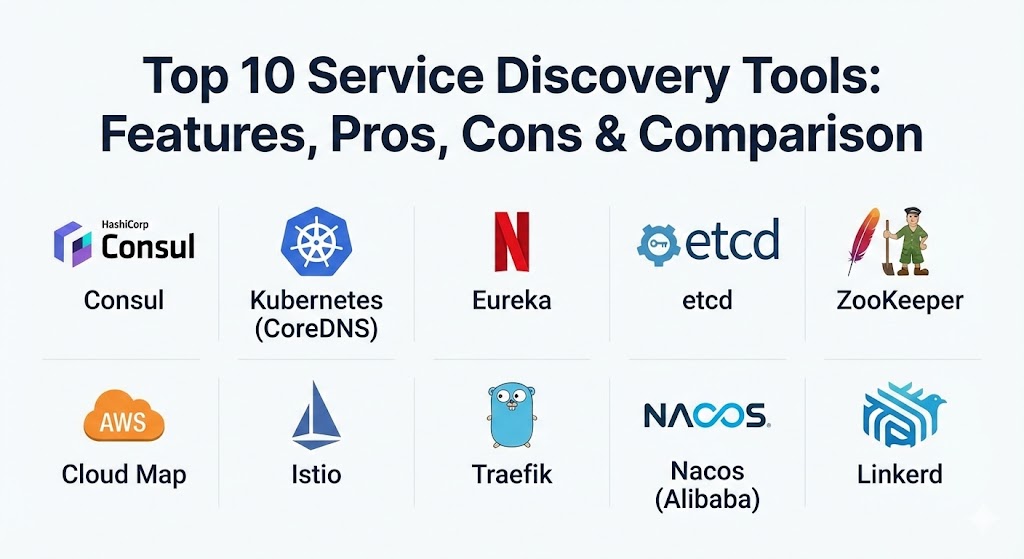
Top 10 Service Discovery Tools
1 — HashiCorp Consul
HashiCorp Consul is widely regarded as the industry standard for service discovery and service mesh. It is a multi-platform tool that provides a distributed, highly available, and data-center-aware solution for connecting and securing services.
- Key features:
- Automatic service registration and discovery via DNS or HTTP interfaces.
- Robust health checking that monitors nodes and individual services.
- Multi-datacenter support with native federation capabilities.
- Key-value store for dynamic configuration management.
- Service mesh functionality with mTLS for secure service-to-service communication.
- Intentions-based security policies for fine-grained access control.
- Pros:
- Extremely versatile; works on bare metal, VMs, and Kubernetes alike.
- The DNS interface allows legacy applications to use service discovery without code changes.
- Cons:
- Significant operational complexity; requires managing a “quorum” of servers.
- The learning curve for advanced features (like Intentions or Mesh) is steep.
- Security & compliance: Supports ACLs, TLS encryption for all traffic, mTLS, and integration with HashiCorp Vault. Compliant with SOC 2 and GDPR frameworks.
- Support & community: Massive community; extensive documentation and official enterprise support available through HashiCorp.
2 — Kubernetes (CoreDNS)
In a Kubernetes environment, service discovery is not just a tool—it is a native part of the platform. CoreDNS serves as the default cluster DNS, automatically creating records for every Service and Pod defined in the cluster.
- Key features:
- Native integration with the Kubernetes API for automatic record management.
- Plugin-based architecture that allows for highly customizable DNS logic.
- Support for SRV records to discover ports alongside IP addresses.
- Efficient caching to reduce the load on the Kubernetes API server.
- Health-aware routing based on Kubernetes Readiness and Liveness probes.
- Pros:
- Zero configuration required; it works out of the box for any K8s cluster.
- Highly performant and lightweight compared to standalone service discovery suites.
- Cons:
- Locked into the Kubernetes ecosystem; cannot easily manage non-K8s services.
- Limited as a general-purpose key-value store compared to Consul or etcd.
- Security & compliance: Relies on Kubernetes RBAC for access control. Supports DNSSEC for record integrity.
- Support & community: Part of the CNCF; supported by the global Kubernetes community and all major cloud providers (EKS, GKE, AKS).
3 — Netflix Eureka
Eureka is a REST-based service discovery tool developed by Netflix, primarily used in the Java ecosystem. It is designed for high availability and follows an “eventually consistent” model, which is ideal for large-scale cloud deployments.
- Key features:
- Client-side discovery where clients cache the registry for maximum resilience.
- “Self-preservation” mode that prevents accidental mass-deregistration during network glitches.
- Native integration with the Spring Cloud ecosystem.
- Peer-to-peer replication between Eureka server nodes.
- Metadata support for providing extra context about service instances.
- Pros:
- Highly resilient; even if the Eureka server goes down, clients can still find each other.
- Simple to set up for Java developers already using Spring Boot.
- Cons:
- Primarily focused on Java; support for other languages is cumbersome.
- Lacks built-in health checks that are as deep as Consul’s (relies on heartbeats).
- Security & compliance: Supports basic authentication and can be secured via Spring Security. Compliance varies by deployment.
- Support & community: Mature open-source community, though development has slowed in favor of more modern “mesh” alternatives.
4 — etcd
While technically a distributed key-value store, etcd is the backbone of Kubernetes service discovery. It is designed to store the most critical data of a distributed system and provides a “Watch” API for real-time updates.
- Key features:
- Strong consistency using the Raft consensus algorithm.
- “Watch” mechanism that notifies clients instantly when a service record changes.
- Lease-based TTL (Time-To-Live) for automatic expiration of dead service records.
- Simple gRPC-based API for high-performance interactions.
- Designed for high availability with automatic leader election.
- Pros:
- Rock-solid reliability; if etcd is up, your cluster state is safe.
- Lightweight and extremely fast for read operations.
- Cons:
- It is a “building block,” not a full service discovery solution (requires a frontend like CoreDNS).
- Can be sensitive to disk latency; requires high-performance SSDs for large clusters.
- Security & compliance: Supports SSL/TLS for client-to-server and peer-to-peer communication. RBAC for key-level access.
- Support & community: Highly active CNCF project with support from major tech giants like Google and Red Hat.
5 — Apache ZooKeeper
ZooKeeper is a veteran in the world of distributed systems. Originally part of the Hadoop project, it provides highly reliable coordination, naming, and configuration management.
- Key features:
- Hierarchical namespace (similar to a file system) for organizing service data.
- Ephemeral nodes that automatically disappear if a service instance disconnects.
- Watchers that allow clients to get notified of changes without polling.
- Strong consistency guarantees for critical coordination tasks.
- Broad support for legacy big-data applications (Kafka, Hadoop, HBase).
- Pros:
- Battle-tested over decades in the most demanding data environments.
- Excellent for complex leader election and distributed locking scenarios.
- Cons:
- Very heavy and resource-intensive; requires a significant JVM footprint.
- Operational complexity is high; maintaining a ZooKeeper “Ensemble” is a specialized task.
- Security & compliance: Supports Kerberos authentication and ACLs for fine-grained node security.
- Support & community: A top-level Apache project with a massive, albeit more traditional, enterprise community.
6 — AWS Cloud Map
For organizations heavily invested in Amazon Web Services, AWS Cloud Map offers a fully managed service discovery resource that spans across ECS, EKS, Lambda, and EC2.
- Key features:
- Unified registry for all AWS resources (containers, serverless, and instances).
- Support for both DNS-based and API-based discovery.
- Automated health checking with integration into Route 53.
- Ability to define custom attributes (metadata) for advanced filtering.
- Regional and cross-account discovery capabilities.
- Pros:
- Serverless and fully managed; no servers for you to patch or scale.
- Deeply integrated with the AWS ecosystem (IAM, CloudWatch, etc.).
- Cons:
- Extreme vendor lock-in; not suitable for multi-cloud or on-premise use.
- Costs can scale quickly if you have thousands of services with frequent health checks.
- Security & compliance: Integrated with AWS IAM for fine-grained permissions. HIPAA, SOC, and PCI DSS compliant.
- Support & community: Backed by AWS premium support and documentation; limited independent community compared to open-source tools.
7 — Istio (Service Registry)
Istio is much more than a discovery tool—it is a full-featured Service Mesh. It abstracts service discovery away from the application entirely, managing it at the platform layer via a “sidecar” proxy.
- Key features:
- Automatic service discovery across multiple Kubernetes clusters.
- Traffic management features like circuit breaking and retries.
- mTLS-by-default for all service-to-service communication.
- Sophisticated observability with built-in telemetry and tracing.
- Policy-based routing (e.g., send 10% of traffic to a “canary” version).
- Pros:
- Provides the most advanced security and traffic control features available.
- Developers don’t need to write any discovery logic in their code.
- Cons:
- Infamous for its complexity; requires significant overhead and expertise.
- Adds latency due to the “sidecar” proxies (Envoy) sitting in the data path.
- Security & compliance: Industry-leading security; provides zero-trust architecture features. FIPS 140-2 compliant.
- Support & community: Backed by Google, IBM, and Red Hat; very large and active community.
8 — Traefik
Traefik is a modern HTTP reverse proxy and load balancer that has built-in, “magic” service discovery. It is designed to listen to your orchestrator and configure itself automatically.
- Key features:
- Native auto-discovery for Docker, Swarm, Kubernetes, Marathon, and more.
- Real-time configuration updates without restarts.
- Built-in Let’s Encrypt support for automatic SSL/TLS.
- Dashboard for visualizing service health and traffic.
- Support for Middlewares (auth, rate-limiting, circuit breakers).
- Pros:
- “Set it and forget it” for Docker and Kubernetes users.
- Very user-friendly and visually oriented compared to command-line heavy tools.
- Cons:
- Primarily a “north-south” (edge) discovery tool; less optimized for “east-west” (internal) service mesh needs.
- Can become complex to manage when using hundreds of custom labels/annotations.
- Security & compliance: Supports modern TLS, forward-auth, and basic security headers.
- Support & community: Excellent documentation and an active forum; professional enterprise support available through Traefik Labs.
9 — Nacos (Alibaba)
Nacos (Naming and Configuration Service) is a prominent open-source project from Alibaba. It aims to provide a unified platform for both dynamic service discovery and configuration management.
- Key features:
- Supports both DNS and RPC-based service discovery.
- Real-time service health monitoring and dynamic routing.
- Dynamic configuration service with versioning and rollbacks.
- Highly scalable; used to power Alibaba’s massive “Double 11” shopping festival.
- Multi-language support (Java, Go, Python, C++, etc.).
- Pros:
- Excellent “all-in-one” tool that combines discovery and config (like Consul).
- Proven at an extreme scale that few other tools have reached.
- Cons:
- Documentation for non-Chinese speakers can sometimes be inconsistent.
- Smaller footprint in North American and European markets compared to HashiCorp.
- Security & compliance: Supports namespace-level isolation and role-based access control.
- Support & community: Very strong in Asia; growing global community under the Apache incubation umbrella.
10 — Linkerd
Linkerd is the “ultralight” alternative to Istio. It is a Kubernetes-native service mesh that provides service discovery, security, and observability with a focus on simplicity and performance.
- Key features:
- Zero-config service discovery for Kubernetes workloads.
- Automatic “Golden Metrics” (success rate, latency, throughput) for every service.
- Instant mTLS for all internal communication.
- Highly optimized Rust-based “micro-proxies” for minimal latency.
- Traffic splitting for canary deployments.
- Pros:
- Significantly easier to install and manage than Istio.
- Provides deep observability without the massive resource overhead of other meshes.
- Cons:
- Strictly focused on Kubernetes; cannot manage external services easily.
- Fewer “knobs and dials” for extreme traffic engineering compared to Istio.
- Security & compliance: SOC 2 compliant; focuses on “security-by-default” with automatic certificate rotation.
- Support & community: Extremely helpful and welcoming community; enterprise support provided by Buoyant.
Comparison Table
| Tool Name | Best For | Platform(s) Supported | Standout Feature | Rating (Gartner/TrueReview) |
| Consul | Hybrid/Multi-Cloud | Any (VM, K8s, Cloud) | Multi-Datacenter Federation | 4.6 / 5 |
| Kubernetes (CoreDNS) | K8s-Only Environments | Kubernetes | Zero-Config Native DNS | 4.7 / 5 |
| Netflix Eureka | Java Microservices | Java/Spring Boot | Client-Side Resiliency | 4.3 / 5 |
| etcd | Distributed State | Linux / Kubernetes | Strong Consistency (Raft) | 4.6 / 5 |
| ZooKeeper | Big Data Systems | Any (JVM based) | Distributed Coordination | 4.4 / 5 |
| AWS Cloud Map | AWS Native Stacks | AWS Ecosystem | Fully Managed Serverless | 4.4 / 5 |
| Istio | Zero-Trust Security | Kubernetes | Advanced Traffic Policy | 4.5 / 5 |
| Traefik | Edge / Docker | Docker, K8s, Cloud | Auto-Configuration Magic | 4.5 / 5 |
| Nacos | Unified Config & Discovery | Any (Multi-language) | Enterprise Scale Performance | 4.4 / 5 |
| Linkerd | Lightweight Mesh | Kubernetes | Performance-Focused mTLS | 4.6 / 5 |
Evaluation & Scoring of Service Discovery Tools
To help you decide which tool fits your stack, we’ve evaluated these solutions across seven critical categories.
| Category | Weight | Description |
| Core Features | 25% | Capacity for auto-registration, DNS/HTTP discovery, and key-value storage. |
| Ease of Use | 15% | Installation complexity, documentation quality, and dashboard availability. |
| Integrations | 15% | How well the tool talks to Docker, Kubernetes, and major cloud providers. |
| Security & Compliance | 10% | Support for mTLS, ACLs, and certifications like SOC 2 or HIPAA. |
| Performance | 10% | Latency in record updates and the resource footprint of the server/agent. |
| Support & Community | 10% | The availability of experts, enterprise support, and open-source updates. |
| Price / Value | 15% | Licensing costs vs. the operational time saved for your DevOps team. |
Which Service Discovery Tool Is Right for You?
Selecting the right tool depends on your infrastructure’s complexity and your team’s expertise.
- Solo Users & SMBs: If you are running simple Docker containers or a small cluster, Traefik is often the best choice because it configures itself automatically. If you’re on a tight budget, the native Kubernetes (CoreDNS) features are usually enough.
- Enterprise & Hybrid Cloud: For companies running a mix of old VMs and new containers across multiple regions, HashiCorp Consul is the clear winner. Its ability to bridge different environments is unmatched.
- Java/Spring Ecosystem: If your entire stack is built on Spring Boot, Netflix Eureka or Nacos provide the most seamless development experience with minimal friction.
- Security-Conscious Organizations: If you require “zero-trust” security where every service must be encrypted and verified, look at Istio or Linkerd.
- Big Data Heavyweights: If you are managing Kafka clusters or massive Hadoop data lakes, Apache ZooKeeper remains the industry standard for coordinating these complex, high-state systems.
Frequently Asked Questions (FAQs)
1. What is the difference between client-side and server-side discovery?
In client-side discovery, the application itself queries the registry to find an address. In server-side discovery, the application talks to a load balancer, which then queries the registry and routes the traffic.
2. Can I use service discovery without Kubernetes?
Yes. Tools like Consul, ZooKeeper, and Nacos are platform-agnostic and work perfectly on virtual machines or even bare metal servers.
3. Does service discovery replace a load balancer?
No. They work together. Service discovery provides the list of healthy IPs, and the load balancer uses that list to distribute traffic effectively.
4. Why is “Consistency” important in these tools?
In a distributed system, you don’t want two different servers seeing two different versions of the “truth.” Tools like etcd and Consul use algorithms like Raft to ensure every node agrees on the registry.
5. How do health checks improve service discovery?
If a service crashes but its IP is still in the registry, traffic will fail. Health checks ensure that only “healthy” instances are returned by the discovery tool.
6. Is service discovery the same as a Service Mesh?
No, but service discovery is a core part of a Service Mesh. A mesh adds extra layers like security (mTLS) and observability on top of the discovery foundation.
7. Is AWS Cloud Map better than Consul?
If you are 100% on AWS, Cloud Map is easier because it’s managed. However, Consul is much more powerful for hybrid-cloud or multi-cloud scenarios.
8. What happens if the service discovery tool goes down?
This is why they are designed as distributed clusters. If one node fails, the others take over. In “eventually consistent” models like Eureka, clients even cache the registry locally.
9. Can these tools manage non-HTTP services (like databases)?
Yes. Most tools support discovery for any network protocol by simply tracking the IP and port, regardless of what the application is doing.
10. What is an “Ephemeral Node” in ZooKeeper?
It’s a record that only exists as long as the client is connected. If the service crashes, the connection drops, and ZooKeeper automatically deletes the node, effectively “deregistering” the service.
Conclusion
As applications continue to decentralize, service discovery tools are becoming the “source of truth” for the entire IT stack. Choosing the right one is about balancing your current infrastructure needs with your future growth. Whether you need the “set it and forget it” simplicity of Traefik, the native power of Kubernetes DNS, or the enterprise-grade complexity of Consul, the goal remains the same: ensuring that your services can always find each other, no matter how fast they move.