Introduction
Security Awareness Training (SAT) platforms are specialized educational ecosystems designed to transform employees from potential liabilities into a robust “human firewall.” These platforms combine interactive learning modules, real-world phishing simulations, and data-driven risk scoring to teach users how to identify and report threats. Rather than a one-time annual lecture, modern SAT solutions focus on continuous behavioral change, delivering bite-sized content that keeps security at the forefront of the employee’s mind.
The importance of these platforms lies in their ability to reduce the “Phish-Prone Percentage”—the likelihood that a user will click a malicious link. Real-world use cases include preventing Business Email Compromise (BEC), identifying sophisticated “vishing” (voice phishing) attempts, and ensuring employees follow secure practices while working in hybrid or remote environments. When evaluating these tools, organizations should look for content variety, automation capabilities, the realism of simulations, and the depth of their reporting analytics to measure actual behavioral shifts.
Best for: Organizations of all sizes—from small businesses to global enterprises—that handle sensitive customer data, operate in regulated industries (finance, healthcare, government), or have a large remote workforce. It is essential for IT and security leaders who want to quantify human risk.
Not ideal for: Organizations that are entirely automated with no human touchpoints, or micro-businesses where security is handled through extreme technical lockdowns and zero-trust architectures that prevent any user-initiated actions.
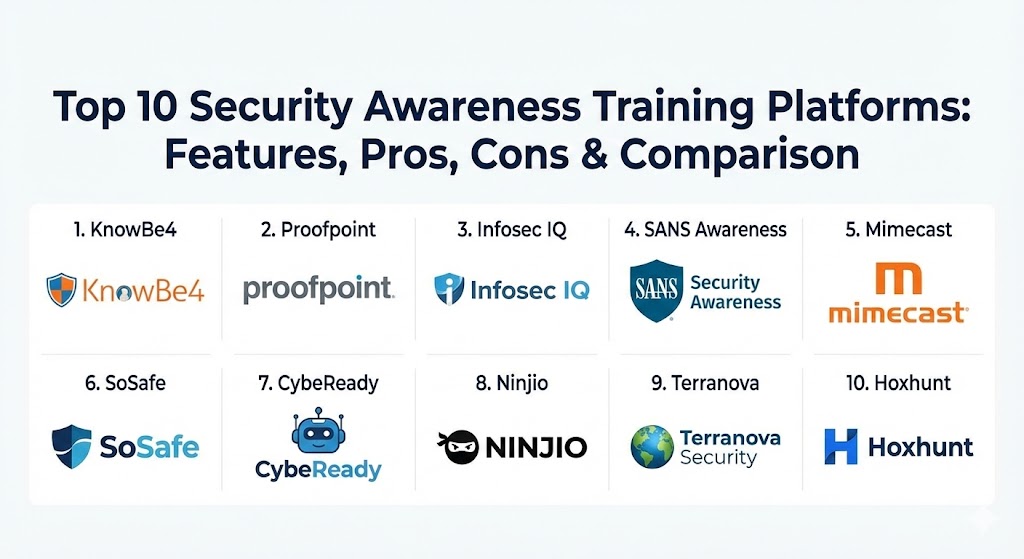
Top 10 Security Awareness Training Platforms
1 — KnowBe4
KnowBe4 is the titan of the industry, currently serving as the world’s largest security awareness training and simulated phishing platform. It is famous for its “ModStore,” a massive library of thousands of content items including videos, games, and posters.
- Key features:
- Automated Security Awareness Program (ASAP): Helps teams build customized programs in minutes.
- Virtual Risk Officer: Quantifies the security risk of individual users and departments using AI.
- Phish-Prone Percentage: Benchmarking reports that show how you stack up against industry peers.
- KnowBe4 Learner App: Allows employees to complete training on mobile devices.
- Phish Alert Button: A one-click reporting tool that integrates directly with major email clients.
- AI-Recommended Training: Suggests specific modules based on a user’s simulation performance.
- Pros:
- Unmatched variety and volume of content, ensuring that training never feels repetitive.
- Highly granular reporting that is perfect for presenting to executive boards or auditors.
- Cons:
- The sheer number of options can be overwhelming for smaller IT teams without a dedicated admin.
- Premium features like advanced reporting and AI risk scoring are locked behind higher price tiers.
- Security & compliance: SOC 2 Type II, GDPR, HIPAA, ISO 27001, and FedRAMP authorized.
- Support & community: Offers dedicated Customer Success Managers (CSMs); extensive documentation and a massive global user base.
2 — Proofpoint Security Awareness Training
Proofpoint leverages its position as a leading email security vendor to provide a training platform deeply informed by real-world threat intelligence. It identifies “Very Attacked People” (VAPs) and tailors training to them.
- Key features:
- Threat-Driven Simulations: Uses actual templates from real-world attacks seen in Proofpoint’s gateways.
- VAP Identification: Automatically tags users who are being targeted most heavily by external attackers.
- Closed-Loop Email Analysis: Teaches users by showing them the specific results of reported emails.
- CyberStrength Assessments: Pre-screening tools to measure baseline knowledge before training begins.
- PhishAlarm: Robust reporting and remediation workflow for security teams.
- Multi-Language Support: Content available in dozens of languages with localized cultural nuances.
- Pros:
- Seamless integration for organizations already using Proofpoint’s email security stack.
- Training content is highly relevant because it reflects the actual threats hitting your organization.
- Cons:
- The administrative interface can be clunky compared to more modern, cloud-native rivals.
- Customization of phishing templates can be more restricted than other platforms.
- Security & compliance: SOC 2 Type II, GDPR, HIPAA, and ISO 27001 compliant.
- Support & community: Strong enterprise-level support; well-established technical documentation and partner ecosystem.
3 — Infosec IQ
Infosec IQ focuses on measurable behavioral change through personalized learning paths. It is widely praised for its award-winning, engaging content that feels more like entertainment than mandatory compliance.
- Key features:
- Personalized Learning Paths: Dynamically adjusts content based on the learner’s existing knowledge.
- Need I Say More? Series: High-quality, storytelling-driven videos that keep engagement high.
- Choose Your Own Adventure® Games: Interactive simulations where users make choices that impact outcomes.
- Automated Campaign Management: Allows admins to “set it and forget it” for the entire year.
- Role-Based Training: Specific modules for developers, executives, and HR staff.
- Real-Time Phishing Feedback: Provides a “teachable moment” the second a user clicks a simulated phish.
- Pros:
- The “Success Manager” provided with many accounts helps drastically reduce administrative workload.
- Content quality is top-tier, consistently winning awards for engagement and production value.
- Cons:
- The backend dashboard can feel a bit sluggish during high-volume data exports.
- Some of the more complex automation rules require a bit of a learning curve to master.
- Security & compliance: SOC 2 Type II, GDPR, and HIPAA compliant.
- Support & community: High-quality documentation and proactive support; very active in the cybersecurity community.
4 — SANS Security Awareness
The SANS Institute is the global leader in professional cybersecurity training, and their awareness platform brings that high-level expertise to the average employee. It is the preferred choice for organizations that value technical depth.
- Key features:
- Expert-Led Content: Developed by the same faculty that teaches SANS professional certifications.
- End-to-End Program Management: Guidance based on the “SANS Security Awareness Maturity Model.”
- MGT521 Training: Offers a professional certification for the administrators of the program.
- Globalized Content: Focuses on cultural relevance for international workforces.
- Advanced Phishing Simulations: Includes sophisticated spear-phishing and social engineering scenarios.
- Comprehensive Compliance Library: Deep coverage of PCI, HIPAA, and GDPR specific requirements.
- Pros:
- Pedigree and authority; the content is technically accurate and respected by security pros.
- Excellent for building a long-term, mature security culture rather than just a quick fix.
- Cons:
- The content can sometimes feel a bit more academic and “dry” compared to humor-based platforms.
- Pricing is generally at the higher end of the market, reflecting the expert brand.
- Security & compliance: ISO 27001, SOC 2, and various government-level certifications.
- Support & community: Unbeatable community of experts; professional consulting services available for program design.
5 — Mimecast Awareness Training
Mimecast takes a unique, humor-based approach to training. They utilize “sitcom-style” video content featuring professional actors to keep users coming back for more, which significantly drives up completion rates.
- Key features:
- Character-Driven Videos: Users follow a recurring cast of characters through security mishaps.
- Personalized Risk Scores: Assigns every employee a score based on behavior and survey data.
- Targeted Remediation: Automatically assigns extra training to “high-risk” individuals.
- Integrated Grid Data: Uses telemetry from Mimecast’s security gateway to inform risk scores.
- Sentiment Surveys: Measures how employees actually feel about security, not just what they know.
- Phishing Simulation Auto-Enrollment: Automatically enrolls clickers into immediate follow-up training.
- Pros:
- Highest user engagement in the industry; employees actually look forward to the videos.
- Short modules (2-3 minutes) respect the employee’s time and reduce “training fatigue.”
- Cons:
- Humor is subjective; while most love it, it might not resonate with every corporate culture.
- The content library is smaller and less diverse than “mega-vendors” like KnowBe4.
- Security & compliance: SOC 2 Type II, ISO 27001, and GDPR compliant.
- Support & community: Excellent customer success teams; streamlined onboarding for Mimecast customers.
6 — SoSafe
SoSafe is a European leader that leans heavily on behavioral science. The platform is designed to be “effortless” for admins, utilizing smart algorithms to personalize the learning experience for every user.
- Key features:
- Behavioral Science Foundations: Content is built using psychological principles to drive habit formation.
- Smart Attack Simulations: Adaptive phishing that gets harder as the user becomes more proficient.
- SoSafe Analytics Dashboard: Clear, actionable KPIs focused on ROI and risk reduction.
- Gamified Elements: Leaderboards and badges that motivate healthy competition.
- Privacy-First Design: Built with strict European privacy standards at its core.
- Deepfake Awareness: Specialized modules to identify AI-generated voice and video fraud.
- Pros:
- The design aesthetics feel contemporary and clean, making the platform a joy to use.
- Excellent for organizations that need to meet strict GDPR and European worker council requirements.
- Cons:
- Currently has a smaller library of niche, industry-specific content than American rivals.
- The premium pricing reflects its status as a high-end, science-led boutique provider.
- Security & compliance: ISO 27001, SOC 2 Type II, and fully GDPR compliant (German-hosted).
- Support & community: Highly responsive technical support; strong documentation and regional community groups.
7 — CybeReady
CybeReady is an autonomous platform that aims to eliminate the “administrative burden” of security training. It is designed to run completely in the background, making it ideal for overstretched IT teams.
- Key features:
- Autonomous Training: The system chooses which training to send to which user and when.
- Fully Managed Simulations: No need for admins to build phishing templates or schedule campaigns.
- Data-Driven Personalization: Individualizes the difficulty level for every single employee.
- High-Frequency, Low-Impact: Focuses on monthly, short interactions rather than long quarterly sessions.
- Business Intelligence Reports: Board-ready reports generated automatically without manual data crunching.
- Multi-Channel Training: Delivers lessons via email, Slack, and Teams.
- Pros:
- Saves hundreds of hours per year for IT administrators; it is a true “set it and forget it” tool.
- Data shows that high-frequency training leads to faster and more permanent behavioral change.
- Cons:
- Lack of manual control may frustrate power users who want to design very specific campaigns.
- Content variety is limited compared to vendors with thousands of external modules.
- Security & compliance: GDPR, SOC 2 Type II, and HIPAA compliant.
- Support & community: Proactive customer success managers; focus on automated, smooth onboarding.
8 — Ninjio
Ninjio focuses on high-impact storytelling, using “Hollywood-style” animated episodes based on actual recent data breaches. Each episode is written by professional writers and features celebrity voice talent.
- Key features:
- NINJIO AWARE: Short, 3-minute episodes that break down a real-world breach.
- Celebrity Voiceovers: Uses recognizable voices to increase engagement and prestige.
- Gamification: Points and leaderboards to drive participation.
- NINJIO PHISH: Phishing simulations that directly link back to the storytelling themes.
- Family Protection: Offers free training for employees’ family members to build security at home.
- Executive Reporting: Clean dashboards that highlight the ROI of the training program.
- Pros:
- The “Hollywood” production value makes the content highly memorable and shareable.
- Excellent at humanizing the “why” behind security policies through relatable stories.
- Cons:
- The animation style is distinct and might not fit the “vibe” of every corporate brand.
- The administrative dashboard is not as feature-rich as those of KnowBe4 or Proofpoint.
- Security & compliance: SOC 2 Type II and GDPR compliant.
- Support & community: Very responsive support team; high customer satisfaction ratings.
9 — Terranova Security (by Fortra)
Terranova Security is a global leader that provides a highly flexible platform. It is notably the technology partner that powers the training component of Microsoft Defender for Office 365.
- Key features:
- Microsoft Integration: Native “connector” for a seamless experience within the Microsoft ecosystem.
- Global Privacy-First Approach: Content available in over 40 languages with localized context.
- Customizable Curricula: Allows for the creation of unique training paths for different departments.
- Real-World Phishing Simulations: A huge library of templates based on current active threats.
- Cyber Games: Gamified modules to keep learning interactive and competitive.
- Managed Services: Offers a fully managed option where Terranova experts run your program.
- Pros:
- Superior for large, global enterprises that require a high degree of content localization.
- The Microsoft partnership makes it a no-brainer for heavy Azure/M365 environments.
- Cons:
- The platform can feel a bit complex to navigate for first-time administrators.
- Some of the “advanced” gamification features are only available in the highest tiers.
- Security & compliance: ISO 27001, SOC 2 Type II, GDPR, and HIPAA compliant.
- Support & community: Professional consulting and global enterprise-level support; very high “defensibility” for audits.
10 — Hoxhunt
Hoxhunt is an adaptive learning platform that turns security training into a game. It is designed to be a “habit-building” tool rather than a “testing” tool, focusing on positive reinforcement.
- Key features:
- Adaptive Phishing: The AI adjusts simulation difficulty in real-time based on user performance.
- Gamified Reporting: Users earn points and “streaks” for reporting suspicious emails.
- Instant Feedback: When a user reports a phish, they get an immediate, positive reward and a quick lesson.
- Deepfake Quality Content: Customers cite their deepfake and social engineering simulations as best-in-class.
- Minimal Administration: Fully automated system that manages the entire user lifecycle.
- Human Risk Management (HRM): Moves beyond SAT into broader behavioral risk quantification.
- Pros:
- Unmatched at driving a “reporting culture” where employees feel like part of the security team.
- High user happiness; users actually enjoy the “recurring challenge” of catching a phish.
- Cons:
- The focus on “reporting” can lead to over-cautious users reporting legitimate internal emails.
- Customization for highly specialized industry needs can be somewhat restrictive.
- Security & compliance: GDPR, SOC 2 Type II, and ISO 27001 compliant.
- Support & community: Highly rated support focused on “Customer Happiness”; excellent enterprise references.
Comparison Table
| Tool Name | Best For | Platform(s) Supported | Standout Feature | Rating (Gartner) |
| KnowBe4 | Content Variety | Web, iOS, Android | Massive “ModStore” Library | 4.6 / 5 |
| Proofpoint | Threat Intelligence | Web, Hybrid | VAP Identification | 4.4 / 5 |
| Infosec IQ | Engagement | Web, Mobile Web | “Success Manager” Support | 4.5 / 5 |
| SANS Awareness | Technical Depth | Web, On-Demand | Expert-Led Pedigree | 4.4 / 5 |
| Mimecast | Humor-Based Learning | Web, Mobile Web | Sitcom-Style Videos | 4.5 / 5 |
| SoSafe | Behavioral Science | Web, Mobile App | Science-Led Personalization | 4.6 / 5 |
| CybeReady | Low Administration | Web, Slack, Teams | Fully Autonomous Platform | 4.7 / 5 |
| Ninjio | Storytelling | Web, Mobile Web | Hollywood Production Quality | 4.8 / 5 |
| Terranova | Global Enterprise | Web, M365 Integrated | Microsoft Security Partner | 4.6 / 5 |
| Hoxhunt | Habit Building | Web, Email Integrated | Adaptive AI Difficulty | 4.7 / 5 |
Evaluation & Scoring of Security Awareness Training Platforms
To provide a clear objective view, we have evaluated the general category of Security Awareness Training against our standardized weighted scoring rubric. Note that individual scores vary based on specific license tiers and organizational needs.
| Category | Weight | Evaluation Rationale | Score (Avg) |
| Core Features | 25% | Includes phishing simulations, content variety, and risk scoring. | 9.2 / 10 |
| Ease of Use | 15% | Administrative dashboard intuitiveness and user experience. | 8.5 / 10 |
| Integrations | 15% | AD/SCIM sync, email gateway, Slack/Teams, and SIEM integration. | 8.8 / 10 |
| Security & Compliance | 10% | SOC 2, ISO 27001, GDPR, and data residency options. | 9.5 / 10 |
| Performance | 10% | Platform uptime, speed of report generation, and mobile app stability. | 9.0 / 10 |
| Support & Community | 10% | Documentation quality, CSM availability, and user forums. | 8.2 / 10 |
| Price / Value | 15% | ROI based on risk reduction versus total cost of ownership. | 8.0 / 10 |
Which Security Awareness Training Platforms Tool Is Right for You?
Selecting the right platform depends on your organizational culture, technical resources, and budget.
Solo Users vs SMB vs Mid-Market vs Enterprise
- SMB (1-250 users): Look for CybeReady or Infosec IQ. These platforms offer high automation or dedicated success managers to help you run a world-class program without needing a full-time security specialist.
- Mid-Market (250-2,000 users): Ninjio or Hoxhunt are excellent choices. They provide high engagement that “sells itself” to employees, making your job as an admin much easier.
- Enterprise (2,000+ users): KnowBe4, Proofpoint, or Terranova Security are the go-to choices. They have the “heavy lifting” infrastructure to handle thousands of employees across diverse global locations and reporting requirements.
Budget-Conscious vs Premium Solutions
If budget is the primary driver, KnowBe4 and Cofense offer very competitive entry-level tiers. If you are looking for a premium, high-impact culture change and are willing to pay for it, SoSafe and Mimecast provide unique, high-quality experiences that justify their price tags.
Feature Depth vs Ease of Use
- Feature Depth: KnowBe4 and Proofpoint have the most “knobs” for power users to turn. You can customize almost every aspect of a campaign.
- Ease of Use: CybeReady and Hoxhunt win here. They are designed to run in the background with minimal manual intervention, using AI to handle the heavy lifting of scheduling and content selection.
Security and Compliance Requirements
If you are in a highly regulated industry (e.g., banking or defense), SANS Security Awareness or Terranova Security offer the most “defensible” content that auditors respect. If you are a European-based company, SoSafe provides the best peace of mind regarding data residency and worker council compliance.
Frequently Asked Questions (FAQs)
1. What is the difference between a “simulation” and “training”?
A simulation (like a phishing test) is an unannounced “test” to see how a user behaves in a real scenario. Training is the educational content (videos, quizzes) that teaches them how to behave. Both are needed for a successful program.
2. How often should we run phishing simulations?
Most experts recommend at least once a month. High-frequency, low-impact training is more effective at building long-term memory than a massive once-a-year session.
3. Does security awareness training actually work?
Yes. Industry data consistently shows that organizations can reduce their “Phish-Prone Percentage” from 30%+ down to less than 5% within 12 months of consistent training.
4. Can these platforms help with insurance requirements?
Absolutely. Most cyber insurance providers now require proof of an active security awareness program and regular phishing simulations to qualify for lower premiums or coverage.
5. How long does it take to implement a new platform?
Modern cloud-native platforms can be “set up” in a day. However, fully integrating your Active Directory, whitelistings, and planning your first year’s curriculum usually takes 2-4 weeks.
6. What is “risk scoring”?
It is a numerical value assigned to a user based on their performance. If they pass all tests, their score is low. If they click every phish, their score is high. This helps IT prioritize who needs more help.
7. Can we train employees on deepfakes and AI?
Yes, top-tier platforms like SoSafe, KnowBe4, and Hoxhunt have released specialized modules in 2026 to address AI-driven voice and video impersonation threats.
8. Are mobile apps necessary for security training?
Not strictly necessary, but they increase completion rates significantly by allowing “deskless” workers or commuters to complete training when it’s convenient for them.
9. What is the most common mistake in running these programs?
Treating them as “punishment.” If you shaming people who fail, they will hide their mistakes. The best programs focus on positive reinforcement and making security a “shared mission.”
10. Do these platforms integrate with our Slack or Microsoft Teams?
Most do. Many platforms now send “nudges” or training alerts directly through Slack or Teams, meeting users where they already spend their time.
Conclusion
In 2026, cybersecurity is no longer just an IT problem—it’s a people problem. Choosing the right Security Awareness Training Platform is about more than just checking a box; it’s about choosing a partner that will help you cultivate a culture of vigilance.
Whether you prioritize the massive content library of KnowBe4, the humor of Mimecast, or the autonomous ease of CybeReady, the “best” tool is ultimately the one that your employees will actually use. Start by assessing your team’s current risk level, define your cultural goals, and choose a platform that turns your weakest link into your strongest defense.