Introduction
Retirement planning tools are sophisticated digital platforms designed to help individuals and financial professionals project future wealth, analyze cash flow, and stress-test financial strategies. By aggregating data from bank accounts, brokerage firms, and pension plans, these tools provide a holistic view of one’s financial health. They allow users to visualize different “what-if” scenarios—such as retiring early, selling a home, or adjusting investment risk—to ensure their money lasts as long as they do.
The importance of using these tools cannot be overstated. Without a data-driven plan, many retirees face the “fear of outliving their assets” or, conversely, over-saving and missing out on their best years. Real-world use cases include optimizing the timing of Social Security benefits, determining tax-efficient withdrawal strategies from IRAs versus 401(k)s, and preparing for long-term care expenses. When evaluating these tools, users should look for features like Monte Carlo simulations (which run thousands of market scenarios), account aggregation (to keep data current), and robust privacy protections.
Best for: DIY investors who want to take control of their future, pre-retirees within 10 years of their target date, and professional financial advisors (CFPs/RIAs) managing complex client estates. They are particularly beneficial for the FIRE (Financial Independence, Retire Early) community and high-net-worth individuals with diverse asset classes.
Not ideal for: Individuals with extremely simple financial lives (e.g., a single pension and no other investments) or those who prefer a purely manual, spreadsheet-only approach. They may also be unnecessary for very young workers just starting their first job, where a simple savings rate tracker is usually sufficient.
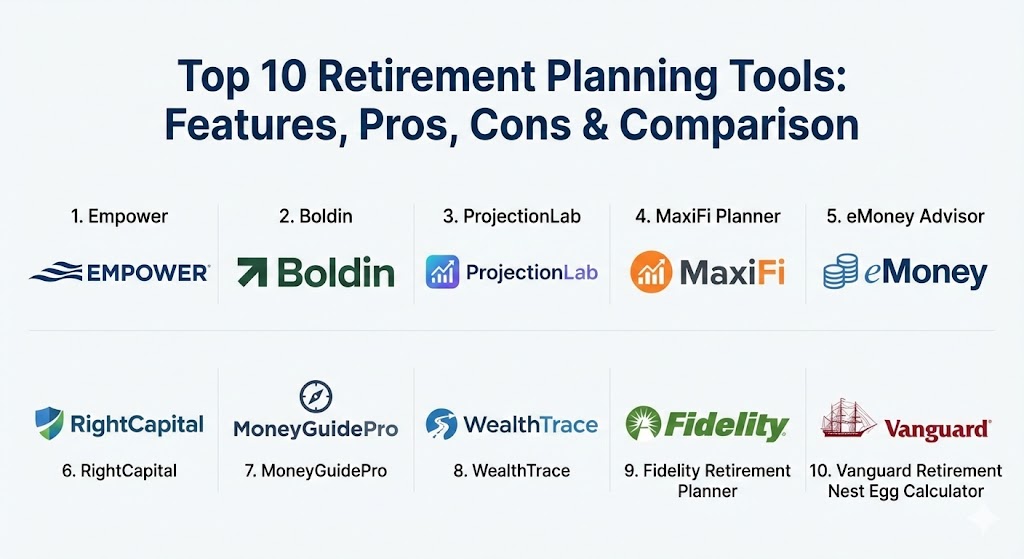
Top 10 Retirement Planning Tools
1 — Empower (formerly Personal Capital)
Empower is widely recognized for its high-quality, free dashboard that aggregates all your financial accounts into one view. It is designed for individuals who want a professional-grade overview of their net worth, investment fees, and retirement readiness without paying for a subscription.
- Key features:
- Automated account aggregation for real-time tracking of net worth.
- Retirement Planner with “Recession Simulator” functionality.
- Investment Checkup tool to analyze portfolio risk and diversification.
- Fee Analyzer to identify hidden costs in 401(k)s and mutual funds.
- Savings Planner for tracking emergency funds and retirement contributions.
- Access to human advisors for users with high investable assets.
- Pros:
- Completely free for the base software suite.
- One of the best user interfaces in the industry, offering a clean, comprehensive “single pane of glass.”
- Cons:
- Frequent sales calls from Empower advisors if your linked assets exceed $100,000.
- Less granular control over specific tax-loss harvesting or Roth conversion modeling compared to paid tools.
- Security & compliance: AES-256 encryption, multi-factor authentication (MFA), SOC 2 Type II, and read-only access to linked accounts.
- Support & community: Extensive online help center, email support, and dedicated advisors for wealth management clients.
2 — Boldin (formerly NewRetirement)
Boldin is a comprehensive DIY planning tool that focuses on providing a detailed, step-by-step roadmap for retirement. It is highly popular among the “planning-nerd” community for its ability to model complex variables like Roth conversions and healthcare costs.
- Key features:
- Highly detailed scenario modeling (retire early, buy a home, move states).
- Social Security and Medicare cost optimization modules.
- Tax-efficient withdrawal strategy modeling.
- Estate planning and legacy tracking.
- Real-time plan health score based on your specific data.
- Estate and legacy planning tools.
- Pros:
- Models “real-world” expenses like healthcare and taxes more accurately than free calculators.
- Very affordable compared to hiring a one-time financial planner.
- Cons:
- The interface can feel overwhelming due to the sheer number of inputs required.
- Free version is limited; the best features are behind a subscription wall.
- Security & compliance: SOC 2, bank-level encryption, and privacy-first data policies.
- Support & community: Active Discord and Facebook communities, regular webinars, and “Coach” support options.
3 — ProjectionLab
ProjectionLab is a modern, privacy-focused tool that has gained massive traction in the FIRE community. It is designed for those who want a beautiful, highly customizable interface without the need to link bank accounts if they prefer not to.
- Key features:
- Privacy-first design with local-only data storage options.
- Beautiful, interactive charts for net worth and cash flow projections.
- Advanced Monte Carlo simulations and historical backtesting.
- “Milestones” feature to track progress toward early retirement.
- Support for international tax settings and multiple currencies.
- Roth conversion ladder modeling.
- Pros:
- Extremely flexible; you can build complex, multi-stage life scenarios.
- No forced account linking, which appeals to security-conscious users.
- Cons:
- Manual data entry can be tedious if you choose not to link accounts.
- Lacks the automated “budgeting” features found in Empower or Mint.
- Security & compliance: End-to-end encryption, local storage options, and no selling of user data.
- Support & community: Very active Discord community and direct access to the developer for feedback.
4 — MaxiFi Planner
Created by economist Laurence Kotlikoff, MaxiFi focuses on “living standard” planning. Unlike other tools that ask how much you want to spend, MaxiFi tells you how much you can safely spend to maintain a consistent lifestyle.
- Key features:
- Proprietary “Living Standard” algorithm to optimize annual spending.
- Integration with “Maximize My Social Security” for benefit optimization.
- Comparison of “Base Plan” vs. “Maximized Plan.”
- Deep analysis of tax-efficient withdrawal sequences.
- Life insurance and annuity impact modeling.
- Pros:
- Economically rigorous; avoids the flaws of simple “percentage of income” rules.
- Excellent at identifying “found money” through tax and Social Security optimization.
- Cons:
- Steep learning curve; the logic is different from traditional retirement tools.
- Does not offer automated account syncing (manual entry only).
- Security & compliance: AES-256 encryption and strict data privacy standards.
- Support & community: Detailed technical documentation and responsive email support.
5 — eMoney Advisor
eMoney is a professional-grade platform used by financial advisors to provide high-end planning for their clients. It is known for its “Decision Center,” which allows for real-time collaboration between advisors and clients.
- Key features:
- Interactive Decision Center for live scenario testing during meetings.
- Robust cash-flow modeling for complex estates and trusts.
- Secure “Vault” for storing important financial and legal documents.
- Deep integration with CRM and portfolio management systems.
- Advanced estate and gift tax planning.
- Pros:
- The “Gold Standard” for holistic, advisor-led financial planning.
- Exceptional client portal that keeps clients engaged with their plan.
- Cons:
- Generally only available through a financial advisor (expensive for individuals).
- Can be overly complex for simple retirement scenarios.
- Security & compliance: SOC 2, HIPAA (for some modules), and enterprise-grade encryption.
- Support & community: Comprehensive advisor training, 24/7 technical support, and large user conferences.
6 — RightCapital
RightCapital has emerged as a top competitor to eMoney and MoneyGuidePro by focusing on a modern, user-friendly interface and unique features like tax-bracket management and student loan planning.
- Key features:
- Tax-efficient distribution and Roth conversion modeling.
- Student loan management module (unique for younger retirees).
- Retirement “Snapshot” for quick health checks.
- Medicare and Social Security planning modules.
- Dynamic, interactive client portal.
- Pros:
- Much more intuitive and “sleek” than older professional software.
- Excellent at visualizing the impact of different tax strategies over time.
- Cons:
- Primarily a B2B product sold to financial advisors.
- Less historical depth in the company compared to legacy players.
- Security & compliance: ISO 27001, SOC 2, and end-to-end data encryption.
- Support & community: High-rated customer service and weekly training webinars for advisors.
7 — MoneyGuidePro
MoneyGuidePro is a “goals-based” planning tool used by thousands of financial professionals. It shifts the focus from “beating the market” to “reaching your specific goals” like travel, healthcare, and legacy.
- Key features:
- “Play Zone” allows clients to interactively adjust their own plans.
- Goals-based approach (Wants, Needs, Wishes).
- Integration with Envestnet’s broader wealth management ecosystem.
- Robust Social Security and longevity risk modeling.
- Built-in “Health Care Smart Goal” for Medicare cost estimates.
- Pros:
- Excellent for clients who are intimidated by complex spreadsheets.
- Focuses on the “why” of money, not just the “how much.”
- Cons:
- Not available for direct consumer purchase; must go through an advisor.
- May lack the cash-flow granularity that some high-net-worth engineers desire.
- Security & compliance: Enterprise-grade security, SOC 2, and rigorous audit logs.
- Support & community: Massive training library and dedicated enterprise support teams.
8 — WealthTrace
WealthTrace offers a powerful middle ground, providing both a consumer version for DIY planners and an advisor version for professionals. It is known for its “Probability of Success” metrics and ease of use.
- Key features:
- Monte Carlo and historical stress-testing.
- Integration with various custodians for account syncing.
- Detailed “What-If” scenarios for early retirement.
- Specific modules for pension and Social Security analysis.
- Comprehensive reporting that is easy for non-experts to read.
- Pros:
- One of the few professional-grade tools you can buy directly as an individual.
- Very accurate tax calculations based on current federal and state laws.
- Cons:
- The user interface is functional but feels a bit dated compared to ProjectionLab or RightCapital.
- Subscription cost is higher than Boldin or MaxiFi.
- Security & compliance: Bank-level encryption and private data handling.
- Support & community: Strong email support and direct phone lines for premium users.
9 — Fidelity Retirement Planner
Fidelity provides a robust, free planning suite for its customers (and even non-customers with a guest account). It is an excellent starting point for those who want a reliable, institution-backed projection of their future.
- Key features:
- Fidelity Retirement Score to gauge your progress.
- Detailed projections based on Fidelity’s proprietary market data.
- Ability to model healthcare costs through a partnership with HealthView.
- Integration with Fidelity’s brokerage and 401(k) accounts.
- Suggested investment adjustments based on your time horizon.
- Pros:
- Backed by one of the largest financial institutions in the world.
- Completely free to use, even if you don’t have all your assets at Fidelity.
- Cons:
- Recommendations naturally skew toward Fidelity-branded funds and products.
- Less customization for “unconventional” assets like crypto or small businesses.
- Security & compliance: Top-tier institutional security, MFA, and SIPC/FDIC protections.
- Support & community: Thousands of local branches and 24/7 phone support.
10 — Vanguard Retirement Nest Egg Calculator
Vanguard’s tool is a “no-frills” Monte Carlo simulator designed to answer one question: “Will my money last?” It is perfect for those who want a quick, academic-style stress test of their portfolio.
- Key features:
- Simple Monte Carlo simulator based on historical market returns.
- Input for savings, spending, and time horizon.
- Clear visualization of the probability of running out of money.
- Focused on “buy and hold” long-term success metrics.
- Pros:
- Incredibly simple; can be completed in under 5 minutes.
- Free of charge and requires no account creation or data linking.
- Cons:
- Lacks any tax, Social Security, or healthcare cost modeling.
- Too basic for anyone with a complex financial life.
- Security & compliance: Standard web security (no sensitive data is stored).
- Support & community: General Vanguard customer service and vast online education library.
Comparison Table
| Tool Name | Best For | Platform(s) Supported | Standout Feature | Rating (TrueReviewnow.com) |
| Empower | Free Net Worth Tracking | Web, iOS, Android | Fee & Risk Analyzer | 4.8 / 5 |
| Boldin | DIY Comprehensive Planning | Web, Mobile | Roth Conversion Modeling | 4.7 / 5 |
| ProjectionLab | FIRE Community / Privacy | Web, Desktop | Local-Only Data Support | 4.9 / 5 |
| MaxiFi Planner | Spending Optimization | Web | Living Standard Algorithm | 4.5 / 5 |
| eMoney Advisor | Advisor-Led Planning | Web, iOS, Android | Collaborative Decision Center | 4.6 / 5 |
| RightCapital | Tax-Smart Planning | Web, Mobile | Tax-Bracket Visualization | 4.7 / 5 |
| MoneyGuidePro | Goals-Based Strategy | Web | “Play Zone” Interactivity | 4.5 / 5 |
| WealthTrace | Professional DIYers | Web | Advisor-Grade Tax Logic | 4.4 / 5 |
| Fidelity Planner | Fidelity Customers | Web, Mobile | Institutional Market Data | 4.3 / 5 |
| Vanguard Calc | Quick Probability Check | Web | Extreme Simplicity | N/A |
Evaluation & Scoring of Retirement Planning Tools
Choosing a tool requires looking beyond the marketing. We have evaluated these solutions based on a weighted rubric to help you identify where each one truly excels.
| Category | Weight | Top Performer | Notes |
| Core Features | 25% | Boldin / MaxiFi | Deepest simulation for tax and Social Security. |
| Ease of Use | 15% | Empower / ProjectionLab | Most modern and intuitive user interfaces. |
| Integrations | 15% | eMoney / RightCapital | Best connectivity with external advisor tools. |
| Security | 10% | Fidelity / ProjectionLab | Institutional trust vs. local-first privacy. |
| Performance | 10% | WealthTrace | Fast calculations and reliable uptime. |
| Support | 10% | Fidelity / Boldin | Extensive human support and community active. |
| Price / Value | 15% | Empower (Free) | Unbeatable value for net worth tracking. |
Which Retirement Planning Tool Is Right for You?
The right tool depends on your current life stage and your level of interest in “tinkering” with the numbers.
- Solo Users vs. Professionals: If you are a DIY investor, Boldin or ProjectionLab offer the best combination of depth and accessibility. If you are a financial advisor, eMoney or RightCapital are the industry standards for client engagement and complex estate work.
- Budget-Conscious vs. Premium: Empower and Fidelity are the best free options. However, if you are nearing retirement, paying $100–$200 a year for MaxiFi or Boldin is a small price to pay to ensure you aren’t making a multi-thousand dollar tax mistake.
- Feature Depth vs. Ease of Use: If you just want to see a “green light” or “red light” for your retirement, Fidelity’s Retirement Score is perfect. If you want to know exactly how much to convert to a Roth IRA to minimize taxes over 30 years, you need RightCapital or Boldin.
- Integration and Scalability: High-net-worth families with accounts at five different banks should prioritize Empower for its aggregation speed. Those who want to keep everything manual and private should choose ProjectionLab.
- Security Requirements: If you are uncomfortable linking bank accounts, ProjectionLab is the clear winner as it allows for completely manual, encrypted local storage.
Frequently Asked Questions (FAQs)
1. Are free retirement planning tools safe to use?
Most reputable tools like Empower and Fidelity use the same encryption levels as banks. However, many “free” tools make money by referring you to their own financial advisory services. Always read the privacy policy regarding your data.
2. Can I use these tools if I live outside the United States?
Most professional tools (eMoney, MoneyGuidePro) are US-centric. However, ProjectionLab is one of the few that offers international tax settings and multi-currency support, making it popular for global retirees.
3. What is a Monte Carlo simulation?
It is a mathematical technique that runs your retirement plan through thousands of potential market scenarios (good, bad, and average) to give you a “probability of success” percentage. It is much more realistic than a “straight-line” 7% return estimate.
4. Do these tools handle Social Security benefits?
The best ones (MaxiFi, Boldin, RightCapital) have sophisticated modules that tell you exactly when to claim your benefits (e.g., age 62 vs. 67 vs. 70) to maximize your lifetime payout.
5. How often should I update my retirement plan?
You should do a deep dive at least once a year. However, using a tool with automated account aggregation (like Empower) allows you to see a daily “health check” of your plan without any extra effort.
6. Is it worth paying for a subscription to a planning tool?
If you have a complex situation (rental properties, stock options, or high tax brackets), the premium features for Roth conversion and tax-loss harvesting can save you tens of thousands of dollars in the long run.
7. Can these tools replace a human financial advisor?
They can replace much of the “number crunching.” However, a human advisor still provides value through emotional behavioral coaching, complex estate law knowledge, and acting as a neutral third party during market downturns.
8. What is “Sequence of Returns Risk”?
This is the risk that the market crashes right after you retire. Modern tools like WealthTrace and Empower help you model this specific scenario to ensure you have enough cash/bonds to weather the storm without selling stocks at a loss.
9. Why doesn’t Vanguard’s tool have tax modeling?
Vanguard keeps their public tools simple to provide a broad “rule of thumb.” For detailed tax planning, they prefer customers to use their “Personal Advisor” service, which pairs you with a human expert.
10. What is the most common mistake when using these tools?
Over-optimism. Users often underestimate their spending or overestimate their investment returns. It is always better to build a “stress-tested” plan with conservative assumptions to ensure you have a margin of safety.
Conclusion
Retirement planning in 2026 is a dynamic process, not a “set-it-and-forget-it” task. Whether you prefer the automated, free overview provided by Empower, the privacy-first customization of ProjectionLab, or the advisor-led depth of eMoney, the most important step is simply to start. A plan that is 80% accurate today is infinitely better than no plan at all. When choosing your tool, prioritize the features that address your biggest anxieties—whether that’s taxes, market volatility, or simply knowing how much you can spend on your next vacation.