Introduction
Remote Patient Monitoring (RPM) is a healthcare delivery method that uses digital technology to collect physiological data (such as blood pressure, heart rate, or blood glucose) from patients in one location and transmit it securely to healthcare providers in another for assessment and recommendations. Unlike traditional telehealth, which relies on synchronized video visits, RPM provides a continuous “live stream” of a patient’s health status, allowing for proactive rather than reactive clinical interventions.
The importance of RPM lies in its ability to bridge the “data gap” between clinical visits. By monitoring patients in their natural environments, providers can identify early signs of deterioration, such as a sudden weight gain in a heart failure patient, and intervene before an expensive Emergency Room visit becomes necessary. Key evaluation criteria for these platforms include the reliability of device connectivity (Cellular vs. Bluetooth), the depth of integration with Electronic Health Records (EHRs), the automation of billing and reimbursement workflows, and the intuitiveness of the patient-facing hardware.
Best for: Large health systems, accountable care organizations (ACOs), and specialized clinics (cardiology, endocrinology) that manage high-risk, chronically ill populations and aim to reduce hospital readmission rates while optimizing revenue through CMS reimbursement codes.
Not ideal for: Solo practitioners with very low patient volumes who lack the administrative staff to manage alerts, or for acute care scenarios where immediate, in-person surgical or emergency intervention is required regardless of data trends.
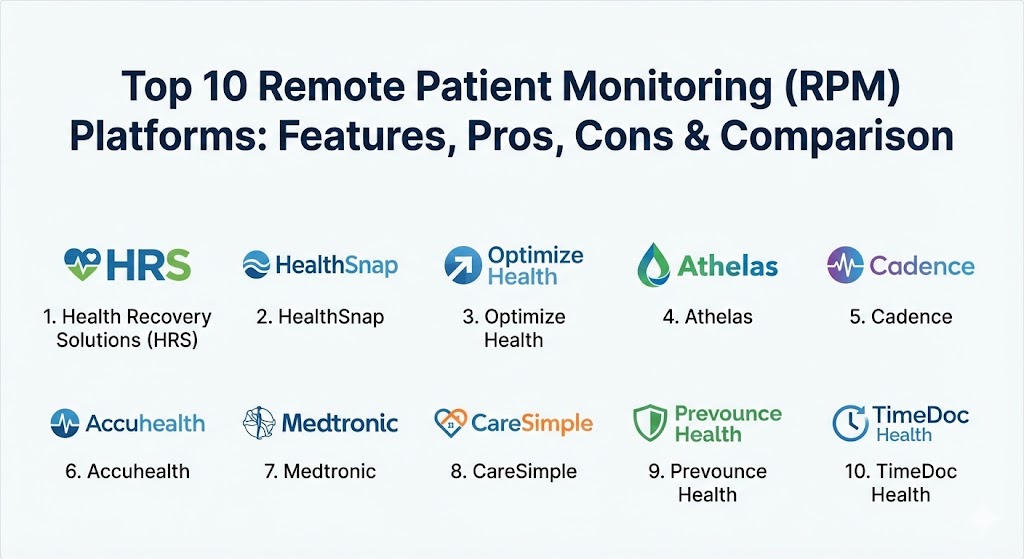
Top 10 Remote Patient Monitoring (RPM) Platforms
1 — Health Recovery Solutions (HRS)
Health Recovery Solutions (HRS) is widely regarded as a market leader in the RPM space, known for its comprehensive “clinician-in-a-box” approach. It provides turnkey kits that include a pre-configured tablet and peripheral medical devices, specifically designed for high-risk, post-acute, and chronic care patients.
- Key features:
- Disease-specific monitoring kits for COPD, CHF, Diabetes, and Hypertension.
- Integrated video conferencing and secure messaging directly on the patient tablet.
- Real-time clinician dashboards with color-coded risk stratification.
- Comprehensive library of educational videos and symptom surveys for patient engagement.
- Automated medication reminders and adherence tracking.
- Advanced wound care imaging and remote evaluation tools.
- Logistics management including device shipping, retrieval, and sanitation.
- Pros:
- Exceptionally high patient engagement rates due to the intuitive, tablet-based interface.
- One of the best “white-glove” logistics services in the industry, taking the hardware burden off the clinic.
- Cons:
- Higher price point compared to software-only or BYOD (Bring Your Own Device) solutions.
- The hardware-heavy approach may be overkill for younger, tech-savvy patient populations.
- Security & compliance: HIPAA compliant, HITRUST certified, SOC 2 Type II, and data encryption at rest and in transit.
- Support & community: Offers 24/7 technical support, dedicated client success managers, and extensive clinician training programs.
2 — HealthSnap
HealthSnap positions itself as the “Operating System” for virtual chronic care management. It focuses heavily on data interoperability and clinical workflow, aiming to make RPM a seamless part of a physician’s daily routine rather than a separate task.
- Key features:
- Patented automated billing and eligibility reporting to maximize reimbursement.
- Deep, bi-directional integration with over 80 Electronic Health Records (EHRs).
- Integrated Chronic Care Management (CCM) and Remote Therapeutic Monitoring (RTM) modules.
- Population health analytics to identify trends across thousands of patients.
- Simplified patient onboarding with cellular-connected devices that require no setup.
- Clinical staff augmentation services to help monitor alerts.
- Pros:
- Reduces administrative “alert fatigue” through intelligent data filtering and prioritization.
- The billing automation is industry-leading, ensuring that no CPT-coded revenue is left on the table.
- Cons:
- Requires a significant initial workflow adjustment to fully leverage the EHR integration.
- Some advanced predictive analytics features are locked behind higher-tier enterprise plans.
- Security & compliance: HIPAA, HITRUST, SOC 2, and SSO integration for enterprise security.
- Support & community: Strong documentation and a proactive onboarding team; features a robust “HealthSnap Academy” for user education.
3 — Optimize Health
Optimize Health is a turnkey RPM platform that prides itself on simplicity and rapid deployment. It is designed for practices that want to launch an RPM program in weeks rather than months, focusing on the most profitable and clinically impactful CPT codes.
- Key features:
- User-friendly “Single Pane of Glass” dashboard for clinical monitoring.
- Automated time-tracking for 99457 and 99458 billing compliance.
- Cellular-enabled blood pressure cuffs, scales, and glucose meters.
- Customizable alert thresholds for individual patients or cohorts.
- Direct-to-patient device shipping and technical support.
- Built-in secure text messaging and telehealth capabilities.
- Pros:
- The interface is remarkably clean and requires minimal training for nursing staff.
- Excellent balance of features and price for mid-market private practices.
- Cons:
- Lacks the deep disease-specific educational content found in HRS.
- Integration with smaller, niche EHRs can be slower than with major players like Epic or Cerner.
- Security & compliance: HIPAA compliant, SOC 2, and end-to-end data encryption.
- Support & community: Responsive account management and a detailed online knowledge base for self-service troubleshooting.
4 — Athelas
Athelas is a technology-first RPM provider that has gained significant traction by focusing on SIM-connected hardware and AI-driven insights. It is particularly well-suited for rural areas where reliable WiFi is not a guarantee.
- Key features:
- SIM-embedded devices that work out of the box without smartphone pairing.
- Athelas Home: A flagship device for automated white blood cell (WBC) monitoring.
- AI-powered health trends and predictive deterioration alerts.
- Full-service billing team that handles claims on behalf of the practice.
- Integration with a wide array of specialized biometric peripherals.
- Automated patient enrollment and eligibility verification tools.
- Pros:
- The cellular “plug-and-play” nature leads to much higher compliance among elderly patients.
- Their billing service is highly effective at reducing claim denials.
- Cons:
- The platform can feel “closed off” if you prefer to use your own existing hardware.
- AI alerts occasionally require fine-tuning to avoid over-notification in complex patients.
- Security & compliance: HIPAA compliant, SOC 2 Type II, and FIPS 140-2 encryption standards.
- Support & community: High-touch implementation support; provides extensive marketing materials to help practices recruit patients.
5 — Cadence
Cadence is a “care-delivery” RPM platform that acts as a clinical extension of the provider’s team. It is designed for large-scale health systems that want to outsource the actual monitoring and triage of patient data.
- Key features:
- Clinical monitoring by Cadence-employed NPs and nurses 24/7.
- Deep integration with Epic and other major health system EHRs.
- Evidence-based care pathways for CHF, Diabetes, Hypertension, and COPD.
- “System-of-record” data synchronization ensures the primary physician is always informed.
- Advanced risk-stratification algorithms to prioritize high-need interventions.
- Pros:
- Solves the massive “clinical staffing shortage” problem by providing the monitoring personnel.
- High focus on clinical outcomes and “value-based care” metrics.
- Cons:
- The outsourced clinical model may feel disconnected for physicians who want direct control.
- Primarily targeted at very large health systems; not ideal for small private practices.
- Security & compliance: HIPAA, HITRUST, SOC 2, and rigorous internal clinical audit logs.
- Support & community: Enterprise-level support with dedicated account executives and clinical leads.
6 — Accuhealth
Accuhealth is known for providing a high-velocity, turnkey RPM solution that focuses on removing all technical barriers for both the patient and the physician. They are often cited for their industry-leading “15-second” device setup.
- Key features:
- 4G/5G cellular-connected devices with no Bluetooth pairing required.
- Automated time-tracking and billing export functionality.
- Multilingual clinical monitoring team to support diverse patient populations.
- Integration with over 500 different EMR/EHR systems.
- Real-time audit logs and documentation for Medicare compliance.
- Comprehensive patient-facing app for data visualization.
- Pros:
- The hardware reliability is exceptional, significantly reducing technical support calls.
- Their multilingual support is a major differentiator for urban health systems.
- Cons:
- The billing dashboard can be data-heavy and slightly overwhelming for new users.
- Limited options for patients who wish to use their own third-party wearables (like Apple Watch).
- Security & compliance: HIPAA, SOC 2, and secure cloud storage using AES-256 encryption.
- Support & community: Features a 24/7 patient support line to handle technical issues directly.
7 — Medtronic (MyCareLink)
As a medical device giant, Medtronic’s MyCareLink platform is the gold standard for monitoring patients with cardiac implantable devices, but it has expanded into broader chronic disease management.
- Key features:
- Direct monitoring of implanted pacemakers, ICDs, and heart failure monitors.
- Integrated “MyCareLink Heart” mobile app for patient data tracking.
- Automated alerts for arrhythmia and device performance issues.
- Seamless data transmission to the clinic-facing CareLink network.
- Expansion into non-implantable RPM through the Medtronic Care Management Services.
- Pros:
- Unrivaled clinical depth for cardiac patients; the hardware and software are “medical-grade.”
- Deeply trusted by specialists and hospitals worldwide for high-risk monitoring.
- Cons:
- The platform is highly specialized; it is not a “general purpose” RPM tool for all conditions.
- Can be difficult to integrate with non-cardiac clinical workflows.
- Security & compliance: ISO 27001, HIPAA, GDPR, and NIST cybersecurity framework alignment.
- Support & community: World-class technical and clinical support; extensive professional education resources.
8 — CareSimple
CareSimple focuses on “Virtual Care Made Simple,” offering an enterprise-grade platform that scales easily across large populations while remaining incredibly easy for senior citizens to use.
- Key features:
- Pre-configured, SIM-enabled devices (Blood Pressure, Weight, Glucose, SpO2).
- Integration with Epic, Cerner, and Athenahealth via HL7 and FHIR.
- Hospital-at-home (HaH) program enablement.
- Clinical dashboard with “Alert-by-Exception” logic to prioritize critical data.
- Automated shipping and logistics for all monitoring equipment.
- Pros:
- One of the few platforms that truly masters the “Hospital-at-Home” use case.
- Excellent design philosophy that minimizes “tech-anxiety” for elderly patients.
- Cons:
- The simplicity of the interface means it lacks some of the hyper-customization of HRS.
- Onboarding for very small practices is less prioritized than enterprise health systems.
- Security & compliance: HIPAA, SOC 2 Type II, GDPR, and ISO 27001.
- Support & community: High-quality enterprise support and clinical implementation consulting.
9 — Prevounce Health
Prevounce is a comprehensive platform for RPM, Chronic Care Management (CCM), and Annual Wellness Visits (AWV). It is designed to be a “practice growth” tool as much as a clinical monitoring tool.
- Key features:
- Multi-modality platform (RPM + CCM + AWV) for a holistic revenue strategy.
- Flexible device options (Cellular, Bluetooth, and BYOD).
- Integrated task management and clinical documentation tools.
- Patient enrollment portal with automated eligibility checks.
- Customizable practice-branded patient apps.
- Pros:
- Extremely cost-effective for smaller practices that want to bundle multiple virtual services.
- Provides great flexibility in how devices are sourced and managed.
- Cons:
- The wide breadth of services means the RPM-specific features aren’t as “deep” as specialized tools.
- The BYOD/Bluetooth models can lead to higher technical support needs from patients.
- Security & compliance: HIPAA, SOC 2, and robust audit trails for Medicare billing defense.
- Support & community: Strong focus on practice-side education and billing support.
10 — TimeDoc Health
TimeDoc Health is a leading provider of virtual care management, focusing on the human element of RPM. They specialize in high-touch services that integrate directly into the existing clinical workflow.
- Key features:
- Clinical staff augmentation for RPM and CCM services.
- Real-time vital monitoring with immediate patient outreach for abnormal readings.
- Seamless bi-directional EMR integration.
- Monthly patient engagement reports and adherence tracking.
- Automated Medicare-compliant billing documentation.
- Pros:
- Excellent for clinics that have the “tech” but lack the “time” to call patients.
- They act as a true extension of the practice, maintaining the doctor-patient relationship.
- Cons:
- The service-heavy model makes it more expensive than a pure software license.
- Lacks some of the more advanced “cutting-edge” AI features found in Athelas or Biofourmis.
- Security & compliance: HIPAA, HITRUST, and secure data tunnels for EMR integration.
- Support & community: Very high levels of customer service and practice-specific implementation plans.
Comparison Table
| Tool Name | Best For | Platform(s) Supported | Standout Feature | Rating (Gartner/TrueReview) |
| HRS | Post-Acute/CHF | Tablet, iOS, Android | “Clinician-in-a-Box” Kits | 4.7 / 5 |
| HealthSnap | Enterprise EHR Integration | Web, iOS, Android | OS for Chronic Care | 4.6 / 5 |
| Optimize Health | Private Practices | Web-based | Cleanest Admin UI | 4.5 / 5 |
| Athelas | Rural/SIM Connectivity | Cellular, Web | AI-Powered Trends | 4.4 / 5 |
| Cadence | Large Health Systems | Epic Integrated | Outsourced Monitoring | 4.6 / 5 |
| Accuhealth | Multilingual/Turnkey | Cellular, Web | 15-Second Device Setup | 4.5 / 5 |
| Medtronic | Cardiac Specialists | MyCareLink App | Implantable Integration | 4.8 / 5 |
| CareSimple | Senior Care/Hospital-Home | Web, Cellular | Plug-and-Play Design | 4.4 / 5 |
| Prevounce | Practice Growth/CCM | Web, Mobile | Holistic Revenue Bundle | 4.3 / 5 |
| TimeDoc Health | Staff Augmentation | Web, Mobile | High-Touch Patient Care | 4.5 / 5 |
Evaluation & Scoring of Remote Patient Monitoring (RPM) Platforms
To help organizations choose the right solution, we have evaluated these platforms based on a weighted rubric that reflects the realities of the 2026 healthcare market.
| Category | Weight | Description |
| Core Features | 25% | Device variety, connectivity reliability, and dashboard functionality. |
| Ease of Use | 15% | Patient interface simplicity and clinician workflow speed. |
| Integrations | 15% | Depth of EHR/EMR compatibility (Epic, Cerner, Athena, etc.). |
| Security | 10% | HIPAA, HITRUST, SOC 2, and encryption standards. |
| Performance | 10% | Uptime, data accuracy, and speed of alert notification. |
| Support | 10% | Training, documentation, and technical support availability. |
| Price / Value | 15% | ROI potential through reimbursement and cost-savings. |
Which Remote Patient Monitoring (RPM) Platform Is Right for You?
The 2026 market offers a diverse range of RPM tools, and the right choice depends on your practice’s specific infrastructure and goals.
- Solo Users & Small Clinics (1-5 Providers): Focus on ROI and ease of setup. Platforms like Optimize Health or Prevounce are ideal because they require minimal upfront investment and provide the billing automation needed to ensure profitability.
- Mid-Market & Multi-Specialty Groups: If your practice sees a high volume of cardiology or endocrinology patients, HealthSnap or Accuhealth provide the necessary clinical depth and EHR integration to handle complex patient cohorts without overloading your staff.
- Large Health Systems & Hospitals: Integration and staff capacity are the primary concerns. Cadence and TimeDoc Health offer clinical staff augmentation, essentially allowing the health system to scale RPM without hiring hundreds of internal monitors. HRS is the best choice for specific post-surgical or high-risk “Hospital-at-Home” programs.
- Budget-Conscious vs. Premium: If budget is the primary driver, a software-only/BYOD platform like Prevounce is most accessible. If patient compliance and long-term outcomes are the drivers, the premium, hardware-centric models of HRS or CareSimple often yield better clinical results.
- Security and Compliance: For organizations under heavy audit scrutiny, Medtronic and HealthSnap (HITRUST-certified) provide the highest levels of third-party validated security.
Frequently Asked Questions (FAQs)
1. What is the difference between RPM and Telehealth?
Telehealth is an electronic visit that replaces an in-person appointment. RPM is the continuous monitoring of physiological data between visits. They are often used together, but they are billed under different CPT codes.
2. Are RPM services covered by Medicare and Private Insurance?
Yes, as of 2026, CMS provides robust reimbursement through codes like 99453, 99454, 99457, and 99458. Most private payers have followed suit, recognizing the cost-savings associated with reduced hospitalizations.
3. Do patients need WiFi or a Smartphone to use these devices?
Not necessarily. Most modern platforms (like Athelas and Accuhealth) provide cellular-connected devices that have an internal SIM card. These work just like a cell phone and require zero setup from the patient.
4. How does RPM reduce hospital readmissions?
RPM allows providers to see “pre-symptomatic” data. For example, a 3-pound weight gain in a heart failure patient often precedes clinical symptoms. Early intervention with a diuretic can prevent the fluid buildup that leads to an ER visit.
5. How long does it take to implement an RPM program?
Turnkey programs (Optimize Health) can be launched in 2 to 4 weeks. Large enterprise integrations involving custom EHR workflows (HealthSnap, HRS) can take 3 to 6 months to fully rollout.
6. What happens when a patient’s vitals go into a “danger zone”?
The platform triggers a real-time alert. Depending on your model, this alert is either managed by your internal nurses or an outsourced monitoring team (like TimeDoc) who triages the patient and contacts the physician if necessary.
7. Can RPM be used for non-physiological data (like therapy adherence)?
Yes, this is known as Remote Therapeutic Monitoring (RTM). RTM uses CPT codes 98975-98981 and is used for musculoskeletal or respiratory status and therapy response.
8. What are the common mistakes when starting an RPM program?
The most common mistake is choosing Bluetooth-only devices for an elderly population, which leads to high abandonment. Another mistake is failing to integrate data with the EHR, creating a “data silo.”
9. How much revenue can a clinic expect from RPM?
On average, a well-managed RPM program can generate between $100 and $150 per patient, per month in net revenue, depending on the CPT codes utilized and the level of monitoring required.
10. Is RPM data legally considered part of the medical record?
Yes. In the eyes of auditors and malpractice courts, the data collected via RPM and the clinician’s response to it are essential components of the patient’s permanent medical record.
Conclusion
Remote Patient Monitoring is no longer a futuristic concept; it is the cornerstone of 2026’s decentralized healthcare model. Whether you are aiming to reduce hospital readmission rates, solve a nursing shortage through clinical automation, or simply provide more proactive care to your chronic patients, there is a platform on this list that fits your needs. The “best” tool is ultimately the one that balances clinical depth with operational simplicity, ensuring that data doesn’t just accumulate—it drives better health outcomes.