Introduction
A Patient Engagement Platform is a specialized software ecosystem designed to facilitate continuous, bidirectional communication between healthcare providers and their patients. Unlike a simple patient portal, a comprehensive engagement platform integrates with Electronic Health Records (EHR) to automate outreach, intake, scheduling, and follow-up care. By leveraging artificial intelligence (AI), secure messaging, and data analytics, these tools ensure that patients remain informed, adherent to their treatment plans, and actively involved in their own health outcomes.
The importance of these platforms is underscored by the current industry landscape, where patient experience scores directly impact reimbursement rates and practice reputation. Real-world use cases range from automated chronic disease monitoring and post-operative “teach-back” quizzes to AI-driven appointment rescheduling and reputation management. When evaluating a platform, decision-makers must look for deep EHR interoperability, omnichannel communication capabilities (SMS, web, voice), mobile-first accessibility, and robust security frameworks that protect sensitive Protected Health Information (PHI).
Best for: Large health systems, specialty clinics, and primary care groups looking to reduce staff burnout, minimize “no-show” rates, and improve patient retention through personalized digital experiences. It is also vital for clinicians managing chronic conditions that require frequent touchpoints.
Not ideal for: Solo practitioners with a very low volume of patients or highly specialized surgical centers where the patient interaction is purely a one-time event with no required follow-up. For these users, basic EHR-integrated messaging may be sufficient.
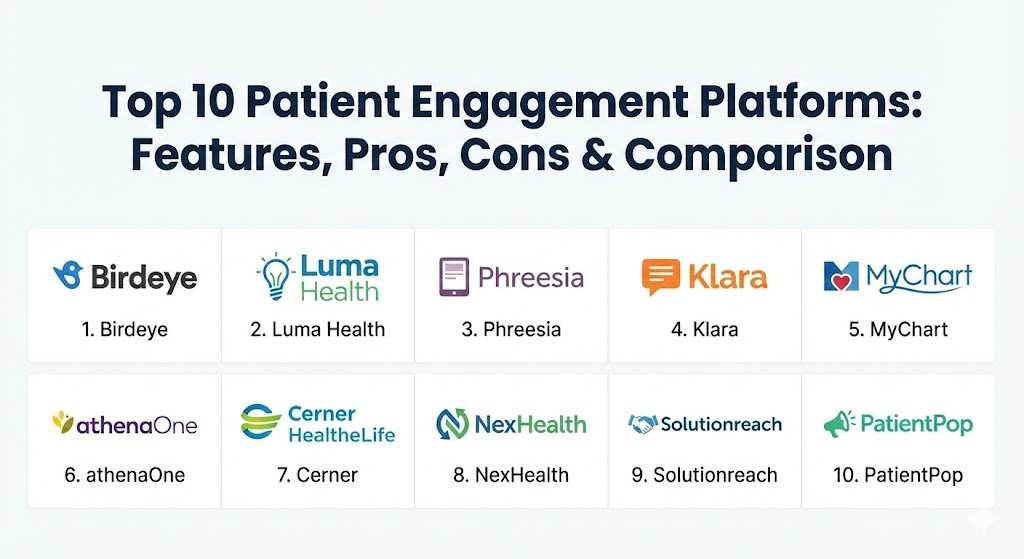
Top 10 Patient Engagement Platforms
1 — Birdeye
Birdeye is an industry-leading agentic marketing and patient engagement platform. It is widely recognized for its AI-powered “Messaging AI” and reputation management tools, making it the top choice for multi-location healthcare brands that want to grow their practice while maintaining high-touch patient relationships.
- Key features:
- AI agents for automated review requests and social messaging responses.
- Unified inbox for SMS, web chat, and social media interactions.
- Advanced reputation management and sentiment analysis.
- Multi-location governance for standardized patient communication.
- Seamless integration with major EHR systems like Epic and Cerner.
- HIPAA-compliant messaging and appointment reminders.
- Patient survey tools to track Net Promoter Scores (NPS).
- Pros:
- Excellent for improving online visibility and patient acquisition through reviews.
- The most awarded platform for usability and implementation in the current market.
- Cons:
- The vast feature set can be overwhelming for smaller, single-site practices.
- Premium AI features require higher-tier subscription plans.
- Security & compliance: HIPAA, SOC 2 Type II, GDPR, and SSO integration.
- Support & community: 24/7 enterprise support, comprehensive “Birdeye University” training, and an active community of healthcare marketers.
2 — Luma Health
Luma Health’s Patient Success Platform focuses on unifying the patient journey across operational, clinical, and financial touchpoints. It is designed for health systems that need to fill “schedule gaps” through intelligent automation.
- Key features:
- Intelligent appointment scheduling and automated waitlist management.
- Integration with over 80 different EHR systems.
- Digital intake forms and centralized patient registration.
- Real-time SMS and broadcast messaging for population health.
- Referral management workflows to capture out-of-network leads.
- Multilingual support for diverse patient populations.
- Pros:
- Exceptionally high ROI through the automated “filling” of canceled slots.
- Strong “patient-first” design that minimizes friction in the booking process.
- Cons:
- Some customization of the “patient flow” requires technical assistance from their team.
- Higher price point compared to simple “reminder-only” tools.
- Security & compliance: HIPAA compliant, SOC 2, and data encryption at rest and in transit.
- Support & community: Dedicated customer success managers for enterprise clients and a robust online knowledge base.
3 — Phreesia
Phreesia is the gold standard for patient intake and front-desk automation. It replaces the “clipboard” experience with a digital-first check-in process that streamlines everything from insurance verification to payment collection.
- Key features:
- Mobile and tablet-based patient check-in and intake.
- Automated insurance verification and real-time co-pay collection.
- Targeted patient education and health screening prompts.
- Patient satisfaction surveys with real-time staff alerts.
- Clinical screening for social determinants of health (SDOH).
- Integration with existing practice management and billing systems.
- Pros:
- Significantly reduces administrative burden and front-desk staff burnout.
- Highly effective at increasing point-of-service collections and revenue.
- Cons:
- Primarily focused on the “intake” part of the journey; lacks some marketing depth.
- Patients may find the frequent payment prompts a bit intrusive.
- Security & compliance: PCI DSS Level 1, HIPAA, SOC 2, and HITRUST certified.
- Support & community: Extensive documentation and specialized onboarding teams for large medical groups.
4 — Klara
Klara is a communication-centric platform that aims to replace phone calls and fragmented emails with a single, unified “collaboration hub” for the entire care team and the patient.
- Key features:
- Secure two-way messaging for patients and internal staff.
- “Call-to-text” functionality to divert phone volume to secure chat.
- Automated reminders and digital intake form delivery.
- Voicemail transcription directly into the patient inbox.
- Team-based messaging to discuss patient cases securely.
- Integrated telehealth video visits.
- Pros:
- Drastically reduces phone tag and administrative “noise” in the office.
- Very easy for patients to use without needing to download a separate app.
- Cons:
- Not a full-scale practice management system; strictly communication-focused.
- Integration with some legacy EHRs can be less “seamless” than competitors.
- Security & compliance: HIPAA compliant, SOC 2, and end-to-end encryption.
- Support & community: Strong onboarding support and a helpful library of pre-built message templates.
5 — MyChart (by Epic Systems)
MyChart is the industry’s most widely adopted patient portal. As a native component of the Epic EHR ecosystem, it offers a level of data depth and integration that third-party tools struggle to match for large health systems.
- Key features:
- Full access to health records, lab results, and immunization history.
- Direct scheduling for in-person and telehealth visits.
- Secure messaging with the entire care team.
- Family access (proxy) for managing pediatric or elderly health.
- Integration with bedside engagement tools in hospital settings.
- Personalized care plans and educational health tips.
- Pros:
- Deep, native integration with the clinician’s existing workflow in Epic.
- High patient trust and familiarity due to widespread use across hospitals.
- Cons:
- Limited flexibility; if you don’t use Epic EHR, you can’t use MyChart.
- The interface can be complex for patients managing multiple conditions.
- Security & compliance: Industry-leading HIPAA, GDPR, and NIST-standard security.
- Support & community: Extensive enterprise support from Epic; massive global user community.
6 — athenaOne (athenaCommunicator)
Part of the athenahealth suite, this platform is a cloud-based solution that excels in the ambulatory and independent practice market. It focuses on closing “care gaps” through automated outreach.
- Key features:
- Automated care gap outreach based on clinical data.
- Online patient scheduling and self-service registration.
- Group-based broadcast messaging for clinic closures or health alerts.
- Integrated billing and online payment portals.
- Multi-channel reminders (voice, text, email).
- Dashboards to track patient engagement metrics.
- Pros:
- The unified cloud platform makes updates and data syncing instant.
- Excellent at identifying and reaching out to patients who are overdue for care.
- Cons:
- The “all-in-one” approach means it is less customizable for specific niches.
- Pricing is often tied to practice revenue, which can be expensive for high-margin clinics.
- Security & compliance: HIPAA, SOC 2, and ISO 27001 compliant.
- Support & community: Robust client success program and the “athenahealth Marketplace” for third-party add-ons.
7 — Cerner HealtheLife
Oracle Cerner’s primary patient engagement platform is designed for large enterprise health systems. It focuses on the “patient-as-partner” model, offering tools for long-term health management.
- Key features:
- Centralized portal for health records and appointment history.
- Telehealth visit integration within the portal app.
- Health goal setting and progress tracking for chronic disease.
- Secure messaging and prescription refill requests.
- Family management for tracking multiple household members.
- Seamless synchronization with the Cerner Millennium EHR.
- Pros:
- Exceptional scalability for multi-hospital systems.
- Strong tools for long-term “wellness” and preventative care tracking.
- Cons:
- The mobile app interface can feel slightly dated compared to “consumer” apps.
- Setup and implementation are complex and require significant IT resources.
- Security & compliance: HIPAA, GDPR, and FedRAMP certified for government use.
- Support & community: Enterprise-grade support from Oracle; extensive global network of consultants.
8 — NexHealth
NexHealth is known as the “API for healthcare.” It differentiates itself through its incredibly fast and deep real-time synchronization with dental and medical practice management systems.
- Key features:
- True 1-click online booking that syncs instantly with the schedule.
- Automated reminders and recall campaigns.
- Digital intake forms and secure online payments.
- “Waitlist” feature to automatically text patients when a slot opens.
- Modern, high-conversion online presence tools.
- Robust developer API for custom health-tech builds.
- Pros:
- The fastest sync speed in the industry; no more “double bookings.”
- Extremely modern and intuitive user interface for both staff and patients.
- Cons:
- Primarily excels in dental and specialty ambulatory care; less suited for inpatient.
- High cost of entry for very small clinics.
- Security & compliance: HIPAA compliant, PCI DSS, and SOC 2.
- Support & community: High-touch onboarding and 24/7 technical support for high-volume groups.
9 — Solutionreach
Solutionreach is a veteran in the space, specifically designed for small-to-medium practices that want to increase patient retention through automated communication and recall.
- Key features:
- Automated recall campaigns for overdue appointments.
- SMS and email appointment reminders.
- Reputation management with automated review requests.
- “SR Conversations” for secure two-way texting.
- Patient education library with customizable newsletters.
- Integrated telehealth for remote consultations.
- Pros:
- Very effective at “reactivating” dormant patients who haven’t visited in years.
- Simple to set up and requires very little ongoing maintenance.
- Cons:
- Lacks the deep “clinical journey” tools found in enterprise platforms.
- The reporting dashboard is less detailed than newer AI-driven rivals.
- Security & compliance: HIPAA compliant and SOC 2 certified.
- Support & community: Excellent customer support with a dedicated “success coach” for most accounts.
10 — PatientPop (by Tebra)
PatientPop is a marketing-first engagement platform. It is designed to help practices grow by optimizing their entire digital footprint, from SEO to post-visit surveys.
- Key features:
- Full-service practice marketing and SEO optimization.
- Online scheduling and automated appointment reminders.
- Digital intake forms and registration workflows.
- Automated reputation management and review generation.
- Analytics dashboard for tracking patient acquisition costs.
- Integration with the broader Tebra (Kareo) ecosystem.
- Pros:
- Best-in-class for practices that are aggressively looking to grow their patient base.
- Takes the “guesswork” out of healthcare marketing and online presence.
- Cons:
- Focused heavily on “marketing”; clinical engagement features are secondary.
- Not suitable for large hospitals that already have an internal marketing team.
- Security & compliance: HIPAA compliant and SOC 2 Type II.
- Support & community: Strong partner network and extensive library of growth-focused webinars.
Comparison Table
| Tool Name | Best For | Platform(s) Supported | Standout Feature | Rating (Gartner/TrueReview) |
| Birdeye | Multi-location Brands | Web, iOS, Android | Agentic Messaging AI | 4.8 / 5 |
| Luma Health | EHR Integration | Web, Cloud | Intelligent Waitlist | 4.5 / 5 |
| Phreesia | Front-desk Automation | Tablet, Mobile, Web | Intake Payments | 4.4 / 5 |
| Klara | Team Communication | Web, Mobile | Call-to-Text Divert | 4.5 / 5 |
| MyChart | Epic EHR Users | Web, iOS, Android | Native Record Access | 4.0 / 5 |
| athenaOne | Ambulatory Cloud | Web, Mobile | Care Gap Outreach | 4.2 / 5 |
| Cerner HealtheLife | Enterprise Systems | Web, iOS, Android | Health Goal Tracking | 3.9 / 5 |
| NexHealth | Real-time Scheduling | Web, Mobile | 1-Click Sync API | 4.7 / 5 |
| Solutionreach | Patient Retention | Web, Desktop | Automated Recall | 4.2 / 5 |
| PatientPop | Practice Growth | Web, Cloud | SEO & Review Mgmt | 4.3 / 5 |
Evaluation & Scoring of Patient Engagement Platforms
To determine the true value of a platform, we use a weighted scoring rubric that prioritizes clinical impact and ease of adoption.
| Category | Weight | Evaluation Criteria |
| Core Features | 25% | Scheduling, reminders, intake, payments, and secure messaging depth. |
| Ease of Use | 15% | Frictionless experience for elderly patients and non-tech-savvy staff. |
| Integrations | 15% | Depth of real-time bidirectional sync with EHR/EMR systems. |
| Security | 10% | HIPAA compliance, SOC 2, HITRUST, and encryption standards. |
| Reliability | 10% | System uptime, sync speed, and delivery rates for SMS/email. |
| Support | 10% | Onboarding quality, specialized healthcare support, and documentation. |
| Price / Value | 15% | ROI measured through reduced no-shows and staff time savings. |
Which Patient Engagement Platform Is Right for You?
Selecting a platform depends on where your practice currently feels the most “pain.”
- Solo Practitioners & Small Clinics: If your goal is just to stop phone tag and send reminders, Klara or Solutionreach offer the best value without overwhelming you with enterprise features.
- Growing Mid-Market Practices: If you are focused on expansion and reputation, Birdeye and PatientPop are the strongest contenders. They provide the marketing engine needed to acquire new patients while automating the engagement of existing ones.
- Dental and Specialty Groups: NexHealth is specifically optimized for high-velocity scheduling and deep practice management integration, making it a favorite for dentists and specialists.
- Large Health Systems (Enterprise): If you are an Epic or Cerner house, starting with MyChart or HealtheLife is standard. However, many systems layer a tool like Luma Health or Phreesia on top to handle the complex intake and scheduling gaps that native portals sometimes miss.
- Focus on Efficiency: If your front desk is drowning in paperwork, Phreesia is the non-negotiable choice for automating intake and insurance.
Frequently Asked Questions (FAQs)
1. What is a Patient Engagement Platform?
It is a suite of digital tools—including messaging, scheduling, and portals—that helps healthcare providers stay connected with patients outside of the clinical visit.
2. How do these platforms help reduce “no-shows”?
By sending automated, multi-channel reminders (text, voice, email) and allowing patients to confirm or reschedule with a single click, these tools significantly improve attendance rates.
3. Is my patient data safe on these platforms?
Top-tier platforms are HIPAA-compliant and often SOC 2 or HITRUST certified, using advanced encryption to ensure that sensitive health data is never compromised.
4. Do patients have to download an app to use these?
Many modern platforms like Klara and Birdeye use web-based or SMS-based communication, meaning patients do not need to download an app to message their doctor or book a visit.
5. Can these tools integrate with my current EHR?
Most leading platforms offer bidirectional integration with major EHRs like Epic, Cerner, eClinicalWorks, and athenahealth, though the “depth” of the sync varies by tool.
6. What is “Reputation Management” in healthcare?
It is the process of automatically asking patients for feedback or reviews after a visit to ensure a practice has a positive, accurate online presence on sites like Google and Healthgrades.
7. How do these tools improve health outcomes?
They improve adherence by sending medication reminders, educational content, and follow-up care plans, ensuring patients follow their treatment protocols correctly.
8. Can I collect payments through these platforms?
Yes, tools like Phreesia and NexHealth allow you to collect co-pays and outstanding balances digitally during the intake process or via text-to-pay links.
9. Are these platforms difficult for elderly patients to use?
The best platforms prioritize “frictionless” design with simple buttons, large text, and SMS-based interactions that do not require complex logins.
10. What is a “Care Gap Outreach”?
It is an automated message sent to patients who are overdue for preventative screenings or follow-ups (e.g., reminding a patient it’s time for their annual wellness visit).
Conclusion
Patient engagement is no longer a “nice-to-have” luxury; it is the competitive frontline of modern medicine. The “best” platform for your organization isn’t necessarily the one with the most features, but the one that your patients will actually use and that your staff won’t find burdensome to manage. Whether you prioritize front-desk efficiency with Phreesia, marketing growth with Birdeye, or seamless EHR integration with MyChart, the goal remains the same: creating a connected, frictionless healthcare journey that improves both the bottom line and the quality of care.