Introduction
Patch Management Tools are specialized software solutions designed to automate the process of discovering, testing, and deploying updates to a network of computers. These updates, or “patches,” are released by software vendors to fix security vulnerabilities (closing the door on hackers), resolve software bugs (preventing system crashes), and introduce new features. In essence, these tools act as an automated maintenance crew for your entire digital estate, ensuring that every laptop, server, and workstation is running the latest and most secure version of its software.
The importance of these tools is underscored by a sobering reality: the majority of successful cyberattacks exploit vulnerabilities for which a patch has existed for months, if not years. Key real-world use cases include ensuring that remote employees’ laptops receive critical Windows updates over home Wi-Fi, automatically updating high-risk third-party apps like Google Chrome or Zoom across an entire fleet, and generating compliance reports to prove to insurers or auditors that a network is fully secure.
When choosing a tool in 2026, users should evaluate several critical factors: the breadth of the third-party application library, the reliability of the automation engine, the speed of deployment over low-bandwidth connections, and the depth of reporting provided for compliance purposes.
Best for: IT administrators, Security Operations (SecOps) teams, and Managed Service Providers (MSPs) who are responsible for maintaining 50 to 50,000+ endpoints. It is essential for organizations in highly regulated industries—such as finance, healthcare, and government—where unpatched systems represent a significant legal and financial liability.
Not ideal for: Very small home offices or micro-businesses with fewer than five computers, where the built-in “Automatic Updates” feature of Windows or macOS is usually sufficient. It is also less relevant for teams running entirely on proprietary, custom-coded hardware that doesn’t utilize standard commercial operating systems or third-party software.
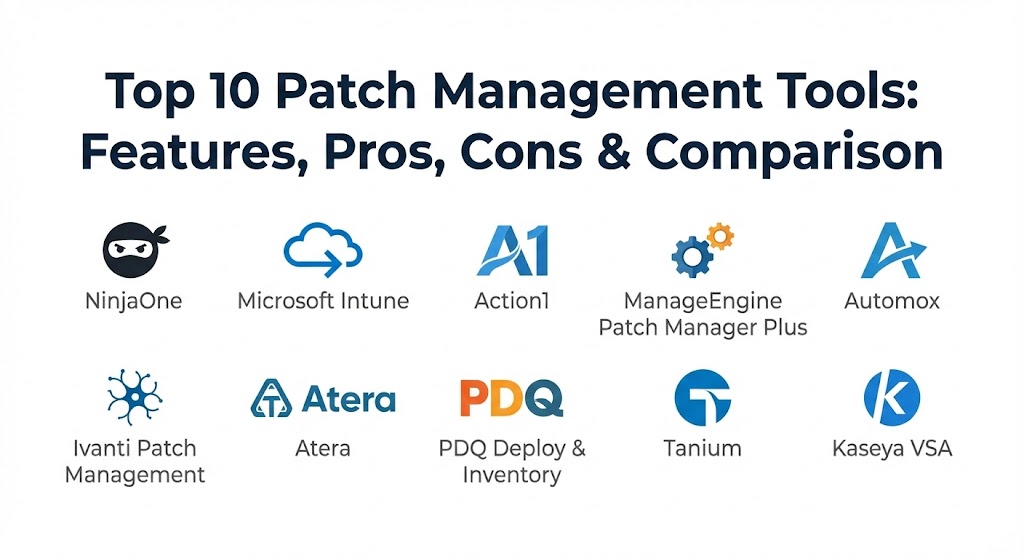
Top 10 Patch Management Tools
1 — NinjaOne
NinjaOne is a modern, cloud-native IT management platform that has consistently ranked at the top of the industry for its speed and ease of use. It is designed for both internal IT departments and MSPs who want a “single pane of glass” to manage everything from patching to remote monitoring.
- Key features:
- Automated Cross-Platform Patching: Handles Windows, macOS, and Linux updates from a single console.
- Massive 3rd-Party Library: Automates updates for over 200 popular applications like Adobe, Slack, and Zoom.
- Policy-Based Automation: Create a “set and forget” schedule for different groups of devices (e.g., Servers vs. Laptops).
- Reboot Scheduling: Fine-grained control over when devices restart to minimize user disruption.
- Individual Patch Approval: The ability to manually block or approve specific updates before they go live.
- Cloud-First Architecture: Patches devices anywhere in the world as long as they have an internet connection.
- Pros:
- One of the fastest and most responsive web interfaces in the IT software market.
- Exceptionally high rating for customer support and a very gentle learning curve for new admins.
- Cons:
- Premium pricing that may be a stretch for very small businesses with tight budgets.
- Lacks some of the ultra-deep, legacy on-premise controls found in tools like MECM.
- Security & compliance: SOC 2 Type II, GDPR, HIPAA, ISO 27001, SSO integration, and 256-bit encryption.
- Support & community: 24/7 global support, highly rated “NinjaOne Academy” for training, and a very active modern user community on Slack and Discord.
2 — Microsoft Intune (with MECM)
Microsoft Intune is the “native” choice for Windows-centric environments. As a cornerstone of the Microsoft 365 ecosystem, it has evolved into a powerful cloud-based Unified Endpoint Management (UEM) tool that bridges the gap between traditional on-premise patching and modern cloud management.
- Key features:
- Windows Autopatch: A service that automatically manages the rollout of Windows and Microsoft 365 updates.
- Conditional Access: Prevents unpatched or non-compliant devices from accessing corporate data.
- Update Rings: Allows IT to test updates on a small group (Ring 0) before rolling out to the whole company.
- Intune Suite Add-ons: Advanced features for third-party app management and privilege elevation.
- Co-Management with MECM: Allows you to manage legacy on-prem servers and modern remote laptops simultaneously.
- Granular Reporting: Deep integration with Azure to provide high-level compliance dashboards.
- Pros:
- Seamless integration if your organization is already paying for Microsoft 365 E3 or E5 licenses.
- The undisputed leader for managing deep Windows OS settings and security baselines.
- Cons:
- The interface can be incredibly complex and often requires a dedicated expert to configure correctly.
- Patching non-Microsoft (Third-Party) apps is traditionally more difficult than in specialized tools.
- Security & compliance: FedRAMP High, SOC 1/2/3, ISO 27001, GDPR, HIPAA, and deep Entra ID (SSO) integration.
- Support & community: Massive global enterprise support network, extensive documentation (Microsoft Learn), and thousands of community forums.
3 — Action1
Action1 has seen a meteoric rise in popularity by focusing specifically on the needs of remote and hybrid workforces. It is a cloud-based solution that prioritizes simplicity and high-speed remediation of security vulnerabilities.
- Key features:
- Real-Time Vulnerability Assessment: Instantly identifies which endpoints are missing critical security patches.
- Automated 3rd-Party Patching: A robust, curated library that handles the heavy lifting of updating non-OS apps.
- Cloud-Based P2P Distribution: Uses a peer-to-peer model to distribute large patches, saving office bandwidth.
- Remote Desktop Integration: Allows admins to hop onto a machine directly from the patch report to fix issues.
- Zero-Infrastructure: No servers or VPNs required; everything is managed via the Action1 secure cloud.
- Policy-Based Reboot Management: Ensures updates are finalized without annoying the end-user mid-meeting.
- Pros:
- Incredibly easy to get started; you can often see your first patch report within 10 minutes.
- Excellent for very distributed teams where traditional VPN-based patching fails.
- Cons:
- As a newer player, the ecosystem of integrations (with CRMs or Help Desks) is still growing.
- Some users find the reporting visualizations to be a bit basic compared to enterprise giants.
- Security & compliance: SOC 2 Type II, GDPR, ISO 27001, HIPAA, and MFA/SSO support.
- Support & community: Responsive chat support, clear documentation, and a growing community of cloud-native IT pros.
4 — ManageEngine Patch Manager Plus
ManageEngine is a veteran in the IT space, and Patch Manager Plus is their dedicated solution for cross-platform patch management. It is known for its incredible depth and support for an enormous range of third-party software.
- Key features:
- Support for 850+ 3rd-Party Apps: One of the largest libraries in the industry, covering everything from browsers to dev tools.
- Cross-Platform Parity: Offers nearly identical patching depth for Windows, macOS, and Linux.
- Test and Approve: Automated workflows to deploy patches to a test group before broad distribution.
- Decline Patches: The ability to permanently or temporarily skip specific updates that are known to cause bugs.
- Automated Vulnerability Scanning: Proactively searches for security holes beyond just missing patches.
- On-Premise or Cloud: One of the few top-tier tools that still offers a robust on-premise installation option.
- Pros:
- The depth of third-party support is almost unrivaled, making it a favorite for “complex” software environments.
- Very competitive pricing, especially for the on-premise version.
- Cons:
- The user interface is functional but can feel cluttered and “industrial” compared to modern startups.
- The mobile app for admins is a bit limited in its current form.
- Security & compliance: ISO, GDPR, HIPAA, SOC 2, and 256-bit AES encryption.
- Support & community: 24/5 global support, an extensive library of “how-to” videos, and a very large, traditional user base.
5 — Automox
Automox is built for the modern DevOps and SecOps era. It emphasizes “IT operations as code,” allowing for massive scale and highly customizable automation through a sleek, modern cloud interface.
- Key features:
- Worklets: A powerful feature that allows admins to write custom scripts to automate any IT task across the fleet.
- Zero-Infrastructure Cloud: Fully managed in the cloud with no need for management servers or complex VPN setups.
- OS Agnostic: Unified management of Windows, macOS, and Linux (including various distros like Ubuntu and RHEL).
- Continuous Patching: The agent constantly checks for compliance rather than waiting for a daily scan.
- Third-Party Catalog: High-speed automation for the most common non-OS applications.
- API-First Design: Easy to integrate into larger security orchestration (SOAR) or CI/CD pipelines.
- Pros:
- The “Worklets” feature is a game-changer for admins who want total control through scripting.
- Modern, clean aesthetics that make it easy for security teams to collaborate with IT teams.
- Cons:
- Can be more expensive than traditional tools if you need high-frequency scanning.
- Initial setup of custom Worklets requires a solid understanding of PowerShell or Bash.
- Security & compliance: SOC 2 Type II, GDPR, HIPAA, ISO 27001, and SSO/MFA support.
- Support & community: High-quality technical support, a “Worklet Catalog” shared by the community, and active forums.
6 — Ivanti Patch Management
Ivanti (formerly Shavlik and MobileIron) is a heavyweight in the enterprise world. They specialize in high-security, high-complexity environments that require absolute control and deep reporting.
- Key features:
- Risk-Based Patching: Prioritizes updates based on actual exploit data, not just vendor severity levels.
- Ivanti Neurons: An AI-powered layer that predicts which patches are most likely to fail or cause issues.
- Deep Linux Support: One of the best options for enterprises managing massive server farms in the data center.
- Offline Patching: The ability to patch systems that aren’t currently connected to the internet (via secure gateways).
- Agentless and Agent-Based: Flexibility to choose how you manage your devices based on security needs.
- Unified Endpoint Manager Integration: Seamlessly links with their larger UEM suite.
- Pros:
- The AI-driven “risk-based” approach is world-class for helping teams focus on what matters most.
- Strongest heritage in managing air-gapped or extremely high-security government environments.
- Cons:
- The platform can be very “heavy” and requires significant training for new staff.
- Implementation projects can take months for larger organizations.
- Security & compliance: FedRAMP, SOC 2, ISO 27001, GDPR, HIPAA, and PCI-DSS.
- Support & community: Global enterprise support, specialized consulting partners, and a long-standing user community.
7 — Atera
Atera is specifically designed for MSPs and small IT teams that want an “all-in-one” solution. It combines patch management with remote support, billing, and ticketing in a unique pricing model.
- Key features:
- Per-Technician Pricing: Unlimited endpoints for a flat monthly fee per admin—uniquely affordable for growth.
- Automated IT Automation Profiles: Create complex workflows (e.g., “Clean disk, then patch, then reboot”).
- Third-Party Integration: Uses Chocolatey (Windows) and Homebrew (Mac) to automate a vast app library.
- Real-Time Alerts: Instantly notifies the admin if a patch fails or a device becomes non-compliant.
- Shared Script Library: Thousands of community-made scripts to handle niche patching needs.
- Mobile App Admin: One of the most functional mobile apps for managing patches on the move.
- Pros:
- The pricing model is unbeatable for companies that have a lot of devices but few IT staff.
- Combines everything an MSP needs into a single, clean dashboard.
- Cons:
- Because it’s a generalist tool, the “depth” of patch reporting is less than specialized tools like Ivanti.
- The Chocolatey/Homebrew integrations can sometimes be less reliable than a curated vendor-owned library.
- Security & compliance: SOC 2 Type II, GDPR, HIPAA, and MFA support.
- Support & community: 24/7 support, a very active community of MSP owners, and extensive webinar training.
8 — PDQ Deploy & Inventory
PDQ is a cult favorite among system administrators who love “no-nonsense,” local-network software. It is a powerhouse for on-premise Windows environments that don’t want or need the cloud.
- Key features:
- Local Network Speed: Lightning-fast deployments within an office or via VPN.
- Dynamic Collections: Automatically groups devices by OS, CPU, or missing software (e.g., “All PCs with old Java”).
- Massive Library of Ready-to-Deploy Apps: Over 250 pre-packaged apps that PDQ keeps updated for you.
- Simple Logic: Uses a “Step-based” deployment (e.g., “Run script, install MSI, run command”).
- No Agent Required: Can manage devices without installing a permanent agent on every PC.
- Integration with Active Directory: Pulls your computer lists directly from your existing domain.
- Pros:
- The community loves the “it just works” nature and the transparent, low-cost pricing.
- No cloud dependency means you have total control over your data locally.
- Cons:
- Traditionally weak for remote employees who aren’t on a VPN.
- Does not natively support macOS or Linux patching.
- Security & compliance: Local control (your security is your own), supports encryption, but less relevant for cloud certifications.
- Support & community: Famous for their YouTube tutorials and “The Patch Tuesday” live streams.
9 — Tanium
Tanium is the “Formula 1” of patch management. It is designed for the world’s largest organizations (think 100,000+ endpoints) that need real-time data and near-instant deployment speeds.
- Key features:
- Linear-Chain Architecture: A unique way of distributing patches that uses almost zero network bandwidth.
- Real-Time Visibility: Ask a question (e.g., “How many PCs have this vuln?”) and get an answer in seconds.
- Global Scale: Capable of patching an entire global workforce in minutes rather than days.
- Integrated EDR: Combines security hunting with patch remediation in the same agent.
- Continuous Compliance: Automatically identifies and fixes “drift” from the corporate gold standard.
- Cloud or On-Premise: Highly flexible deployment for the most demanding security needs.
- Pros:
- The only tool that can handle “massive” scale without slowing down the network.
- Provides a level of visibility that makes IT teams feel like they have “superpowers.”
- Cons:
- Extremely high price point; essentially out of reach for small and medium businesses.
- Requires specialized training (Tanium Certified) to operate effectively.
- Security & compliance: FedRAMP, SOC 2, ISO 27001, GDPR, HIPAA, and advanced audit logs.
- Support & community: High-end technical account managers, specialized enterprise training, and a focused user community.
10 — Kaseya VSA
Kaseya VSA is a high-automation platform that has been a staple of the MSP industry for decades. It is known for its ability to handle complex, multi-tenant environments with ease.
- Key features:
- Policy-Based Patching: Highly granular rules for when and how different companies or departments are updated.
- Software Management: A dedicated module for automating third-party application rollouts.
- Agent Procedures: A library of scripts that can be used to prepare a system for patching or fix it if a patch fails.
- Integrated Monitoring: Sees the health of the hardware and the patch status in a single dashboard.
- Remote Control: Built-in high-performance remote access for troubleshooting.
- IT Complete Ecosystem: Deeply integrates with other Kaseya tools like Datto and IT Glue.
- Pros:
- Excellent for automation-heavy teams that want to minimize human touch-points.
- Very strong for MSPs managing hundreds of different small client networks.
- Cons:
- The user interface has a significant learning curve and can feel dated in some areas.
- Has faced high-profile security challenges in the past, though they have significantly hardened the platform since.
- Security & compliance: SOC 2, GDPR, HIPAA, and enhanced post-breach security protocols.
- Support & community: Large global user base, “Kaseya Connect” conferences, and extensive documentation.
Comparison Table
| Tool Name | Best For | Platform(s) Supported | Standout Feature | Rating (Gartner) |
| NinjaOne | Modern IT / MSPs | Win, Mac, Linux | Ease of Use & UI Speed | 4.8 / 5 |
| Microsoft Intune | Windows Enterprises | Win, Mac, iOS, Android | Native M365 Integration | 4.5 / 5 |
| Action1 | Remote Workforces | Win | Cloud-Native P2P Speed | 4.7 / 5 |
| ManageEngine | Deep 3rd-Party Support | Win, Mac, Linux | 850+ App Library | 4.5 / 5 |
| Automox | DevOps / SecOps | Win, Mac, Linux | Custom Script “Worklets” | 4.6 / 5 |
| Ivanti | High-Security Enterprise | Win, Mac, Linux | Risk-Based AI Prioritization | 4.4 / 5 |
| Atera | Small MSPs / SMBs | Win, Mac | Per-Technician Pricing | 4.6 / 5 |
| PDQ | On-Prem Windows Admins | Windows | No-Nonsense Local Control | 4.7 / 5 |
| Tanium | Massive-Scale Orgs | Win, Mac, Linux | Real-Time Global Visibility | 4.6 / 5 |
| Kaseya VSA | Automation-Heavy MSPs | Win, Mac, Linux | Multi-Tenant Automation | 4.3 / 5 |
Evaluation & Scoring of Patch Management Tools
To choose the right tool, you need to look past the marketing. Below is our weighted scoring rubric based on what actually matters in a 2026 production environment.
| Criteria | Weight | Evaluation Focus |
| Core Features | 25% | OS support depth, 3rd-party library size, and reboot logic. |
| Ease of Use | 15% | Intuitiveness of the dashboard and speed of the agent installation. |
| Integrations | 15% | Connectivity with Help Desk (PSA), CRM, and Security (EDR) tools. |
| Security & Compliance | 10% | Encryption standards, SOC 2 status, and MFA/SSO availability. |
| Performance | 10% | Bandwidth usage and impact on the end-user’s device speed. |
| Support & Community | 10% | Quality of documentation, forums, and technical response times. |
| Price / Value | 15% | ROI for the specific target market (e.g., per-node vs. per-user). |
Which Patch Management Tool Is Right for You?
Solo Users vs. SMB vs. Mid-Market vs. Enterprise
If you are an SMB with 25–100 devices, Action1 or Atera are the most logical places to start; they are fast to set up and very affordable. Mid-market companies (200–1,000 devices) often find the most balance in NinjaOne or ManageEngine. For Global Enterprises, the choice usually boils down to the “big three”: Microsoft Intune (for Windows-first), Ivanti (for security-first), or Tanium (for scale-first).
Budget-Conscious vs. Premium Solutions
If budget is your primary concern, ManageEngine and PDQ offer the most features for every dollar spent on-premise. If you have an unlimited budget and need the “absolute best” for a huge fleet, Tanium is the premium choice. Atera is the “hack” for growing teams because its per-technician pricing means your costs don’t increase as you add more computers.
Feature Depth vs. Ease of Use
For ease of use, NinjaOne is the current industry champion. Your team will enjoy using it, which means they’ll actually do the patching. For feature depth, Automox (via Worklets) and Ivanti offer the most control for admins who want to tweak every possible setting in their environment.
Frequently Asked Questions (FAQs)
1. Why do I need a tool if Windows has “Windows Update”?
Windows Update only handles Microsoft software. It won’t update your Chrome browser, your Slack app, or your PDF reader—which are often the biggest security risks. A patch management tool handles all of them in one place.
2. Can I manage remote workers who are never in the office?
Yes. In 2026, tools like NinjaOne, Automox, and Action1 are cloud-native. They communicate with devices over the internet, so a worker at a coffee shop is just as easy to patch as a worker in the office.
3. Will patching slow down my employees’ computers?
If configured correctly, the impact is minimal. Modern tools can “throttle” bandwidth usage and schedule updates to run during lunch hours or at night so the user never feels a slowdown.
4. What is a “Third-Party App” in patching?
This refers to any software not made by the OS vendor (Microsoft or Apple). Examples include Zoom, Google Chrome, Adobe Acrobat, and Spotify. These often have more frequent security holes than the OS itself.
5. How often should I be patching?
Critical security patches should ideally be deployed within 24–48 hours of release. For non-critical bug fixes, most companies roll them out once a week (often on “Patch Tuesday” or Wednesday).
6. Can I patch Mac and Linux from the same tool as Windows?
Yes. Cross-platform tools like NinjaOne, ManageEngine, and Automox allow you to manage all three from a single dashboard.
7. What is “Patch Testing”?
It is the process of deploying a patch to a small “pilot group” of computers first. If those computers don’t crash after 24 hours, you then roll the patch out to the rest of the company.
8. Is “Agentless” patching better?
Agentless is easier because you don’t have to install software, but it usually requires a VPN or local network connection. “Agent-based” is better for remote work because it works over any internet connection.
9. Can these tools help with HIPAA or GDPR compliance?
Yes. They provide the “Audit Logs” and “Compliance Reports” that prove your systems were updated, which is a key requirement for most modern data privacy laws.
10. What happens if a patch breaks a computer?
High-quality tools offer a “Rollback” feature, allowing you to quickly uninstall the problematic update and return the computer to its previous working state.
Conclusion
Patch management is no longer a “nice-to-have” IT function; it is a fundamental pillar of modern business survival. In 2026, a single unpatched laptop is all it takes to bring down an entire corporate network.
The “best” tool is the one that fits your team’s workflow. Whether you choose the user-friendly speed of NinjaOne, the native ecosystem of Microsoft Intune, or the massive scale of Tanium, the goal is the same: visibility and automation. Don’t wait for a breach to realize your systems are out of date. Start with a trial of one of the cloud-native tools listed above and close your security gaps today.