Introduction
Nutrition Practice Management Tools are specialized, all-in-one software platforms designed to centralize the clinical and administrative workflows of nutrition professionals. Unlike generic office software, these tools are built to handle the unique nuances of a nutrition practice, such as nutrient analysis, food journaling, body composition tracking, and complex meal plan delivery. By integrating telehealth, scheduling, and billing into a single hub, these platforms allow practitioners to spend less time on paperwork and more time on patient care.
The importance of these tools lies in their ability to foster client accountability and improve clinical outcomes. Real-world use cases include automating a client’s intake forms, providing real-time feedback on a digital food journal, and securely processing insurance superbills or credit card payments. When evaluating these tools, users should look for strong mobile accessibility, deep integration with wearables (like Apple Health or Fitbit), robust security protocols, and the ability to scale as the practice grows from a solo operation to a multi-provider clinic.
Best for: Registered Dietitians (RDs), nutritionists, health coaches, and integrative medicine clinics of all sizes. They are particularly beneficial for practitioners who need to maintain strict HIPAA or GDPR compliance while managing a high volume of recurring appointments and personalized dietary protocols.
Not ideal for: Fitness-only trainers who do not provide dietary advice, or very large hospital systems that already utilize comprehensive medical EHRs (like Epic or Cerner) where a niche nutrition tool might create unnecessary data silos.
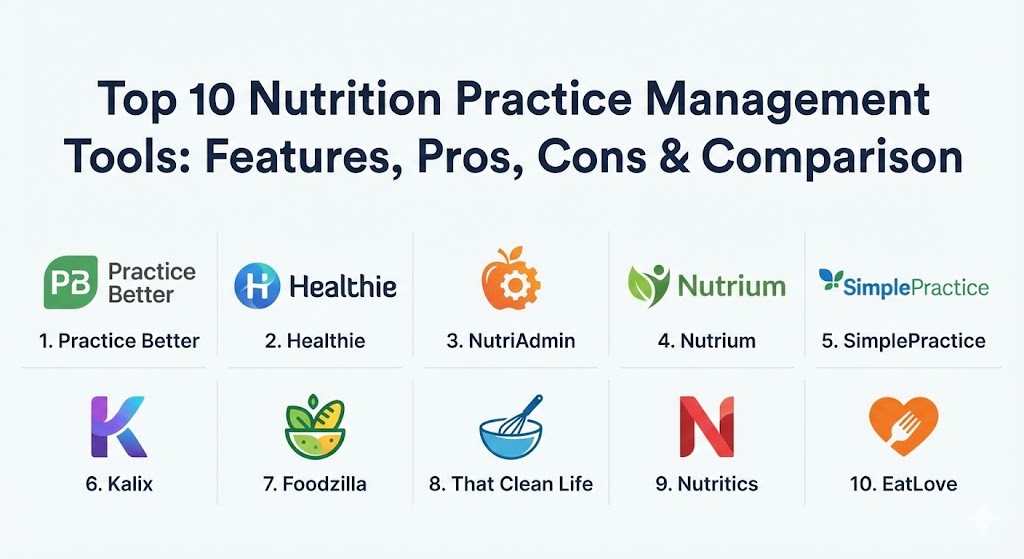
Top 10 Nutrition Practice Management Tools
1 — Practice Better
Practice Better is widely considered the industry leader for integrated wellness management. It is a comprehensive “virtual command center” designed to handle everything from client onboarding and program delivery to advanced metabolic tracking.
- Key features:
- HIPAA-compliant telehealth and secure messaging.
- Automated program delivery for fixed-date or evergreen courses.
- Integrated food journaling with photo-logging capabilities.
- Robust wearable syncing (Oura, Garmin, Fitbit, Apple Health).
- Comprehensive supplement and lab integration (e.g., Fullscript).
- Professional billing, invoicing, and insurance superbill generation.
- Pros:
- Exceptionally deep automation that can virtually run a practice on “autopilot.”
- The most polished and reliable mobile app for both practitioners and clients.
- Cons:
- The sheer volume of features can lead to a steep learning curve for new users.
- Higher-tier pricing is required to access advanced automation and white-labeling.
- Security & compliance: HIPAA, GDPR, and PIPEDA compliant. Features include SSO, end-to-end encryption, and BAA (Business Associate Agreement) availability.
- Support & community: Top-tier documentation, regular webinars, and a massive “Better Together” community of wellness professionals.
2 — Healthie
Healthie is a powerful EHR and practice management platform built for both solo practitioners and large, multidisciplinary wellness organizations. It shines in its ability to support group coaching and insurance-heavy workflows.
- Key features:
- Full EHR capabilities with nutrition-specific clinical charting templates.
- Integrated “Chat” feature that replaces the need for separate messaging apps.
- Detailed outcome tracking and reporting for insurance reimbursement.
- Group program hosting with video conferencing.
- Extensive wearable integrations, including Dexcom CGM for glucose monitoring.
- Multi-provider scheduling and task management for teams.
- Pros:
- The strongest choice for practices that rely heavily on insurance billing and superbills.
- Highly scalable for large clinics needing complex administrative hierarchies.
- Cons:
- The user interface can feel more “clinical” and less “lifestyle-oriented” than competitors.
- Customization of the client experience often requires a higher price point.
- Security & compliance: HIPAA, SOC 2 Type II, and HITRUST certified. Includes audit logs and secure data hosting.
- Support & community: Offers dedicated account managers for larger teams and a comprehensive help center.
3 — NutriAdmin
NutriAdmin is a highly efficient, logical tool designed specifically for nutritionists who want to keep all their business processes in one straightforward place without the “fluff” of social-style coaching apps.
- Key features:
- Automated meal plan generator that builds plans based on calories and macros.
- Large database of over 360,000 recipes and 7 nutrition databases (USDA, AUSNUT, etc.).
- One-click client questionnaires that sync directly with clinical records.
- Professional report and document builder with auto-populated client data.
- Stripe integration for seamless payment collection.
- AI-powered recipe generator and nutrition analysis.
- Pros:
- Extremely fast at generating professional documentation and meal plans.
- Very straightforward interface that doesn’t require high technical proficiency.
- Cons:
- Currently lacks a dedicated native mobile app (uses a mobile-responsive web portal).
- Fewer “community” or “gamified” features for long-term client habit tracking.
- Security & compliance: HIPAA and GDPR compliant. Data is encrypted at rest and in transit.
- Support & community: Known for very fast email support (often under 2 hours) and clear video tutorials.
4 — Nutrium
Nutrium focuses heavily on the nutritional science side of practice management, making it a favorite for dietitians who prioritize accurate dietary analysis and adherence.
- Key features:
- Advanced nutrition analysis for over 30 nutrients.
- Direct client communication through a dedicated, interactive mobile app.
- Integrated appointment booking and automated email/SMS reminders.
- Meal planning with specific macro/micro targets and food exclusions.
- Progress tracking for weight, measurements, and metabolic markers.
- Financial management for tracking payments and revenue.
- Pros:
- Excellent balance between clinical data accuracy and client engagement.
- High-quality mobile app that simplifies the food logging process for clients.
- Cons:
- The administrative dashboard can feel a bit crowded with data points.
- Integration with third-party labs is not as deep as Practice Better or Healthie.
- Security & compliance: GDPR and HIPAA compliant. Uses SSL encryption and secure cloud storage.
- Support & community: Strong global presence with support available in multiple languages and a robust blog.
5 — SimplePractice
While SimplePractice is a general healthcare practice management tool, its “Wellness” version is a popular choice for nutritionists who want the most intuitive and aesthetically pleasing interface on the market.
- Key features:
- Fully paperless intake process with custom digital forms.
- One-click telehealth with no separate software required.
- Integrated credit card processing through Stripe.
- Mobile app for practitioners to manage their business on the go.
- Client portal for easy booking, billing, and document access.
- Professional website builder included in some plans.
- Pros:
- Widely considered the most user-friendly and visually clean platform.
- Simplifies the “business” side (taxes, billing, scheduling) better than almost any tool.
- Cons:
- Lacks niche nutrition features like meal planning or nutrient analysis.
- Not designed for high-volume program delivery or group coaching.
- Security & compliance: HIPAA-ready, HITRUST certified, and PCI compliant for payments.
- Support & community: Large user base with a massive library of help articles and community forums.
6 — Kalix
Kalix is an affordable, “no-nonsense” EHR and practice management solution designed specifically for independent dietitians who need clinical depth without a high monthly price tag.
- Key features:
- Highly customizable charting templates based on the Nutrition Care Process (NCP).
- Integrated faxing for communicating with doctors and specialists.
- Online booking and automated appointment reminders.
- Secure messaging and HIPAA-compliant telehealth.
- Insurance billing with direct clearinghouse integrations (Office Ally).
- Document storage and e-signatures for waivers and contracts.
- Pros:
- One of the most cost-effective options for practitioners just starting out.
- Excellent clinical charting flexibility that follows professional standards.
- Cons:
- The user interface feels dated and less “modern” than Practice Better or Healthie.
- Client engagement features (like food journals) are less interactive.
- Security & compliance: HIPAA and PIPEDA aligned. Offers BAA for all paid accounts.
- Support & community: Reliable customer support and a focused knowledge base for clinical users.
7 — Foodzilla
Foodzilla is a modern, mobile-first nutrition platform that excels in providing an engaging experience for younger, tech-savvy clients through its high-quality app.
- Key features:
- AI-assisted food logging that reduces the “friction” of manual data entry.
- Recipe builder and professional meal planner.
- In-app chat and real-time client monitoring.
- Automated shopping lists based on shared meal plans.
- Integration with Apple Health, Google Fit, and Garmin.
- Branded mobile app options for established practices.
- Pros:
- Very high engagement rates from clients due to the intuitive mobile experience.
- AI features for food logging significantly improve client adherence.
- Cons:
- Newer to the market, so it lacks some of the deep clinical history of older tools.
- The web-based admin dashboard is slightly less comprehensive than the app.
- Security & compliance: HIPAA and GDPR compliant. Encrypted data storage and secure login protocols.
- Support & community: Responsive technical support and a growing ecosystem of online resources.
8 — That Clean Life
While primarily a meal planning and recipe tool, That Clean Life has expanded its features to become a vital piece of the practice management puzzle for food-focused practitioners.
- Key features:
- Extensive library of thousands of tested, high-quality recipes.
- Drag-and-drop meal planning with automated nutrition facts.
- Grocery list generation with Instacart integration for easy shopping.
- Branded PDFs and digital meal plans that look professional and high-end.
- Dietary filters for specific conditions (PCOS, Anti-inflammatory, etc.).
- Integration with Practice Better and other major EHRs.
- Pros:
- Unmatched in the quality and presentation of meal plans and recipes.
- Saves practitioners hours of time spent on recipe research and formatting.
- Cons:
- Not a full EHR; it lacks native billing, telehealth, and clinical charting.
- Best used as an “add-on” rather than a standalone practice manager.
- Security & compliance: SOC 2 and GDPR compliant. Does not typically store patient PHI unless integrated.
- Support & community: Excellent documentation and an active “Inner Circle” community for practitioners.
9 — Nutritics
Nutritics is the choice for practitioners who require “research-grade” accuracy and deep clinical data for complex patient populations.
- Key features:
- World-class nutrition database with unmatched depth of micronutrient data.
- Interactive client app (Libro) for food logging and feedback.
- Professional report generation with visual data visualizations.
- Meal planning with costing and waste calculation (useful for clinics with kitchens).
- Anthropometric tracking for body composition and skinfolds.
- Integration with research tools and academic databases.
- Pros:
- The gold standard for data accuracy and clinical reporting.
- Highly professional dashboards that make complex data easy for clients to digest.
- Cons:
- Can be overly complex for a standard weight-loss or wellness coach.
- Pricing is generally higher, reflecting its professional/academic positioning.
- Security & compliance: ISO 27001 certified, GDPR and HIPAA compliant.
- Support & community: High-level enterprise support and extensive academic documentation.
10 — EatLove
EatLove is a unique “nutrition intelligence” platform that focuses on personalized meal planning at scale through advanced algorithms and grocery fulfillment.
- Key features:
- 24/7 personalized meal recommendations for over 30 health conditions.
- Integration with major grocery retailers for one-click ordering.
- Recipe database with over 5,000 dietitian-vetted options.
- Client dashboard for tracking adherence and preferences.
- Branded experience for providers to stay “front and center” for the client.
- Automated nutrient analysis based on real-world portions.
- Pros:
- Best-in-class for solving the “what should I eat for dinner?” problem for clients.
- High adherence rates because it makes the grocery run effortless.
- Cons:
- Lacks the deep clinical charting and insurance billing of a full EHR.
- The automation can sometimes feel “less personal” than a hand-crafted plan.
- Security & compliance: HIPAA compliant and secure data handling.
- Support & community: Strong onboarding support and professional webinars.
Comparison Table
| Tool Name | Best For | Platform(s) Supported | Standout Feature | Rating (Gartner/TrueReview) |
| Practice Better | All-in-One / Automation | Web, iOS, Android | Deep Wearable Syncing | 4.9 / 5 |
| Healthie | Insurance / Group Care | Web, iOS, Android | Multi-Provider Scaling | 4.8 / 5 |
| NutriAdmin | Efficiency / Documents | Web (Responsive) | Auto-Meal Plan Gen | 4.7 / 5 |
| Nutrium | Clinical Analysis | Web, iOS, Android | Micro/Macro Targeting | 4.6 / 5 |
| SimplePractice | Ease of Use / Admin | Web, iOS, Android | UI/UX Simplicity | 4.8 / 5 |
| Kalix | Budget-Conscious RDs | Web (Cloud) | NCP Charting Templates | 4.5 / 5 |
| Foodzilla | Tech-Savvy Clients | Web, iOS, Android | AI Food Logging | 4.6 / 5 |
| That Clean Life | High-End Meal Plans | Web (Cloud) | Instacart Integration | 4.9 / 5 |
| Nutritics | Research / Clinical | Web, iOS, Android | Research-Grade Data | 4.7 / 5 |
| EatLove | Meal Adherence | Web, iOS, Android | Grocery Fulfillment | 4.5 / 5 |
Evaluation & Scoring of Nutrition Practice Management Tools
To ensure we are recommending the best value for practitioners, we evaluated these tools against a weighted scoring rubric based on current 2026 industry standards.
| Category | Weight | Evaluation Metrics |
| Core Features | 25% | Charting, meal planning, billing, and telehealth capabilities. |
| Ease of Use | 15% | Intuitiveness of the UI and the speed of the onboarding process. |
| Integrations | 15% | Syncing with wearables, labs, supplements, and calendars. |
| Security | 10% | HIPAA/GDPR status, BAA availability, and encryption levels. |
| Performance | 10% | App stability, load times, and mobile responsiveness. |
| Support | 10% | Help desk speed, documentation, and user community access. |
| Price / Value | 15% | Total cost versus the administrative time saved per month. |
Which Nutrition Practice Management Tool Is Right for You?
Selecting the right tool depends on your current business stage and your specific clinical focus.
- Solo Users & New Practices: If you are just starting out, prioritize ease of use and low overhead. SimplePractice is excellent for general admin, while Kalix offers the best price-to-clinical depth ratio.
- Growing SMBs: If you are managing 20+ clients and want to automate your workflow, Practice Better is the undisputed champion of efficiency. Its ability to host programs and automate follow-ups will save you dozens of hours a month.
- Clinical & Research Focused: If your work requires high-precision data for metabolic conditions or academic research, Nutritics is the only tool that offers the necessary level of nutrient depth.
- Insurance & Large Teams: For those who manage multiple providers and bill insurance companies, Healthie provides the most robust back-end infrastructure to handle complex claims and team permissions.
- Meal Plan Specialists: If your primary service is delivering beautiful, actionable meal plans, a combination of Practice Better and That Clean Life is the industry’s “power couple.”
Frequently Asked Questions (FAQs)
1. Is it better to use one all-in-one tool or several niche apps?
Generally, an all-in-one tool like Practice Better or Healthie is better because it reduces “app fatigue” for your clients and ensures all data stays in one secure, HIPAA-compliant location.
2. Can these tools really help me get more clients?
Yes. Features like automated Google Review requests, professional client portals, and streamlined online booking make your practice look more professional, which builds trust and increases referrals.
3. Do I need to be a Registered Dietitian (RD) to use these?
No. While many tools are built for RDs, they are also used by health coaches, nutritionists, and personal trainers. However, some tools (like Kalix) are more clinical in their terminology.
4. How do these tools handle HIPAA compliance?
Reputable tools sign a Business Associate Agreement (BAA) with you, ensuring they follow federal guidelines for data encryption, storage, and access control for Protected Health Information (PHI).
5. Can I import my existing client data?
Most platforms offer data migration services where they will help you move your notes, client lists, and documents from your old system to theirs, often for free.
6. Do my clients have to pay to use the mobile app?
No. In almost every case, the client app is free for your patients to download. You pay the subscription fee as the practitioner to provide the service to them.
7. Can I white-label these tools with my own branding?
Yes, several tools (Practice Better, Healthie, and Foodzilla) offer “white-labeling” on their higher-tier plans, allowing you to use your own logo, colors, and even a custom app name.
8. Do these tools work for international practices?
Yes, tools like Nutrium and Nutritics have a strong international presence, supporting multiple languages, metric units, and localized food databases (like the UK or Australia).
9. Can I bill insurance directly through these platforms?
Yes, platforms like Healthie and Kalix have direct integrations with clearinghouses, allowing you to submit claims and track reimbursements without leaving the software.
10. What is the most common mistake when choosing a tool?
Buying more “features” than you need. A solo coach doesn’t necessarily need a multi-provider enterprise EHR. Start with the features you use daily (like scheduling and charting) and scale up later.
Conclusion
The right Nutrition Practice Management Tool is more than just a software subscription; it is a digital partner that enables your business to scale while maintaining a high standard of personalized care. Whether you prioritize the clinical accuracy of Nutritics, the meal planning brilliance of That Clean Life, or the all-in-one automation of Practice Better, the goal is the same: removing the administrative barriers between you and your clients.
Ultimately, the “best” tool is the one that your clients will actually use and that makes your workday feel lighter. By centralizing your practice, you protect your time, ensure your compliance, and—most importantly—provide a professional experience that helps your clients achieve their health goals.