Introduction
Mental health therapy apps are specialized mobile and web-based applications designed to support psychological well-being through various modalities. These include evidence-based self-help tools (like Cognitive Behavioral Therapy or CBT), mindfulness and meditation guides, and direct teletherapy interfaces. By providing 24/7 access to therapeutic resources, these apps allow individuals to manage stress, anxiety, and depression in real-time, often right from their smartphones.
The importance of these apps lies in their ability to bridge the gap between “need” and “access.” Key real-world use cases include managing workplace burnout, treating postpartum depression, assisting with sleep disorders, and providing a discreet outlet for those who may not be comfortable with traditional in-person visits. When evaluating these tools, users should look for clinical validation (studies proving the app works), data privacy (HIPAA/GDPR compliance), therapist credentials, and user experience (how easy it is to stick with the routine).
Best for: Individuals seeking affordable, flexible support; busy professionals who cannot attend 9-to-5 appointments; and large corporations looking to provide scalable wellness benefits to remote employees.
Not ideal for: Those experiencing acute psychiatric crises (e.g., active suicidal ideation), individuals with severe psychosis, or anyone who lacks a stable internet connection and a private space for video calls. In these cases, traditional in-person emergency services are essential.
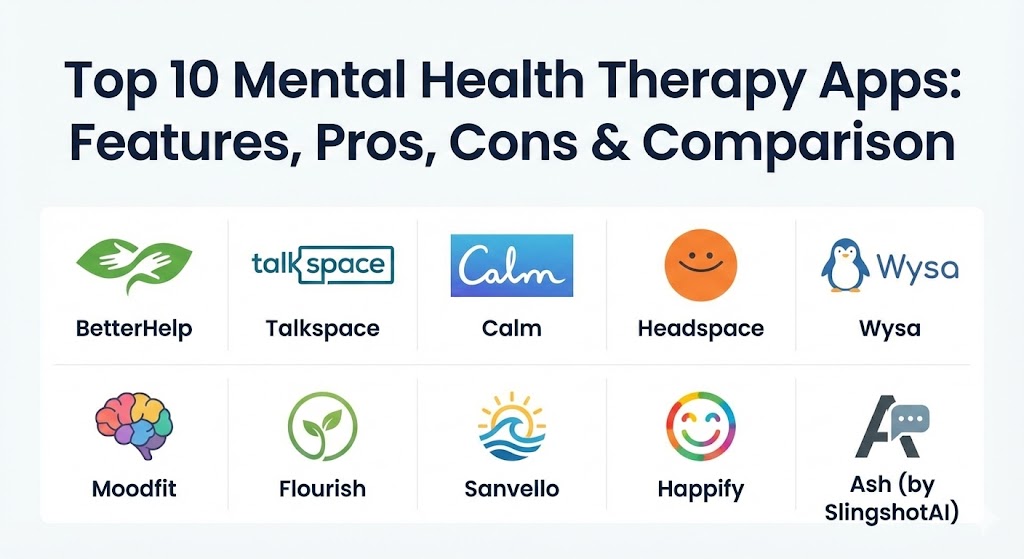
Top 10 Mental Health Therapy Apps
1 — BetterHelp
BetterHelp is currently the world’s largest online therapy platform. It is designed to mirror traditional therapy by matching users with licensed, accredited therapists for ongoing counseling via text, live chat, phone, or video sessions.
- Key features:
- Algorithmic matching with licensed therapists (LCSW, LMFT, PhD).
- Flexible communication: synchronous (video/phone) and asynchronous (messaging).
- Included “extras” like group sessions and interactive journaling.
- Easy therapist switching if the initial match isn’t right.
- Goal-setting and progress-tracking modules.
- Pros:
- Massive network of therapists ensures a match for almost any specialty.
- Highly convenient for those who prefer messaging-based support throughout the week.
- Cons:
- Does not accept most insurance plans (primarily cash-pay).
- Not suitable for individuals needing psychiatric medication management.
- Security & compliance: HIPAA compliant, uses banking-grade encryption, and follows SOC 2 standards.
- Support & community: Extensive self-help resources, 24/7 technical support, and a highly active community of millions of users.
2 — Talkspace
Talkspace is a direct competitor to BetterHelp but distinguishes itself by offering integrated psychiatric services and accepting a wide range of insurance plans, making it a favorite for enterprise-level wellness programs.
- Key features:
- Access to licensed therapists and board-certified psychiatrists.
- Medication management and prescription services (where applicable).
- Talkspace Go: A self-guided app for classes and reflection.
- Unlimited messaging-based therapy plans.
- Specialized tracks for teens, couples, and veterans.
- Pros:
- The best choice for users who want to use their health insurance.
- Provides a “one-stop shop” for both talk therapy and psychiatric medication.
- Cons:
- Cash-pay prices can be significantly higher than BetterHelp.
- Administrative/billing support can sometimes have longer wait times.
- Security & compliance: HIPAA compliant, SOC 2 Type II certified, and GDPR compliant for international users.
- Support & community: Robust enterprise onboarding for HR departments and 24/7 customer support for individuals.
3 — Calm
Calm is the industry leader for mindfulness, sleep, and stress reduction. It has evolved from a simple meditation app into a holistic wellness platform that even offers “Calm Health” for clinical environments.
- Key features:
- “Sleep Stories” narrated by world-class celebrities.
- Extensive library of guided meditations for anxiety, focus, and sleep.
- Masterclasses taught by world-renowned mindfulness experts.
- Daily Calm: A fresh, 10-minute meditation provided every morning.
- Breathing exercises and relaxing soundscapes.
- Pros:
- Unrivaled production quality and a deeply soothing user interface.
- Exceptionally effective for those struggling with insomnia and acute stress.
- Cons:
- Not a “therapy” app in the clinical sense; no access to live professionals.
- The sheer amount of content can be overwhelming for some users.
- Security & compliance: SOC 2 compliant; privacy policies are GDPR-aligned.
- Support & community: Large user community; excellent onboarding for new meditators.
4 — Headspace
Headspace is known for its friendly, animated approach to meditation. In 2026, it has deepened its clinical roots by integrating AI-driven guides and offering direct access to mental health coaches and therapists.
- Key features:
- Ebb: An AI companion that offers personalized meditation prompts.
- Structured “Courses” to learn the fundamentals of mindfulness.
- Access to 1-on-1 mental health coaching for premium members.
- Focus music and “The Wake Up” daily video content.
- SOS sessions for moments of sudden panic or stress.
- Pros:
- The most educational app for beginners who want to understand the “why” of meditation.
- Scientific validation through multiple peer-reviewed research studies.
- Cons:
- High-tier plans involving human coaches are relatively expensive.
- The cartoon-style aesthetic may feel too “juvenile” for some users.
- Security & compliance: HIPAA and GDPR compliant; uses AES-256 encryption.
- Support & community: Exceptional customer documentation and corporate wellness support.
5 — Wysa
Wysa is a “clinically safe” AI chatbot designed to help users manage emotions using CBT, DBT, and mindfulness. It is widely used by the NHS in the UK and by global enterprises for early intervention.
- Key features:
- 24/7 conversational AI penguin that “listens” and responds empathetically.
- Library of over 150 therapeutic exercises (anxiety, sleep, pain).
- Optional upgrade to live, text-based coaching with humans.
- Anxiety and depression screening tools (PHQ-9 and GAD-7).
- Anonymous use; users do not need to provide their real names.
- Pros:
- Immediate, 24/7 support without the “scheduling” friction of human therapy.
- Extremely low cost compared to teletherapy platforms.
- Cons:
- The AI can occasionally provide repetitive or “scripted” responses.
- Not intended to replace a therapist for complex trauma or personality disorders.
- Security & compliance: HIPAA and GDPR compliant; DCB0129 (UK Clinical Safety) certified.
- Support & community: High-quality technical support; extensive documentation for enterprise partners.
6 — Moodfit
Moodfit is often described as the “fitness tracker for your mind.” It focuses on actionable data and behavioral change, providing users with a personalized toolkit to improve their mood.
- Key features:
- Daily mood check-ins with detailed analytics and trend reports.
- Customizable “Daily Goals” (e.g., exercise, gratitude, sleep).
- CBT-based thought records to challenge negative thinking.
- Integration with wearable data (heart rate, sleep quality).
- Breathing exercises and grounding tools.
- Pros:
- Empowers users with data, making it easy to see which habits impact mood.
- Highly flexible; you only use the features that work for you.
- Cons:
- The interface is more “utility” than “soothing” (like Calm).
- Does not offer any live human interaction or professional therapy.
- Security & compliance: GDPR compliant; uses secure cloud storage for data logs.
- Support & community: Helpful in-app tutorials; proactive customer service via email.
7 — Flourish
A standout newcomer in 2026, Flourish is an evidence-based wellness system grounded in positive psychology. It uses an AI “wellness buddy” named Sunnie to foster habit building and emotional resilience.
- Key features:
- Sunnie AI: Provides 24/7 emotional support and habit coaching.
- All-in-one wellness support: habit tracking, peer support, and insights.
- Scientifically validated through Randomized Controlled Trials (RCTs).
- “Deep Insights” reports that explain psychological patterns.
- Peer-to-peer connection for shared wellness goals.
- Pros:
- One of the few apps with high-level scientific validation of its efficacy.
- Combines the best of AI coaching with a supportive social community.
- Cons:
- Newer platform, so the user base is smaller than legacy apps.
- Focuses on “wellness” more than clinical pathology (e.g., severe OCD).
- Security & compliance: SOC 2 and GDPR compliant; strong focus on data anonymization.
- Support & community: Excellent peer support groups; responsive development team.
8 — Sanvello
Sanvello (formerly Pacifica) offers a comprehensive ecosystem that bridges the gap between self-help and professional care. It uses CBT as its primary framework and provides a path from mood tracking to live therapy.
- Key features:
- Professional teletherapy and 1-on-1 coaching.
- Peer support communities moderated for safety.
- “Guided Journeys” (CBT courses) for anxiety and depression.
- Comprehensive mood and health tracking tools.
- Meditations and “Hope” boards for visual inspiration.
- Pros:
- Excellent transition path: start for free and add a therapist when ready.
- Very strong focus on community and peer-to-peer connection.
- Cons:
- Professional therapy services are only available in specific regions.
- The app can feel a bit “cluttered” due to the high number of features.
- Security & compliance: HIPAA compliant; HITRUST CSF certified.
- Support & community: One of the most active peer-support communities in the market.
9 — Happify
Happify uses gamification to turn mental health into an engaging activity. It is built on the principles of positive psychology, CBT, and mindfulness to help users “break old patterns.”
- Key features:
- Science-based “Tracks” (e.g., “Conquering Negative Thoughts”).
- Engaging games and activities designed to reduce stress.
- Personal “Happify Daily” content feed.
- Detailed “Happiness Score” tracking and assessment.
- AI-powered digital coach to guide users through activities.
- Pros:
- The best option for users who find traditional therapy “boring” or intimidating.
- Short, high-impact activities (5-10 minutes) fit easily into a busy day.
- Cons:
- Not suitable for users who prefer a more “clinical” or serious tone.
- Some users may find the gamification distracting from deep emotional work.
- Security & compliance: GDPR compliant; HIPAA compliant for enterprise clients.
- Support & community: Robust enterprise portal; helpful user forums.
10 — Ash (by SlingshotAI)
Ash represents the cutting edge of “AI Therapy” in 2026. Unlike simple chatbots, Ash uses a sophisticated Large Language Model (LLM) to act as an always-on conversational companion grounded in therapeutic principles.
- Key features:
- Voice-based conversational therapy (talk to the app like a human).
- Persistent memory: Ash remembers context from previous weeks.
- Emotion-aware insights and personalized “check-ins.”
- Judgment-free, 24/7 reflective conversations.
- Completely free (as of early 2026) while in its growth phase.
- Pros:
- The closest experience to a human conversation without the cost.
- Voice interaction makes it highly accessible for those who dislike typing.
- Cons:
- It is an AI, not a licensed professional; it cannot diagnose or prescribe.
- Privacy-conscious users may be wary of voice data being processed by LLMs.
- Security & compliance: Uses “Privacy by Design”; data is encrypted and anonymized.
- Support & community: Evolving documentation; community-driven feedback loop.
Comparison Table
| Tool Name | Best For | Platform(s) Supported | Standout Feature | Rating (Trustpilot/Review) |
| BetterHelp | Ongoing human therapy | iOS, Android, Web | Huge licensed network | 4.5 / 5 |
| Talkspace | Insurance & Psychiatry | iOS, Android, Web | Insurance acceptance | 4.1 / 5 |
| Calm | Sleep & Meditation | iOS, Android, TV | Celebrity Sleep Stories | 4.8 / 5 |
| Headspace | Habit building | iOS, Android, Web | “Ebb” AI Meditation | 4.7 / 5 |
| Wysa | Immediate AI chat | iOS, Android | AI Penguin Companion | 4.6 / 5 |
| Moodfit | Data & Tracking | iOS, Android | Mood Analytics | 4.4 / 5 |
| Flourish | Wellness & RCT Evidence | iOS, Android, Web | “Sunnie” AI Buddy | 4.8 / 5 |
| Sanvello | Peer Support | iOS, Android, Web | Hybrid Care Model | 4.5 / 5 |
| Happify | Gamification | iOS, Android, Web | Positive Psych Games | 4.3 / 5 |
| Ash | Voice AI Companion | iOS, Android, Web | Persistent AI Memory | 4.5 / 5 |
Evaluation & Scoring of Mental Health Therapy Apps
To determine which app truly leads the market, we evaluated them based on the following weighted rubric, prioritizing clinical safety and ease of adoption.
| Category | Weight | Evaluation Criteria |
| Core Features | 25% | Presence of evidence-based tools (CBT, DBT), live therapy access, and AI support. |
| Ease of Use | 15% | Intuitiveness of UI, signup speed, and engagement/retention design. |
| Integrations | 15% | Ability to sync with wearables, health apps (Apple Health/Google Fit), and insurance. |
| Security & Compliance | 10% | HIPAA/GDPR adherence, encryption standards, and data ownership transparency. |
| Performance | 10% | App stability, load times, and voice/video quality during sessions. |
| Support & Community | 10% | Moderation of peer forums, technical support speed, and educational content. |
| Price / Value | 15% | Monthly cost vs. the quality of care and professional access provided. |
Which Mental Health Therapy App Is Right for You?
The “right” app is the one you will actually use. Here is a guide based on your specific situation:
- Solo Users on a Budget: If you need support but can’t afford $200+/month, start with Wysa or Moodfit. They provide excellent self-management tools for a fraction of the cost of therapy.
- Enterprise & HR Managers: If you are buying for a company, Talkspace and Calm are the leaders in the space, offering dedicated portals for employee engagement and seamless insurance billing.
- Those Seeking Clinical Therapy: If you want a dedicated professional to talk to every week, BetterHelp is the gold standard for flexibility and matching.
- Feature Depth vs. Simplicity: If you want a deep dive into data, go with Moodfit. If you want a “one-button” solution to feel better right now, Calm or Headspace are superior.
- Cutting Edge AI: If you are comfortable with AI and want a companion that feels “human,” Ash or Flourish represent the newest wave of tech-assisted therapy.
Frequently Asked Questions (FAQs)
1. Are mental health apps as effective as in-person therapy?
For mild-to-moderate anxiety and depression, research shows that digital CBT and teletherapy are often as effective as in-person visits. However, for complex disorders, they are usually best used as a supplement rather than a replacement.
2. Can these apps prescribe medication?
Only specific platforms with psychiatric departments, like Talkspace, can facilitate psychiatric evaluations and prescriptions. Most “therapy” apps focus strictly on talk therapy or coaching.
3. Is my data truly private and anonymous?
Reputable apps like those listed here use HIPAA-compliant encryption. However, always check the “Data Sharing” settings. Some apps (like Wysa) allow for total anonymity, while others require full identity verification for clinical safety.
4. How much do these apps typically cost?
Self-guided apps range from $10 to $15 per month. Human-led therapy platforms usually cost between $60 and $100 per week, often billed monthly.
5. What happens if I have a crisis while using an app?
Any reputable app will have a “Crisis” button that immediately connects you to national suicide hotlines or emergency services. They are not intended for emergency use.
6. Can I use these apps for couples counseling?
Yes, platforms like BetterHelp (through their sister site ReGain) and Talkspace offer specialized joint accounts for couples therapy.
7. Do I need to use the app every day?
Consistency is key. Most users see the best results when engaging with the app for at least 5-10 minutes a day, even if it’s just a quick mood check-in or a short meditation.
8. Will my employer see what I talk about if they pay for the app?
No. Under HIPAA laws, employers receive aggregate data (e.g., “15% of employees use the app”) but never individual session notes or personal mood logs.
9. Can teens use these apps?
Specific platforms like Sanvello and Talkspace have dedicated modules for teens (aged 13-17), though they typically require parental consent.
10. What is the biggest mistake people make with these apps?
The “one-and-done” mistake. Many users download an app, use it once during a panic attack, and delete it. These tools work best as a preventative, daily habit, not just an emergency fire extinguisher.
Conclusion
Choosing a mental health therapy app in 2026 is a highly personal journey. Whether you prioritize the clinical depth of BetterHelp, the insurance compatibility of Talkspace, or the AI-driven warmth of Wysa or Flourish, the key is to find a tool that aligns with your daily routine and specific emotional needs. Remember that these apps are powerful companions, but the “best” outcome is always achieved when technology serves to empower your own innate resilience.