Introduction
Medication Adherence Apps are digital health solutions designed to bridge the gap between a doctor’s prescription and a patient’s daily routine. At their core, these apps provide much more than simple alarms. They act as “digital pillboxes,” offering smart reminders, drug-to-drug interaction alerts, refill tracking, and even caregiver notifications. By providing visual cues (like pill shapes and colors) and health journaling features, these tools help users stay on track with complex regimens that may involve dozens of different medications.
The importance of these apps has surged alongside the rise of telemedicine and home-based care. Real-world use cases range from an elderly patient managing hypertension to a parent coordinating a child’s post-operative antibiotics. When choosing a tool, users should evaluate the reliability of notification engines, privacy standards (HIPAA/GDPR compliance), ease of medication entry (e.g., barcode scanning), and the depth of reporting features for sharing data with healthcare providers.
Best for: Individuals managing chronic conditions (diabetes, heart disease, HIV), caregivers looking after aging parents, and health organizations or insurers aiming to improve patient outcomes through behavioral incentives. It is also ideal for clinical trial participants needing strict protocol adherence.
Not ideal for: Patients with severe cognitive impairments who cannot interact with a smartphone, or those with very simple, short-term prescriptions (e.g., a 3-day course of painkillers) where a standard phone alarm is sufficient.
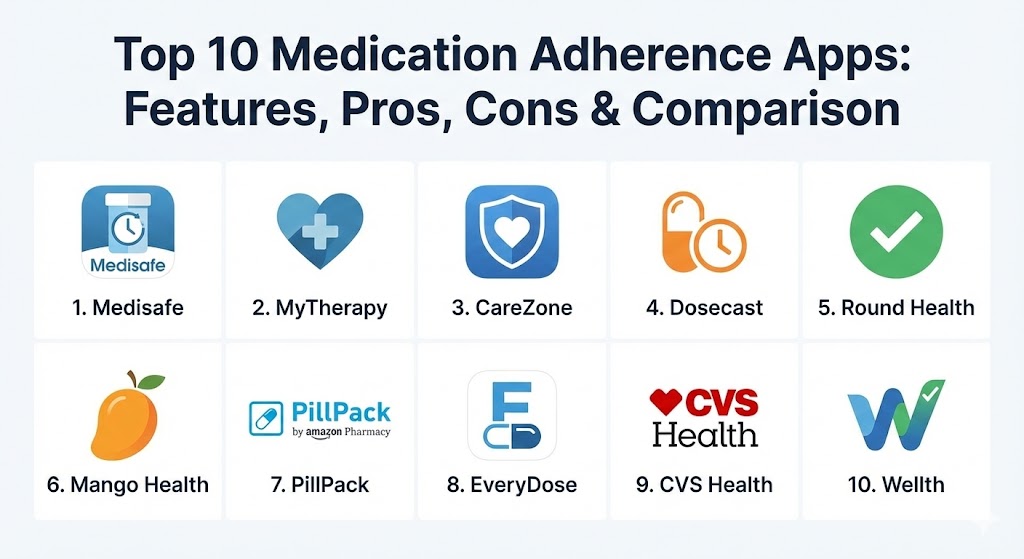
Top 10 Medication Adherence Apps
1 — Medisafe
Medisafe is widely considered the market leader in the medication adherence space. It offers a comprehensive “virtual pillbox” that groups medications by the time of day and provides a highly persistent notification system that is difficult to ignore.
- Key features:
- Smart reminders that automatically adjust to different time zones.
- “Medfriend” caregiver alerts that notify a loved one if a dose is missed.
- Integrated drug-to-drug interaction checker to flag potential safety risks.
- Refill reminders based on remaining pill counts.
- Health tracker for monitoring blood pressure, glucose, and weight.
- Detailed adherence reports exportable for doctors (PDF/Excel).
- Personalized health tips and educational videos based on specific conditions.
- Pros:
- The most robust and reliable notification engine in the industry.
- Excellent visual aids, including pill shapes and colors for easy identification.
- Cons:
- The premium version requires a subscription for advanced features like unlimited Medfriends.
- The interface can feel cluttered due to the high volume of features.
- Security & compliance: HIPAA and GDPR compliant. Uses 256-bit encryption for data in transit and at rest.
- Support & community: Extensive online knowledge base, in-app support, and a massive global community of millions of active users.
2 — MyTherapy
MyTherapy is a holistic health management app that goes beyond pill reminders to track symptoms, measurements, and physical activity. It is designed to provide a complete picture of a user’s treatment progress.
- Key features:
- Integrated medication, symptom, and activity diary.
- Support for a wide range of dosages (pills, drops, injections, inhalers).
- Adherence reports that correlate medication intake with symptom changes.
- Family-sharing feature for collaborative care.
- Team-based approach allowing users to invite their doctors to view data.
- Pill-specific instructions (e.g., “take with food” or “avoid dairy”).
- Pros:
- One of the best apps for tracking how medication affects daily well-being.
- Completely free for individual users without hidden “pro” fees for core features.
- Cons:
- Lacks some of the advanced drug interaction databases found in Medisafe.
- The “Team” feature requires significant setup from both patient and provider.
- Security & compliance: GDPR compliant (developed in Germany). Data is pseudonymized and stored on secure European servers.
- Support & community: Active support team via email and social media; high-quality documentation for onboarding.
3 — CareZone
CareZone is specifically built for caregivers. It focuses on the logistical side of managing health, such as scanning pill bottles to create lists and organizing insurance information in one secure location.
- Key features:
- Camera-based pill bottle scanning for instant medication entry.
- Secure vault for insurance cards, ID cards, and medical documents.
- Shared calendar for tracking doctor appointments and lab work.
- Journaling feature for recording observations and questions for physicians.
- Pharmacy integration for ordering refills and tracking shipments.
- Contact list for managing doctors, pharmacies, and insurance providers.
- Pros:
- The best tool for individuals managing the health of multiple family members.
- Scanning technology drastically reduces the time needed for data entry.
- Cons:
- The app’s privacy policy has faced scrutiny in the past regarding data sharing.
- Not as focused on “smart” alarms as dedicated adherence tools.
- Security & compliance: HIPAA compliant. Uses multi-factor authentication and bank-level encryption.
- Support & community: Strong community-driven help center; responsive email support for troubleshooting.
4 — Dosecast
Dosecast is the “power user” app of medication adherence. It offers highly granular scheduling options that most other apps cannot match, making it ideal for patients with complex, non-standard regimens.
- Key features:
- Advanced scheduling logic (e.g., “every 3 days,” “weekends only,” or specific cycles).
- Dose tracking for injections, inhalers, and liquid medications with custom units.
- Smart silencing that prevents alarms during specified “bedtime” hours.
- Dose history that tracks late, skipped, and postponed doses accurately.
- CloudSync feature for syncing data across multiple devices and family members.
- Drug database for quick searching and pre-populating medication info.
- Pros:
- Unmatched flexibility for complex medication schedules.
- Lightweight design that works well on older hardware.
- Cons:
- The user interface feels dated and less intuitive than modern competitors.
- Many essential features (like photo capture) are locked behind the Pro version.
- Security & compliance: Basic encryption; does not collect personally identifiable information (PII) by default.
- Support & community: Standard email support; comprehensive FAQ section on the developer’s website.
5 — Round Health
Round Health is a minimalist, elegant app designed for the iOS ecosystem. It focuses on “windows” of time for taking medication rather than rigid, singular alarms.
- Key features:
- “Reminder Windows” that allow users to set a span of time to take a dose.
- Minimalist, distraction-free interface with a clean visual calendar.
- Support for complex medications including birth control and vitamins.
- Apple Watch integration for quick dose confirmations from the wrist.
- iCloud sync for seamless transitions between iPhone and iPad.
- Tracking for “as needed” (PRN) medications.
- Pros:
- The aesthetic and ease of use are second to none for iOS users.
- The “Window” concept reduces the stress of missing an alarm by exactly one minute.
- Cons:
- Strictly available for Apple devices; no Android version exists.
- Lacks deep clinical features like drug interaction checkers or health measurements.
- Security & compliance: Uses Apple’s native security framework; GDPR and HIPAA aligned.
- Support & community: Limited to email support and basic web-based documentation.
6 — Mango Health
Mango Health gamifies the medication experience. It uses a rewards-based system to encourage users to stay adherent, making it a favorite for pediatric patients or those motivated by incentives.
- Key features:
- Earn “points” for taking medication on time and tracking health habits.
- Raffle system where points can be traded for gift cards and prizes.
- Daily health tips and information about drug-to-drug interactions.
- Adherence streak tracking to maintain momentum.
- Reminders for healthy habits like drinking water or tracking mood.
- Pros:
- Highly engaging; significantly better retention for users who find health apps boring.
- Free to use without an aggressive subscription model.
- Cons:
- The rewards system can sometimes overshadow the clinical importance of the data.
- Not ideal for users who prefer a serious, medical-style interface.
- Security & compliance: SOC 2 and HIPAA compliant. Data is encrypted in transit.
- Support & community: Fun, engaging onboarding; active social media presence for user support.
7 — PillPack (by Amazon Pharmacy)
PillPack is a unique hybrid of a digital app and a physical pharmacy service. While the app provides reminders, the core value is the physical delivery of pre-sorted pill packets.
- Key features:
- Automatic sorting of all medications into tear-off packets by date and time.
- Free monthly delivery of medications to your doorstep.
- App-based tracking of the entire shipping and fulfillment process.
- 24/7 access to talk to a pharmacist via the app or phone.
- Integration with Amazon Pharmacy for easy prescription transfers.
- Comprehensive medication list with images of every pill.
- Pros:
- Eliminates the physical task of sorting pills into boxes.
- Excellent for those with high pill burdens (e.g., 5+ different daily meds).
- Cons:
- Users must switch their primary pharmacy to PillPack to get the full benefit.
- Cannot include certain items like liquids, inhalers, or refrigerated meds in packets.
- Security & compliance: Fully HIPAA compliant; Amazon-grade data security and encryption.
- Support & community: Premium, 24/7 pharmacist support; extensive help for insurance transitions.
8 — EveryDose
EveryDose leverages artificial intelligence to provide a more personalized adherence experience. Its AI assistant, “Maxwell,” helps users manage their medications through natural language interactions.
- Key features:
- “Maxwell” AI chatbot for answering medication-related questions.
- Automated dose tracking and smart reminders.
- Provider-facing dashboard for doctors to monitor patient adherence.
- Drug interaction alerts and safety info.
- Progress charts that visualize adherence over weeks and months.
- Pros:
- The AI assistant makes the app feel more interactive and supportive.
- Strong “care team” connectivity for professional monitoring.
- Cons:
- AI responses are limited to general info and cannot replace medical advice.
- Relatively new to the market compared to giants like Medisafe.
- Security & compliance: HIPAA compliant. Uses SOC 2 Type II certified data centers.
- Support & community: Professional documentation for both patients and healthcare providers.
9 — CVS Health App
For those who already use CVS as their primary pharmacy, the CVS Health app is a powerhouse of integration, combining adherence reminders with pharmacy management and minute-clinic bookings.
- Key features:
- Integrated “Pill Reminder” tool that pulls data directly from your CVS prescriptions.
- Barcode scanning for prescription pickups and payment.
- Text-to-refill and refill status tracking.
- Video chat with doctors and healthcare providers 24/7.
- Secure storage for vaccine records and lab results.
- Family-wide management of all pharmacy needs in one place.
- Pros:
- Drastically simplifies the refill process for existing CVS customers.
- One-stop-shop for both medication management and clinical care.
- Cons:
- Features are heavily locked to the CVS ecosystem.
- The app can be buggy and slow due to the massive number of integrated services.
- Security & compliance: HIPAA and PCI DSS compliant. Encrypted data storage.
- Support & community: In-store support at any CVS pharmacy location; extensive phone support.
10 — Wellth
Wellth is an enterprise-level app that uses “behavioral economics” to improve adherence. It is typically offered through insurers or employers and pays users to take their medication.
- Key features:
- Financial incentives (cash rewards) for maintaining high adherence rates.
- Photo-based dose verification (users take a photo of the pill in their hand).
- Daily check-ins to monitor health status and adherence.
- Direct connection to care managers for high-risk patients.
- Behavioral science-driven notifications to prevent “alarm fatigue.”
- Pros:
- The most effective tool for “unmotivated” patients due to financial rewards.
- Photo verification provides high-certainty data for clinical purposes.
- Cons:
- Not available as a standalone download for the general public (must be invited).
- The photo-taking requirement can be burdensome for some users.
- Security & compliance: HIPAA and SOC 2 compliant. High-level biometric security.
- Support & community: Dedicated account managers for corporate clients; 24/7 tech support.
Comparison Table
| Tool Name | Best For | Platform(s) Supported | Standout Feature | Rating (Gartner/TrueReview) |
| Medisafe | Chronic Care | iOS, Android, Watch | Medfriend Caregiver Alerts | 4.8 / 5 |
| MyTherapy | Symptom Tracking | iOS, Android | Holistic Symptom Diary | 4.7 / 5 |
| CareZone | Family Caregivers | iOS, Android, Web | Pill Bottle Scanner | 4.5 / 5 |
| Dosecast | Complex Logic | iOS, Android | Interval-based Scheduling | 4.3 / 5 |
| Round Health | iOS Minimalists | iOS only | Reminder Windows | 4.6 / 5 |
| Mango Health | Gamification | iOS, Android | Real-world Rewards | 4.4 / 5 |
| PillPack | High Pill Burdens | iOS, Android, Web | Pre-sorted Pill Packets | 4.8 / 5 |
| EveryDose | AI-driven Support | iOS, Android | Maxwell AI Assistant | 4.4 / 5 |
| CVS Health | CVS Pharmacy Users | iOS, Android | Pharmacy System Sync | 4.2 / 5 |
| Wellth | Payers & Providers | iOS, Android | Financial Incentives | N/A |
Evaluation & Scoring of Medication Adherence Apps
To determine which app provides the most value, we evaluated the top contenders against a weighted scoring rubric. This helps differentiate between an app that is “fun to use” and one that is “clinically reliable.”
| Category | Weight | Evaluation Criteria |
| Core Features | 25% | Reliability of notifications, refill tracking, and caregiver alerts. |
| Ease of Use | 15% | Speed of setup, UI intuitiveness, and accessibility features. |
| Integrations | 15% | Syncing with pharmacies, wearables (Apple Watch), and health platforms. |
| Security & Compliance | 10% | HIPAA/GDPR standards and data encryption protocols. |
| Performance | 10% | App stability, battery usage, and offline functionality. |
| Support & Community | 10% | Availability of help docs and responsiveness of support teams. |
| Price / Value | 15% | Cost of premium tiers relative to the features offered. |
Which Medication Adherence App Is Right for You?
The “right” app is largely determined by your specific medical needs and technical comfort level.
- Solo Users with Chronic Conditions: Medisafe remains the gold standard. Its persistence ensures you never miss a dose, and the drug interaction checker provides an extra layer of safety.
- Caregivers Managing Parents: CareZone is the superior choice for its ability to scan documents and share calendars among multiple family members.
- Budget-Conscious Users: MyTherapy and Round Health offer incredible value without the monthly subscription fees found in Medisafe Premium.
- Patients with High Pill Counts: If you take more than five different medications daily, PillPack is the best solution because it removes the manual labor of sorting pills every Sunday night.
- Tech-Savvy vs. Minimalists: If you love apps and rewards, Mango Health will keep you engaged. If you hate clutter and just want a simple notification, Round Health is the clear winner.
- Enterprise & Public Health: Wellth and EveryDose are the go-to choices for insurers or clinical trials where verifying adherence is more important than the user’s personal preference.
Frequently Asked Questions (FAQs)
1. Are medication adherence apps free?
Most offer a robust free version, but many (like Medisafe) require a monthly subscription for advanced features like family sharing, custom notification sounds, and unlimited medication slots.
2. Can these apps work without an internet connection?
Yes. Core pill reminders are usually stored locally on the device and will trigger even if you are offline. However, features like CloudSync and drug interaction updates require an active connection.
3. Do these apps replace a physical pillbox?
For many, yes. However, for those with severe memory issues, using an app alongside a physical pillbox (or a service like PillPack) provides a “double-check” safety system.
4. How do these apps protect my medical data?
Look for apps that are HIPAA (in the US) or GDPR (in the EU) compliant. Top-tier apps use bank-level encryption and allow you to request that your data be deleted at any time.
5. Can I track “as needed” (PRN) medications like painkillers?
Yes, most apps have a specific setting for PRN meds that allows you to log the dose when you take it without setting a recurring daily alarm.
6. Do these apps work with the Apple Watch or Android Wear?
Top apps like Medisafe, MyTherapy, and Round Health have dedicated wearable integrations that allow you to mark a dose as “Taken” directly from your wrist.
7. Can an app tell me if two drugs shouldn’t be taken together?
Several apps (Medisafe, Mango Health) include a drug-to-drug interaction database. However, this should always be verified with your pharmacist or doctor.
8. Is it possible to share my adherence history with my doctor?
Yes. Apps like MyTherapy and Medisafe allow you to export a PDF or CSV report of your medication history, which you can then email to your provider or show them on your screen.
9. Can I manage my child’s or parent’s medications from my own phone?
Yes, through “Caregiver” or “Medfriend” features. You will receive a notification on your device if they fail to mark their medication as “taken” within a certain timeframe.
10. What happens if I change time zones?
Apps like Medisafe automatically detect time zone changes and ask if you would like to keep your original dosing schedule or shift your reminders to the new local time.
Conclusion
Managing medication is one of the most stressful parts of modern healthcare, but it doesn’t have to be a manual process. Whether you need the persistent alarms of Medisafe, the physical sorting of PillPack, or the minimalist windows of Round Health, there is a digital solution that fits your lifestyle. When choosing, prioritize the features that mitigate your specific risks—whether that’s forgetting a dose or worrying about a drug interaction. Ultimately, the best app is the one that you will actually use every single day.