Introduction
A Medical Imaging PACS System is a comprehensive healthcare technology platform designed to eliminate the need for physical film by providing electronic storage, retrieval, management, distribution, and presentation of medical images. It typically consists of four main components: the imaging modalities (such as CT, MRI, and X-ray), a secured network for data transmission, workstations for interpreting and reviewing images, and an archive for the storage and retrieval of images and reports.
The importance of PACS lies in its ability to streamline clinical workflows. By replacing manual film handling with digital access, PACS reduces the turnaround time for diagnoses, facilitates remote consultations through teleradiology, and ensures that a patient’s longitudinal imaging history is available at the click of a button. In the real world, this means a surgeon in the OR can view a patient’s pre-operative MRI in real-time while a radiologist miles away provides a specialized consult. When choosing a PACS solution in 2026, organizations must evaluate criteria such as AI-orchestration capabilities, cloud-native scalability, interoperability with existing Electronic Health Records (EHR) via FHIR/HL7 standards, and robust cybersecurity frameworks to protect against the rising threat of medical data breaches.
Best for: Large hospital networks, multi-site imaging centers, and specialized diagnostic clinics that require high-volume data handling, advanced diagnostic toolsets, and seamless integration with broader hospital information systems.
Not ideal for: Very small, single-practitioner clinics with extremely low imaging volumes or facilities that only require basic storage without diagnostic-grade viewing or complex workflow orchestration. In these cases, a simpler Vendor Neutral Archive (VNA) or basic cloud storage might suffice.
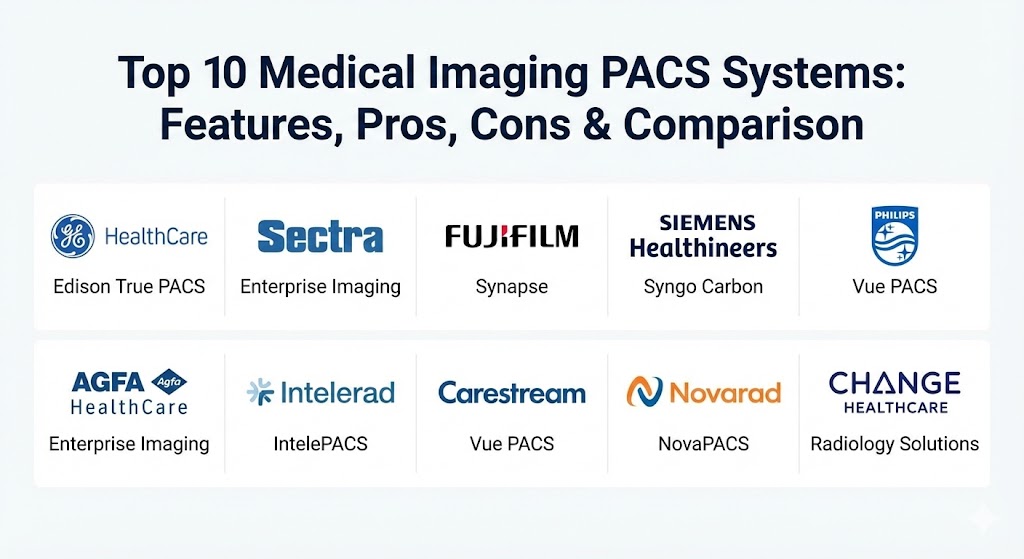
Top 10 Medical Imaging PACS Systems
1 — GE HealthCare (Edison True PACS)
GE HealthCare’s Edison True PACS represents a shift toward intelligent, AI-driven imaging management. Designed as a cloud-enabled, diagnostic-grade solution, it integrates advanced visualization and AI orchestration directly into the radiologist’s reading workflow. It is built for health systems that want to leverage data-rich insights without the overhead of heavy on-premises infrastructure.
- Key features:
- Edison AI Orchestrator for seamless third-party AI app integration.
- ZFP (Zero Footprint) universal viewer for collaboration anywhere.
- Automated exam prioritization based on clinical urgency.
- Integrated diagnostic toolsets for 2D, 3D, and 4D imaging.
- Advanced analytics for operational and clinical performance tracking.
- Scalable cloud-native and hybrid deployment options.
- Pros:
- Deep integration with the broader GE Edison intelligence platform.
- Exceptional workflow efficiency through “one-click” advanced visualization.
- Cons:
- Can be complex to set up for smaller organizations.
- Premium pricing reflects its high-end enterprise positioning.
- Security & compliance: HIPAA, GDPR, ISO 27001, and SOC 2 Type II compliant. Includes end-to-end encryption and advanced audit logging.
- Support & community: Extensive global support network; 24/7 expert live support; comprehensive training through GE HealthCare’s educational portal.
2 — Sectra Enterprise Imaging (Sectra PACS)
Consistently ranked at the top of industry satisfaction surveys, Sectra PACS is renowned for its stability, cybersecurity, and high performance. It offers a unified strategy for all imaging needs, allowing multi-site organizations to act as a single, cohesive entity regardless of geographic distance.
- Key features:
- Secure-by-design architecture with robust penetration testing.
- Unified diagnostic workspace for all imaging specialties.
- High-speed image handling even over low-bandwidth networks.
- Modular workflows for radiology, pathology, and cardiology.
- Built-in disaster recovery and life-cycle management.
- Advanced reporting tools with voice recognition integration.
- Pros:
- Industry-leading customer satisfaction and reliability scores.
- Highly scalable from single sites to massive multi-national networks.
- Cons:
- The interface, while powerful, has a learning curve for new users.
- Some advanced modules require separate licensing.
- Security & compliance: ISO 27001, GDPR, HIPAA, and FIPS 140-2 validated encryption.
- Support & community: Best-in-KLAS support for multiple consecutive years; proactive account management and dedicated customer success teams.
3 — Fujifilm Synapse PACS
Fujifilm’s Synapse PACS is one of the most established names in the industry, known for its ultra-fast image loading and intuitive web-based interface. It utilizes unique wavelet compression technology to deliver diagnostic-quality images in seconds, making it a favorite for high-volume hospitals.
- Key features:
- 100% web-based architecture with on-demand access.
- CommonView technology for querying multiple DICOM archives simultaneously.
- Patented high-ratio compression without sacrificing image quality.
- Integrated Synapse 3D for advanced clinical analysis.
- Customizable individual hanging protocols to suit radiologist preferences.
- Virtualization support to reduce on-site hardware footprints.
- Pros:
- Exceptional speed; images often load in less than two seconds.
- Strong multi-site management capabilities and cross-facility collaboration.
- Cons:
- Upgrades can sometimes be disruptive if not managed carefully.
- Interface customization can be overwhelming for non-technical admins.
- Security & compliance: HIPAA, GDPR, and ISO standards compliant; secure web administration tools.
- Support & community: Solid technical documentation and a mature user community; 24/7 enterprise support availability.
4 — Siemens Healthineers (Syngo Carbon)
Syngo Carbon is Siemens Healthineers’ answer to the modern need for “Enterprise Imaging.” It breaks down the silos between radiology and other imaging departments, providing a single point of truth for all patient-related imaging data and clinical results.
- Key features:
- Unified data model that eliminates departmental silos.
- AI-ready architecture for automated case preparation.
- Quantitative reading functionality for oncology and neurology.
- Cross-modality fusion and multi-time-point registration.
- Findings Navigator for structured, clinical-decision support.
- Flexible licensing model for concurrent user scalability.
- Pros:
- Unmatched depth in quantitative analysis for specialized clinical cases.
- Highly intelligent automation that pre-fetches and prepares cases.
- Cons:
- Highly dependent on the Siemens ecosystem for maximum benefit.
- Hardware requirements for on-prem components are substantial.
- Security & compliance: HIPAA, GDPR, and ISO 27001; features Siemens Remote Service for proactive monitoring.
- Support & community: World-class professional services; global presence with 24/7 remote monitoring and maintenance.
5 — Philips (Vue PACS / IntelliSpace)
Philips provides a robust, multi-modality PACS solution that focuses on clinical collaboration and ease of access. Its Vue PACS (formerly Carestream) is particularly strong in lesion management and interactive multiplanar reconstruction (MPR).
- Key features:
- Embedded advanced visualization tools that eliminate standalone workstations.
- Multi-modality diagnostic workspace for 2D, 3D, and 4D imaging.
- Native lesion management for oncology treatment tracking.
- Multimedia reporting with embedded key images and charts.
- Teleradiology-ready architecture with fast streaming.
- Interactive patient and referring physician portals.
- Pros:
- Strong focus on providing data-rich, quantitative reports to referring doctors.
- Excellent tools for longitudinal tracking of tumors and chronic conditions.
- Cons:
- Some users report that the interface can feel cluttered with many tools.
- Integration with non-Philips EHRs can require significant configuration.
- Security & compliance: SOC 2, HIPAA, and GDPR compliant; features strong encryption in transit and at rest.
- Support & community: High-quality phone and web support; extensive on-site training options for large rollouts.
6 — Agfa HealthCare (Enterprise Imaging)
Agfa’s Enterprise Imaging platform is designed to act as a “universal solution” that goes beyond a traditional PACS. It provides a single, unified platform for all medical imaging, significantly reducing IT complexity and infrastructure costs.
- Key features:
- True zero-footprint application (no downloads or plugins needed).
- RUBEE Orchestrator for AI-powered workflow automation.
- Intelligent streaming technology for blazing-fast image access.
- Rule-based workflow that balances loads across radiologists.
- Native advanced imaging tools (MIP, MPR, PET fusion).
- Integrated Image Lifecycle Management for cost-effective archiving.
- Pros:
- Exceptional at reducing radiologist burnout through smart worklist orchestration.
- Significantly lower IT overhead due to its clientless architecture.
- Cons:
- The “one system for everything” approach requires a major cultural shift for some departments.
- Initial migration and data consolidation can be a lengthy process.
- Security & compliance: ISO 27001, HIPAA, GDPR, and SOC 2; cloud-ready security features.
- Support & community: Highly configurable system with expert consulting services; 24/7 global support.
7 — Intelerad (IntelePACS)
Intelerad’s IntelePACS is a market leader for high-volume diagnostic centers and teleradiology groups. It is built for speed and distributed reading, allowing radiologists to work from anywhere with the same performance as if they were in the hospital.
- Key features:
- Unified worklist that aggregates studies from multiple disparate sites.
- Advanced diagnostic viewer optimized for remote and high-latency links.
- Natural language processing (NLP) for automated report population.
- Real-time screensharing for instant clinical consultation.
- Referring Physician and Patient portals for self-service access.
- Integrated ultrasound digital worksheets and structured reporting.
- Pros:
- The premier choice for teleradiology and distributed care teams.
- Highly reliable performance with zero-latency image streaming.
- Cons:
- Less focus on departmental “deep dives” (e.g., pathology) compared to competitors.
- Customizing complex reporting templates can be time-consuming.
- Security & compliance: HIPAA, GDPR, SOC 2, and FIPS 140-2 encryption.
- Support & community: Dedicated technical account managers; strong training programs for administrators.
8 — Carestream (Vue PACS)
Now part of the Philips portfolio but often still recognized for its distinct Vue architecture, Carestream Vue PACS is a high-performance system that excels in consolidating various imaging data into a single workstation experience.
- Key features:
- 64-bit architecture for handling massive study sizes and high server speeds.
- Native voice recognition for hands-free dictation.
- Real-time volumetric matching and automatic registration.
- Integrated teleradiology modules for easy remote service expansion.
- Patient engagement tools including an intuitive patient portal.
- Scalable design from small clinics to enterprise networks.
- Pros:
- Unified workspace reduces the need to switch between different applications.
- Strong diagnostic confidence tools like automatic vessel segmentation.
- Cons:
- User interface aesthetics have been criticized as being somewhat utilitarian.
- Ongoing integration into the Philips ecosystem may cause roadmap uncertainty.
- Security & compliance: HIPAA and GDPR compliant; robust cybersecurity protocols.
- Support & community: Well-established documentation and a large global user base.
9 — Novarad (NovaPACS)
Novarad is a trailblazer in the PACS space, particularly known for its innovation in augmented reality (AR) and cloud integration. NovaPACS is a highly flexible, vendor-neutral system that offers one of the most cost-effective enterprise imaging solutions.
- Key features:
- Hybrid-cloud architecture for local reliability and cloud scalability.
- Augmented Reality (AR) surgical navigation integration.
- Fast, browser-based diagnostic viewer with zero footprint.
- Integrated disaster recovery and automated cloud backup.
- User-customizable dashboards for clinical and business intelligence.
- Advanced AI integration for triage and automated measurements.
- Pros:
- High value for money; brings enterprise features to mid-market budgets.
- Innovative feature set that pushes the boundaries of traditional imaging.
- Cons:
- Lacks the massive global brand presence of GE or Siemens.
- Some advanced AR features are still specialized for specific niches.
- Security & compliance: SOC 2, HIPAA, and GDPR compliant; rigorous data security protocols.
- Support & community: Praised for its personalized customer service and rapid implementation times.
10 — Change Healthcare (Radiology Solutions)
Change Healthcare (an Optum company) offers a modern, cloud-native PACS solution designed to future-proof radiology operations. It focuses on breaking down the barriers of legacy systems through a standards-based, interoperable framework.
- Key features:
- Cloud-native deployment that eliminates the need for expensive local servers.
- Integrated advanced clinical workflow with quantitative analysis.
- Collaboration tools that allow radiologists to control their “consulting availability.”
- Real-time screen sharing and instant messaging for care teams.
- Seamless integration with Vendor Neutral Archives (VNA).
- Standards-based integration (DICOM, HL7, FHIR).
- Pros:
- Excellent for organizations looking to fully transition to the cloud.
- Strong emphasis on radiologist collaboration and cross-specialty communication.
- Cons:
- Cloud-only focus may not suit facilities with unreliable internet connectivity.
- Pricing can be complex depending on data throughput and storage.
- Security & compliance: HIPAA, GDPR, SOC 2 Type II; high-level cloud security certifications.
- Support & community: Extensive enterprise support through the Optum network; detailed case studies and whitepapers available.
Comparison Table
| Tool Name | Best For | Platform(s) Supported | Standout Feature | Rating (Gartner) |
| GE HealthCare | Enterprise Health Systems | Cloud, Hybrid, On-prem | Edison AI Orchestrator | 4.2 / 5 |
| Sectra PACS | Multi-site Stability | Cloud (SaaS), On-prem | Best-in-KLAS Reliability | 4.8 / 5 |
| Fujifilm Synapse | Speed & Performance | Web-based, Cloud, Hybrid | Wavelet Compression | 4.5 / 5 |
| Siemens Syngo | Specialist Diagnostics | On-prem, Hybrid | Syngo Carbon Unified Data | 4.3 / 5 |
| Philips Vue | Oncology & Reporting | Cloud, Hybrid | Native Lesion Management | 3.8 / 5 |
| Agfa Enterprise | IT Consolidation | Web (ZFP), Cloud | RUBEE Workflow Orchestrator | 4.1 / 5 |
| Intelerad | Teleradiology | Cloud, Hybrid | Unified Multi-site Worklist | 4.4 / 5 |
| Carestream Vue | Advanced Visualization | On-prem, Hybrid | 64-bit Architecture | 4.0 / 5 |
| Novarad NovaPACS | Mid-market Innovation | Cloud, Hybrid | AR Surgical Integration | 4.5 / 5 |
| Change Healthcare | Cloud-native Growth | Cloud (SaaS) | Standards-based Interop | 4.0 / 5 |
Evaluation & Scoring of Medical Imaging PACS Systems
When selecting a PACS provider, organizations should use a weighted scoring rubric to ensure the tool aligns with their specific clinical and operational goals.
| Criteria | Weight | Evaluation Focus |
| Core Features | 25% | Multi-modality support, diagnostic viewing tools, and reporting efficiency. |
| Ease of Use | 15% | User interface design, learning curve, and radiologist satisfaction scores. |
| Integrations & Ecosystem | 15% | Seamless connectivity with EHR (Epic, Cerner), RIS, and VNA. |
| Security & Compliance | 10% | HIPAA/GDPR readiness, audit trails, and cybersecurity resilience. |
| Performance & Reliability | 10% | Image loading speed, system uptime, and teleradiology performance. |
| Support & Community | 10% | Training quality, responsiveness of support teams, and user community size. |
| Price / Value | 15% | Total cost of ownership (TCO) including maintenance, upgrades, and storage. |
Which Medical Imaging PACS System Is Right for You?
The “perfect” PACS system is highly subjective and depends largely on the size and scope of your medical practice.
- Solo Practitioners & Small Clinics: You should prioritize ease of use and cost-efficiency. Systems like Novarad NovaPACS or Change Healthcare offer cloud-based options that minimize upfront capital expenditure and reduce the need for an in-house IT team.
- Medium-sized Imaging Centers (SMB): Organizations in this tier often need to balance high-end features with budget constraints. Intelerad is an excellent choice if you handle a high volume of remote reads, while Fujifilm Synapse is ideal if your primary goal is rapid image turnaround for a local patient base.
- Large Multi-site Enterprises & Mid-Market Hospitals: Stability and data consolidation are paramount here. Sectra is the industry gold standard for reliability, while Agfa Enterprise Imaging offers the best path for organizations looking to consolidate multiple departmental systems into one.
- Academic Medical Centers & Specialized Hospitals: If you require deep clinical “deep dives” into specific modalities like oncology or cardiology, Siemens Syngo Carbon or GE HealthCare (Edison) provide the most sophisticated quantitative analysis and AI tools available in 2026.
- Teleradiology Groups: For those whose business model is entirely based on remote reading, Intelerad and Philips Vue offer the most robust remote viewing and collaborative toolsets to maintain diagnostic quality across distributed networks.
Frequently Asked Questions (FAQs)
1. What is the difference between a PACS and a VNA?
A PACS (Picture Archiving and Communication System) is designed for a specific department (like Radiology) to manage its workflow and diagnostic viewing. A VNA (Vendor Neutral Archive) is an enterprise-wide storage layer that can store data from any PACS or modality in a standardized format, preventing vendor lock-in.
2. Can I use a PACS on a regular computer or tablet?
Most modern PACS systems offer “Zero Footprint” (ZFP) viewers that run in a standard web browser (like Chrome or Safari) on any device. However, for primary diagnostic interpretation, radiologists must use specialized, high-resolution medical-grade monitors that meet specific luminance and resolution standards.
3. Is cloud-based PACS safer than on-premises?
In 2026, cloud-based PACS systems are often considered safer because large providers (like AWS, Azure, or specialized healthcare clouds) have massive security teams and redundant backups that most local hospitals cannot afford. However, cloud-native systems require highly reliable, high-speed internet.
4. How does AI improve the PACS workflow?
AI can automatically triage cases, flagging life-threatening conditions like a brain bleed for immediate review. It can also automate tedious tasks like segmenting an organ or calculating a tumor’s volume, allowing radiologists to focus on the diagnosis itself.
5. What is the average implementation time for an enterprise PACS?
For a small clinic, a cloud PACS can be live in weeks. For a large enterprise hospital, the process of data migration, server setup, and staff training usually takes between 6 to 18 months, depending on the complexity of the legacy data.
6. Does PACS integrate with my EHR (Electronic Health Record)?
Yes, most top-tier PACS providers use standards like HL7 and FHIR to link images to the patient’s medical record. This allows a doctor to click a link within Epic or Cerner and have the patient’s images open immediately in the PACS viewer.
7. What are the typical costs of a PACS system?
Costs vary wildly. Smaller clinics might pay a few hundred dollars per month on a subscription basis. Large hospitals can expect to pay hundreds of thousands (or even millions) in upfront licensing, hardware, and ongoing maintenance fees.
8. What is teleradiology?
Teleradiology is the ability of radiologists to interpret medical images while not physically present at the site where the images were taken. Modern PACS like Intelerad and Change Healthcare are specifically optimized for this remote workflow.
9. How do PACS systems handle large datasets like 3D or 4D imaging?
They use advanced streaming technology (like wavelet compression) to send only the data needed for the current view, allowing for smooth navigation of 3D reconstructions without requiring the entire massive file to be downloaded first.
10. What happens if the internet goes down with a cloud PACS?
Most enterprise cloud PACS utilize a “hybrid” approach where a small local server (sometimes called an “edge cache”) keeps the most recent and urgent images on-site, allowing the hospital to continue working even during an internet outage.
Conclusion
Choosing a Medical Imaging PACS System in 2026 is no longer just an IT decision—it is a strategic clinical decision. The landscape has shifted from simple storage to intelligent orchestration. While Sectra leads in reliability and GE and Siemens lead in clinical depth, the right choice for your organization will depend on your specific volume, your budget, and whether you are ready to embrace a fully cloud-native future. Regardless of the winner, prioritizing interoperability, AI-readiness, and security will ensure your imaging department remains a high-performance engine of patient care for years to come.