Introduction
Market Data Platforms are comprehensive software ecosystems that aggregate, normalize, and distribute financial information from hundreds of global exchanges and over-the-counter (OTC) markets. They provide a mix of real-time pricing, historical time-series data, financial news, fundamental analysis, and sophisticated charting tools. Without these platforms, the modern financial industry would grind to a halt, as price discovery and risk assessment would become impossible tasks.
The importance of these tools lies in their ability to reduce “latency”—the delay between an event occurring and a user being able to act on it. Key real-world use cases include institutional asset management, where firms must value multi-billion dollar portfolios daily, and high-frequency trading, where microsecond advantages translate into millions in profit. When evaluating a platform, users must look beyond the user interface. Critical criteria include data accuracy, the breadth of asset class coverage (equities, fixed income, crypto, FX), API flexibility for custom development, and the robustness of the platform’s infrastructure during periods of extreme market volatility.
Best for: Institutional investors, hedge fund managers, equity researchers, corporate treasurers, and professional day traders. These tools are indispensable for large financial institutions and boutique investment firms that require high-fidelity data for regulatory reporting and alpha generation.
Not ideal for: Casual retail investors or students who only need delayed price quotes. The high subscription costs—often reaching tens of thousands of dollars per year—and the steep learning curves make these platforms overkill for those not managing significant capital or conducting professional-grade research.
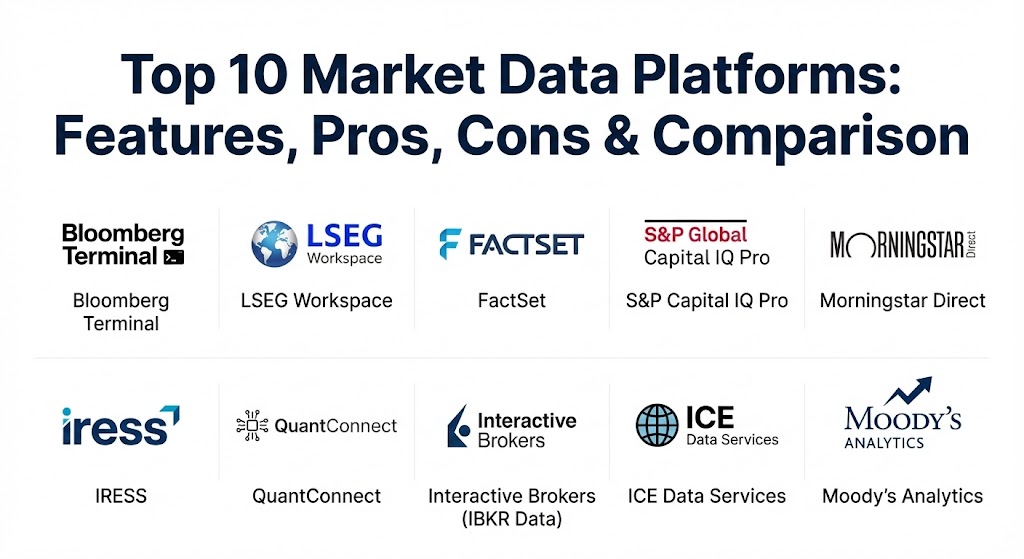
Top 10 Market Data Platforms Tools
1 — Bloomberg Terminal
The Bloomberg Terminal remains the undisputed heavyweight champion of the financial world. It is more than just a data platform; it is a global social network for the financial elite, defined by its iconic black background and the “Bloomberg Professional” service.
- Key features:
- Real-time global data across all asset classes, including obscure fixed-income instruments.
- The “Instant Bloomberg” (IB) chat service, used by over 300,000 professionals.
- Powerful analytical functions (like BDP and BDH) for Excel integration.
- Comprehensive news coverage from Bloomberg News and thousands of third-party sources.
- Integrated execution management system (EMSX) for seamless trading.
- Sophisticated supply chain and ESG data visualization tools.
- Pros:
- Unrivaled depth of data in fixed income and commodities.
- The terminal’s community provides immediate access to liquidity and market counterparts.
- Cons:
- The most expensive tool on the market (approx. $27,000+ per year).
- Uses a proprietary keyboard and unique command-based interface that takes months to master.
- Security & compliance: SOC 2 Type II, ISO 27001, end-to-end encryption, and rigorous audit trails for trade execution.
- Support & community: 24/7 “Help Help” concierge service, extensive physical training centers globally, and an elite community of users.
2 — LSEG Workspace (formerly Refinitiv Eikon)
Owned by the London Stock Exchange Group, LSEG Workspace is the primary challenger to Bloomberg. It offers a more modern, open-source approach to financial data, allowing for easier integration with third-party applications.
- Key features:
- Deep coverage of global equity markets and FX (via its integration with Reuters).
- Powerful search functionality using natural language processing.
- The “Datastream” service for world-class historical economic data.
- Integrated Messenger that connects with the Eikon and LSEG community.
- Open platform architecture that supports Python-based data science workflows.
- Advanced ESG (Environmental, Social, and Governance) scores and analytics.
- Pros:
- More flexible user interface than Bloomberg; works exceptionally well in a web browser.
- Superior economic and historical time-series data through Datastream.
- Cons:
- Fixed income data, while strong, is often considered a step behind Bloomberg.
- The transition from Eikon to “Workspace” has caused some legacy navigation confusion.
- Security & compliance: GDPR, HIPAA (where relevant), SOC 2, and advanced SSO integration.
- Support & community: Extensive online Academy, responsive global support desks, and a strong presence in European and Asian markets.
3 — FactSet
FactSet is the preferred tool for buy-side and sell-side analysts who focus heavily on fundamental research and portfolio management. It excels in consolidating data into a workflow-friendly format.
- Key features:
- Industry-leading portfolio analytics and attribution tools.
- Seamless Excel integration that allows for highly complex financial modeling.
- Detailed company identifiers and hierarchy data for risk management.
- Comprehensive “Estimates” data (FactSet Estimates) which is an industry benchmark.
- Multi-asset class risk modeling and performance measurement.
- Custom report building with automated data refreshes.
- Pros:
- Exceptionally high-quality customer service; each firm often gets a dedicated consultant.
- The most streamlined workflow for equity researchers and M&A professionals.
- Cons:
- Real-time trading and execution capabilities are not as robust as Bloomberg.
- News coverage is good but lacks the “breaking news” impact of Reuters or Bloomberg.
- Security & compliance: ISO 27001, SOC 2, and FISMA compliant. Secure cloud delivery options.
- Support & community: Famous for its “dedicated consultant” model; support is proactive and highly technical.
4 — S&P Capital IQ Pro
S&P Capital IQ Pro (formerly SNL Financial) is a powerhouse for fundamental data, M&A research, and sector-specific deep dives (particularly in banking, energy, and real estate).
- Key features:
- Deep-dive financial statements with “click-through” transparency to original filings.
- Comprehensive M&A and private equity database.
- Sector-specific mapping (e.g., power plants, bank branches, mining sites).
- Integrated screening tools for identifying investment targets.
- Credit ratings and research directly from S&P Global.
- Powerful Excel “Plug-in” for automated valuation modeling.
- Pros:
- The best platform for “auditing” data—you can see exactly where a number came from.
- Unmatched depth in specific niches like the financial services industry and real estate.
- Cons:
- Less focused on real-time macro-economic news compared to LSEG or Bloomberg.
- Charting tools are more focused on fundamentals than technical analysis.
- Security & compliance: ISO 27001, GDPR, and SOC 2 Type II. Encrypted data delivery via API or Desktop.
- Support & community: Strong documentation and 24/7 phone/email support with a high level of sector expertise.
5 — Morningstar Direct
Morningstar Direct is the global standard for fund research and asset allocation. It is used by wealth managers and institutional consultants to evaluate mutual funds, ETFs, and separate accounts.
- Key features:
- The world’s largest database of managed investment vehicles.
- Proprietary Morningstar Ratings (Stars) and Sustainability Ratings (Globes).
- Advanced “Portfolio Lab” for constructing and backtesting multi-asset portfolios.
- Peer group analysis and custom benchmarking tools.
- ESG data integration through the Sustainalytics acquisition.
- Presentation-ready reporting for client communication.
- Pros:
- The absolute authority on fund data and manager research.
- Excellent tools for ESG and impact investing analysis.
- Cons:
- Not designed for real-time equity trading or high-frequency data.
- Limited coverage of individual corporate bonds compared to ICE or Bloomberg.
- Security & compliance: SOC 2, GDPR, and ISO 27001. Rigorous data privacy standards for wealth management users.
- Support & community: Great onboarding programs and a very active community of financial advisors and asset allocators.
6 — IRESS
IRESS is a dominant player in the Asia-Pacific market and is increasingly gaining ground in the UK and South Africa. It bridges the gap between a data platform and a sophisticated execution system.
- Key features:
- Highly customizable “Market Map” for real-time price monitoring.
- Integrated order management system (OMS) for direct market access (DMA).
- Advanced technical analysis and charting suite.
- Multi-currency, multi-market portfolio tracking.
- Wealth management modules for financial planning and client CRM.
- API-first design for developers building bespoke trading apps.
- Pros:
- Exceptional market connectivity in Asia and Australia.
- Combines front-office data with middle-office wealth management tools.
- Cons:
- Global news and fundamental data are not as deep as FactSet or Bloomberg.
- User interface can feel “busy” due to the high density of trading information.
- Security & compliance: ISO 27001, Australian Privacy Principles (APP) compliant, and SOC 2.
- Support & community: Strong regional support teams with deep local knowledge of exchange rules.
7 — QuantConnect
QuantConnect represents the “new guard” of market data. It is a cloud-based algorithmic trading platform that provides institutional-grade data for a fraction of the cost of legacy terminals.
- Key features:
- Access to high-resolution tick data for equities, FX, crypto, and futures.
- Integrated backtesting engine (LEAN) using C# or Python.
- Cloud-based IDE for developing and deploying trading algorithms.
- Alternative data sets (satellite data, news sentiment) ready for ingestion.
- Co-located brokerage connectivity for low-latency execution.
- Collaborative environment for “crowd-sourced” alpha.
- Pros:
- Extremely cost-effective for developers and quant-focused hedge funds.
- Eliminates the need for expensive on-premise data storage and infrastructure.
- Cons:
- No “terminal” UI—requires coding knowledge to access and visualize data.
- Not suitable for traditional discretionary analysts or wealth managers.
- Security & compliance: SOC 2, AES-256 encryption, and secure API keys with IP whitelisting.
- Support & community: Massive community of over 200,000 quant developers and a very active forum.
8 — Interactive Brokers (IBKR Data)
While primarily a brokerage, Interactive Brokers provides one of the most widely used market data feeds for professional-level retail traders and small hedge funds.
- Key features:
- Low-cost subscription to real-time data from over 150 global exchanges.
- The Trader Workstation (TWS) platform with advanced charting.
- Robust API for integrating data into custom trading bots.
- Access to fundamental data through the “Fundamentals Explorer.”
- Bond scanner and fixed-income price discovery tools.
- Global news feeds from Reuters, Dow Jones, and Fly on the Wall.
- Pros:
- Best price-to-performance ratio in the industry.
- Allows users to pay only for the specific exchange data they need.
- Cons:
- Support can be slower and less “white-glove” than FactSet or Bloomberg.
- TWS interface is notoriously complex and lacks a modern aesthetic.
- Security & compliance: SEC, FINRA, and international regulatory oversight. Two-factor authentication (2FA) is mandatory.
- Support & community: Large user base; plenty of third-party tutorials and a comprehensive online “IBKR Campus.”
9 — ICE Data Services
ICE (Intercontinental Exchange) Data Services is a global leader in “Consolidated Feeds,” providing high-quality, low-latency data that powers many other platforms and bank trading systems.
- Key features:
- Ultra-low latency “ticker plant” for high-frequency trading.
- Market-leading fixed income pricing and reference data.
- ICE Connect: A desktop solution for real-time visualization.
- Deep insights into the energy and commodities markets (ICE Futures).
- Continuous evaluated pricing (CEP) for illiquid bonds.
- Historical tick data for backtesting and regulatory compliance.
- Pros:
- The gold standard for fixed-income pricing and bond valuation.
- Infrastructure is built for the most demanding high-frequency traders.
- Cons:
- Desktop interface (ICE Connect) is less feature-rich for analysts than FactSet.
- Primarily a “data-first” company; less focus on news and social features.
- Security & compliance: ISO 27001, SOC 2, and specialized compliance for MiFID II and SEC reporting.
- Support & community: High-level technical support for infrastructure and API integration.
10 — Moody’s Analytics
Moody’s Analytics provides the macro-economic and credit risk data that fuels long-term strategic decisions. It is the go-to platform for economists and risk officers.
- Key features:
- World-class economic forecasting and scenario modeling.
- Integrated credit risk scores for millions of public and private entities.
- Global macroeconomic database covering over 200 countries.
- Stress testing tools for banking and insurance sectors.
- Specialized research on demographics, labor markets, and consumer credit.
- Real estate market analysis and forecasting.
- Pros:
- Unrivaled for long-term economic planning and credit risk assessment.
- Integration of “real-world” data with financial market projections.
- Cons:
- Not a real-time trading platform; data is mostly daily, monthly, or quarterly.
- Limited coverage of intraday equity market movements.
- Security & compliance: ISO 27001, GDPR, and SOC 2. Strong focus on data sovereignty.
- Support & community: Strong academic and professional reputation; support is provided by economists and risk specialists.
Comparison Table
| Tool Name | Best For | Platform(s) Supported | Standout Feature | Rating (Gartner/Industry) |
| Bloomberg | Institutional Trading | Terminal (Hardware), Web, Mobile | Instant Bloomberg (Chat) | 4.8 / 5 |
| LSEG Workspace | Open Data/Research | Desktop, Web, Mobile, API | Datastream (Historical) | 4.6 / 5 |
| FactSet | Analyst Workflow | Desktop, Web, Mobile | Excel Integration | 4.7 / 5 |
| S&P Cap IQ | Fundamental/M&A | Web, Excel | Click-through Auditing | 4.5 / 5 |
| Morningstar | Fund Research | Desktop, Web | Sustainability Ratings | 4.4 / 5 |
| IRESS | APAC Execution | Desktop, Web, Mobile | Market Connectivity | 4.3 / 5 |
| QuantConnect | Quant Developers | Cloud (Browser-based) | Backtesting Engine | 4.7 / 5 |
| IBKR Data | Professional Retail | Desktop, Web, Mobile, API | Low-cost Feed Selection | 4.2 / 5 |
| ICE Data | Fixed Income/HFT | Desktop, API, Feeds | Bond Evaluated Pricing | 4.6 / 5 |
| Moody’s Analytics | Credit/Macro Risk | Web, API | Economic Forecasting | 4.5 / 5 |
Evaluation & Scoring of Market Data Platforms
The following rubric provides a weighted scoring system based on the requirements of professional financial organizations.
| Category | Weight | Evaluation Criteria |
| Core Features | 25% | Latency, asset class coverage, historical depth, and news quality. |
| Ease of Use | 15% | User interface design, search functionality, and learning curve. |
| Integrations | 15% | Excel plug-ins, Python/API support, and third-party app ecosystem. |
| Security & Compliance | 10% | Encryption, SSO, audit logs, and MiFID II/SEC readiness. |
| Performance | 10% | Stability during market crashes and data normalization speed. |
| Support | 10% | Help desk availability, training resources, and account management. |
| Price / Value | 15% | ROI relative to subscription costs and infrastructure requirements. |
Which Market Data Platforms Tool Is Right for You?
Choosing a market data platform is one of the most expensive and impactful decisions a financial firm can make. Here is how to navigate the choice:
- Solo Traders vs. SMB Hedge Funds: If you are a single trader or a small startup fund, Interactive Brokers or QuantConnect offer the best path to institutional data without a $2,000 monthly bill. They provide the raw data you need to build your own “terminal.”
- Mid-market Asset Managers: If your focus is on equities and fundamental research, FactSet or S&P Capital IQ are the leaders. They offer better workflow tools for analysts than Bloomberg and are often slightly more cost-effective.
- Large Investment Banks & Hedge Funds: For these firms, Bloomberg is the mandatory “tax” of the industry. You need it for the chat functionality alone. However, many of these firms are augmenting Bloomberg with ICE Data Services for execution or LSEG Workspace for their quant desks.
- Feature Depth vs. Ease of Use: If you want the most “modern” feel and easy web access, LSEG Workspace wins. If you want the most “power” and don’t mind a 1980s-style command line, Bloomberg remains king.
- Budget vs. Premium: If budget is no object and latency is everything, ICE and Bloomberg are the choices. For budget-conscious professionals who still need “pro” data, IRESS (especially in APAC) and IBKR are the standout winners.
Frequently Asked Questions (FAQs)
1. Why is Bloomberg so much more expensive than other platforms?
Bloomberg charges for the “network effect.” While its data is excellent, users pay a premium for the Instant Bloomberg chat, which is where the world’s largest trades are negotiated and confirmed.
2. Can I use these platforms on a Mac?
Most platforms (FactSet, LSEG, S&P) now have excellent web-based versions that work on any OS. However, the Bloomberg Terminal hardware is Windows-based, though “Bloomberg Anywhere” allows Mac access via a browser.
3. What is the difference between “Level 1” and “Level 2” data?
Level 1 provides the current bid/ask price. Level 2 (Market Depth) shows the “order book”—the list of all pending buy and sell orders at different prices, which is crucial for understanding liquidity.
4. How does “latency” affect my data?
For a discretionary long-term investor, a 1-second delay doesn’t matter. For an algorithmic trader, a 1-millisecond delay can make a strategy unprofitable. High-end platforms like ICE minimize this delay.
5. Do I need to buy a separate feed for every exchange?
Usually, yes. While the platform provides the “software,” the exchanges (like NYSE or LSE) charge “user fees.” Most platforms manage these subscriptions for you as “pass-through” costs.
6. Can I get these tools for free as a student?
Many universities have “Bloomberg Terminals” or “FactSet Labs” in their library or business school. Check with your institution, as individual student subscriptions are rarely available.
7. Is crypto data included in these platforms?
Yes, most (especially Bloomberg, LSEG, and QuantConnect) now provide institutional-grade crypto pricing, though coverage varies between spot and futures markets.
8. What is “Alternative Data”?
It is non-traditional financial data. For example, a market data platform might provide a feed showing the number of cars in a retailer’s parking lot (via satellite) to predict quarterly sales.
9. How do these tools integrate with Excel?
Most use an “add-in” that provides custom formulas. Instead of typing a number, you type =BDP(“AAPL US Equity”, “PX_LAST”), and the cell will update automatically with Apple’s latest price.
10. What happens to my data during a market crash?
This is where premium platforms prove their worth. During high-volume crashes, cheap feeds can “lag” or freeze. Premium platforms invest billions in infrastructure to ensure their data remains “live” during volatility.
Conclusion
The market data landscape in 2026 is defined by a choice between “walled gardens” and “open ecosystems.” Bloomberg continues to dominate through its social network, while LSEG and FactSet offer more flexible, integration-friendly alternatives. For the quantitative-minded, platforms like QuantConnect have democratized access to data that was once the exclusive domain of billionaire-run hedge funds.
Ultimately, the “best” platform is the one that fits your specific asset class and your technical ability. Whether you need the lightning-fast execution of IRESS, the fund-deep research of Morningstar, or the economic foresight of Moody’s, choosing the right tool is the first step toward achieving professional success in the global markets.