Introduction
A Laboratory Information Management System (LIMS) is a software-based solution designed to manage samples, laboratory users, instruments, and the massive amounts of data generated by scientific workflows. At its core, a LIMS automates the journey of a sample—from its initial “accessioning” or logging, through various testing phases, to final reporting and archiving. By acting as the central nervous system of the lab, these tools eliminate human transcription errors and ensure that data remains traceable and secure.
The importance of a LIMS cannot be overstated in today’s data-driven world. Key real-world use cases include clinical diagnostics where patient health depends on accurate results, pharmaceutical R&D where data integrity is required for FDA approval, and environmental testing where longitudinal studies require years of consistent data. When evaluating a LIMS in 2026, users should look for “cloud-native” architectures, seamless instrument integration through IoT (Internet of Things), robust AI-driven analytics, and strict adherence to international standards like ISO 17025 and 21 CFR Part 11.
Best for: Lab managers, research scientists, and QA/QC teams in medium-to-large enterprises within the pharmaceutical, biotech, healthcare, and environmental sectors. It is essential for organizations that must maintain rigorous audit trails and manage high volumes of sample data.
Not ideal for: Very small, early-stage academic labs with low throughput or startup research teams that lack a formal quality management system. In such cases, a simple Electronic Lab Notebook (ELN) or even a basic database may suffice until the lab matures.
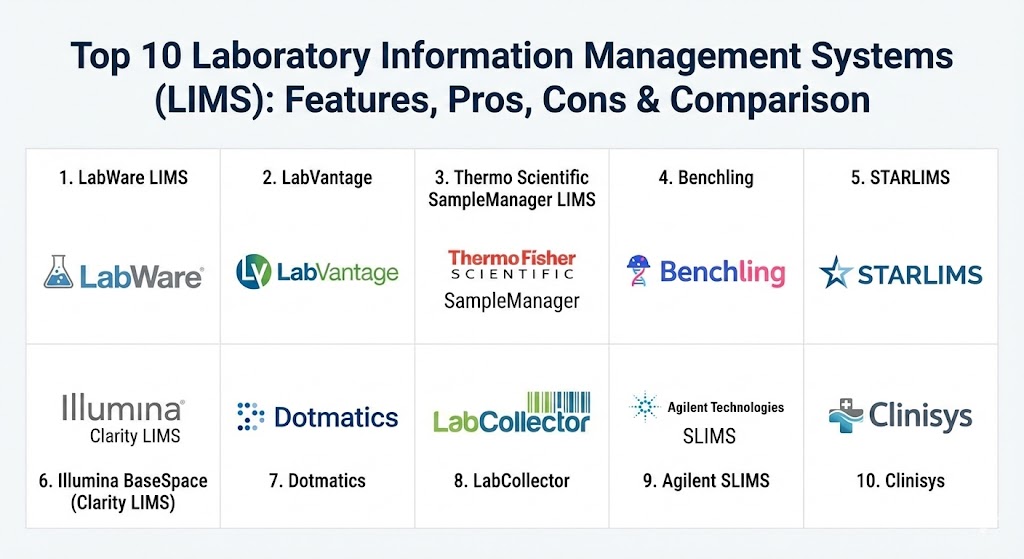
Top 10 Laboratory Information Management Systems (LIMS) Tools
1 — LabWare LIMS
LabWare LIMS is widely recognized as the global leader in enterprise-level laboratory automation. It is a highly flexible, highly scalable solution used by many of the world’s largest pharmaceutical and clinical organizations to manage complex, multi-site workflows.
- Key features:
- Comprehensive sample tracking with full lifecycle management.
- Integrated Electronic Laboratory Notebook (ELN) for unified data entry.
- Extensive library of instrument interfaces for automated data collection.
- Powerful workflow designer that allows for deep customization without coding.
- Advanced inventory and reagent management with automated reorder alerts.
- Built-in statistical quality control (SQC) and trending tools.
- Multi-language and multi-currency support for global deployments.
- Pros:
- Unrivaled flexibility; the system can be tailored to almost any laboratory type or industry.
- Extremely robust audit trails and electronic signature capabilities for regulatory compliance.
- Cons:
- High total cost of ownership (TCO) due to licensing and implementation complexity.
- Requires a significant time investment for initial setup and user training.
- Security & compliance: FDA 21 CFR Part 11, GxP, ISO 17025, HIPAA, SOC 2, and GDPR compliant. Includes advanced SSO and AES-256 encryption.
- Support & community: World-class enterprise support with a massive global user community and “LabWare University” for formal certification.
2 — LabVantage LIMS
LabVantage is a 100% browser-based LIMS that eliminates the need for client-side installations. In 2026, it is highly regarded for its modern user interface and its “configuration over customization” philosophy, which speeds up deployment times.
- Key features:
- Fully browser-based platform accessible from any device or operating system.
- Pre-configured “Industry Accelerators” for Pharma, Biobanking, and Quality QC.
- Integrated SDMS (Scientific Data Management System) for capturing raw instrument files.
- AI-assisted data analytics for predictive laboratory management.
- Native mobile app for sample collection in the field or on the lab floor.
- Visual workflow editor with drag-and-drop functionality.
- Dynamic dashboards for real-time monitoring of lab KPIs.
- Pros:
- Lower IT overhead because no software needs to be installed on individual workstations.
- Fast implementation compared to traditional enterprise LIMS through pre-built modules.
- Cons:
- Deeply custom logic may still require specialized consulting services.
- Performance can be dependent on internet connectivity for cloud-hosted versions.
- Security & compliance: ISO 27001, SOC 2 Type II, HIPAA, and 21 CFR Part 11. Supports complex password policies and audit logging.
- Support & community: Extensive online knowledge base, responsive helpdesk, and annual user conferences for networking and training.
3 — Thermo Scientific SampleManager LIMS
Developed by one of the biggest names in lab equipment, SampleManager LIMS is designed to be the digital core of a connected laboratory. It is uniquely positioned to offer deep integration with Thermo Fisher’s vast array of scientific instruments.
- Key features:
- Seamless integration with chromatography (CDS) and mass spectrometry software.
- Integrated LES (Laboratory Execution System) to guide technicians through SOPs.
- Advanced data visualization tools for identifying trends and outliers.
- Mobile functionality for barcode scanning and remote data entry.
- Built-in resource management for tracking staff training and instrument calibration.
- Automated reporting and certificate of analysis (CoA) generation.
- Scalable architecture from single-site labs to global enterprises.
- Pros:
- Best-in-class instrument integration, reducing manual data entry to nearly zero.
- Strong focus on “Lab Execution,” ensuring that technicians follow protocols strictly.
- Cons:
- Can feel overly complex for labs that do not use Thermo Scientific hardware.
- Implementation often requires specialized consultants from the vendor.
- Security & compliance: GxP, 21 CFR Part 11, ISO 9001, and GDPR. Robust identity management and audit trails.
- Support & community: Professional global support network with dedicated implementation teams and extensive technical documentation.
4 — Benchling
Benchling has revolutionized the biotech space with a modern, cloud-native R&D platform. It is specifically designed for biologics and modern life sciences, moving away from the “static” sample management of legacy systems toward a more fluid, research-focused approach.
- Key features:
- Unified platform combining LIMS, ELN, Molecular Biology tools, and Registry.
- Visual DNA/RNA sequence design and CRISPR tool integration.
- Graph-based data model that maps relationships between samples, batches, and experiments.
- Automated request management for internal core facilities.
- High-throughput screening and plate management modules.
- Real-time collaboration features for distributed research teams.
- API-first design for easy integration with modern data stacks.
- Pros:
- Exceptionally modern and intuitive user interface—teachers and students love it.
- Perfect for R&D where experimental flexibility is more important than rigid QC workflows.
- Cons:
- Not as strong in traditional “high-volume” manufacturing QC compared to LabWare.
- The “all-in-one” pricing can be expensive for labs only needing simple sample tracking.
- Security & compliance: SOC 2, HIPAA, GDPR, and 21 CFR Part 11 compliant. End-to-end encryption for all data.
- Support & community: Excellent onboarding, responsive chat support, and a very active community of biotech professionals.
5 — STARLIMS (by Abbott Informatics)
STARLIMS provides a comprehensive suite of informatics solutions that manage the entire product lifecycle. It is highly favored in forensic, environmental, and public health laboratories due to its specialized vertical solutions.
- Key features:
- Specialized modules for Forensics, Clinical, and Manufacturing industries.
- Integrated ELN and SDMS for a holistic view of laboratory data.
- Advanced analytics engine for identifying operational bottlenecks.
- Inventory and equipment management with automated maintenance scheduling.
- Mobile-ready interface for field sample collection and remote approvals.
- Support for complex regulatory reporting (e.g., EPA, FDA).
- Multi-tier architecture for high availability and disaster recovery.
- Pros:
- Industry-specific “out-of-the-box” functionality reduces the need for custom coding.
- Strong data visualization and business intelligence (BI) capabilities.
- Cons:
- The user interface can feel a bit traditional compared to newer SaaS players.
- Upgrades between major versions can be complex and time-consuming.
- Security & compliance: ISO 17025, 21 CFR Part 11, HIPAA, and GDPR. Detailed audit trails for every database action.
- Support & community: Strong global presence with local support teams and a well-established user base in government and clinical sectors.
6 — Illumina BaseSpace (Clarity LIMS)
Specifically designed for the needs of genomics and Next-Generation Sequencing (NGS) labs, Clarity LIMS focuses on the high-complexity workflows associated with genetic testing and precision medicine.
- Key features:
- Pre-configured workflows for popular NGS libraries and protocols.
- Direct integration with Illumina sequencing platforms.
- Automated “reagent tracking” for high-cost genetic sequencing kits.
- Visual plate mapping and tracking for high-throughput genomic labs.
- Integration with bioinformatics pipelines for automated result analysis.
- Compliance modules specifically for clinical genomics.
- Scalable cloud or on-premise deployment options.
- Pros:
- The industry standard for genomics; it “speaks the language” of NGS.
- Significantly reduces the risk of sample mix-ups in complex genetic workflows.
- Cons:
- Very niche; not suitable for general chemistry or environmental labs.
- Heavily optimized for the Illumina ecosystem, though it supports others.
- Security & compliance: HIPAA, GDPR, CAP/CLIA, and 21 CFR Part 11. Strong focus on patient data privacy.
- Support & community: Backed by Illumina’s extensive genomics support network; high-quality technical documentation.
7 — Dotmatics
Dotmatics is an enterprise R&D informatics platform that focuses on the drug discovery process. It is designed to bridge the gap between chemistry, biology, and data science, providing a unified view of the research pipeline.
- Key features:
- Chemical structure searching and biological entity registration.
- Integrated data visualization and SAR (Structure-Activity Relationship) analysis.
- Cloud-based collaboration for global drug discovery teams.
- High-volume data management for screening and proteomics.
- Integrated ELN that captures both structured and unstructured data.
- Automated data capture from analytical instruments.
- Flexible workflow orchestration for early-stage discovery.
- Pros:
- Excellent for “Discovery LIMS” where researchers need to query across chemistry and biology.
- Highly scalable for large-scale screening operations.
- Cons:
- Less focused on “Routine QC” or manufacturing-side laboratory management.
- Can be complex to configure for non-discovery workflows.
- Security & compliance: SOC 2, HIPAA, GDPR, and GxP. Data is protected with multi-layer encryption.
- Support & community: Strong expert-led support; specialized training for computational biologists and chemists.
8 — LabCollector
LabCollector by AgileBio is a modular, cost-effective LIMS that is popular with SMBs and academic research centers. Its unique selling point is its modularity; you only buy the parts of the system you actually need.
- Key features:
- Modular architecture (Inventory, Samples, Reagents, Equipment, etc.).
- Customizable database fields without requiring programming knowledge.
- Integrated barcode generator and support for RFID tracking.
- Web-based interface that can be hosted locally or in the cloud.
- “Add-on” modules for ELN, Workflows, and Service Management.
- Support for instrument integration via “I-Collector” middleware.
- Budget-friendly licensing for smaller laboratories.
- Pros:
- Extremely cost-effective compared to enterprise solutions like LabWare.
- High degree of “user-configurability” makes it easy to adapt to changing needs.
- Cons:
- The UI is functional but lacks the “slick” feel of premium SaaS tools.
- Not ideally suited for massive, multi-site global enterprise deployments.
- Security & compliance: ISO 17025, 21 CFR Part 11, and GDPR compliant options available.
- Support & community: Good documentation and responsive email/ticket support; popular in European and academic circles.
9 — Agilent SLIMS
Agilent SLIMS combines the best of a LIMS and an Electronic Lab Notebook (ELN) into a single, integrated platform. It is designed to streamline workflows for labs that handle everything from sample intake to complex analytical testing.
- Key features:
- Unified SIS (Sample Information System) and ELN.
- Visual workflow designer for mapping out lab protocols.
- Deep integration with Agilent analytical hardware and OpenLab software.
- Built-in inventory management and instrument maintenance tracking.
- Compliance-ready features for regulated environments.
- Dashboards for monitoring throughput and lab efficiency.
- Role-based access and secure data sharing.
- Pros:
- Simplifies the software stack by combining LIMS and ELN into one license.
- Seamless data flow for labs already using Agilent’s chromatography or mass spec tools.
- Cons:
- Younger product compared to the established “titans” like STARLIMS.
- Integration with non-Agilent hardware may require extra configuration.
- Security & compliance: ISO 17025, 21 CFR Part 11, and GxP. High standards for data integrity.
- Support & community: Professional support from Agilent’s global service organization; extensive training materials.
10 — Clinisys (formerly Sunquest/Horizons)
Clinisys focuses exclusively on the clinical and diagnostic laboratory market. It is designed to handle the high-speed, high-stakes environment of hospital and reference labs where patient outcomes depend on rapid turnaround.
- Key features:
- Specialized workflows for Pathology, Hematology, and Microbiology.
- Integration with Hospital Information Systems (HIS) and Electronic Health Records (EHR).
- Real-time tracking of critical patient results and alerts.
- Automated billing and insurance verification modules.
- Quality control management tailored for clinical CLIA/CAP standards.
- Multi-site management for large hospital networks.
- Robust reporting for public health and infectious disease tracking.
- Pros:
- Deeply “clinical-aware”; handles patient-specific data better than general LIMS.
- Reliable and stable for 24/7 high-volume diagnostic operations.
- Cons:
- Not suitable for R&D, manufacturing, or environmental testing.
- High cost of implementation within a complex hospital IT infrastructure.
- Security & compliance: HIPAA, GDPR, CAP/CLIA, and SOC 2. Maximum emphasis on patient data security.
- Support & community: Specialized clinical support teams; strong presence in the healthcare IT community.
Comparison Table
| Tool Name | Best For | Platform(s) Supported | Standout Feature | Rating (Gartner Peer Insights) |
| LabWare LIMS | Enterprise / Global | Windows, Web, Cloud | Extreme Flexibility | 4.6 / 5 |
| LabVantage | Browser-Based QC | Cloud, Web (SaaS) | Configuration over Code | 4.5 / 5 |
| Thermo SampleManager | Instrument-Heavy Labs | Windows, Web, Cloud | Native Instrument Control | 4.4 / 5 |
| Benchling | Biotech / Modern R&D | Cloud (SaaS) | Biology-First Design | 4.8 / 5 |
| STARLIMS | Forensic / Public Health | Windows, Web, Cloud | Vertical-Specific Modules | 4.3 / 5 |
| Clarity LIMS (Illumina) | Genomics / NGS | Cloud, On-Premise | NGS Workflow Optimization | 4.5 / 5 |
| Dotmatics | Drug Discovery | Cloud, Web | Chem/Bio Data Integration | 4.4 / 5 |
| LabCollector | SMBs / Academia | Web, On-Premise | Modular Pricing | 4.2 / 5 |
| Agilent SLIMS | Analytical Labs | Web, Cloud | Integrated LIMS/ELN | 4.4 / 5 |
| Clinisys | Hospital Diagnostics | On-Premise, Cloud | Clinical/EHR Integration | 4.3 / 5 |
Evaluation & Scoring of Laboratory Information Management Systems (LIMS)
Choosing a LIMS requires evaluating how well the software aligns with your lab’s unique operational goals. The following rubric provides a framework for ranking these tools based on industry-standard requirements.
| Category | Weight | Evaluation Criteria |
| Core Features | 25% | Sample tracking, workflow automation, inventory, and reporting capabilities. |
| Ease of Use | 15% | UI/UX design, mobile accessibility, and the learning curve for lab technicians. |
| Integrations | 15% | Ability to connect with lab hardware, ERP systems, and cloud data lakes. |
| Security & Compliance | 10% | Audit trails, electronic signatures, and adherence to FDA/ISO/HIPAA standards. |
| Performance | 10% | System speed, reliability under high throughput, and disaster recovery. |
| Support & Community | 10% | Quality of documentation, speed of helpdesk, and active user forums. |
| Price / Value | 15% | Upfront cost vs long-term efficiency gains; transparency of the pricing model. |
Which Laboratory Information Management Systems (LIMS) Tool Is Right for You?
The “perfect” LIMS depends heavily on your industry, the volume of samples you handle, and the regulatory environment you operate in.
- Solo Users & Startup Labs: If you are a small team of 2-5 researchers, avoid the “enterprise giants.” A modular solution like LabCollector or a research-focused platform like Benchling offers a much smoother onboarding process without the six-figure price tag.
- SMBs (10-50 users): For growing labs in the mid-market, Agilent SLIMS or LabVantage are excellent choices. They provide professional-grade compliance features without the extreme complexity of a fully bespoke enterprise system.
- Large Enterprises & Multi-Site Labs: If you need to manage a global network of labs, LabWare LIMS is the industry standard for a reason. Its ability to handle massive scale and diverse workflows is unmatched, provided you have the IT budget to support it.
- Industry Specialists:
- Genomics/NGS: Go with Clarity LIMS.
- Hospital/Clinical Diagnostics: Go with Clinisys.
- Early-Stage Drug Discovery: Go with Dotmatics.
- Budget-Conscious Labs: If you have internal technical talent and a limited budget, LabCollector or even open-source frameworks (if you have dev support) provide the best path to automation without high recurring licensing fees.
Frequently Asked Questions (FAQs)
1. What is the difference between a LIMS and an ELN?
A LIMS is designed for structured, repetitive data like sample tracking and QC workflows. An Electronic Lab Notebook (ELN) is designed for unstructured data, like documenting a researcher’s daily experimental notes and observations. Modern tools often combine both.
2. How much does a LIMS implementation cost?
For a small lab, it might start at $5,000–$10,000. For a global enterprise, implementation can cost anywhere from $250,000 to over $1,000,000 including licensing, hardware, consulting, and validation services.
3. Is “Cloud-SaaS” LIMS secure enough for clinical data?
Yes. In 2026, major LIMS providers use highly secure cloud infrastructure (AWS/Azure) that is SOC 2 and HIPAA compliant. Cloud systems often provide better disaster recovery and security than many on-premise lab servers.
4. How long does it take to get a LIMS up and running?
A simple, “out-of-the-box” SaaS LIMS can be live in 4–8 weeks. A complex, customized enterprise LIMS typically takes 6–12 months to fully implement, validate, and train users.
5. What does “21 CFR Part 11” mean for LIMS?
This is an FDA regulation that sets the requirements for electronic records and electronic signatures. It ensures that the data in the LIMS is as reliable and trustworthy as paper records with hand-written signatures.
6. Do I need to buy new lab instruments to use a LIMS?
No. Most LIMS tools use “middleware” or specialized drivers to connect with existing instruments. However, newer instruments with IoT capabilities are much easier to integrate than 20-year-old legacy hardware.
7. Can a LIMS manage my chemical inventory?
Yes. Most modern LIMS include or offer an add-on module for inventory management, allowing you to track reagents, expiration dates, and SDS (Safety Data Sheets) alongside your samples.
8. What is “Validation” in the context of LIMS?
Validation is the documented proof that the LIMS performs its intended functions correctly and meets all regulatory requirements. It is a mandatory step for labs in pharma, biotech, and clinical sectors.
9. Can I use a LIMS on my tablet or smartphone?
Most modern LIMS (like LabVantage and Benchling) are responsive and work in a mobile browser. Some also offer native apps for field collection and barcode scanning using the device’s camera.
10. Why not just use Excel or Google Sheets for my lab data?
Excel lacks an audit trail, electronic signatures, and proper version control. It is very easy to accidentally delete or change data without leaving a trace, which makes it non-compliant for regulated scientific research.
Conclusion
The selection of a Laboratory Information Management System is one of the most significant strategic decisions a lab manager will make. In 2026, a LIMS is not just a tool for logging samples; it is a platform for ensuring data integrity, driving scientific discovery, and meeting the rigorous demands of global regulators. Whether you choose the massive flexibility of LabWare, the modern R&D focus of Benchling, or the modularity of LabCollector, the key is to prioritize a system that can grow with your lab. The “best” LIMS is ultimately the one that your scientists actually enjoy using and that your auditors trust implicitly.