Introduction
A Digital Identity Wallet is a software application or hardware-bound container that allows individuals to securely store, manage, and share verifiable digital credentials. These aren’t just digital versions of your driver’s license or credit cards; they are cryptographic representations of your identity, diplomas, health records, and even professional certifications. Rooted in the principle of Self-Sovereign Identity (SSI), these wallets give you full control over your data, allowing you to share only what is necessary (selective disclosure) without relying on a central authority to “vouch” for you every time you log in.
The importance of DIWs in 2026 cannot be overstated. As deepfakes and AI-driven identity theft become more sophisticated, the need for “tamper-proof” identity verification is critical for the global economy. Real-world use cases are already ubiquitous: citizens across the EU are using the mandated EUDI Wallet to open bank accounts and file taxes; travelers in the US are passing through TSA checkpoints with Apple Wallet; and remote employees are using Microsoft Entra to verify their credentials instantly without traditional background checks.
When choosing a DIW, users and organizations must look for high-assurance security (hardware-level encryption), interoperability (support for W3C Verifiable Credentials), and a seamless user experience that works across mobile and web platforms.
Best for: Citizens in regulated regions (like the EU), HR departments managing remote global workforces, financial institutions requiring high-fidelity KYC (Know Your Customer), and developers building privacy-first applications.
Not ideal for: Organizations that are perfectly satisfied with traditional, centralized Single Sign-On (SSO) systems and do not handle sensitive personal data, or regions where digital infrastructure remains entirely physical and manual.
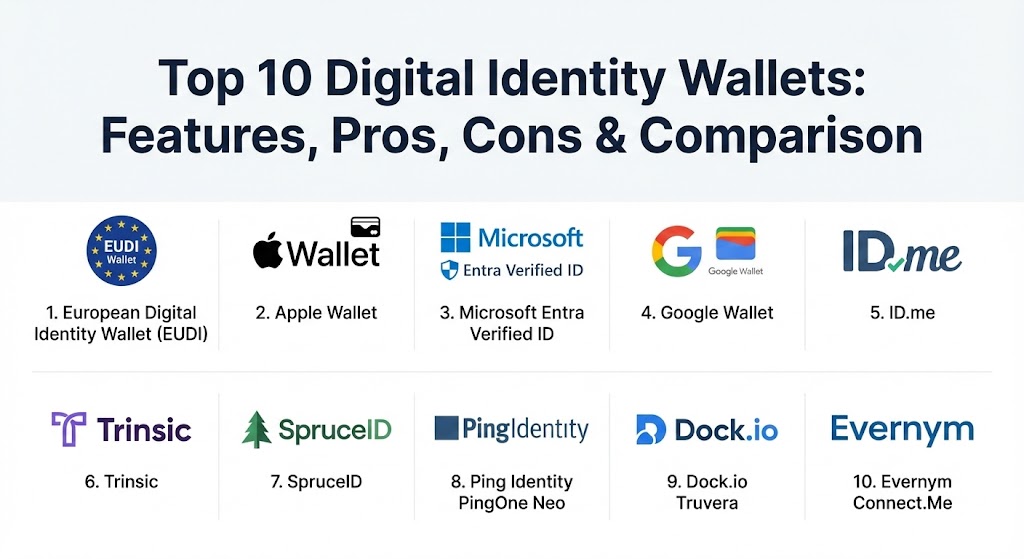
Top 10 Digital Identity Wallets
1 — European Digital Identity Wallet (EUDI)
As of late 2026, the EUDI Wallet is the gold standard for regulatory compliance. Mandated under the eIDAS 2.0 framework, every EU member state now provides at least one certified wallet to its citizens, residents, and businesses.
- Key features:
- Full legal recognition across all 27 EU member states.
- Support for “Qualified Electronic Signatures” (QES) with high legal standing.
- Selective disclosure (e.g., proving you are over 18 without revealing your birth date).
- Integration with public services (taxes, social security, health).
- Offline mode for in-person verification without a data connection.
- Open-source reference architecture ensuring transparency.
- Pros:
- Unmatched legal and regulatory backing in the European market.
- High security standards certified by ENISA.
- Cons:
- Implementation varies slightly by country, leading to minor UX differences.
- Heavy focus on European standards may limit global utility outside the EU.
- Security & compliance: eIDAS 2.0 High-Level Assurance, GDPR, and ISO 23220 compliant.
- Support & community: Managed by national governments; supported by massive Large Scale Pilot (LSP) communities like POTENTIAL and NOBID.
2 — Apple Wallet (Digital ID)
Apple has leveraged its massive hardware ecosystem to become a dominant player in the personal digital identity space, focusing on high-assurance consumer use cases.
- Key features:
- Hardware-bound security using the iPhone’s Secure Enclave.
- Direct integration with US state DMVs for mobile Driver’s Licenses (mDL).
- “Digital ID” creation using passport data for non-mDL states.
- TSA-integrated for biometric-based airport security checks.
- “Verify with Wallet” API for third-party apps and websites.
- Apple Intelligence integration for automatic document organizing.
- Pros:
- Unrivaled user experience and seamless biometric authentication (FaceID/TouchID).
- Physical security is arguably the best in class due to hardware isolation.
- Cons:
- Ecosystem lock-in; only available to iOS users.
- Limited to specific regions (primarily US and Japan as of early 2026).
- Security & compliance: ISO 18013-5 (mDL standard), SOC 2, and FIPS 140-2 Level 3 equivalent.
- Support & community: World-class documentation for developers; 24/7 consumer support through Apple channels.
3 — Microsoft Entra Verified ID
Microsoft focuses on the B2B and enterprise side of identity, turning the Entra (formerly Azure AD) ecosystem into a powerful issuer and verifier of professional credentials.
- Key features:
- Built on open standards like W3C Verifiable Credentials and DIDs (Decentralized Identifiers).
- Seamless employee onboarding and passwordless “first-day” login.
- High-assurance “Face Check” for liveness and biometric matching.
- Automated credential revocation for offboarding employees.
- Integration with LinkedIn for verified professional history.
- Support for multi-cloud and hybrid identity environments.
- Pros:
- Perfect for organizations already entrenched in the Microsoft 365 ecosystem.
- High scalability for global enterprises with millions of identities.
- Cons:
- The administrative backend is complex for non-IT professionals.
- Requires an Entra subscription for full feature access.
- Security & compliance: SOC 2, ISO 27001, GDPR, and FedRAMP High.
- Support & community: Managed via the Microsoft Microsoft Entra portal; massive global partner network for implementation.
4 — Google Wallet (Digital Identity)
Google’s approach focuses on inclusivity and cross-platform accessibility, aiming to be the most widely adopted digital wallet on the planet by the end of 2026.
- Key features:
- Support for Aadhaar cards (India), My Number (Japan), and US mDLs.
- “Generic Pass” API for digitizing almost any physical card with a barcode.
- Android StrongBox support for hardware-level key storage.
- Integration with Google Chrome for autofilling verified identity data.
- Open-source “Identity Credential” library for Android developers.
- Shared wallet capabilities for families or business partners.
- Pros:
- Deeply inclusive, supporting a wide range of global government IDs.
- Extremely lightweight and fast on both flagship and budget Android devices.
- Cons:
- Historical privacy concerns associated with the Google ecosystem.
- Some features are fragmented based on local Android version support.
- Security & compliance: Android StrongBox, GDPR, and W3C Verifiable Credentials.
- Support & community: Extensive developer documentation; growing community of Android identity developers.
5 — ID.me Wallet
ID.me has become the de facto standard for government and highly regulated private-sector identity verification in the United States.
- Key features:
- “Reusable Identity” that works across 30+ US states and 10 federal agencies.
- Virtual In-Person (VIP) verification via video chat for high assurance.
- NIST 800-63-3 compliant identity proofing.
- Support for veteran, student, and first-responder status verification.
- Integrated “No-Knowledge” verification for retail discounts.
- Robust mobile app for managing reusable credentials.
- Pros:
- Highest level of “out-of-the-box” trust with US government entities.
- Reduces “KYC fatigue” by allowing users to verify once and reuse everywhere.
- Cons:
- Heavy focus on the US market; limited international utility.
- Privacy advocates have raised concerns over their facial recognition database.
- Security & compliance: IAL2/AAL2 (NIST), SOC 2 Type II, HIPAA, and CCPA.
- Support & community: 24/7 help desk and extensive self-service knowledge base.
6 — Trinsic
Trinsic is the leading developer-first platform for building digital wallets, providing the infrastructure for companies to launch their own white-label wallet solutions in minutes.
- Key features:
- API-first architecture for rapid integration.
- “Bring Your Own Login” (OIDC) for easy user onboarding.
- Native SDKs for iOS, Android, and Web.
- Support for “Cloud Wallets” (no app download required).
- Advanced schema management for custom credential types.
- Interoperable with Hyperledger Aries and W3C standards.
- Pros:
- The fastest way for a startup to build and launch a digital wallet.
- Highly flexible; you can “white-label” their tech to keep your own branding.
- Cons:
- More of a “B2B infrastructure” than a consumer-facing app.
- Requires development resources to implement effectively.
- Security & compliance: SOC 2, GDPR-aligned, and supports Zero-Knowledge Proofs (ZKPs).
- Support & community: Excellent developer support, GitHub-based resources, and active Slack community.
7 — SpruceID
SpruceID is the go-to choice for organizations prioritizing open-source transparency and “Web3” compatibility, famously known for the “Sign-In with Ethereum” standard.
- Key features:
- “SpruceKit” for decentralized identity and data storage.
- “Kepler” for self-sovereign storage of user data.
- Full support for ENS (Ethereum Name Service) integration.
- Open-source mobile wallet reference implementation.
- Integration with decentralized finance (DeFi) protocols.
- Focus on “Linked Data” and content-addressable storage.
- Pros:
- Ideal for the decentralized web and privacy-conscious users.
- No centralized database; the user truly owns their “keys.”
- Cons:
- Higher technical barrier to entry for the average consumer.
- Lacks the government-backed “officialdom” of EUDI or ID.me.
- Security & compliance: SOC 2, open-source audit logs, and GDPR-aligned architecture.
- Support & community: Very active developer forums and Discord; heavily community-driven.
8 — Ping Identity (PingOne Neo)
Ping Identity targets large enterprises that need to bridge the gap between their legacy IAM (Identity and Access Management) systems and modern digital wallets.
- Key features:
- No-code orchestration for identity journeys via “PingOne DaVinci.”
- “Smart Wallet” features that prompt users for needed credentials automatically.
- Reusable KYC for financial services and fintechs.
- Integration with over 1,000+ pre-built enterprise connectors.
- Decentralized identity support without replacing current SSO.
- High-assurance biometric binding.
- Pros:
- Easiest transition path for large companies already using Ping for security.
- Powerful “orchestration” allows for very complex business logic.
- Cons:
- Can be prohibitively expensive for small businesses.
- Complex initial setup compared to “wallet-in-a-box” solutions.
- Security & compliance: ISO 27001, SOC 2, HIPAA, and GDPR.
- Support & community: Full enterprise-grade SLAs, dedicated account managers, and formal training.
9 — Dock.io (Truvera)
Dock.io, through its Truvera platform, provides a specialized solution for “reusable” identity, focusing on reducing friction in regulated onboarding processes.
- Key features:
- Blockchain-backed “anchoring” for tamper-proof credentials.
- Selective disclosure via Zero-Knowledge Proofs (ZKPs).
- White-label mobile app and SDK for quick deployment.
- High-performance API for high-volume credential issuance.
- Multi-network support (Dock Blockchain and others).
- Built-in biometric protection (FaceID/Fingerprint).
- Pros:
- Exceptional focus on privacy; verifiers never see the underlying raw data.
- Low latency for verification, making it great for high-traffic environments.
- Cons:
- Smaller ecosystem compared to the tech giants like Google or Apple.
- Relies on blockchain infrastructure which some enterprises still find niche.
- Security & compliance: SOC 2, GDPR, and W3C Verifiable Credentials.
- Support & community: Strong technical whitepapers and a helpful developer forum.
10 — Evernym Connect.Me
As one of the pioneers of the SSI movement, Evernym (now part of Avast/Gen) offers a mature, battle-tested wallet based on the Hyperledger Indy and Aries frameworks.
- Key features:
- “Connect.Me” app—a highly stable, privacy-first consumer wallet.
- Peer-to-peer encrypted communication channels.
- Support for “Vcx” (Verifiable Credentials Exchange) library.
- Built-in “Liveness” checks and biometric binding.
- Cloud agent support for persistent identity across devices.
- Used in global projects like the IATA Travel Pass.
- Pros:
- Mature technology that has been tested in massive global pilots.
- Strong adherence to open-source standards to prevent vendor lock-in.
- Cons:
- UX can feel slightly less “consumer-friendly” than Apple or Google.
- Integrating with their enterprise platform (“Verity”) can be costly.
- Security & compliance: FIPS 140-2, GDPR, HIPAA, and ISO standards.
- Support & community: Robust professional services; backed by the security giant Gen Digital.
Comparison Table
| Tool Name | Best For | Platform(s) Supported | Standout Feature | Rating (Gartner / TrueReview) |
| EUDI Wallet | EU Citizens | iOS, Android | Full Legal Recognition | N/A (New in 2026) |
| Apple Wallet | High-Assurance UX | iOS, Apple Watch | Hardware Secure Enclave | 4.7 / 5.0 |
| MS Entra ID | Corporate / B2B | Web, iOS, Android | Verified Employee ID | 4.5 / 5.0 |
| Google Wallet | Global Inclusivity | Android, WearOS | “Generic Pass” API | 4.4 / 5.0 |
| ID.me | US Government | iOS, Android, Web | Reusable Gov KYC | 4.5 / 5.0 |
| Trinsic | App Developers | SDK (Multi) | White-label Infrastructure | 4.8 / 5.0 |
| SpruceID | Web3 / Open-source | Web, iOS, Android | Sign-In with Ethereum | 4.4 / 5.0 |
| Ping Identity | Enterprise IAM | Cloud, Mobile | DaVinci Orchestration | 4.3 / 5.0 |
| Dock.io | Privacy-first SSI | Cloud, Mobile | Zero-Knowledge Proofs | 4.3 / 5.0 |
| Evernym | SSI Pioneers | iOS, Android | Hyperledger Maturity | 4.4 / 5.0 |
Evaluation & Scoring of Digital Identity Wallets
When evaluating these tools, we use a weighted scoring rubric based on the most critical needs of modern users and organizations.
$$Score = (F \times 0.25) + (U \times 0.15) + (I \times 0.15) + (S \times 0.10) + (R \times 0.10) + (C \times 0.10) + (V \times 0.15)$$
| Category | Weight | Evaluation Criteria |
| Core Features (F) | 25% | Protocol support (W3C VCs, mDL), selective disclosure, and offline mode. |
| Ease of Use (U) | 15% | Onboarding speed, biometric integration, and UI design. |
| Integrations (I) | 15% | Ecosystem depth (Azure, Google, Apple) and API/SDK flexibility. |
| Security (S) | 10% | Hardware-level protection (TEE/SE), ZKPs, and encryption standards. |
| Performance (R) | 10% | Verification speed, low latency, and high availability (uptime). |
| Support (C) | 10% | Quality of documentation, developer communities, and enterprise SLAs. |
| Price / Value (V) | 15% | TCO for issuers and the “utility density” for the end-user. |
Which Digital Identity Wallet Tool Is Right for You?
The “right” choice depends heavily on your region, your existing tech stack, and whether you are an individual user or a business.
Solo Users vs SMB vs Mid-Market vs Enterprise
- Solo Users: Stick to Apple Wallet or Google Wallet for personal convenience. They are free, secure, and increasingly accepted everywhere.
- SMBs: Focus on Trinsic or CData Arc for a “wallet-in-a-box” approach that doesn’t require a large IT security team.
- Mid-Market: ID.me is excellent for US-based firms needing high-assurance customer verification without building their own system.
- Enterprise: Microsoft Entra or Ping Identity are essential for managing global workforces and integrating with existing IAM.
Budget-Conscious vs Premium Solutions
- Budget: Google Wallet and SpruceID (open-source) offer the most features for the lowest cost of entry.
- Premium: Ping Identity and Evernym offer white-glove service and complex orchestration but come with significant licensing fees.
Feature Depth vs Ease of Use
If you need deep privacy (Zero-Knowledge Proofs), choose Dock.io. If you need the easiest UX for your non-technical customers, Apple Wallet is the winner.
Security and Compliance Requirements
If you are operating in Europe, you must ensure compatibility with the EUDI Wallet architecture. If you are a US government contractor, ID.me‘s NIST compliance is mandatory.
Frequently Asked Questions (FAQs)
1. What is the difference between a Digital Wallet and a Digital Identity Wallet?
A Digital Wallet (like Venmo) stores payment methods and money. A Digital Identity Wallet stores “credentials”—like your ID, degree, or health pass—using cryptography to prove their authenticity.
2. Is my data stored in a central database with these wallets?
In most 2026 models (like EUDI or Apple), your data is stored locally on your device. The issuer (like the DMV) only provides the signature; they don’t see when or where you use the ID.
3. What happens if I lose my phone?
Most wallets use secure backup and recovery. For example, Apple uses iCloud with end-to-end encryption, while SSI wallets like Evernym use “cloud agents” to help you restore your credentials to a new device.
4. Are these wallets legally valid?
Yes, increasingly so. In the EU, the EUDI wallet has full legal recognition. In the US, many states and the TSA now legally accept mDLs in Apple and Google Wallets.
5. What is “Selective Disclosure”?
It’s a privacy feature where you can prove something (like “I am over 21”) without revealing other data (like your full birth date, address, or name).
6. Do I need an internet connection to use my wallet?
Most modern wallets (like EUDI and Apple) support offline verification via NFC or Bluetooth, allowing you to show your ID in person even without a signal.
7. Can these wallets be used for travel?
Yes. Projects like the IATA Travel Pass and TSA’s integration with Apple/Google Wallet mean you can use your digital identity for boarding and security checks.
8. How do businesses benefit from accepting digital wallets?
Businesses save millions by reducing “manual” verification, eliminating fake documents, and drastically lowering the cost of customer onboarding (KYC).
9. Is blockchain required for a digital identity wallet?
No, but it’s common. Some wallets use blockchain as a “public registry” to verify signatures, while others (like Apple) use direct trust-exchange between the device and the verifier.
10. What is the biggest mistake when implementing a wallet?
Failing to plan for interoperability. If you choose a “closed” system that doesn’t follow W3C standards, you might find your digital credentials aren’t accepted by other organizations.
Conclusion
Digital Identity Wallets are no longer a “futuristic” concept; they are the fundamental building blocks of a secure, digital society in 2026. Whether you are a citizen managing your personal privacy or a CTO looking to secure your company’s perimeter, the choice of wallet matters.
The “best” tool isn’t universal—it is the one that fits your specific regulatory environment and tech ecosystem. While Apple and Google dominate the consumer UX, platforms like Microsoft and Ping provide the enterprise muscle, and the EUDI framework provides the legal backbone for the world’s most advanced digital market. Prioritize interoperability, hardware-level security, and user control, and you will be well-positioned for the identity-first economy.