Introduction
A Customer Experience (CX) Platform is a comprehensive software suite designed to collect, analyze, and act on customer feedback and behavioral data throughout the entire customer journey. These platforms integrate with existing CRM, support, and marketing stacks to provide a 360-degree view of the customer. By leveraging AI-driven sentiment analysis, journey mapping, and predictive modeling, CX platforms allow businesses to identify friction points and resolve them before they lead to churn.
The importance of these tools lies in their ability to turn “quiet” data into actionable insights. Real-world use cases include automatically alerting a store manager when a customer leaves a negative review, predicting which high-value accounts are likely to leave, and personalizing web content based on a user’s previous support interactions. When choosing a platform, organizations must evaluate the depth of their sentiment analysis, the ease of closed-loop automation, and how seamlessly the tool integrates with their existing data lake.
Best for: Large-scale enterprises with complex omnichannel touchpoints, B2B companies looking to reduce churn through predictive health scoring, and retail brands that need to manage reputation across hundreds of physical locations.
Not ideal for: Micro-businesses with very few customers where manual outreach is still feasible, or companies that only operate on a single channel (like a simple Shopify store) where native analytics may be sufficient.
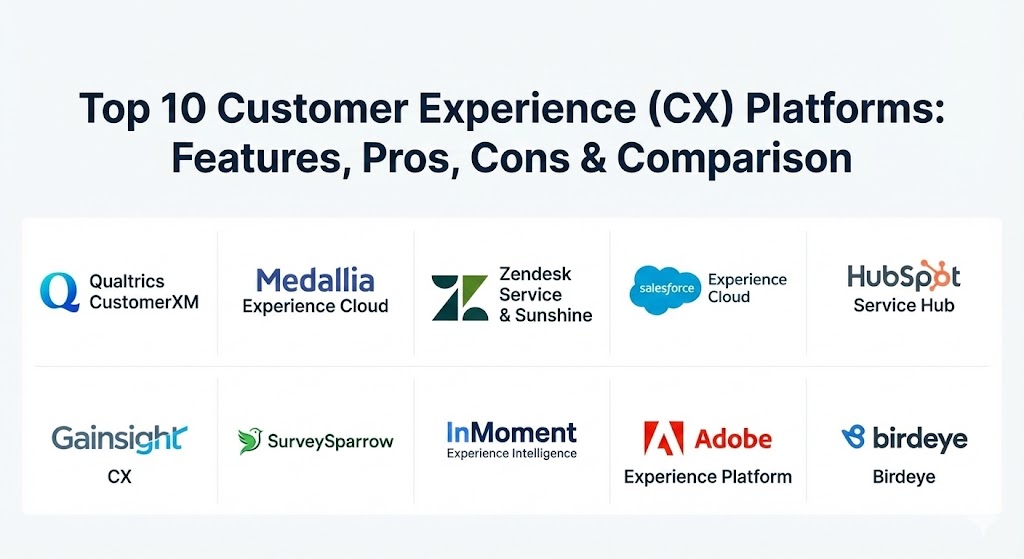
Top 10 Customer Experience (CX) Platforms
1 — Qualtrics CustomerXM
Qualtrics is widely regarded as the “category king” of experience management. Its CustomerXM product is an enterprise-grade platform that uses advanced “XM/os” technology to listen to customers across every channel and predict their next move.
- Key features:
- iQ Engines: AI-powered text, stats, and sentiment analysis.
- Predictive Churn Modeling to identify “at-risk” customers in real-time.
- Omnichannel listening across web, mobile, social, and in-app.
- Sophisticated closed-loop ticketing to ensure feedback is acted upon.
- Advanced journey mapping with visual “friction” identification.
- Role-based dashboards tailored for everyone from the CEO to the front line.
- Pros:
- The most powerful analytical engine in the CX space; can handle massive datasets.
- Extremely high flexibility—if you can imagine a survey or workflow, Qualtrics can build it.
- Cons:
- Premium pricing that often requires a significant multi-year commitment.
- The platform is so deep that it typically requires a dedicated admin or “Center of Excellence.”
- Security & compliance: SOC 2 Type II, ISO 27001, GDPR, HIPAA, FedRAMP, and SSO/SAML integration.
- Support & community: World-class enterprise support; Qualtrics XM Institute provides extensive research, certifications, and a massive user community.
2 — Medallia Experience Cloud
Medallia is a high-performance CX platform that specializes in capturing “signals” from vast amounts of unstructured data, such as video, voice, and social media, to create a real-time view of the customer.
- Key features:
- Athena AI: Proprietary machine learning for deep behavioral prediction.
- Video and Voice of the Customer (VoC) capture for emotive analysis.
- Real-time reporting with zero-latency data processing.
- Native mobile app for managers to manage alerts on the go.
- Advanced “Experience Orchestration” to trigger marketing actions based on sentiment.
- Integration with physical IoT devices for in-store experience tracking.
- Pros:
- Excellent at handling “unstructured” data like call recordings or video feedback.
- Very strong at operationalizing CX in large retail and hospitality environments.
- Cons:
- Implementation can be a long, multi-month process involving professional services.
- The user interface for administrative configuration is famously complex.
- Security & compliance: PCI-DSS, HIPAA, GDPR, SOC 2, and FIPS-compliant encryption.
- Support & community: Extensive documentation and “Medallia City” community; offers high-touch professional services for implementation.
3 — Zendesk Service & Sunshine
Zendesk has evolved from a simple helpdesk into a comprehensive CX platform. Its “Sunshine” platform (built on AWS) allows for a unified customer view that bridges the gap between support and broader experience management.
- Key features:
- Unified agent workspace that aggregates all customer history.
- Automated AI-powered “Answer Bot” for instant resolution.
- Custom objects and events tracking through the Sunshine platform.
- Seamless integration between support tickets and satisfaction (CSAT) surveys.
- Social messaging integration (WhatsApp, Messenger) for modern CX.
- Robust “Side Conversations” to collaborate internally on customer issues.
- Pros:
- The fastest “time-to-value” for companies prioritizing support-led CX.
- Beautiful, intuitive UI that agents actually enjoy using.
- Cons:
- Not as deep in “predictive analytics” compared to Qualtrics or Medallia.
- Advanced features are gated behind high-tier “Suite” pricing.
- Security & compliance: ISO, SOC 2, HIPAA, GDPR, and enterprise-grade SSO.
- Support & community: Massive global community; excellent self-service documentation and a large partner ecosystem.
4 — Salesforce Experience Cloud
Salesforce Experience Cloud allows companies to build beautiful, CRM-powered digital experiences, including portals, forums, and sites that are directly connected to customer data.
- Key features:
- Native integration with Salesforce CRM for a 360-degree data view.
- Einstein AI for personalized content and product recommendations.
- Lightning Bolt templates for rapid deployment of industry-specific portals.
- Community forums for peer-to-peer customer support.
- Integrated knowledge base distribution.
- Direct link to Marketing Cloud for experience-driven campaigns.
- Pros:
- If you are already on Salesforce, the data integration is unbeatable.
- Highly scalable—can handle millions of portal users without lag.
- Cons:
- Requires a Salesforce developer or specialized admin for custom builds.
- Can feel “clunky” if not configured correctly; high technical debt potential.
- Security & compliance: FedRAMP, HIPAA, SOC 1/2/3, and GDPR.
- Support & community: The “Trailblazer” community is arguably the best in software history; endless free learning via Trailhead.
5 — HubSpot Service Hub
HubSpot provides a more accessible, “all-in-one” approach to CX. It focuses on the “Flywheel” model, ensuring that service, sales, and marketing are perfectly aligned to create a frictionless experience.
- Key features:
- Customer portal for secure, self-service ticket management.
- Omnichannel inbox for chat, email, and social messaging.
- Automated feedback surveys (NPS, CSAT, CES).
- Customizable playbooks for support teams to ensure consistency.
- Service-level agreement (SLA) tracking and reporting.
- Knowledge base creator with search engine optimization.
- Pros:
- Incredibly easy to use; teams can be up and running in days.
- The integration between the CRM and the CX tools is seamless and native.
- Cons:
- Lacks the heavy-duty “statistical analysis” capabilities of Qualtrics.
- Automation becomes limited as the organization moves into “Enterprise” complexity.
- Security & compliance: SOC 2 Type II, GDPR, HIPAA (on certain tiers), and ISO 27001.
- Support & community: Excellent 24/7 phone support; HubSpot Academy is a gold standard for CX education.
6 — Gainsight CX
Gainsight is the leader in the “Customer Success” category, but its CX platform is specifically designed for B2B companies that need to manage long-term relationships and prevent churn.
- Key features:
- Customer Health Scoring based on product usage and feedback.
- Journey Orchestrator for automated, multi-step “Success Plans.”
- NPS and CSAT surveying tailored for B2B account structures.
- In-app engagements to guide users through software features.
- Revenue intelligence to link CX metrics directly to account growth.
- Executive sponsor tracking for key accounts.
- Pros:
- The best tool for B2B SaaS companies that care about “retention” above all else.
- Links customer sentiment directly to financial outcomes (renewals/upsells).
- Cons:
- Not suitable for B2C/Retail environments.
- Steep learning curve; requires a dedicated Customer Success Ops role.
- Security & compliance: SOC 2, GDPR, and robust data privacy controls for enterprise accounts.
- Support & community: Very active “Pulse” community and annual conferences; highly regarded thought leadership in CX.
7 — SurveySparrow
SurveySparrow has disrupted the market by focusing on “conversational” CX. It turns boring surveys into chat-like experiences, significantly increasing response rates.
- Key features:
- Chat-style surveys that feel like a conversation.
- Executive dashboards with real-time sentiment tracking.
- Offline survey capabilities for field events or retail stores.
- Recursive surveys for automated, periodic feedback loops.
- Workflows for automatic ticket creation based on survey answers.
- White-labeling to ensure consistent brand identity.
- Pros:
- Much higher completion rates than traditional “form” surveys.
- Very affordable compared to the enterprise giants.
- Cons:
- Lacks the deep AI-predictive power of Medallia or Qualtrics.
- Native integrations are not as extensive as the major CRM-linked platforms.
- Security & compliance: GDPR, HIPAA, SOC 2, and ISO 27001 compliant.
- Support & community: 24/5 support; good documentation and a growing user base in the SMB and mid-market sectors.
8 — InMoment
InMoment focuses on “Experience Intelligence” (XI). It prides itself on its ability to integrate disparate data sources to find the “hidden stories” in customer behavior.
- Key features:
- Active Listening: AI that adjusts survey questions in real-time based on answers.
- Market Research modules to compare internal CX with industry trends.
- Advanced text analytics that detect “intent” as well as sentiment.
- Case management for large-scale enterprise feedback loops.
- Reputation management for tracking reviews on third-party sites.
- Video feedback analysis with facial expression sentiment detection.
- Pros:
- Exceptional text analytics that understand nuance and sarcasm.
- Combines traditional VoC with deep market research data.
- Cons:
- The platform can feel fragmented across different modules.
- Visual reporting is powerful but not as “pretty” as HubSpot or Zendesk.
- Security & compliance: ISO 27001, SOC 2, HIPAA, and GDPR.
- Support & community: Dedicated “Success Teams” for enterprise clients; good global support presence.
9 — Adobe Experience Platform
Adobe is for the “CX Perfectionist.” It focuses on the marketing and creative side of the experience, ensuring that every digital touchpoint is beautifully designed and perfectly personalized.
- Key features:
- Real-time Customer Data Platform (CDP) for instant profile updates.
- AI-driven personalization through Adobe Sensei.
- Deep integration with Adobe Creative Cloud for asset management.
- Advanced journey orchestration across email, web, and mobile.
- Predictive modeling for customer lifetime value (LTV).
- Seamless connection to Adobe Analytics for granular web behavior.
- Pros:
- The ultimate tool for high-end digital marketing and personalization.
- Unbeatable for brands where “visual identity” is a core part of the experience.
- Cons:
- Prohibitively expensive for many mid-market firms.
- Highly complex ecosystem that requires certified Adobe specialists.
- Security & compliance: SOC 2, HIPAA, GDPR, and ISO 27001.
- Support & community: Massive enterprise support; Adobe Summit is the premier CX event in the world.
10 — Birdeye
Birdeye is specifically built for multi-location businesses. It focuses on reputation management, local SEO, and making sure that customer experiences lead to more sales.
- Key features:
- Review aggregation from 150+ sites into a single dashboard.
- Automated review solicitation via SMS and email.
- Local SEO tools to help stores show up in “near me” searches.
- Webchat that converts site visitors into text conversations.
- Ticketing system for resolving issues mentioned in public reviews.
- Competitor benchmarking at the local level.
- Pros:
- The best choice for businesses with physical locations (dentists, auto shops, retail).
- Directly links “good experience” to “improved search rankings.”
- Cons:
- Not a deep “Voice of the Customer” tool for complex B2B SaaS.
- Pricing can scale quickly if you have hundreds of locations.
- Security & compliance: SOC 2, GDPR, and HIPAA compliant.
- Support & community: Strong support for local businesses; very active “customer success” outreach.
Comparison Table
| Tool Name | Best For | Platform(s) Supported | Standout Feature | Rating (Gartner) |
| Qualtrics | Enterprise Analytics | Web, iOS, Android | iQ Predictive Engine | 4.8 / 5 |
| Medallia | Omnichannel Signals | Web, iOS, Android | Video/Voice Analytics | 4.7 / 5 |
| Zendesk | Support-Led CX | Web, Mobile, SaaS | Unified Agent Workspace | 4.5 / 5 |
| Salesforce | CRM-Integrated CX | Web, Mobile, Cloud | 360-Degree Data View | 4.4 / 5 |
| HubSpot | SMB All-in-One | Web, iOS, Android | Native CRM Flywheel | 4.6 / 5 |
| Gainsight | B2B SaaS Retention | Web, SaaS | Account Health Scoring | 4.6 / 5 |
| SurveySparrow | Conversational CX | Web, Mobile, Offline | Chat-Style UI | 4.5 / 5 |
| InMoment | Intent Analysis | Web, Mobile | Active Listening AI | 4.4 / 5 |
| Adobe | Personalization | Web, Cloud | Real-time CDP | 4.3 / 5 |
| Birdeye | Multi-location/Local | Web, iOS, Android | Review/SEO Automation | 4.7 / 5 |
Evaluation & Scoring of Customer Experience (CX) Platforms
To help you weigh your options objectively, we have scored the overall category using our weighted rubric.
| Category | Weight | Score | Evaluation Notes |
| Core Features | 25% | 9.5 | The industry has peaked in terms of sentiment and journey mapping. |
| Ease of Use | 15% | 7.0 | Enterprise tools are still notoriously complex to set up. |
| Integrations | 15% | 8.5 | Most now offer robust API/Zapier/Native connections. |
| Security & Compliance | 10% | 10.0 | High-level certifications (HIPAA/GDPR) are now baseline. |
| Performance | 10% | 9.0 | 2026 standards for real-time data processing are very high. |
| Support & Community | 10% | 9.0 | CX vendors usually practice what they preach regarding support. |
| Price / Value | 15% | 6.5 | TCO (Total Cost of Ownership) remains high for enterprise tiers. |
Which Customer Experience (CX) Platform Is Right for You?
Choosing a CX platform is a significant investment that should align with your company’s growth stage and technical maturity.
Solo Users vs SMB vs Mid-Market vs Enterprise
If you are a solo founder, a platform like SurveySparrow offers a professional touch without the enterprise price tag. For SMBs, HubSpot is often the winner because it consolidates so many different tools into one. Mid-market companies that are growing fast usually gravitate toward Zendesk to handle their support-led CX. At the enterprise level, the battle is usually between Qualtrics (for those who prioritize data science) and Medallia (for those who prioritize real-time operational signals).
Budget-conscious vs Premium Solutions
If budget is your primary constraint, look at SurveySparrow or the lower tiers of HubSpot. However, remember that CX platforms are designed to generate revenue by reducing churn. If you have a high customer lifetime value, a premium solution like Qualtrics often pays for itself through the identification of just a few at-risk accounts.
Feature Depth vs Ease of Use
This is the classic trade-off in the CX world. Adobe and Medallia offer depth that can personalize every pixel of a customer’s journey, but they require a team of experts to manage. If you have a small team, HubSpot or Zendesk will be far more effective because they “get out of your way” and allow you to focus on the customer rather than the software.
Integration and Scalability Needs
If your entire company lives in the Salesforce ecosystem, using their native Experience Cloud is a logical choice to minimize data friction. For B2B companies specifically, Gainsight provides a level of scalability regarding account-based health scoring that traditional “survey” tools simply cannot match.
Frequently Asked Questions (FAQs)
1. What is the difference between CRM and CX platforms?
A CRM (Customer Relationship Management) tracks who your customers are and what they’ve bought. A CX platform tracks how they feel about those interactions and predicts what they will do next based on sentiment.
2. Is NPS (Net Promoter Score) still relevant in 2026?
Yes, but it is no longer the “only” metric. Modern CX platforms combine NPS with CSAT (Satisfaction), CES (Effort), and behavioral data to create a more nuanced “Health Score.”
3. Can CX platforms help with social media reviews?
Many platforms, specifically Birdeye and InMoment, have native reputation management features that pull in reviews from Google, Yelp, and social media to be managed in one place.
4. How long does it take to see ROI from a CX platform?
Most companies see a “soft ROI” (improved sentiment) within 3 months and a “hard ROI” (reduced churn or increased upsells) within 6 to 12 months.
5. Do these tools work for B2B companies?
Absolutely. Platforms like Gainsight and Qualtrics have specific B2B modules that account for complex hierarchies where you might have many users within a single “client” account.
6. Is AI actually useful in CX, or is it just hype?
In 2026, AI is indispensable. It is used to perform “Text Analytics” on thousands of comments in seconds, identifying trends that a human would take weeks to find.
7. Can CX platforms help with employee experience (EX)?
Yes, several leaders like Qualtrics and HubSpot offer EX modules. Happy employees usually lead to happy customers, so managing both on one platform is a growing trend.
8. Do I need a data scientist to run Qualtrics or Medallia?
While you don’t need one, having someone with a background in statistics or data analysis will help you get 100% of the value out of these high-end platforms.
9. Are CX platforms GDPR and HIPAA compliant?
Almost all major players are now compliant. However, always check that the specific tier you are buying includes the compliance “Business Associate Agreement” (BAA) if you are in healthcare.
10. What is “Closed-Loop” feedback?
It is the process of taking a customer’s feedback and ensuring a team member actually reaches out to them to resolve the issue, then “closing the loop” in the system to prove it was handled.
Conclusion
The “best” CX platform is not the one with the most features; it’s the one that your team will actually use to change customer outcomes. In 2026, data is cheap, but empathy is expensive. Whether you choose the analytical power of Qualtrics, the support focus of Zendesk, or the local SEO boost of Birdeye, the goal remains the same: listen more than you speak, and act faster than your competitors.