Introduction
A Credential Issuance Platform is a specialized software ecosystem used to design, distribute, and track digital credentials such as badges, certificates, and diplomas. These platforms act as a bridge between issuers (like universities or companies), earners (students or employees), and verifiers (recruiters). By using cryptographic signatures and, in many cases, blockchain technology, these tools ensure that a credential cannot be forged or altered, providing instant “one-click” verification for third parties.
The importance of these tools lies in their ability to enhance the value of an achievement. Instead of a static PDF, a digital credential contains “baked-in” metadata that lists specific skills, the criteria met for the award, and proof of the issuer’s authority. This transparency reduces the administrative burden on HR teams and increases the marketing reach of educational institutions when earners share their successes on social media. When evaluating platforms, users should look for compliance with the Open Badges standard, ease of bulk issuance, and deep integration with Learning Management Systems (LMS).
Best for: Educational institutions, professional certification bodies, and mid-to-large enterprises looking to modernize their workforce recognition programs. It is also a critical tool for MOOC providers and HR departments in highly regulated industries.
Not ideal for: Individual tutors with very few students or hobbyist groups that do not require formal verification. In these cases, simple graphic design tools or basic email delivery may suffice.
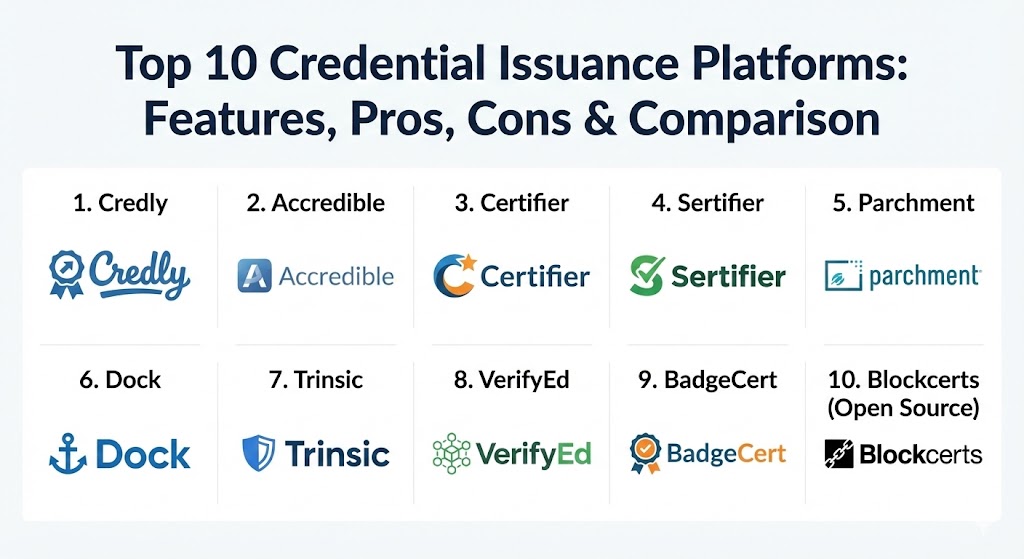
Top 10 Credential Issuance Platforms
1 — Credly (by Pearson)
Credly is the most recognized name in the digital badging industry. Owned by Pearson, it focuses heavily on a “skills-first” approach, helping earners connect their digital badges to actual job market opportunities through its vast network of employers.
- Key features:
- Extensive marketplace and talent directory for recruiters.
- Advanced skills taxonomy and metadata tagging.
- Automated learning pathways and “stackable” credentials.
- One-click sharing to LinkedIn, Twitter, and professional portfolios.
- Robust analytics on badge views, shares, and clicks.
- High-assurance verification with global recognition.
- Pros:
- Unmatched brand recognition; a “Credly badge” is an industry standard.
- Strongest ecosystem for connecting earners directly to job listings.
- Cons:
- Can be significantly more expensive than newer, more agile competitors.
- Customization of the actual certificate design is somewhat limited compared to Accredible.
- Security & compliance: SOC 2 Type II, GDPR, HIPAA, and ISO 27001 certifications.
- Support & community: Comprehensive enterprise support, a dedicated “Success Manager” for higher tiers, and a large global community of issuers.
2 — Accredible
Accredible is a powerhouse for organizations that prioritize branding and high-end certificate design. It provides a highly polished experience for both the issuer and the recipient, with a focus on creating “digital certificate pages” that act as a permanent record.
- Key features:
- Advanced certificate designer with dozens of professional templates.
- White-labeling options to keep the platform under your own domain.
- Integrated “Skills Wallet” for earners to manage multiple achievements.
- Automatic name change and expiration management.
- Deep integrations with Salesforce, Moodle, Canvas, and Zapier.
- Support for both digital badges and high-resolution certificates.
- Pros:
- Superior design flexibility and branding options.
- The analytics dashboard provides granular data on earner engagement.
- Cons:
- The interface has a slight learning curve due to the sheer number of features.
- Entry-level plans may restrict access to advanced integration features.
- Security & compliance: GDPR compliant, SOC 2, and FERPA support for academic institutions.
- Support & community: High-quality documentation, live chat support, and an extensive library of webinars.
3 — Certifier
Certifier is the go-to solution for organizations looking for speed, affordability, and a modern, clutter-free interface. It is particularly popular among online course creators and small-to-medium businesses (SMBs) who need to issue thousands of credentials in minutes.
- Key features:
- Lightning-fast bulk issuance via CSV or API.
- Simple, drag-and-drop certificate and badge builder.
- Built-in email automation for credential delivery.
- One-click verification portal for employers.
- Social sharing optimized for LinkedIn’s “Add to Profile” feature.
- Competitive, transparent pricing models.
- Pros:
- One of the most user-friendly interfaces in the market.
- Excellent value for money, offering professional features at a lower entry price.
- Cons:
- Lacks the complex “labor market insights” found in Credly.
- Community resources are smaller than the legacy enterprise giants.
- Security & compliance: GDPR compliant, data encryption at rest and in transit.
- Support & community: Fast email support and a growing knowledge base with video tutorials.
4 — Sertifier
Sertifier positions itself as a data-driven credentialing tool that helps organizations understand the ROI of their training programs. It focuses heavily on the post-issuance lifecycle of a credential.
- Key features:
- AI-driven skill suggestions for badge creation.
- Detailed recipient behavior insights and marketing tracking.
- Automated expiration and re-certification alerts.
- Branded earner portals and employer-facing verification pages.
- Comprehensive API for custom enterprise integrations.
- Pros:
- Strong focus on marketing and brand visibility for the issuer.
- Integration ecosystem is very diverse, covering LMS and CRM tools.
- Cons:
- The analytics can be overwhelming for organizations with simple needs.
- Some users find the initial setup of learning pathways complex.
- Security & compliance: GDPR, ISO 27001, and SOC 2 compliance.
- Support & community: Dedicated account management and multi-language support.
5 — Parchment
Parchment is the heavyweight of the academic world. While other tools focus on badges, Parchment specializes in official transcripts, diplomas, and Comprehensive Learner Records (CLRs) for K-12 and Higher Ed.
- Key features:
- Direct SIS (Student Information System) integration for automated syncing.
- “Secure Blue Ribbon” PDF technology for tamper-proof transcripts.
- Professional print-and-mail services integrated with digital delivery.
- Support for high-volume state and district-level reporting.
- Verification services for universities and employers worldwide.
- Pros:
- The gold standard for official academic record exchange.
- Handles both digital and physical credentials in a single workflow.
- Cons:
- Primarily designed for schools; not ideal for corporate “skill badges.”
- The pricing and sales process are tailored for institutional budgets.
- Security & compliance: FERPA, HIPAA, GDPR, and SOC 2.
- Support & community: Institutional-grade support with dedicated implementation teams.
6 — Dock
Dock is a pioneer in the “Verifiable Credentials” (VC) and Web3 space. It uses decentralized identity (DID) standards and blockchain technology to give earners full control over their data without relying on a central server.
- Key features:
- W3C Verifiable Credentials standard support.
- Blockchain-anchored trust registry for zero-fraud verification.
- Reusable digital identity wallets for recipients.
- Developer-first API and SDK for building custom identity apps.
- Selective disclosure (share only what’s needed, e.g., “over 18” without showing DOB).
- Pros:
- Future-proof technology built on open, decentralized standards.
- Eliminates “vendor lock-in”—credentials exist independently of the platform.
- Cons:
- Requires more technical knowledge to implement than drag-and-drop tools.
- The concept of “identity wallets” may be confusing for non-tech-savvy recipients.
- Security & compliance: GDPR compliant, cryptographic security, and decentralized data model.
- Support & community: Technical documentation is excellent; active developer community on Discord.
7 — Trinsic
Trinsic is an infrastructure-focused platform that allows companies to build their own credentialing and identity ecosystems. It is designed for developers who want to embed “identity-first” workflows into their products.
- Key features:
- Support for OpenID4VCI (Verifiable Credential Issuance) protocol.
- Cross-platform “Wallet” integrations (Apple and Google Wallet support).
- High-assurance identity verification workflows.
- Governance frameworks for industry-specific ecosystems.
- Multi-blockchain support for cryptographic anchors.
- Pros:
- Highly scalable for massive, global identity projects.
- Seamless integration with mobile OS wallets like Apple Wallet.
- Cons:
- Not a standalone “badge creator”—it is a developer tool.
- Pricing can be complex as it scales with API calls and usage.
- Security & compliance: ISO 27001, GDPR, and support for high-trust frameworks (EUDI).
- Support & community: Professional developer support and extensive API documentation.
8 — VerifyEd
VerifyEd leverages blockchain technology to solve the “Is this real?” problem for MOOCs and universities. It focuses on permanent, tamper-proof records that are instantly verifiable by anyone in the world.
- Key features:
- Automated batch issuance for thousands of learners.
- Instant QR-code-based verification for every certificate.
- Permanent blockchain storage (no central database risks).
- Social sharing optimized for professional portfolios.
- Skills mapping to align credentials with industry standards.
- Pros:
- Provides absolute certainty that a credential has not been altered.
- Very high claim rates due to a frictionless recipient experience.
- Cons:
- Blockchain “gas fees” can sometimes make pricing less predictable (though many vendors hide this cost).
- Limited legacy LMS integrations compared to Accredible.
- Security & compliance: Cryptographically secured, GDPR compliant.
- Support & community: Responsive support and a focus on UK/EU educational markets.
9 — BadgeCert
BadgeCert offers a balanced platform that combines the visual appeal of digital badges with the formality of certificates, targeted specifically at professional associations and certification bodies.
- Key features:
- “Digital Vault” for earners to store credentials from multiple sources.
- Gamification features like leaderboards and progress tracking.
- Employer-facing portals to verify a candidate’s entire portfolio.
- Multi-language support for global associations.
- Automated name change and expiration alerts.
- Pros:
- Excellent for long-term credential management and professional portfolios.
- Strong emphasis on “lifelong learning” for the earner.
- Cons:
- The user interface for admins can feel slightly dated.
- Mobile app experience is less polished than Trinsic or Dock.
- Security & compliance: GDPR, HIPAA, and SSL encryption.
- Support & community: Strong partner-led support and customized onboarding.
10 — Blockcerts (Open Source)
Blockcerts is not a company, but an open-source standard and toolkit originally developed by the MIT Media Lab. It is the best choice for organizations that want to build their own solution without any licensing fees.
- Key features:
- Completely vendor-neutral; you own the code and the data.
- Verification via Bitcoin or Ethereum blockchains.
- Recipient-controlled mobile wallets for credential storage.
- Open standards ensure credentials last forever.
- No recurring subscription fees.
- Pros:
- Zero cost for licensing; only pay for blockchain transaction fees.
- Maximum privacy and data ownership.
- Cons:
- Requires significant technical resources to set up and maintain.
- No customer support team to call if something breaks.
- Security & compliance: Varies by implementation; inherently tamper-evident.
- Support & community: Large developer community on GitHub; no formal enterprise support.
Comparison Table
| Tool Name | Best For | Platform(s) Supported | Standout Feature | Rating (Gartner/TrueReview) |
| Credly | Global Skills Network | Web / SaaS | Recipient Talent Directory | 4.7 / 5 |
| Accredible | Custom Branding | Web / SaaS | Digital Certificate Pages | 4.8 / 5 |
| Certifier | Speed & SMB Value | Web / SaaS | Bulk Issuance Speed | 4.6 / 5 |
| Sertifier | ROI & Marketing | Web / SaaS | AI Skill Suggestions | 4.5 / 5 |
| Parchment | Academic Records | Web / SIS Integrated | Print & Digital Hybrid | 4.4 / 5 |
| Dock | Web3 / Privacy | Web / Blockchain | Verifiable Credentials (VC) | 4.5 / 5 |
| Trinsic | Identity Infrastructure | API / SDK / Mobile | Apple/Google Wallet Sync | 4.6 / 5 |
| VerifyEd | Fraud Prevention | Web / Blockchain | QR Verification | 4.4 / 5 |
| BadgeCert | Professional Portfolios | Web / SaaS | Earner Digital Vault | 4.3 / 5 |
| Blockcerts | Self-Hosted / Free | Open Source | Vendor-Neutral Standards | N/A |
Evaluation & Scoring of Credential Issuance Platforms
To help you decide, we have evaluated these platforms against seven key criteria using a weighted scoring rubric.
| Criteria | Weight | What We Look For |
| Core Features | 25% | Badge/Certificate builders, bulk issuance, and verification portals. |
| Ease of Use | 15% | Intuitiveness for both the admin and the student recipient. |
| Integrations | 15% | Native connections to LMS (Canvas/Moodle), CRM (Salesforce), and Zapier. |
| Security & Compliance | 10% | GDPR, SOC 2, and tamper-proof cryptographic proofs. |
| Performance | 10% | Uptime, API speed, and the ability to handle massive badge “blasts.” |
| Support | 10% | Documentation quality, response times, and community size. |
| Price / Value | 15% | Transparency and the cost-to-feature ratio. |
Which Credential Issuance Platforms Tool Is Right for You?
Choosing the right platform depends on your organizational maturity and your primary goal (e.g., marketing vs. compliance).
- Solo Educators & SMBs: If you are running a small online course or a training bootcamp, Certifier or Accredible offer the best “out-of-the-box” experience. They allow you to look professional without needing an IT team to set up the system.
- Large Enterprises: For internal workforce tracking, Credly is the gold standard because it helps your employees see their skills in the context of the wider job market. If you need deep data on training ROI, Sertifier is a strong contender.
- Higher Education: If you are a university, Parchment is essential for traditional transcripts, while VerifyEd is ideal for issuing stackable micro-credentials on the blockchain.
- Web3 & Privacy Advocates: If your priority is data sovereignty and giving users total control over their identity, Dock and Trinsic are the clear winners.
- Budget-Conscious / Technical: If you have developers and zero budget for licensing, Blockcerts allows you to build a world-class system for free.
Frequently Asked Questions (FAQs)
1. What is the difference between a digital badge and a digital certificate?
A digital badge is usually a smaller, visual icon used for micro-credentials or specific skills. A digital certificate is a more formal, high-resolution document equivalent to a traditional diploma. Most platforms issue both.
2. Are digital credentials legally recognized?
In most jurisdictions, yes—especially those backed by cryptographic signatures. They are widely accepted by universities for credit transfers and by tech companies for hiring.
3. Can I integrate these platforms with my current LMS?
Yes. Most top platforms (Accredible, Credly, Certifier) have native plugins for Moodle, Canvas, and Blackboard, allowing badges to be issued automatically upon course completion.
4. What happens if the issuance platform goes out of business?
This is a risk with centralized platforms. Blockchain-based tools (Dock, Blockcerts) solve this by ensuring the credential lives on the ledger, independent of the company that issued it.
5. How much do these platforms cost?
Pricing varies from “forever free” plans (Certifier) to enterprise contracts costing tens of thousands per year (Credly/Accredible). Most charge based on the number of active earners or credentials issued per year.
6. Do recipients have to pay to receive their badges?
No. In almost all cases, the issuing organization pays for the platform, and the recipient can claim, store, and share their credentials for free.
7. Can digital credentials be forged?
Standard PDFs can be forged, but digital credentials on these platforms use cryptographic “hashing” to ensure that any change to the document immediately invalidates the verification link.
8. What is the “Open Badges” standard?
Open Badges is a global technical standard that ensures badges are interoperable. A badge issued on one platform can be stored and verified in a different “backpack” or “wallet” tool.
9. Can I revoke a credential if a student fails a later requirement?
Yes. Most platforms allow you to “revoke” or “expire” a credential, which immediately updates the public verification page to show the award is no longer valid.
10. How do employers verify these credentials?
Employers simply click a link or scan a QR code provided by the candidate. The platform instantly confirms the issuer’s identity and the validity of the achievement.
Conclusion
Credential Issuance Platforms are the engine behind the shift to a skills-based economy. By providing a secure, transparent way to prove what a person knows and can do, these tools are replacing the “trust me” era of resumes with a “verify me” era of digital proof. Whether you prioritize the global network of Credly, the design elegance of Accredible, or the decentralized future of Dock, the best tool is ultimately the one that aligns with your earners’ needs and your organization’s brand.