Introduction
A Clinical Trial Management System (CTMS) is a specialized software platform designed to manage the administrative and operational aspects of clinical research. Unlike an Electronic Data Capture (EDC) system, which focuses on the patient data itself, a CTMS focuses on the “meta-data” of the trial—site selection, investigator monitoring, regulatory document tracking, milestone management, and financial payments. It serves as the single source of truth for study managers, ensuring that trials remain on schedule, within budget, and compliant with global health authority standards.
The importance of a CTMS lies in its ability to provide real-time visibility. Without one, sponsors and Contract Research Organizations (CROs) struggle with fragmented data, leading to delayed site payments and missed safety reporting deadlines. Key real-world use cases include automating “Trip Reports” for clinical monitors, tracking patient recruitment rates across hundreds of global sites, and managing complex payment schedules based on completed procedures. When evaluating a CTMS, users should prioritize the depth of its integration ecosystem, the ease of its user interface for site staff, and its built-in compliance with 21 CFR Part 11 and GDPR.
Best for: Pharmaceutical and biotechnology sponsors, Contract Research Organizations (CROs), and large Academic Medical Centers (AMCs) that manage multiple concurrent protocols and require centralized oversight of site performance and finances.
Not ideal for: Early-stage pre-clinical laboratories that do not involve human subjects, or single-investigator clinics running a single, small-scale pilot study where the administrative overhead of a full CTMS would outweigh the benefits.
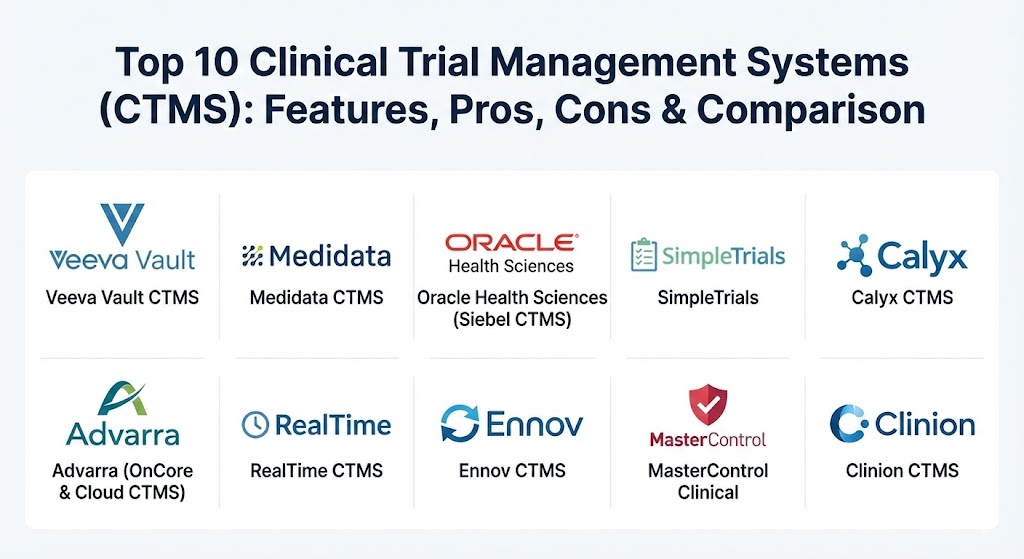
Top 10 Clinical Trial Management Systems (CTMS) Tools
1 — Veeva Vault CTMS
Veeva Vault CTMS is widely considered the industry benchmark for cloud-native trial management. Part of the broader Veeva Development Cloud, it offers a unified platform that connects clinical operations with quality, regulatory, and safety data.
- Key features:
- Unified platform architecture ensuring data flows seamlessly between CTMS, eTMF, and Study Training.
- Automated Monitoring Trip Reports that pull data directly from study records to reduce manual entry.
- Real-time site performance dashboards with proactive risk-based monitoring (RBM) triggers.
- Seamless Investigator Portal for direct communication and document exchange.
- Advanced financial management for site payments and budget tracking.
- Built-in support for decentralized and hybrid trial models.
- Pros:
- Eliminates data silos by housing all clinical documents and management data in one place.
- Highly scalable; suitable for everything from emerging biotechs to the world’s largest pharma giants.
- Cons:
- High cost of ownership, making it difficult for smaller organizations with limited budgets.
- The system is so feature-rich that it requires significant training and dedicated administrators.
- Security & compliance: 21 CFR Part 11, Annex 11, GDPR, HIPAA, SOC 2 Type II, and ISO 27001.
- Support & community: Top-tier enterprise support, a massive global user community (Veeva Summit), and extensive online training through Veeva Learn.
2 — Medidata CTMS
Medidata, a Dassault Systèmes company, provides a CTMS that is deeply integrated into the Medidata Platform (formerly Rave). It is favored by organizations that already use Medidata for EDC and RTSM, offering a truly cohesive user experience.
- Key features:
- Real-time data synchronization with Medidata EDC to track enrollment and milestones automatically.
- Edge Study Management for centralized monitoring and issue tracking.
- Intelligent site payments module that triggers checks based on data entered in the EDC.
- Robust reporting engine with predictive analytics for study completion dates.
- Flexible configuration for local, regional, and global studies.
- Pros:
- The integration between EDC and CTMS is arguably the smoothest in the industry, reducing data reconciliation efforts.
- Strong emphasis on “Big Data” analytics to identify underperforming sites early.
- Cons:
- Best utilized only within the Medidata ecosystem; integration with third-party EDCs is more complex.
- Pricing is often perceived as premium and may include “per-module” costs.
- Security & compliance: SOC 2, ISO 27001, 21 CFR Part 11, GDPR, and HIPAA.
- Support & community: Medidata Academy provides comprehensive onboarding; global 24/7 technical support and professional services are available.
3 — Oracle Health Sciences (Siebel CTMS)
Oracle’s Siebel CTMS remains a powerhouse in the enterprise space. While it is one of the more traditional players, Oracle has modernized it for 2026 with cloud-native features and advanced financial forecasting tools like ClearTrial.
- Key features:
- Massive scalability capable of managing thousands of protocols simultaneously.
- Deep integration with Oracle ClearTrial for precision budget forecasting and planning.
- Complex investigator relationship management (IRM) tools.
- Detailed site monitoring and protocol deviation tracking.
- Comprehensive audit trails and electronic signature capabilities.
- Pros:
- Exceptional for massive, multi-national organizations that require extreme customizability.
- The most robust financial and forecasting capabilities in the clinical space.
- Cons:
- The user interface can feel more industrial and less “modern” than Veeva or SimpleTrials.
- Implementation timelines are typically longer and require specialized consultants.
- Security & compliance: FIPS 140-2, 21 CFR Part 11, GDPR, HIPAA, and ISO 27001.
- Support & community: Enterprise-grade support with a global reach; extensive documentation and a legacy user base.
4 — SimpleTrials
SimpleTrials is a specialized SaaS CTMS designed to provide the core functionality of an enterprise system at a price point accessible to small-to-mid-sized sponsors and CROs.
- Key features:
- Out-of-the-box templates for rapid study setup and site onboarding.
- Integrated eTMF (Electronic Trial Master File) and CTMS in a single subscription.
- Subject tracking, site monitoring, and document management features.
- Flexible payment tracking for site-related expenses.
- Clean, simplified interface that requires minimal training.
- Pros:
- Highly cost-effective; one of the few systems with transparent, tiered pricing on their website.
- Rapid implementation—teams can be up and running in days rather than months.
- Cons:
- Lacks some of the ultra-advanced automation (like AI-driven trip reports) found in high-end tools.
- Limited customizability for extremely complex, non-traditional study designs.
- Security & compliance: 21 CFR Part 11, HIPAA, GDPR, and SOC 2.
- Support & community: Excellent personal customer service, detailed webinars, and a straightforward knowledge base.
5 — Calyx CTMS
Calyx (formerly part of PAREXEL) offers a CTMS that is built on decades of CRO experience. It focuses on reducing the administrative burden on clinical research associates (CRAs) through intelligent automation.
- Key features:
- Automated workflow management for regulatory document collection.
- Advanced Monitoring Visit Reports (MVR) with offline capabilities for remote areas.
- Dynamic site performance scoring based on enrollment and safety data.
- Integration with Calyx IRT and medical imaging solutions.
- Multi-currency and multi-tax support for global site payments.
- Pros:
- Designed by people who actually run trials; workflows are logically mapped to real-world tasks.
- Strong global support, making it ideal for international Phase III studies.
- Cons:
- The software is deeply complex and can be “click-heavy” for simple tasks.
- Primarily appeals to mid-to-large sized organizations due to pricing structure.
- Security & compliance: ISO 27001, 21 CFR Part 11, HIPAA, and GDPR.
- Support & community: Robust professional services and a strong technical support team with deep industry knowledge.
6 — Advarra (OnCore & Cloud CTMS)
Advarra provides two distinct paths: OnCore (the industry standard for AMCs and Cancer Centers) and Advarra Cloud CTMS (geared toward sponsors). It excels at managing complex institutional requirements.
- Key features:
- Protocol management with granular version control.
- Unified billing and coverage analysis for academic medical centers.
- Patient recruitment and retention tracking with integrated eSource.
- Comprehensive reporting on diversity and inclusion metrics.
- Seamless integration with Advarra’s IRB and IBC services.
- Pros:
- The absolute gold standard for academic medical centers and health systems.
- Excellent at handling the financial complexities of hospital-based research.
- Cons:
- OnCore is an enterprise-level installation that is often too heavy for a small biotech.
- Cloud CTMS is still growing its feature set compared to established sponsor-side rivals.
- Security & compliance: SOC 2, HIPAA, 21 CFR Part 11, and GDPR.
- Support & community: Strong presence at industry conferences; dedicated “Advarra University” for user training.
7 — RealTime CTMS
RealTime CTMS is a site-focused system that has expanded into the sponsor/CRO space. It is particularly known for its focus on operational efficiency and patient recruitment.
- Key features:
- Integrated eSource and eSourcing modules to eliminate paper at the site level.
- Text-messaging and email patient recruitment automation.
- Real-time financial tracking with a built-in “Site Pay” portal.
- Mobile app for CRAs and investigators to manage tasks on the go.
- Robust scheduling calendar that syncs with Outlook and Google.
- Pros:
- One of the most “site-friendly” interfaces, leading to higher data quality and faster entry.
- Exceptional recruitment and retention tools that help studies meet enrollment targets.
- Cons:
- The reporting engine, while good, is not as deep as Oracle or Veeva for global multi-study analytics.
- Implementation can be complex if trying to integrate with older, legacy EDC systems.
- Security & compliance: HIPAA, GDPR, SOC 2, and 21 CFR Part 11.
- Support & community: Very responsive support team and an active user base within the “Site Solutions” community.
8 — Ennov CTMS
Ennov provides a unified platform that is especially popular in the European market. It offers a unique blend of CTMS, Quality Management (QMS), and Regulatory (RIM) features in a single stack.
- Key features:
- Fully unified clinical and regulatory platform (one login for everything).
- Highly flexible configuration that does not require custom coding.
- Multi-language support tailored for European and Asian regional requirements.
- Integrated eTMF with automatic synchronization of site documents.
- Advanced analytics with built-in data visualization tools.
- Pros:
- The unified nature of the platform significantly reduces the “integration tax” of connecting different systems.
- Great balance of price and performance for mid-sized global organizations.
- Cons:
- Brand recognition is lower in North America compared to Veeva or Medidata.
- Fewer third-party consultants are available for this platform compared to Oracle.
- Security & compliance: ISO 27001, 21 CFR Part 11, GDPR, and HIPAA.
- Support & community: Global support centers with a strong emphasis on European regulatory nuance.
9 — MasterControl Clinical
MasterControl is primarily known as a Quality Management System (QMS), but its clinical module offers a powerful CTMS for organizations where compliance and document control are the top priorities.
- Key features:
- Strong document-centric workflows with automated versioning and approvals.
- Automated training management for all clinical staff and investigators.
- Integrated “Clinical Excellence” suite that covers TMF and CTMS.
- Detailed audit management and CAPA (Corrective and Preventive Actions) tracking.
- Milestone-driven project management views.
- Pros:
- Unbeatable for organizations that want to integrate trial management with their broader quality and manufacturing processes.
- Makes regulatory audits much smoother due to the “always-ready” document architecture.
- Cons:
- Not as strong as Medidata or Veeva in terms of “operational” site monitoring features.
- The interface is designed around “quality” workflows, which may feel different to a CRA.
- Security & compliance: 21 CFR Part 11, ISO 9001, ISO 13485, GDPR, and HIPAA.
- Support & community: Extensive customer success programs and a very active user group in the medical device and diagnostics sector.
10 — Clinion CTMS
Clinion is an AI-enabled clinical trial platform that offers a modern, highly integrated CTMS designed to reduce trial timelines through automation.
- Key features:
- AI-powered patient recruitment and enrollment forecasting.
- Integrated EDC, CTMS, eCOA, and RTSM in a single environment.
- Real-time monitoring dashboards with automated anomaly detection.
- Budget and expense management with multi-currency support.
- User-friendly mobile interface for remote study oversight.
- Pros:
- Excellent value for money for small and mid-sized biotechs.
- The AI integration helps in identifying recruitment bottlenecks before they delay the study.
- Cons:
- As a newer entrant, it lacks the massive legacy of Oracle or the market dominance of Veeva.
- Integration with older, non-standard lab systems may require custom work.
- Security & compliance: 21 CFR Part 11, GDPR, HIPAA, and SOC 2.
- Support & community: Personalized onboarding and responsive technical support; growing community of innovative biotechs.
Comparison Table
| Tool Name | Best For | Platform(s) Supported | Standout Feature | Rating (Gartner/TrueReview) |
| Veeva Vault | Global Enterprise | Cloud (SaaS) | Unified Ops & Regulatory | 4.8 / 5 |
| Medidata CTMS | Integrated EDC Users | Cloud (SaaS) | EDC Data Synchronization | 4.6 / 5 |
| Oracle Siebel | Large-Scale Financials | On-Prem / Cloud | Budgeting & Forecasting | 4.2 / 5 |
| SimpleTrials | SMB / Rapid Setup | Cloud (SaaS) | Price/Performance Value | 4.7 / 5 |
| Calyx CTMS | Global Study Monitoring | Cloud (SaaS) | CRA Workflow Automation | 4.4 / 5 |
| Advarra OnCore | Academic Medical Centers | On-Prem / Cloud | Institutional Billing | 4.5 / 5 |
| RealTime CTMS | Site Efficiency | Cloud / Mobile | Recruitment & eSource | 4.8 / 5 |
| Ennov CTMS | European Compliance | Cloud (SaaS) | Unified RIM/QMS/CTMS | 4.5 / 5 |
| MasterControl | Quality & MedDevice | Cloud (SaaS) | Quality-Driven Compliance | 4.4 / 5 |
| Clinion CTMS | AI-Driven Automation | Cloud (SaaS) | AI Patient Forecasting | 4.6 / 5 |
Evaluation & Scoring of Clinical Trial Management Systems
When selecting a CTMS in 2026, the criteria have evolved beyond mere data entry. We now look for systems that actively help prevent errors rather than just recording them.
| Category | Weight | Evaluation Criteria |
| Core Features | 25% | Site management, monitoring reports, milestones, and financial tracking. |
| Ease of Use | 15% | Intuitiveness for CRAs and site staff; mobile accessibility. |
| Integrations | 15% | APIs and native connectors for EDC, eTMF, and RTSM systems. |
| Security & Compliance | 10% | 21 CFR Part 11, GDPR, and data residency capabilities. |
| Performance | 10% | Uptime, reporting speed, and handling of large global datasets. |
| Support | 10% | Quality of documentation and speed of the enterprise help desk. |
| Price / Value | 15% | Transparency of pricing and ROI for the specific organization size. |
Which Clinical Trial Management Systems Tool Is Right for You?
The decision-making process for a CTMS depends largely on your role and the scale of your research.
- Solo Users vs SMBs: If you are a small biotech or a startup CRO, SimpleTrials or Clinion are likely your best bets. They offer low entry costs, fast implementation, and don’t require a dedicated IT team to maintain.
- Mid-Market CROs: Organizations that need to balance global reach with budget constraints often find Ennov or Calyx to be the sweet spot. These tools offer the enterprise “feel” without the enterprise “price tag” of Oracle or Veeva.
- Enterprise Pharma: For the largest organizations, the choice usually comes down to Veeva Vault or Oracle Health Sciences. If your strategy is to have a “unified” development cloud, Veeva is the winner. If your trials are exceptionally complex financially, Oracle’s ClearTrial integration is hard to beat.
- Academic Medical Centers: If you are managing research within a hospital system, Advarra OnCore is the specialized choice. It handles the nightmare of hospital billing and departmental resource sharing better than any sponsor-focused system.
- Medical Device Companies: If your trial is part of a larger manufacturing and quality lifecycle, MasterControl offers the best alignment between clinical data and your quality management system.
Frequently Asked Questions (FAQs)
1. Does a CTMS replace an EDC?
No. An EDC (Electronic Data Capture) records patient clinical data (like blood pressure or lab results). A CTMS (Clinical Trial Management System) manages the business of the trial (like site monitoring, payments, and document tracking).
2. Is a CTMS required by law?
While the FDA and EMA do not specifically “require” a CTMS, they do require that trials be managed according to Good Clinical Practice (GCP). In 2026, proving GCP compliance without a validated CTMS is practically impossible for any large study.
3. What is 21 CFR Part 11?
This is an FDA regulation that sets the standards for electronic records and electronic signatures. Any CTMS used for trials submitted to the FDA must be validated to meet these requirements.
4. How long does a CTMS implementation take?
For a SaaS solution like SimpleTrials, it can take 1–2 weeks. For a massive enterprise system like Oracle Siebel, it can take 6–12 months including validation and data migration.
5. Can a CTMS help with patient recruitment?
Yes. Modern systems like RealTime and Clinion have built-in recruitment modules that track enrollment funnels and use AI to predict which sites will meet their targets.
6. How much does a CTMS cost?
Pricing varies from $10,000 per year for small SaaS packages to millions of dollars for global enterprise licenses. Most vendors charge based on the number of active protocols or users.
7. Is data migration from an old CTMS difficult?
Data migration is often the biggest hurdle. Most modern systems offer migration tools, but “cleaning” the data from legacy systems or spreadsheets is a labor-intensive process.
8. Do these tools work offline?
Some systems like Calyx and Veeva offer offline mobile apps for monitors (CRAs) so they can write their trip reports while at a site with no internet connection and sync later.
9. Can a CTMS handle site payments in different currencies?
Yes, enterprise-level systems (Oracle, Veeva, Medidata) include sophisticated financial engines that handle global tax laws and currency conversions automatically.
10. What is a “Unified Platform” in clinical research?
A unified platform (like Veeva or Ennov) means that the CTMS, eTMF, and EDC share the same database. This ensures that when you update a site’s address in one module, it updates everywhere instantly.
Conclusion
Choosing a Clinical Trial Management System is one of the most significant strategic decisions a clinical operations team can make. By 2026, the technology has reached a point where AI and unified data architectures can significantly reduce the “white space” between trial milestones. Whether you opt for the market-leading power of Veeva Vault, the site-centric efficiency of RealTime, or the budget-friendly simplicity of SimpleTrials, the goal remains the same: ensuring that life-saving treatments reach patients as safely and quickly as possible.