Introduction
Change Data Capture (CDC) is a set of software patterns used to determine and track data that has changed in a source database so that action can be taken using the changed data. Instead of performing bulk exports that put a heavy load on production systems, CDC tools monitor transaction logs (or use triggers and timestamps) to capture “Inserts,” “Updates,” and “Deletes” in near real-time. This captured data is then streamed to target systems like data warehouses (Snowflake, BigQuery), data lakes, or message queues (Apache Kafka).
The importance of CDC tools lies in their efficiency and low latency. By only moving the specific rows that have changed, they drastically reduce network bandwidth and source system overhead. Key real-world use cases include real-time fraud detection, microservices synchronization, zero-downtime database migrations, and powering “live” business intelligence dashboards. When evaluating these tools, users should look for log-based capture (the least intrusive method), support for schema evolution (automatically handling table changes), and robust error-handling to ensure data consistency during network flickers.
Best for: Data engineers, DevOps teams, and enterprise architects in mid-to-large organizations. It is essential for industries like e-commerce, finance, and logistics where “stale data” equals lost revenue.
Not ideal for: Small businesses with static data that only changes once a week, or teams with very simple reporting needs where a basic nightly CSV export is sufficient and more cost-effective.
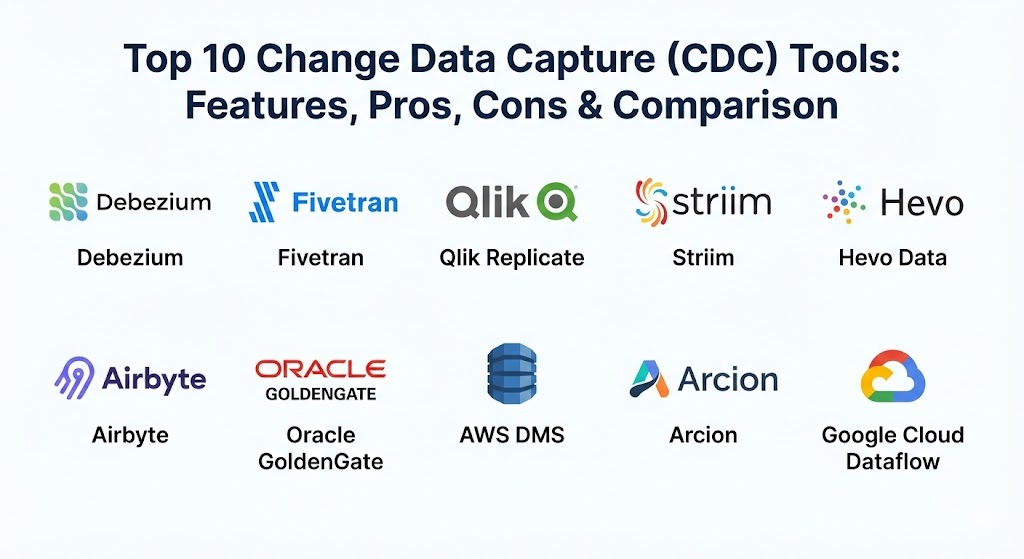
Top 10 Change Data Capture (CDC) Tools
1 — Debezium
Debezium is the industry-standard open-source CDC platform. Built on top of Apache Kafka, it consists of a set of connectors that monitor different database management systems (DBMS) and convert their changes into a unified stream of events.
- Key features:
- Log-based CDC for minimal impact on source databases.
- Supports MySQL, PostgreSQL, MongoDB, Oracle, and SQL Server.
- Snapshot mode to capture the initial state of the database.
- Integration with Kafka Connect for scalable streaming.
- Automatic schema change detection and propagation.
- Filters and masking to exclude sensitive columns or tables.
- Pros:
- Completely free and open-source with a massive community.
- Highly flexible and customizable for complex engineering stacks.
- Cons:
- Requires significant expertise in Kafka and ZooKeeper to manage.
- Can be resource-heavy to maintain at a very large scale.
- Security & compliance: Supports SSL/TLS encryption, Kerberos authentication, and RBAC via Kafka. Compliance depends on the underlying infrastructure.
- Support & community: Exceptional community support (StackOverflow, GitHub); professional enterprise support is available via vendors like Red Hat and Confluent.
2 — Fivetran
Fivetran is a leading automated data movement platform that offers a fully managed, “zero-maintenance” CDC experience. It is designed for teams that want to set up data pipelines in minutes without writing a single line of code.
- Key features:
- Fully managed SaaS platform; no infrastructure to provision.
- HVR-powered high-volume CDC for enterprise databases.
- Automatic schema evolution and table re-syncing.
- Pre-built connectors for 300+ sources and targets.
- Telemetry and monitoring dashboards for pipeline health.
- Built-in transformations via dbt integration.
- Pros:
- The most user-friendly tool on the market; “set it and forget it.”
- Extremely reliable with an industry-leading 99.9% uptime.
- Cons:
- Pricing is based on “Monthly Active Rows,” which can become very expensive.
- Limited control over the inner workings of the data movement.
- Security & compliance: SOC 2 Type II, ISO 27001, PCI DSS, GDPR, HIPAA, and HITRUST.
- Support & community: 24/7 enterprise support, comprehensive documentation, and a dedicated customer success manager for larger accounts.
3 — Qlik Replicate
Formerly known as Attunity, Qlik Replicate is a powerful, enterprise-grade data replication and CDC tool that specializes in high-speed data ingestion across heterogeneous environments.
- Key features:
- “Click-to-replicate” visual interface for designing pipelines.
- Log-based CDC with zero footprint on the source database.
- Support for mainframe sources (DB2, IMS) and SAP.
- Automated end-to-end mapping from source to target.
- Optimized for cloud data warehouses like Snowflake and Databricks.
- Advanced filtering and transformation during the stream.
- Pros:
- Unmatched performance in moving massive datasets from legacy systems.
- Excellent for large-scale hybrid-cloud migrations.
- Cons:
- High upfront licensing costs; not suitable for startups.
- The UI can feel a bit dated compared to modern web-native tools.
- Security & compliance: Enterprise-grade encryption (AES-256), SSL/TLS, and deep audit logging for SOC 2/HIPAA.
- Support & community: High-quality professional support and dedicated training programs through Qlik University.
4 — Striim
Striim is a real-time data integration and streaming analytics platform. It goes beyond simple data movement by allowing users to process and analyze data while it is still in flight.
- Key features:
- Continuous log-based CDC for sub-second latency.
- In-flight data processing (SQL-based transformations, joins, and masking).
- Real-time dashboards for monitoring data streams and business KPIs.
- High-availability architecture with built-in checkpointing.
- Connectors for cloud-native targets and legacy on-prem databases.
- “Time travel” capability to replay old data streams.
- Pros:
- One of the few tools that combine CDC with real-time stream processing.
- Very low latency, making it ideal for fraud detection or live inventory.
- Cons:
- Complex configuration due to the breadth of features.
- Resource-intensive if performing heavy transformations in-flight.
- Security & compliance: SOC 2, HIPAA, GDPR, and end-to-end encryption in transit and at rest.
- Support & community: Robust enterprise support with a focus on architecture design and proactive monitoring.
5 — Hevo Data
Hevo Data is a no-code, bidirectional data pipeline platform designed for modern data teams. It focuses on simplicity and speed, with a particular strength in connecting databases to cloud warehouses.
- Key features:
- No-code interface that enables setup in under 5 minutes.
- Automated schema management and mapping.
- Reverse ETL capabilities to push data from warehouses back to apps.
- Real-time data streaming with sub-minute latency.
- Alerting and notifications via Slack or Email.
- Python-based transformation for complex data cleaning.
- Pros:
- Very competitive pricing for growing companies.
- Extremely clean and intuitive user interface.
- Cons:
- Limited number of connectors compared to Fivetran or Airbyte.
- Transformation options are slightly more basic than enterprise rivals.
- Security & compliance: SOC 2 Type II, GDPR, HIPAA, and ISO 27001.
- Support & community: Responsive 24/7 live chat support and a very helpful online knowledge base.
6 — Airbyte
Airbyte is a modern, open-source data integration platform that has quickly become a favorite for its “community-first” approach and massive library of connectors.
- Key features:
- Open-source core with a hosted “Cloud” version for simplicity.
- 300+ pre-built connectors (the largest library in the industry).
- Integration with dbt for SQL-based transformations.
- “Connector Builder” that allows users to create new sources in minutes.
- Granular scheduling and monitoring features.
- Native support for log-based CDC on Postgres and MySQL.
- Pros:
- Highly extensible; if a connector doesn’t exist, you can build it.
- Predictable, credit-based pricing for the cloud version.
- Cons:
- Some community-contributed connectors can be hit-or-miss in terms of quality.
- CDC performance for very high-volume databases is still maturing.
- Security & compliance: SOC 2, ISO 27001, GDPR, and HIPAA (via customer-hosted planes).
- Support & community: Massive Slack community (40,000+ members) and excellent technical documentation.
7 — Oracle GoldenGate
Oracle GoldenGate is the veteran of the replication world. It is a comprehensive software package for real-time data integration and replication in heterogeneous IT environments.
- Key features:
- Gold-standard for Oracle database replication.
- Support for high-availability and disaster recovery scenarios.
- Sub-second latency even across global distances.
- Parallel processing for massive transaction volumes.
- Veridata tool for identifying and repairing data out-of-sync issues.
- Support for NoSQL and Big Data targets (Hadoop, Kafka).
- Pros:
- Incredibly stable and trusted by Fortune 500 companies for decades.
- The most functionally complete tool for mission-critical Oracle environments.
- Cons:
- Notoriously complex to install and manage.
- Very high cost and rigid licensing structure.
- Security & compliance: FIPS 140-2, Common Criteria, and deep integration with Oracle’s security stack.
- Support & community: Premier global support from Oracle; vast ecosystem of certified consultants.
8 — AWS Database Migration Service (DMS)
AWS DMS is a managed service that makes it easy to migrate databases to AWS quickly and securely. It includes a robust CDC feature for continuous replication.
- Key features:
- Low-cost migration and replication tool.
- Supports homogeneous (MySQL to MySQL) and heterogeneous migrations.
- Multi-AZ support for high availability.
- Integration with AWS Schema Conversion Tool (SCT).
- Minimal setup; no need to install drivers or applications.
- Automatically monitors health and manages failover.
- Pros:
- Extremely inexpensive compared to enterprise software.
- Native integration with the broader AWS ecosystem.
- Cons:
- Limited features for transformation or complex filtering.
- Can sometimes struggle with very complex, high-transaction loads.
- Security & compliance: Integrated with AWS IAM, KMS, and CloudTrail; HIPAA and SOC compliant.
- Support & community: Standard AWS support plans apply; extensive documentation and re:Post community.
9 — Arcion (by Databricks)
Recently acquired by Databricks, Arcion is the only real-time, in-memory CDC platform architected for petabyte-scale scalability. It is designed for high-performance data movement with zero code required.
- Key features:
- Agentless CDC for 20+ enterprise sources (Oracle, DB2, SAP).
- In-memory processing for ultra-low latency.
- Automatic vertical and horizontal scaling.
- Out-of-the-box support for schema conversion.
- Exactly-once delivery guarantee.
- Multi-threaded architecture for maximum throughput.
- Pros:
- Best-in-class performance for extremely large enterprise workloads.
- Agentless architecture means no software installation on source databases.
- Cons:
- Pricing is focused on large-scale enterprise needs.
- Newest player on the block (though now backed by Databricks).
- Security & compliance: SOC 2 Type II, HIPAA, and PCI compliant.
- Support & community: Enterprise-grade support; now integrating into the Databricks support ecosystem.
10 — Google Cloud Dataflow
Google Cloud Dataflow is a serverless, unified stream and batch data processing service. While it is a general processing engine, it has powerful native CDC templates for ingesting data into BigQuery.
- Key features:
- Serverless architecture; no clusters to manage.
- Horizontal autoscaling to handle spikes in data.
- Built-in CDC templates for Oracle and PostgreSQL.
- Integration with Google Cloud Pub/Sub and BigQuery.
- Visual pipeline monitoring and debugging tools.
- Supports Java and Python (Apache Beam) for custom logic.
- Pros:
- Seamlessly scales from tiny datasets to global petabyte streams.
- “Pay-as-you-go” pricing makes it very cost-efficient.
- Cons:
- Requires knowledge of Apache Beam for custom (non-template) pipelines.
- Can be complex to troubleshoot when things go wrong in a large pipeline.
- Security & compliance: ISO 27001, SOC 2/3, HIPAA, and GDPR compliant.
- Support & community: Global Google Cloud support; strong community around the Apache Beam project.
Comparison Table
| Tool Name | Best For | Platform(s) Supported | Standout Feature | Rating (Gartner Peer Insights) |
| Debezium | Engineers / DIY | Linux, Docker, Kubernetes | Open-source standard | 4.6 / 5 |
| Fivetran | Zero-Maintenance | SaaS | High reliability (99.9%) | 4.7 / 5 |
| Qlik Replicate | Legacy / Hybrid | Windows, Linux, Mainframe | “Click-to-replicate” UI | 4.5 / 5 |
| Striim | In-flight Analytics | SaaS, Cloud, On-prem | SQL-based stream processing | 4.5 / 5 |
| Hevo Data | Startups / SMBs | SaaS | No-code Reverse ETL | 4.4 / 5 |
| Airbyte | Extensibility | SaaS, Open-Source | 300+ Connectors | 4.3 / 5 |
| Oracle GoldenGate | Oracle Databases | Windows, Linux, Solaris | Platinum-tier HA/DR | 4.4 / 5 |
| AWS DMS | AWS Ecosystem | AWS Managed | Extremely Low Cost | 4.1 / 5 |
| Arcion | Petabyte-scale | Cloud, On-prem | Agentless In-memory CDC | 4.8 / 5 |
| Google Dataflow | Serverless / BigQuery | Google Cloud | Massive Autoscaling | 4.6 / 5 |
Evaluation & Scoring of Change Data Capture (CDC) Tools
Choosing a CDC tool involves more than just comparing features; it requires balancing the technical overhead against the business value of real-time data.
| Category | Weight | Evaluation Criteria |
| Core Features | 25% | Log-based capture, schema evolution, protocol support, and throughput. |
| Ease of Use | 15% | Time-to-value, UI intuitiveness, and no-code vs. code requirements. |
| Integrations | 15% | Breadth of source/target library and compatibility with the modern data stack. |
| Security | 10% | Encryption, SSO, compliance certs (SOC 2, GDPR), and audit logs. |
| Performance | 10% | Latency, source system overhead, and reliability during network drops. |
| Support | 10% | Response times, documentation quality, and community vibrancy. |
| Price / Value | 15% | Predictability of costs and ROI relative to maintenance hours saved. |
Which Change Data Capture (CDC) Tool Is Right for You?
The “perfect” tool is an intersection of your budget, your existing cloud provider, and your team’s engineering maturity.
- Solo Users & SMBs: If you have a tight budget and need something simple, AWS DMS is unbeatable on price. If you want a clean UI and no-code setup for a few dozen pipelines, Hevo Data is an excellent choice.
- Mid-Market & Rapidly Growing Teams: Airbyte is the go-to for teams that want the flexibility of open-source but the convenience of a cloud platform. If your priority is absolute reliability and you have the budget, Fivetran will save your engineers hundreds of hours of maintenance.
- Enterprises with Legacy Hardware: If you are moving data from mainframes or SAP systems, Qlik Replicate is the industry standard. For mission-critical Oracle environments, Oracle GoldenGate remains the king of stability.
- Performance-Obsessed Teams: If you are dealing with petabyte-scale data where every millisecond counts, Arcion is the modern high-performance choice. If you are already all-in on Google Cloud, Dataflow provides the best serverless experience.
- Security & Compliance Needs: For industries like banking or healthcare, Fivetran and Qlik offer the most comprehensive pre-certified compliance packages, reducing the burden on your legal team.
Frequently Asked Questions (FAQs)
1. What is the difference between log-based and query-based CDC?
Log-based CDC reads the database’s transaction logs directly, meaning it has zero impact on the database’s performance. Query-based CDC periodically asks the database for new rows using timestamps, which can slow down the system during peak times.
2. Can CDC tools handle schema changes automatically?
Most modern tools (like Fivetran, Hevo, and Debezium) can detect when you add a column to a table and automatically replicate that change to your target warehouse without breaking the pipeline.
3. Is CDC faster than traditional ETL?
Yes. Traditional ETL usually runs in batches (e.g., every 24 hours). CDC is continuous, moving data in small increments every few seconds, resulting in much lower latency.
4. How do I prevent data loss if the network goes down?
Top-tier CDC tools use “checkpointing” or “offsets.” They remember the last transaction they successfully moved. When the network returns, they simply pick up exactly where they left off.
5. Does CDC work with NoSQL databases like MongoDB?
Yes, tools like Debezium and Arcion have specific connectors that monitor MongoDB’s “Oplog” to capture changes just like they would with a traditional SQL log.
6. What is the “Source Overhead” of a CDC tool?
Log-based CDC tools typically have an overhead of less than 3%, as they only read files the database was already writing. Query-based tools can have significantly higher overhead (10-20%).
7. Is open-source CDC (Debezium) really “free”?
The software is free, but the “total cost of ownership” includes the salary of the engineers needed to manage Kafka, the cost of the servers to run it, and the time spent troubleshooting.
8. Can I use CDC for real-time fraud detection?
Absolutely. Tools like Striim are designed for this; they capture a credit card transaction via CDC and immediately run a fraud-check algorithm before the data even reaches the warehouse.
9. What is “Reverse ETL”?
Reverse ETL is the process of taking the synced data from your warehouse (e.g., a customer’s health score) and pushing it back into your operational apps (e.g., Salesforce), allowing your sales team to act on it.
10. Do I need a Data Lake or a Data Warehouse for CDC?
It depends on your goal. Most companies stream CDC data into a Data Warehouse (like Snowflake) for reporting, while those doing machine learning often stream it into a Data Lake (like S3).
Conclusion
The shift toward real-time data is no longer a luxury—it is a competitive necessity. Change Data Capture (CDC) has matured from a complex engineering hack into a robust category of tools that can handle everything from a small startup’s first pipeline to a global bank’s mission-critical replication.
When choosing your tool, remember that the cheapest option on paper often becomes the most expensive in maintenance hours. Focus on a tool that handles schema evolution gracefully and integrates deeply with your existing cloud stack. Whether you choose the open-source flexibility of Debezium or the managed simplicity of Fivetran, the goal remains the same: ensuring your data is as fresh as your business decisions.