Introduction
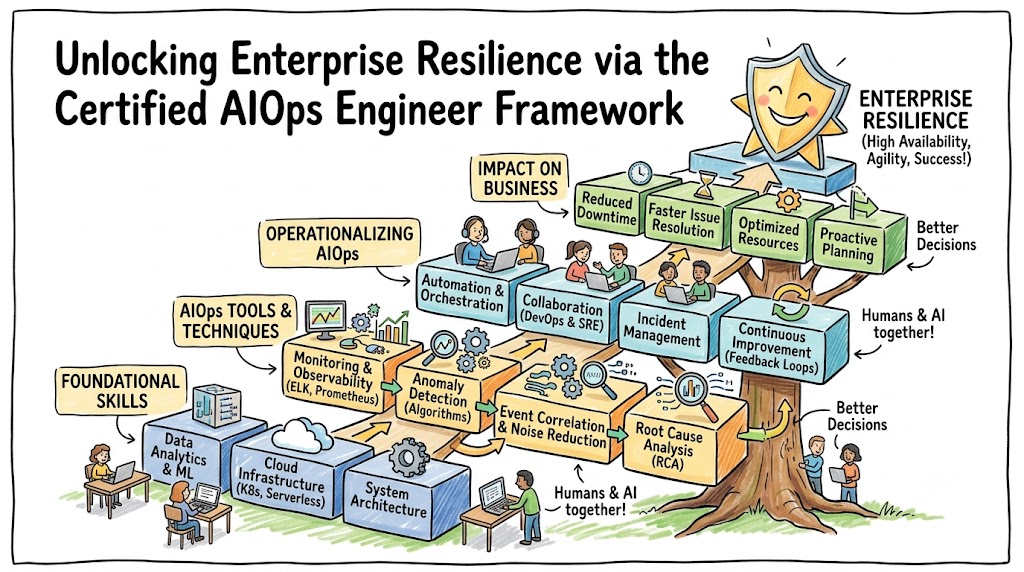
The operational complexity of modern software delivery has outpaced human capacity. As microservices multiply and multi-cloud architectures become the corporate standard, traditional monitoring methods fail under the weight of endless alert noise and fragmented telemetry. This comprehensive guide provides a strategic roadmap for engineering professionals, platform architects, and technology leaders looking to transition from reactive system maintenance to proactive, intelligent automation. By exploring structured educational tracks, you will understand how algorithmic incident correlation, predictive capacity forecasting, and automated remediation can revitalize organizational efficiency. This resource is designed to help you analyze career trajectories, technical depths, and real-world execution plans so you can choose the optimal development path.
The modern cloud-native landscape demands an objective validation of skills that unifies systems engineering with data-driven infrastructure automation. The Certified AIOps Engineer curriculum, accessible through the official program portal at aiopsschool.com, establishes a global performance benchmark for professionals aiming to deploy algorithmic operations at scale. Hosted on the comprehensive aiopsschool platform, this technical framework focuses heavily on replacing manual alert triage with closed-loop engineering workflows. For infrastructure practitioners navigating high-throughput production environments, mastering these automated methodologies is essential for maintaining strict service level objectives.
What is the Certified AIOps Engineer?
The Certified AIOps Engineer designation is a comprehensive professional validation confirming an engineer’s capability to apply machine learning, statistical patterns, and automated logic to live IT infrastructure. This program was established because legacy dashboard alerts rely on static thresholds that fail to catch complex, cascading system degradations. Rather than focusing on abstract data science theory, this curriculum teaches practitioners how to orchestrate real-time telemetry pipelines, parse high-volume log streams, and automate incident isolation.
Modern enterprise environments require engineering squads to move past manual operations and implement self-healing platforms that diagnose root causes autonomously. The training aligns directly with advanced site reliability workflows, showing engineers how to establish behavioral baselines and isolate statistical anomalies across thousands of infrastructure nodes. By prioritizing production-focused scenario training over memorization, this certification ensures that professionals can reliably design and maintain data streams that handle multi-gigabit operational telemetry.
Who Should Pursue Certified AIOps Engineer?
This certification program is engineered specifically for systems professionals responsible for maintaining high-availability cloud infrastructure who wish to integrate algorithmic decision-making into their toolsets. DevOps engineers, Site Reliability Engineers (SREs), systems architects, and cloud infrastructure specialists will find immediate practical utility in the design patterns taught. Furthermore, security engineers, database administrators, and data pipeline professionals can utilize these core concepts to build highly resilient observation layers and intelligent threat defense patterns.
The modular curriculum layout accommodates various professional experience levels, offering accessible entry points for junior engineers building their automation fundamentals as well as deep technical paths for veteran architects. Engineering managers, technical directors, and enterprise operations leaders also benefit significantly, gaining the high-level perspective required to guide organizational modernizations and evaluate vendor tooling objectively. Globally, the demand for these specialized competencies spans across major enterprise sectors, including North America, Europe, and the rapidly growing engineering ecosystems throughout India.
Why Certified AIOps Engineer
The current enterprise software footprint changes too quickly for human operators to monitor using standard threshold notifications. Achieving the Certified AIOps Engineer designation provides long-term career durability by decoupling your professional skill set from individual vendor applications and focusing instead on fundamental architectural principles. As organizations scale their hybrid cloud deployments, engineers who know how to extract actionable intelligence from disparate data streams will remain highly sought after by enterprise recruiters.
Investing time into this technical validation delivers a highly clear return on investment by placing your skill set at the intersection of systems engineering and big data analytics. Frontend monitoring tools change frequently, but the foundational theories of log parsing, metric aggregation, and automated incident triage retain their value across any cloud provider. Mastering these methodologies guarantees your long-term relevance as corporate entities actively seek to lower their mean time to resolution (MTTR) and mitigate infrastructure overhead.
Certified AIOps Engineer Certification Overview
The professional training tracks are delivered via structured learning modules designed to build hands-on technical competency through direct implementation. The entire curriculum ecosystem is managed by the central hosting platform, ensuring that educational requirements match modern architectural realities and current enterprise hiring patterns. Assessment protocols lean heavily on practical, scenario-driven laboratory evaluations and comprehensive technical examinations to confirm actual engineering troubleshooting capabilities under pressure.
The structural management of the certification ensures that the content remains strictly vendor-neutral while comprehensively covering both open-source frameworks and enterprise infrastructure utilities. Instead of simple multiple-choice formats, the evaluation methodology directly challenges a candidate’s capacity to design resilient telemetry pipelines and diagnose multi-system infrastructure anomalies. This structured approach provides enterprises with a reliable mechanism for validating engineering talent against industry-vetted operational baselines.
Certified AIOps Engineer Certification Tracks & Levels
The certification framework is divided into progressive technical tiers to match different levels of engineering experience and organizational focus areas. The foundation level introduces the core fundamentals of telemetry harvesting, log schema formatting, and basic statistical analysis within distributed systems. This serves as the primary stepping stone for systems administrators and operations engineers looking to move into automated, data-driven infrastructure roles.
The professional and advanced tracks focus on complex anomaly detection algorithms, high-throughput stream processing, and autonomous closed-loop mitigation playbooks. Additionally, specialized specialization tracks allow engineers to customize their learning path to match their exact job domain, whether that involves integrating automated patterns into cloud spend analysis, security auditing, or platform engineering. This granular structure ensures that your educational investment aligns directly with your daily engineering challenges and upcoming career milestones.
Complete Certified AIOps Engineer Certification Table
| Track | Level | Who it’s for | Prerequisites | Skills Covered | Recommended Order |
|---|---|---|---|---|---|
| Core Monitoring | Foundation | Associate Engineers & Support Staff | Fundamental Linux administration and basic network topologies | Telemetry ingestion, log filtering, metric charting, shell scripting | First |
| Algorithmic Operations | Professional | SREs, Systems Architects & DevOps | Two years cloud administration and basic Python programming | Event correlation models, anomaly isolation, alert reduction, script automation | Second |
| Autonomous Platform | Advanced | Principal Infrastructure Architects | Professional level certification and complex scripting fluency | Closed-loop self-healing, stream data architectures, predictive capacity design | Third |
| Threat Intelligence | Specialist | DevSecOps and Security Analysts | Strong understanding of security compliance and system auditing | Log behavior profiling, automated threat isolation, SIEM data transformation | Optional Component |
| Asset Optimization | Specialist | FinOps Architects and Cloud Analysts | Basic cloud pricing models and asset management knowledge | Cost anomaly detection, automated resource downsizing, consumption forecasting | Optional Component |
Detailed Guide for Each Certified AIOps Engineer Certification
Certified AIOps Engineer – Foundation Level
What it is
This entry-tier certification validates an engineer’s practical understanding of baseline observability frameworks and data collection methods. It proves your ability to configure basic telemetry pipelines, manage distributed log aggregators, and read system performance metrics accurately.
Who should take it
Systems administrators, application support specialists, and junior DevOps engineers who want to migrate away from manual dashboard tracking and learn structured telemetry collection.
Skills you’ll gain
- Deploying open-source data collectors and forwarding utilities across distributed cloud instances
- Standardizing unstructured log formats using expressions and structured JSON data schemas
- Building unified observability dashboards tracking metrics, application logs, and system events
- Implementing dynamic alert rules based on statistical variation rather than static limits
Real-world projects you should be able to do
- Construct a centralized log collection framework that aggregates and parses data from a multi-tier cloud application
- Design an operational health dashboard that maps infrastructure capacity against live application response times
Preparation plan
- 7–14 Days: Master core monitoring concepts, focusing entirely on the structural differences between logs, metrics, and distributed request traces.
- 30 Days: Configure local virtual labs with open-source log collectors to practice parsing, filtering, and indexing data streams.
- 60 Days: Review standard deployment architectures, complete mock assessment modules, and reinforce basic script-based data transformations.
Common mistakes
- Reading documentation theoretically without spending time configuring and breaking actual telemetry pipelines in a lab environment
- Overlooking the importance of data formatting standards and schema normalization across diverse log sources
Best next certification after this
- Same-track option: Certified AIOps Engineer – Professional Level
- Cross-track option: Certified DevOps Systems Associate
- Leadership option: Technical Team Lead Foundation
Certified AIOps Engineer – Professional Level
What it is
This mid-tier certification verifies an engineer’s capability to apply advanced statistical models and algorithmic processing to live operational streams. It certifies that you can systematically lower alert fatigue, group related events, and orchestrate automated incident responses.
Who should take it
Mid-to-senior Site Reliability Engineers (SREs), platform engineering specialists, and DevOps practitioners managing high-scale production systems.
Skills you’ll gain
- Implementing time-series mathematical models to catch subtle infrastructure performance deviations
- Creating event-correlation rule sets that consolidate thousands of concurrent alerts into a single incident root cause
- Writing diagnostic automation scripts that trigger instantly when specific infrastructure anomalies occur
- Fine-tuning pattern recognition tools used to scan large-scale enterprise system log structures
Real-world projects you should be able to do
- Deploy an event correlation layer that filters production alarm streams and isolates the root cause during a network outage
- Build a predictive warning mechanism that flags incoming memory leaks long before they trigger application crashes
Preparation plan
- 7–14 Days: Review time-series statistical theories, focusing on standard deviation, rolling averages, and behavioral baseline equations.
- 30 Days: Set up an event processing framework in a staging environment to build advanced alert grouping and correlation rules.
- 60 Days: Run simulated failure injections inside a test cluster to verify that your automated detection models respond accurately.
Common mistakes
- Jumping directly into complex machine learning models when basic statistical baseline formulas solve the alerting problem faster
- Forgetting to scrub and normalize historical operational data before using it to train anomaly detection algorithms
Best next certification after this
- Same-track option: Certified AIOps Engineer – Advanced Level
- Cross-track option: Certified DevSecOps Engineering Professional
- Leadership option: Engineering Manager Professional
Certified AIOps Engineer – Advanced Level
What it is
This expert-level certification confirms your ability to architect fully autonomous, self-healing enterprise platforms and high-throughput telemetry data lakes. It demonstrates your capacity to deploy closed-loop mitigation loops that fix live production bugs without requiring human intervention.
Who should take it
Principal infrastructure architects, enterprise automation directors, and senior staff engineers responsible for global platform uptime and systemic scaling strategies.
Skills you’ll gain
- Designing distributed, highly available data streaming pipelines that process terabytes of system logs in real time
- Building secure closed-loop orchestration frameworks that safely perform destructive modifications in production clusters
- Engineering predictive resource forecasting systems that align long-term hardware additions with corporate business trends
- Establishing policy and security safeguards for automated scripts executing within critical infrastructure layers
Real-world projects you should be able to do
- Construct an autonomous mitigation pipeline that detects traffic overload, triggers infrastructure scale-outs, and updates routing layers automatically
- Architect a secure enterprise observability data lake combining infrastructure logs, application traces, and financial cost metrics
Preparation plan
- 7–14 Days: Study large-scale event-driven design patterns, message broker configurations, and real-time streaming architectures.
- 30 Days: Write multi-phase automation scripts that securely hook into public cloud APIs and container orchestrator systems.
- 60 Days: Focus on security compliance for telemetry storage, high-availability data topologies, and safety guardrail implementations.
Common mistakes
- Failing to design fallback patterns or safety breaks that prevent automation loops from runaway infrastructure scaling
- Creating fragile data pipelines that crash under high telemetry load during major system outages
Best next certification after this
- Same-track option: Enterprise Operations Fellowship
- Cross-track option: Cloud FinOps Architect
- Leadership option: Director of Platform Engineering Track
Choose Your Learning Path
DevOps Path
This educational track concentrates on integrating automated telemetry checks and intelligent performance validations directly into your deployment pipelines. Technicians learn to leverage data analytics to scan build logs, identify deployment regressions immediately, and manage automated canary deployment testing. By embedding statistical analysis directly into the continuous integration cycle, development teams can minimize code release hazards and increase delivery velocity.
DevSecOps Path
Security-minded engineers use this trajectory to apply behavioral profiling and pattern correlation across system event logs, authentication trails, and network traffic records. This specialization path trains engineers to instantly isolate normal infrastructure patterns from sophisticated cyber attacks or internal policy breaches. Participants learn to trigger immediate, automated security isolations to secure production assets long before a security team can respond.
SRE Path
The site reliability engineering pathway prioritizes system health preservation, error budget tracking, and algorithmic alert reduction to minimize engineer on-call fatigue. It offers exhaustive technical execution training on service level metric tracking, event filtering, and automated triage playbooks. Practitioners pursuing this path gain the skills needed to replace fragile manual playbooks with programmatic, software-defined recovery mechanisms.
AIOps Path
This focused technical avenue addresses the foundational statistical algorithms, data formatting structures, and pipeline layouts used to drive modern operational analytics. Engineers focus entirely on designing real-time data streaming architectures, tuning anomaly model variables, and establishing storage practices for enterprise telemetry. The curriculum remains dedicated to building high-capacity, vendor-neutral analytics engines tailored explicitly for enterprise platforms.
MLOps Path
Engineers following this path dedicate themselves to the deployment orchestration, lifecycle management, and performance safety of machine learning models in production. The coursework instructs engineers on how to build automated retraining data loops, monitor live models for feature drift, and manage version registries securely. It provides the foundational systems engineering knowledge required to support data science groups within enterprise environments.
DataOps Path
This special track targets the data reliability, pipeline architecture, and horizontal scaling characteristics of large-scale distributed analytics engines. Engineers learn to deploy real-time data verification mechanisms, automate schema updates safely, and locate performance blocks inside distributed cluster setups. This educational path ensures that corporate data delivery remains accurate and operational despite underlying infrastructure variations.
FinOps Path
The financial operations path links infrastructure performance metrics with resource billing records to eliminate public cloud waste automatically. Engineers discover how to deploy automated cost anomaly alarms, construct predictive budget consumption models, and write automated rightsizing workflows. This specialization ensures that technology groups can maintain application performance metrics while maximizing structural financial efficiency.
Role → Recommended Certified AIOps Engineer Certifications
| Role | Recommended Certifications |
|---|---|
| DevOps Engineer | Foundation Level, Professional Level, Systems Reliability Track |
| SRE | Professional Level, Advanced Level, Systems Reliability Track |
| Platform Engineer | Professional Level, Advanced Level, Platform Architecture Track |
| Cloud Engineer | Foundation Level, Professional Level, Platform Architecture Track |
| Security Engineer | Foundation Level, Security Operations Specialist Track |
| Data Engineer | Professional Level, DataOps Path Components |
| FinOps Practitioner | Foundation Level, Financial Optimization Specialist Track |
| Engineering Manager | Foundation Level, Specialized Leadership Overview Modules |
Next Certifications to Take After Certified AIOps Engineer
Same Track Progression
Upon completing the core curriculum, advanced progress focuses on custom model design and complex autonomous architecture patterns. Engineers can pursue highly specialized credentials that validate their capability to craft bespoke mathematical algorithms tailored to unique enterprise scale limitations. This continuous technical progression cements your status as a principal platform specialist capable of managing complex operations frameworks.
Cross-Track Expansion
Broadening your professional utility requires moving into neighboring paths such as cloud cost architecture, advanced security design, or big data processing. Earning credentials across these intersecting domains empowers you to tackle multi-dimensional engineering issues, such as matching runtime performance with strict compliance policies. This cross-functional training broadens your market versatility and increases your value to diverse technical teams.
Leadership & Management Track
Migrating toward technical leadership involves shifting your focus away from individual script deployment to long-term operational systems design and team development. Pursuing engineering management pathways trains senior engineers to analyze tool infrastructure budgets, orchestrate skills transformations, and build modern platform engineering teams. This career pivot successfully prepares you for strategic roles like Director of Platform Reliability.
Training & Certification Support Providers for Certified AIOps Engineer
DevOpsSchool delivers extensive instructor-led training courses built to help active technology professionals master modern automation systems and configuration infrastructure. Their structured lessons concentrate primarily on practical implementation labs and real-world system deployments.
Cotocus provides specialized IT consulting and intensive technical bootcamps designed to help corporate teams modernize their infrastructure delivery frameworks. Their educational modules emphasize the hands-on configuration of enterprise monitoring environments.
Scmgalaxy functions as a broad community knowledge portal and training provider focused on upgrading configuration management and software release engineering competencies. They offer comprehensive step-by-step practical guides for system validation.
BestDevOps specializes in providing top-tier, practical instructional programs that cover the entirety of the contemporary software delivery and platform engineering landscape. Their targeted courses guide engineering organizations toward adopting standardized operational pipelines.
devsecopsschool targets the intersection of cloud security frameworks and production automation by offering immersive, lab-driven educational tracks. Their classes instruct practitioners on how to inject continuous security policy checks into delivery pipelines.
sreschool concentrates entirely on site reliability engineering principles, providing highly technical courses on error budget execution and automated incident triage. Their lessons assist teams in migrating away from manual infrastructure monitoring models.
aiopsschool serves as a premier, dedicated training entity for intelligent infrastructure automation, offering the precise educational steps needed for modern data-driven certifications. Their platform is devoted exclusively to building automated operations competence.
dataopsschool hosts targeted technical courses built around maximizing the performance speed, availability, and quality of enterprise data pipelines. Their classes assist data teams in engineering resilient operational structures.
finopsschool delivers specialized curriculum focusing on cloud financial engineering, instructing technology professionals on how to track and limit public cloud waste programmatically. Their coursework merges financial responsibility with modern platform management.
Frequently Asked Questions (General)
- What are the foundational prerequisites to start learning intelligent operations engineering? Candidates need a solid baseline knowledge of Linux systems operation, standard network routing, cloud infrastructure components, and introductory scripting using Python or Bash.
- How many hours should an engineer dedicate to passing the entry-level certification? Most active engineers allocating approximately five to ten hours per week can master the baseline examination topics within a thirty to sixty-day window.
- Are these types of platform certifications vendor-dependent or universally applicable? The certification paths prioritize vendor-neutral architectural patterns, underlying statistical logic, and open-source formats, guaranteeing broad industry applicability.
- What long-term professional benefits do engineers receive from completing advanced automation training? Practitioners often enjoy faster promotions, higher engineering authority within enterprise organizations, and a significant expansion of their advanced technical debugging skills.
- Can backend application developers benefit from pursuing infrastructure operations training? Yes, software developers learn how their code changes behave under load in production, allowing them to architect more resilient and easily observable applications.
- How exactly do algorithmic event correlation models reduce engineering alert burnout? By applying data correlation parameters, these engines group hundreds of duplicate alert messages into a single root-cause incident notification.
- What separates basic dashboard monitoring from modern platform observability frameworks? Standard monitoring checks system availability against hard-coded metrics, while observability processes complete system telemetry to diagnose why a complex platform failed.
- Is writing programming code an absolute requirement for modern platform engineering roles? Yes, a clear understanding of scripting or programming languages is necessary to construct data paths, write automation playbooks, and connect with cloud APIs.
- How often should enterprise technology professionals refresh their certified credentials? Because software delivery tools evolve rapidly, updating your technical credentials every two to three years is a recommended career practice.
- Do these preparation paths provide access to practical lab sandboxes for real-world simulation? Yes, authorized training tracks use isolated sandbox labs where candidates configure actual enterprise tools and remediate simulated system outagess.
- How do technical managers utilize information learned in these engineering courses? Managers gain the technical clarity needed to evaluate software tooling expenses, coordinate engineering headcount, and set realistic platform reliability benchmarks.
- Can these automation pathways assist teams during large-scale cloud migration projects? Absolutely, the foundational methodologies learned apply directly to modern hybrid configurations, ensuring smoother infrastructure migrations and reduced downtime.
FAQs on Certified AIOps Engineer
- How difficult is the Certified AIOps Engineer exam compared to standard DevOps certifications? The evaluation process requires a deeper understanding of statistics and data streaming architecture than basic configuration management tests. Candidates must demonstrate proficiency in real-time log ingestion, data transformations, and statistical baseline tuning. This emphasis on practical data pipelines makes the testing process highly rigorous and focused on real production situations.
- Do I need an advanced academic background in data science to pass this program? No formal mathematical or data science degree is required to navigate this certification successfully. The curriculum is tailored specifically for infrastructure engineers, focusing on the configuration and integration of automated models rather than theoretical algorithm creation. A basic comfort level with Python scripting and core statistics is entirely sufficient.
- How does holding a Certified AIOps Engineer credential influence my professional market value? Earning this certification demonstrates to prospective employers that you possess the advanced technical capability required to run high-scale, modern infrastructure environments. It differentiates you from traditional sysadmins by proving you can deploy automated systems that lower incident resolution times and eliminate manual alert tracking.
- Can I bypass the introductory courses and take the professional-level examination directly? While entering the professional track directly is allowed if you have extensive field experience, completing the foundational module first is highly advised. The initial tier confirms your understanding of specific telemetry formats and log schema configurations that form the baseline of advanced exam questions.
- Which specific software tools and open-source frameworks are covered in the training? The coursework covers a diverse range of industry-standard logging utilities, metric collection daemons, message streaming systems, and time-series databases. The instructional modules ensure you learn how to assemble these open-source elements into a single cohesive operations platform.
- How does the Certified AIOps Engineer track handle modern multi-cloud architectures? The curriculum addresses multi-cloud patterns as a baseline enterprise standard, teaching engineers how to collect and unify telemetry from completely different cloud environments. You will learn to construct central observation layers that merge data streams from distinct public providers into one analytical view.
- What sort of practical scenarios can I expect to solve during the laboratory exams? Candidates are placed into active, broken infrastructure environments where they must diagnose systemic performance errors, filter out alert noise, and implement automated remediation scripts. These lab scenarios mimic live production incidents to test your engineering capability under realistic pressures.
- How frequently does the hosting platform update the Certified AIOps Engineer content? The educational curriculum undergoes structured technical audits and content updates to ensure all training blocks align with current cloud architectures and shifting enterprise trends. This continuous review process guarantees that your learned skills remain highly valuable to modern technology organizations.
Final Thoughts: Is Certified AIOps Engineer Worth It?
Building a sustainable engineering career requires balancing mastery over current operations with preparation for future architectural realities. The shift toward algorithmic automation within cloud-native environments is not an optional trend; it is an absolute necessity driven by the growing scale of modern enterprise software. Traditional, manual dashboard tracking simply cannot keep up with short-lived container instances and distributed cloud networks.
Pursuing the Certified AIOps Engineer track offers a clear, structured blueprint for transitioning your engineering capabilities away from reactive firefighting toward proactive platform architecture. It pushes you to treat operational telemetry as a core data asset that can be programmatically analyzed and optimized. If you want to lead enterprise platform initiatives and construct resilient, self-healing networks, this educational path provides the objective, vendor-neutral verification required to achieve your professional goals.