Introduction
Kubernetes policy enforcement is the practice of using software to automatically validate, mutate, or reject resource requests before they are applied to a cluster. These tools typically sit at the “Admission Controller” stage of the Kubernetes API, acting as a gatekeeper. They replace manual code reviews and “best-effort” security with declarative, version-controlled rules that cannot be bypassed.
The importance of these tools lies in their ability to scale security. Without them, platform engineers are forced to play “whack-a-mole” with configuration drift. Key real-world use cases include enforcing resource limits to prevent noisy neighbors, requiring specific labels for cost-center tracking, and blocking the use of vulnerable or untrusted container registries. When choosing a tool, users should evaluate the learning curve of the policy language, the availability of pre-built rule libraries, and the performance impact on API request latency.
Best for: Platform engineering teams, DevSecOps professionals, and organizations operating in regulated industries (Finance, Healthcare, Govt) that require strict compliance like SOC 2 or HIPAA. It is essential for any company running multi-tenant clusters or production-scale Kubernetes.
Not ideal for: Solo developers running local “minikube” clusters for personal learning or very small startups with a single, trusted development team where the overhead of policy management might outweigh the immediate risk of a misconfiguration.
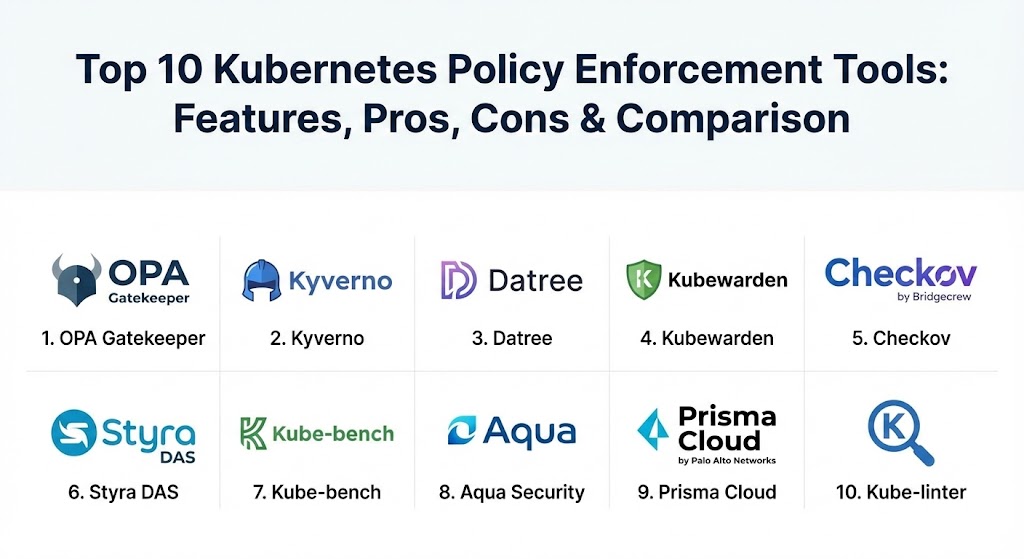
Top 10 Kubernetes Policy Enforcement Tools
1 — OPA Gatekeeper
Gatekeeper is the most widely adopted enterprise-grade policy controller for Kubernetes. It is built on the Open Policy Agent (OPA) engine and uses a purpose-built declarative language called Rego to define and enforce constraints.
- Key features:
- Native integration with Kubernetes via Custom Resource Definitions (CRDs).
- Uses Rego, a powerful and highly flexible declarative policy language.
- Supports “Audit” mode to surface violations in existing resources without blocking them.
- Constraint Templates for creating reusable policy logic across clusters.
- Multi-target support (can enforce policies across K8s and other OPA-integrated services).
- Support for “Dry Run” to test new policies before active enforcement.
- Pros:
- Extremely mature with a massive ecosystem of pre-built policy libraries.
- Decouples policy logic from Kubernetes, allowing the same language for cloud and K8s.
- Cons:
- Rego has a steep learning curve; it is a logic-based language unlike YAML or Python.
- Can become complex to manage at a massive scale without a central management plane.
- Security & compliance: SOC 2 Type II, HIPAA, and GDPR compliant frameworks. Supports SSO and robust audit logging.
- Support & community: Highly active CNCF-graduated project; extensive documentation and enterprise support available through Styra.
2 — Kyverno
Kyverno is a Kubernetes-native policy engine that allows you to write policies entirely in YAML. It is designed specifically for Kubernetes and feels like a natural extension of the platform.
- Key features:
- YAML-based policies: No need to learn a new programming language like Rego.
- Mutation and Generation: Can automatically fix resources or create new ones (e.g., creating a NetworkPolicy for every new Namespace).
- Native integration with Kubernetes RBAC and service accounts.
- Background scanning to detect drift in existing workloads.
- GitOps friendly; policies are managed just like any other K8s manifest.
- Built-in support for image signature verification (Cosign).
- Pros:
- The most developer-friendly tool; if you know K8s, you know Kyverno.
- Exceptional automation capabilities (mutation/generation) that OPA lacks out-of-the-box.
- Cons:
- Limited to Kubernetes; cannot be used for broader cloud or application policies.
- YAML logic can become verbose for extremely complex, nested policy requirements.
- Security & compliance: Integrated with CNCF security standards; supports audit logs and standard compliance reports.
- Support & community: Rapidly growing community; backed by Nirmata with strong open-source documentation.
3 — Datree
Datree is a developer-centric policy enforcement tool that focuses on preventing misconfigurations early in the development lifecycle (Shift-Left). It is often used as a CLI tool or CI/CD plugin.
- Key features:
- 100+ pre-built “best practice” rules for K8s security and reliability.
- Integrated “Policy-as-Code” CLI for local developer testing.
- Dashboard for centralized visibility of policy violations across the organization.
- Custom rule engine using JSON Schema or Rego.
- Seamless integration with GitHub Actions, GitLab CI, and Jenkins.
- Support for Helm, Kustomize, and standard YAML manifests.
- Pros:
- Provides immediate feedback to developers before code reaches the cluster.
- The centralized dashboard makes it easy for management to see compliance scores.
- Cons:
- Primarily a “preventative” tool; less focused on runtime or mutation than OPA/Kyverno.
- Advanced management features require a paid subscription.
- Security & compliance: SOC 2 Type II compliant; focuses on CIS Benchmarks and NSA/CISA hardening.
- Support & community: Excellent onboarding and “Datree University” for learning; responsive customer support.
4 — Kubewarden
Kubewarden is a modern policy engine that uses WebAssembly (Wasm) to execute policies. This allows developers to write policies in almost any language (Go, Rust, Python, etc.) and run them securely in a sandbox.
- Key features:
- Multi-language support: Write policies in C#, Go, Swift, or AssemblyScript.
- Secure, sandboxed execution environment via WebAssembly.
- Integration with existing OPA/Rego policies.
- Distributed as a standard Kubernetes Admission Controller.
- Capability-based security model for the policy engine itself.
- Pros:
- Unmatched flexibility; teams can use their existing language expertise.
- High performance and low overhead due to the nature of Wasm.
- Cons:
- Newer tool in the ecosystem; the community and pre-built library are smaller.
- Wasm-based debugging can be more complex than standard YAML or Rego.
- Security & compliance: ISO 27001 and GDPR ready. Uses OCI registries for secure policy distribution.
- Support & community: Backed by SUSE/Rancher; integrated into the Rancher ecosystem with professional support.
5 — Checkov (by Bridgecrew/Prisma)
Checkov is a static code analysis tool for Infrastructure-as-Code (IaC). It scans Kubernetes manifests, Terraform, and CloudFormation to identify security risks before deployment.
- Key features:
- Over 1,000 pre-built security and compliance policies.
- Scans YAML, Helm charts, and Kustomize templates.
- Integration with Prisma Cloud for unified visibility.
- “Smart Fix” capability to automatically suggest remediation code.
- CLI-based tool that fits perfectly into Git hooks and CI pipelines.
- Pros:
- Incredible breadth; manages policies for K8s, AWS, Azure, and GCP in one tool.
- Highly effective at catching secrets (API keys, passwords) in plain text.
- Cons:
- It is a “scanner,” not an “enforcer”—it doesn’t sit inside the cluster to block manual
kubectlchanges. - False positives can occur in complex, dynamic templates.
- It is a “scanner,” not an “enforcer”—it doesn’t sit inside the cluster to block manual
- Security & compliance: HIPAA, PCI DSS, SOC 2, and NIST compliant policies.
- Support & community: Backed by Palo Alto Networks; massive open-source community and enterprise-grade support.
6 — Styra DAS (Declarative Authorization Service)
Styra DAS is the enterprise management plane for OPA. While OPA is the engine, Styra DAS provides the “control tower” to manage OPA across thousands of clusters.
- Key features:
- Centralized policy authoring and distribution.
- Real-time impact analysis (see how a policy change will affect traffic before committing).
- Compliance reporting for various frameworks (CIS, PCI).
- Integrated lifecycle management for OPA Gatekeeper instances.
- Advanced analytics and decision logging.
- Pros:
- Essential for large enterprises needing a “single pane of glass” for global policies.
- Simplifies Rego authoring with a visual policy builder.
- Cons:
- Commercial product; can be expensive for mid-market or smaller teams.
- Requires the deployment of OPA/Gatekeeper as the underlying enforcement agents.
- Security & compliance: SOC 2 Type II, HIPAA, and GDPR. Offers multi-tenant isolation.
- Support & community: The creators of OPA; world-class support and formal training.
7 — Kube-bench
Kube-bench is a specialized tool that checks whether Kubernetes is deployed securely by running the checks documented in the CIS Kubernetes Benchmark.
- Key features:
- Automated auditing of master nodes and worker nodes.
- Specifically mapped to CIS versioned standards.
- Can be run as a containerized job or a CLI tool.
- Support for managed services like EKS, GKE, and AKS.
- JSON and JUnit output for CI/CD integration.
- Pros:
- The industry standard for initial cluster hardening.
- Provides clear, actionable “PASS/FAIL” results with remediation steps.
- Cons:
- Very narrow focus; it doesn’t enforce custom business policies or runtime behavior.
- Static check; it doesn’t prevent a user from making an insecure change five minutes later.
- Security & compliance: Strictly focused on CIS Benchmarks.
- Support & community: Open-source project by Aqua Security; very widely used with extensive community templates.
8 — Aqua Security / Trivy
Aqua’s security platform (and the open-source tool Trivy) provides a comprehensive suite of security and policy enforcement, moving from image scanning to admission control.
- Key features:
- Vulnerability and misconfiguration scanning for containers and K8s.
- Image Assurance Policies: Block pods from starting if they have “Critical” vulnerabilities.
- Runtime policy enforcement to detect and block suspicious container behavior.
- Integration with K8s Admission Controllers to enforce “scan-before-deploy.”
- Secret scanning and IaC security checks.
- Pros:
- Complete lifecycle protection; it catches risks in the registry, the pipeline, and the cluster.
- Trivy is exceptionally fast and easy to use as a standalone tool.
- Cons:
- The full enterprise platform is a significant investment in both cost and time.
- Policy customization is less flexible than a pure-play engine like OPA.
- Security & compliance: SOC 2, ISO, HIPAA, GDPR, and PCI DSS support.
- Support & community: Strong enterprise support; Trivy is a community favorite with rapid updates.
9 — Prisma Cloud (by Palo Alto Networks)
Prisma Cloud is a Cloud-Native Application Protection Platform (CNAPP) that includes deep Kubernetes policy enforcement as part of its massive feature set.
- Key features:
- Unified policy management across cloud infrastructure and K8s.
- Machine learning-based behavioral monitoring for K8s workloads.
- Automated threat detection and blocking at the network and process level.
- Deep integration with the Checkov policy engine.
- Compliance dashboards for almost every global regulatory framework.
- Pros:
- The most comprehensive tool for organizations with a massive, multi-cloud footprint.
- Consolidates dozens of security categories into one dashboard.
- Cons:
- Overkill for teams that only need Kubernetes policy enforcement.
- High complexity and high cost; typically an executive-level purchase.
- Security & compliance: FedRAMP, SOC 2, HIPAA, GDPR, PCI DSS, and more.
- Support & community: Massive global support network; extensive partner ecosystem.
10 — Kube-linter
Kube-linter is an open-source tool by StackRox (Red Hat) that focuses on identifying misconfigurations in Kubernetes manifests and Helm charts.
- Key features:
- Fast, lightweight static analysis.
- Dozens of built-in checks for security best practices (e.g., dropping capabilities).
- Easy integration into GitOps workflows.
- Customizable rules via a simple configuration file.
- Direct feedback for developers during the “linting” stage.
- Pros:
- Extremely simple to set up; ideal for adding a layer of security to small teams.
- High speed; adds almost zero latency to CI pipelines.
- Cons:
- Like Checkov, it is a static check—it has no “active” presence in the cluster.
- The rule-set is not as expansive as Datree or OPA Gatekeeper.
- Security & compliance: Varies; maps loosely to common security hardening guides.
- Support & community: Backed by Red Hat; reliable documentation but smaller community than OPA.
Comparison Table
| Tool Name | Best For | Platform(s) Supported | Standout Feature | Rating (Gartner Peer Insights) |
| OPA Gatekeeper | Enterprise Governance | Any K8s, Multi-platform | Universal Rego Engine | 4.6 / 5 |
| Kyverno | DevOps / K8s Native | Kubernetes only | YAML-native policies | 4.7 / 5 |
| Datree | Developer Workflow | CI/CD, K8s | Misconfiguration Dashboard | 4.8 / 5 |
| Kubewarden | Modern / Flexible | Any K8s, Wasm | Multi-language (Wasm) | N/A |
| Checkov | IaC Security | K8s, Terraform, Cloud | 1,000+ Pre-built Rules | 4.5 / 5 |
| Styra DAS | Multi-cluster Mgmt | Enterprise OPA/K8s | Impact Analysis (Preview) | 4.4 / 5 |
| Kube-bench | Cluster Hardening | Master/Worker Nodes | CIS Benchmark Mapping | 4.5 / 5 |
| Aqua Security | End-to-End Security | Cloud, K8s, Registry | Vulnerability-Gatekeeping | 4.3 / 5 |
| Prisma Cloud | Multi-Cloud/CNAPP | AWS, Azure, GCP, K8s | Holistic Cloud Defense | 4.2 / 5 |
| Kube-linter | Fast Static Checks | Manifests, Helm | Lightweight Linting | N/A |
Evaluation & Scoring of Kubernetes Policy Enforcement Tools
To help you objectively compare these tools, we have evaluated them using a weighted scoring rubric based on industry requirements for 2026.
| Category | Weight | Evaluation Focus |
| Core Features | 25% | Admission control, mutation, generation, and compliance mapping. |
| Ease of Use | 15% | Complexity of the policy language and speed of initial setup. |
| Integrations | 15% | Support for CI/CD, GitOps, Helm, and cloud providers. |
| Security & Compliance | 10% | Encryption, SSO, and mapping to frameworks like SOC 2 or HIPAA. |
| Performance | 10% | Latency added to the K8s API server and resource overhead. |
| Support & Community | 10% | Availability of pre-built rules and community/vendor help. |
| Price / Value | 15% | Total cost of ownership vs. risk reduction. |
Which Kubernetes Policy Enforcement Tool Is Right for You?
The “best” tool depends largely on your team’s existing skill set and the scale of your operations.
- Solo Users & Small Teams: Start with Kyverno or Datree. Kyverno allows you to use your existing YAML knowledge to lock down your cluster, while Datree provides immediate feedback in your terminal or CI/CD without needing a complex setup.
- Mid-Market Enterprises: If you are managing 5–10 clusters, OPA Gatekeeper is the strategic choice. It provides the most robust governance framework and ensures you aren’t locked into a single-vendor solution.
- Large-Scale Enterprise: Organizations with 50+ clusters across multiple regions should look at Styra DAS or Prisma Cloud. These platforms provide the centralized visibility and reporting required for executive oversight and global compliance.
- Security-First Organizations: If your primary concern is high-risk vulnerabilities, Aqua Security or Trivy is the winner. Their ability to block deployments based on real-time vulnerability data from container images is a critical layer of defense.
- Budget-Conscious: You can build a world-class policy engine using only open-source tools. A combination of Kube-bench (for hardening), Checkov (for the pipeline), and Kyverno (for the cluster) provides 90% of enterprise features at zero software cost.
Frequently Asked Questions (FAQs)
1. What is a Kubernetes Admission Controller? It is a piece of code that intercepts requests to the Kubernetes API server prior to persistence of the object, but after the request is authenticated and authorized. Policy tools use this to validate or modify requests.
2. Is YAML better than Rego for writing policies? YAML (used by Kyverno) is easier to learn and faster to implement for simple K8s rules. Rego (used by OPA) is more powerful for complex logical operations and can be used across your entire tech stack, not just Kubernetes.
3. Do policy enforcement tools slow down my cluster? If a tool has poorly written policies, it can add latency to kubectl apply commands. However, most modern tools like Kyverno and Gatekeeper add negligible overhead (often <50ms) per request.
4. Can these tools fix security issues automatically? Yes. Tools like Kyverno and OPA Gatekeeper support “mutation,” where they can automatically inject missing labels, resource limits, or security contexts into a resource as it is being deployed.
5. What is “Shift-Left” in Kubernetes policy? It refers to moving policy checks as far “left” in the development cycle as possible—meaning checking for security errors in the developer’s IDE or CI/CD pipeline before the code ever reaches a cluster.
6. Do I need these tools if I have RBAC? Yes. RBAC controls who can do something, but policy enforcement controls what they can do. For example, RBAC allows a user to deploy a Pod, but a policy tool ensures that Pod isn’t running as root.
7. Can these tools manage multi-cloud environments? OPA Gatekeeper and Prisma Cloud are excellent for multi-cloud. Since OPA is general-purpose, you can use the same Rego policies for your AWS infrastructure and your Kubernetes clusters.
8. Are there free versions of these tools? Most of the top tools (Kyverno, Gatekeeper, Trivy, Checkov, Kube-bench) are open-source and free to use. Commercial versions (Styra, Aqua, Prisma) add management, dashboards, and support.
9. What is the CIS Kubernetes Benchmark? It is a set of best practices for securing Kubernetes clusters, created by the Center for Internet Security. Tools like Kube-bench check your cluster against these specific rules.
10. Can I use multiple policy tools at once? Yes, it is common to use Checkov in the pipeline for static scanning and Kyverno or Gatekeeper in the cluster for runtime admission control. This provides “defense in depth.”
Conclusion
In 2026, Kubernetes policy enforcement is no longer optional—it is foundational. Whether you prioritize the ease of Kyverno’s YAML-native approach, the cross-platform power of OPA Gatekeeper, or the developer-first simplicity of Datree, the goal remains the same: ensuring your cluster is secure by design. The best strategy is to start small with a few “must-have” rules (like blocking root users) and gradually expand your policy library as your team’s comfort level grows.
Kubernetes policy enforcement now uses automated, real-time guardrails to catch misconfigurations before they reach your clusters. The contrast between OPA Gatekeeper’s universal reach and Kyverno’s Kubernetes-native approach highlights the “shift left” security trend. This guide is a solid resource for maintaining strict compliance without slowing down the CI/CD pipeline.