Introduction
SSL/TLS Certificate Authorities Tooling serves as the central nervous system for Public Key Infrastructure (PKI). At its core, this tooling facilitates the entire lifecycle of a digital certificate: from the initial Certificate Signing Request (CSR) and validation by a trusted CA to deployment, renewal, and eventual revocation. As the industry moves toward shorter certificate lifespans (shifting from years to 90-day cycles), manual management via spreadsheets is no longer a viable strategy.
The importance of these tools cannot be overstated. They act as a safeguard against data interception (Man-in-the-Middle attacks) and provide “Machine Identity Management”—a critical security pillar in the age of cloud-native applications and IoT. Real-world use cases include securing e-commerce transactions, encrypting internal microservices communication, and providing secure authentication for thousands of remote employees via VPNs. When evaluating these tools, organizations should prioritize automation capabilities (ACME support), discovery features (finding “rogue” certificates), crypto-agility, and vendor-agnosticism.
Best for: Security architects, PKI administrators, and DevOps teams in mid-to-large enterprises. Industries such as financial services, healthcare, and government agencies—where compliance and uptime are mission-critical—benefit most from these automated systems.
Not ideal for: Small personal blogs or very early-stage startups with a single domain. For these users, basic hosting-provided certificates or simple manual Let’s Encrypt scripts are usually sufficient, as the overhead of a full CLM platform would outweigh the benefits.
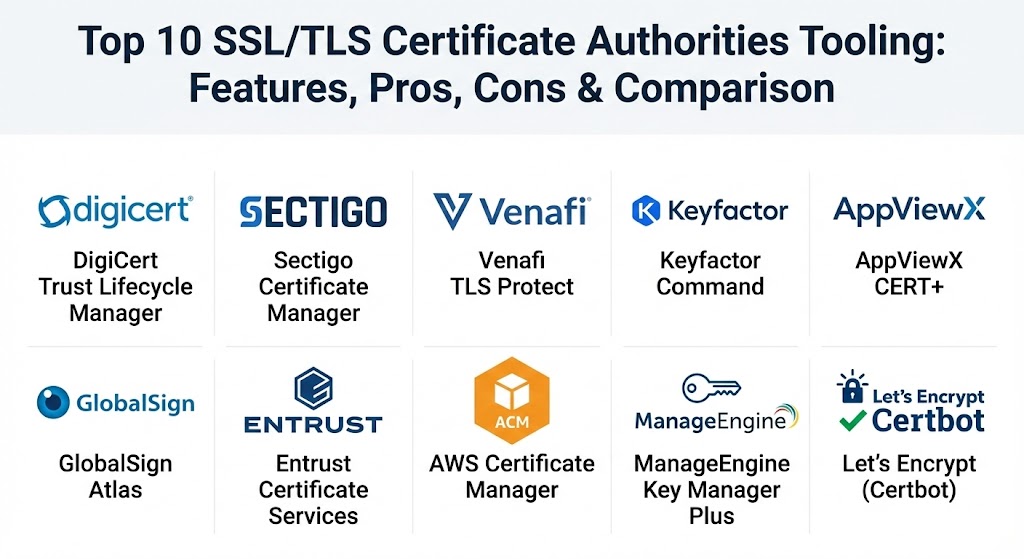
Top 10 SSL/TLS Certificate Authorities Tooling Tools
1 — DigiCert Trust Lifecycle Manager
DigiCert is widely recognized as a market leader in the CA space, and its Trust Lifecycle Manager is a comprehensive platform that combines CA-agnostic certificate management with DigiCert’s own high-assurance public and private trust. It is designed for large-scale digital trust across entire enterprise environments.
- Key features:
- Centralized management of public and private PKI.
- CA-agnostic discovery that finds certificates issued by other vendors.
- Full automation via ACME, SCEP, and EST protocols.
- Granular role-based access control (RBAC) for large teams.
- Integrated with the DigiCert ONE platform for unified digital trust.
- Specialized modules for IoT and code signing management.
- Pros:
- Highly reliable global infrastructure with unmatched root ubiquity.
- Excellent visibility into certificate expiration and compliance status.
- Cons:
- Premium pricing can be high for smaller organizations.
- The platform’s breadth can lead to a significant learning curve for new admins.
- Security & compliance: SOC 2 Type II, WebTrust audited, GDPR, HIPAA, and FIPS 140-2 Level 3 HSM support.
- Support & community: 24/7 global premium support; extensive knowledge base and enterprise-level onboarding services.
2 — Sectigo Certificate Manager (SCM)
Sectigo Certificate Manager is a cloud-based platform that offers a single point of control for all digital certificates within an organization. It is praised for its automation depth and its ability to handle complex hybrid environments.
- Key features:
- “Zero-touch” automation for certificate issuance and installation.
- Support for multi-cloud environments (AWS, Azure, Google Cloud).
- Comprehensive reporting and audit trails for compliance validation.
- Advanced discovery tools to eliminate unmanaged or “rogue” certs.
- Integration with popular DevOps tools like Terraform and Ansible.
- Automated revocation and re-issuance workflows.
- Pros:
- Very strong automation capabilities that significantly reduce manual labor.
- User-friendly dashboard that provides a clear “health score” of the certificate fleet.
- Cons:
- Support response times can vary depending on the service tier.
- Initial configuration of discovery agents in complex networks can be tricky.
- Security & compliance: ISO 27001, WebTrust, SOC 2, and HIPAA readiness. Supports SSO via SAML.
- Support & community: Multi-tiered support (Silver/Gold/Platinum); active technical webinars and a dedicated customer success portal.
3 — Venafi TLS Protect
Venafi is often considered the pioneer of machine identity management. Its TLS Protect solution is designed for global enterprises that need to secure thousands of certificates across diverse infrastructures, including containers and Kubernetes.
- Key features:
- Unrivaled “Crypto-Agility” tools for rapid certificate replacement.
- Deep integration with Kubernetes via Jetstack Secure.
- Automated policy enforcement to prevent weak algorithm usage.
- Advanced “Avenue” discovery for finding certificates in hidden network segments.
- Self-service portal for developers to request certificates securely.
- High-availability architecture for mission-critical environments.
- Pros:
- The most mature platform for managing machine identities at extreme scale.
- Exceptional visibility into the “Chain of Trust” for every certificate.
- Cons:
- Primarily targeted at very large enterprises; may be overkill for mid-market firms.
- Implementation often requires significant professional services for full value.
- Security & compliance: FIPS 140-2, SOC 2, HIPAA, and GDPR compliant. Deep HSM integration support.
- Support & community: High-end enterprise support; strong community presence via the “Venafi Warrior” program.
4 — Keyfactor Command
Keyfactor Command focuses on making PKI and certificate management “straightforward.” It provides a unified view of every certificate across public and private CAs, including in-house Microsoft CAs and cloud-native trust.
- Key features:
- Continuous discovery and monitoring of all endpoints.
- One-click renewal and automated provisioning to web servers.
- Integrated “EJBCA Enterprise” for powerful private CA capabilities.
- Real-time alerts for impending expirations and policy violations.
- Extensive API library for custom infrastructure integrations.
- Post-quantum cryptography (PQC) readiness tools.
- Pros:
- Exceptionally intuitive user interface compared to traditional PKI tools.
- Highly scalable; able to handle millions of certificates without performance lag.
- Cons:
- Full automation features require more complex orchestrator installations.
- Documentation for niche integrations can sometimes be sparse.
- Security & compliance: SOC 2 Type II, ISO 27001, and Common Criteria certified. Supports SSO and audit logging.
- Support & community: Responsive technical support team; active participation in industry PQC standards.
5 — AppViewX CERT+
AppViewX CERT+ is a modular platform designed for end-to-end certificate lifecycle automation. It is unique in its “low-code” approach, allowing users to build complex certificate workflows with minimal scripting.
- Key features:
- Visual workflow designer for drag-and-drop automation.
- “Smart Discovery” using multiple scanning techniques.
- Native integration with F5, Citrix, and major ADC vendors.
- Role-based self-service for various business units.
- Cloud-native deployment (SaaS or on-premise containers).
- Integrated SSH key management module.
- Pros:
- The low-code interface is a major differentiator for teams without deep PKI expertise.
- Excellent at managing certificates on load balancers and network appliances.
- Cons:
- The browser-based UI can occasionally be slow with very large datasets.
- Some advanced reporting features require custom configuration.
- Security & compliance: SOC 2, HIPAA, and GDPR compliant. Includes detailed audit logs and RBAC.
- Support & community: 24/7 technical support; provide comprehensive training modules for new users.
6 — GlobalSign Atlas
GlobalSign is one of the world’s most trusted CAs, and Atlas is its high-throughput, cloud-based platform. It is engineered for the modern era of speed and automation, particularly for DevOps and high-volume IoT needs.
- Key features:
- RESTful APIs designed for high-frequency certificate issuance.
- Automated deployment via ACME and Microsoft AD integrations.
- Unified dashboard for both public and private PKI needs.
- Specialized “IoT Identity Platform” for massive-scale device security.
- Zero-footprint cloud architecture (SaaS-only).
- Fast validation processes to speed up certificate issuance.
- Pros:
- Extremely fast issuance times, making it ideal for CI/CD pipelines.
- Very reliable uptime and low latency for global operations.
- Cons:
- Being a SaaS-only model, it might not suit air-gapped or high-security on-prem needs.
- Fewer “CLM-only” features compared to vendor-agnostic platforms like Venafi.
- Security & compliance: WebTrust audited, ISO 27001, and SOC 2. Data residency options available for EU/Asia.
- Support & community: Solid documentation; localized support in multiple languages.
7 — Entrust Certificate Services
Entrust is a veteran in the security space, and its Certificate Services platform offers a robust cloud-based portal for managing SSL/TLS certificates across multiple servers and domains.
- Key features:
- “Flexible Licensing” models that allow for easy re-allocation of certs.
- Automated domain validation and instant issuance for pre-approved domains.
- Centralized monitoring of third-party certificates.
- Integrated vulnerability scanning for websites.
- Mobile app for monitoring certificate health on the go.
- Robust reporting tools for executive-level compliance reviews.
- Pros:
- Excellent customer service with dedicated account managers for large clients.
- Reliable, high-assurance CA foundation with a strong brand reputation.
- Cons:
- The interface feels more traditional and less “DevOps-native” than some competitors.
- Automation features for cloud-native stacks (like K8s) are not as deep.
- Security & compliance: WebTrust, FIPS 140-2 Level 3, SOC 2, and HIPAA compliant.
- Support & community: 24/5 and 24/7 support options; high-quality technical whitepapers and webinars.
8 — AWS Certificate Manager (ACM)
For organizations running entirely or primarily on Amazon Web Services, ACM is the default choice. It provides a seamless way to provision and manage certificates for AWS resources.
- Key features:
- Seamless integration with CloudFront, ELB, and API Gateway.
- Automated renewal for all ACM-issued certificates.
- ACM Private CA for creating internal PKI within AWS.
- No additional cost for public certificates used with AWS services.
- Integrated with AWS Config for compliance monitoring.
- Support for importing third-party certificates into the AWS ecosystem.
- Pros:
- Absolute simplicity for AWS users; renewals are literally “set and forget.”
- Zero cost for public SSL/TLS certificates (when used with AWS load balancers/CDNs).
- Cons:
- Very limited functionality for on-premise or multi-cloud environments.
- Certificates cannot be exported; they must be used within the AWS network.
- Security & compliance: Fully compliant with all major AWS standards (SOC, PCI, HIPAA).
- Support & community: Integrated with AWS Support; massive community of AWS developers for troubleshooting.
9 — ManageEngine Key Manager Plus
ManageEngine is known for its practical IT management tools. Key Manager Plus is a web-based tool that focuses on the visibility and management of both digital certificates and SSH keys.
- Key features:
- Automated discovery of certificates across the network.
- Tracking of SSL/TLS certificate expirations with multi-channel alerts.
- Centralized repository for all certificates and private keys.
- Integration with Let’s Encrypt for automated free certificates.
- CSR generation and certificate deployment automation.
- Comprehensive audit logs for every user action.
- Pros:
- One of the most affordable options for mid-market organizations.
- Very broad platform support, including Windows and various Linux distros.
- Cons:
- Automation logic is not as sophisticated as enterprise-grade CLM tools.
- Lacks its own public CA trust; acts purely as a management layer.
- Security & compliance: GDPR and HIPAA readiness features; supports MFA and SSO.
- Support & community: Extensive self-help resources; active user forums and responsive email support.
10 — Let’s Encrypt (Certbot / ACME Tooling)
While Let’s Encrypt is a CA, the “tooling” aspect (primarily Certbot and various ACME clients) is the backbone of the automated internet. It is the de-facto standard for free, automated certificate issuance.
- Key features:
- Native ACME protocol support for fully automated renewals.
- Lightweight clients (Certbot) for almost every OS.
- Automated DNS-01 and HTTP-01 validation challenges.
- Wildcard certificate support.
- Massive ecosystem of plugins for web servers (Nginx, Apache).
- Integration into almost every modern cloud hosting control panel.
- Pros:
- Completely free of charge, regardless of the number of certificates.
- Has forced the entire industry toward better automation and security standards.
- Cons:
- No support for Organization Validation (OV) or Extended Validation (EV) certs.
- Lacks a centralized “enterprise dashboard” for monitoring disparate servers.
- Security & compliance: Domain Validation (DV) only; highly secure but lacks organizational identity verification.
- Support & community: Peer-to-peer community support via the Let’s Encrypt Community forum; no official enterprise SLA.
Comparison Table
| Tool Name | Best For | Platform(s) Supported | Standout Feature | Rating (Gartner/G2) |
| DigiCert Trust Lifecycle Manager | Global Digital Trust | Cloud, On-Prem, IoT | Unified Trust Platform | 4.8 / 5 |
| Sectigo Certificate Manager | Automation-First Firms | Cloud, Hybrid | Zero-Touch Automation | 4.6 / 5 |
| Venafi TLS Protect | Massive Scaling / K8s | Global Enterprise | Jetstack K8s Integration | 4.7 / 5 |
| Keyfactor Command | Simplifying Complex PKI | Cloud, Hybrid | Intuitive PQC Readiness | 4.7 / 5 |
| AppViewX CERT+ | Network/Appliance Mgmt | Cloud, On-Prem | Low-Code Workflow Engine | 4.5 / 5 |
| GlobalSign Atlas | DevOps & IoT Speed | SaaS Only | High-Throughput APIs | 4.4 / 5 |
| Entrust Certificate Services | High-Assurance Needs | Cloud, Hybrid | Flexible Licensing Model | 4.3 / 5 |
| AWS Certificate Manager | AWS-Centric Orgs | AWS Cloud | Seamless AWS Integration | 4.6 / 5 |
| ManageEngine Key Mgr Plus | SMB Budget/Simplicity | Windows, Linux | SSH + SSL Combo Mgmt | 4.2 / 5 |
| Let’s Encrypt (Certbot) | Open Source / Devs | All Major OS | Completely Free/Open | 4.8 / 5 |
Evaluation & Scoring of SSL/TLS Certificate Authorities Tooling
The following scoring rubric evaluates the effectiveness of these tools based on weighted criteria relevant to modern enterprise environments in 2026.
| Tool Name | Core Features (25%) | Ease of Use (15%) | Integrations (15%) | Security & Comp. (10%) | Performance (10%) | Support (10%) | Value (15%) | Total Score |
| DigiCert | 9.5 | 8.0 | 9.0 | 9.8 | 9.5 | 9.5 | 8.0 | 9.1 |
| Venafi | 9.8 | 7.5 | 9.5 | 9.8 | 9.8 | 9.0 | 7.0 | 8.9 |
| Keyfactor | 9.0 | 9.0 | 8.5 | 9.2 | 9.2 | 9.0 | 8.5 | 8.9 |
| Sectigo | 9.0 | 8.5 | 8.5 | 9.2 | 9.0 | 8.0 | 8.8 | 8.7 |
| AppViewX | 8.8 | 9.2 | 8.8 | 8.5 | 8.5 | 8.5 | 8.5 | 8.7 |
| Entrust | 8.5 | 8.0 | 8.0 | 9.5 | 9.0 | 9.2 | 7.5 | 8.4 |
| GlobalSign | 8.2 | 8.5 | 9.0 | 9.0 | 9.5 | 8.0 | 8.0 | 8.5 |
| AWS ACM | 7.0 | 9.8 | 6.0 | 9.5 | 9.8 | 8.5 | 9.5 | 8.3 |
| ManageEngine | 7.5 | 8.5 | 7.0 | 8.0 | 8.0 | 8.0 | 9.2 | 7.9 |
| Let’s Encrypt | 6.0 | 8.0 | 9.5 | 8.5 | 9.8 | 5.0 | 10.0 | 7.8 |
Which SSL/TLS Certificate Authorities Tooling Tool Is Right for You?
Selecting the right tooling is a balance of your current infrastructure, your compliance burden, and the technical maturity of your team.
Solo Users vs SMB vs Mid-Market vs Enterprise
- Solo Users/Developers: If you are managing a single server or a portfolio of personal projects, stick with Let’s Encrypt and Certbot. There is no reason to pay for tooling at this scale.
- SMBs: Organizations with 50-200 certificates should look at ManageEngine Key Manager Plus or AWS ACM (if in the cloud). These provide visibility without the six-figure price tags of enterprise CLM.
- Mid-Market: Growing firms with hybrid infrastructures benefit from AppViewX CERT+ or Keyfactor Command. The intuitive UIs help smaller teams manage increasing complexity.
- Enterprise: Global organizations with compliance requirements (PCI, HIPAA, etc.) should choose between DigiCert, Sectigo, or Venafi. These offer the discovery tools needed to pass rigorous audits.
Budget-Conscious vs Premium Solutions
If budget is the primary driver, Let’s Encrypt (Free) or AWS ACM (Free for public certs) are the winners. However, “free” often comes with the “cost” of manual oversight. Premium solutions like Venafi or DigiCert provide insurance against multimillion-dollar outages, making them a “value” play for large brands.
Feature Depth vs Ease of Use
If your team lacks deep PKI experts, avoid Venafi and go for AppViewX or Keyfactor. They prioritize user experience. If you have a dedicated security team, the depth of Venafi’s policy engine is unmatched.
Integration and Scalability Needs
For Kubernetes and cloud-native environments, Venafi (via Jetstack) and Sectigo have the deepest roots. For traditional networking (F5/Citrix), AppViewX is often the preferred choice.
Frequently Asked Questions (FAQs)
1. What is the difference between a CA and a CLM tool?
A Certificate Authority (CA) is the entity that issues the certificate (the “notary”). Certificate Lifecycle Management (CLM) tooling is the software that manages those certificates across your servers (the “filing cabinet and alarm system”).
2. Why are 90-day certificates becoming the new standard?
The industry (led by Google) is pushing for 90-day lifespans to improve security by forcing regular key rotation and reducing the window of time a compromised certificate can be used. This makes automation tools essential.
3. Do I still need an HSM if I use cloud-based CLM tooling?
Yes, if you are an enterprise. Hardware Security Modules (HSMs) are used to store the private keys of your Root and Issuing CAs. Most modern CLM tools integrate directly with cloud HSMs (like Azure or AWS HSM).
4. Can one tool manage certificates from different authorities?
Yes, this is called “CA-agnostic management.” Tools like Keyfactor, Venafi, and Sectigo can manage certificates from DigiCert, GlobalSign, and Let’s Encrypt all in one dashboard.
5. How do discovery tools find “rogue” certificates?
They scan network ranges and ports (like 443) for active TLS handshakes, or they monitor Certificate Transparency (CT) logs to see every certificate issued to your domains in real-time.
6. Is AWS Certificate Manager (ACM) enough for my hybrid network?
Usually no. ACM is great for AWS, but it cannot manage certificates on your on-premise Apache servers or in another cloud provider like Azure. You would need a vendor-agnostic tool for that.
7. What is “Crypto-Agility”?
It is the ability of an organization to quickly replace all its certificates and shift to a new algorithm (like moving from RSA to ECC or Post-Quantum Cryptography) in response to a newly discovered vulnerability.
8. Do these tools help with HIPAA or PCI compliance?
Yes. Compliance requires proving that all data is encrypted. These tools provide the audit logs and “proof of encryption” dashboards that auditors look for.
9. Can I automate certificates for internal-only servers?
Yes. You can use a private CA (like Microsoft CA or EJBCA) and manage it through these tools using protocols like SCEP or ACME to automate internal servers without paying for public trust.
10. What is a common mistake when implementing CLM tooling?
The most common mistake is failing to include “discovery” in the initial phase. If you don’t know where all your certificates are, you can’t manage them, leading to surprise outages even after you buy the software.
Conclusion
The evolution of SSL/TLS Certificate Authorities Tooling has transitioned from a “nice-to-have” monitoring utility to a mandatory pillar of enterprise security. As certificate lifespans continue to shrink and the number of machine identities explodes due to IoT and microservices, the risk of manual error has reached a breaking point.
When choosing the “best” tool, remember that it is not about the brand of the certificate alone, but the orchestration and visibility provided by the platform. For pure simplicity in the cloud, AWS ACM is excellent; for the absolute highest levels of global digital trust and high-assurance automation, DigiCert Trust Lifecycle Manager and Venafi remain the industry benchmarks. Ultimately, the right solution is one that scales with your infrastructure and provides the “crypto-agility” needed to navigate the security threats of 2026 and beyond.
