Introduction
A domain registration platform, commonly known as a domain registrar, is an ICANN-accredited entity that manages the reservation of internet domain names. These platforms provide the interface through which you can search for, purchase, and manage your domain’s DNS settings. They act as the link between you and the central registry for various top-level domains (TLDs) like .com, .net, or niche extensions like .ai and .tech.
Choosing the right platform is vital because a poor choice can lead to hidden renewal fees, aggressive upselling of unnecessary services, and complex transfer processes that feel like a hostage situation. Real-world use cases range from a solo blogger securing their personal brand to a global corporation managing a portfolio of thousands of defensive domains to prevent brand spoofing. When evaluating these tools, users should look for pricing transparency (registration vs. renewal costs), the inclusion of WHOIS privacy protection, the robustness of security features like DNSSEC and two-factor authentication (2FA), and the quality of customer support.
Best for: Small business owners, digital marketers, software developers, and enterprise IT managers who need reliable, secure, and manageable control over their digital addresses. It is ideal for anyone looking to establish a long-term online presence with stable DNS infrastructure.
Not ideal for: Users who are strictly looking for a one-time, temporary landing page where the brand name is irrelevant, or individuals who prefer to use free subdomains provided by social media platforms or basic “link-in-bio” tools.
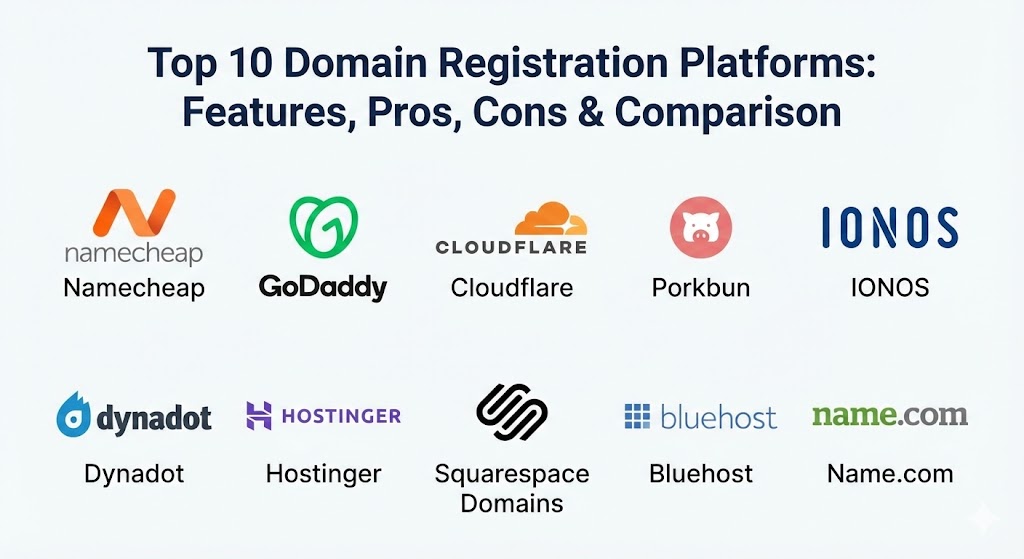
Top 10 Domain Registration Platforms
1 — Namecheap
Namecheap has long been a favorite in the tech community for its balance of affordability and ethical business practices. In 2026, it remains a top contender by offering a streamlined interface that avoids the cluttered, aggressive sales tactics common in the industry. It is designed for everyone from first-time site owners to experienced developers who manage hundreds of domains.
- Key features:
- Free Domain Privacy (WHOIS) for life on all eligible domains.
- Integrated AI-powered domain name generator for brainstorming.
- Support for specialized Handshake (decentralized) domains.
- Bulk domain management and search tools.
- High-level security including DNSSEC and 2FA.
- User-friendly “Standard” and “Advanced” DNS management views.
- One-click integration with major hosting and email providers.
- Pros:
- Exceptionally transparent pricing with no hidden “first-year-only” traps.
- One of the most intuitive and modern user interfaces in the registrar market.
- Cons:
- Some advanced TLDs can be more expensive than niche-specific registrars.
- Customer support is primarily chat-based; no direct phone support is available.
- Security & compliance: GDPR compliant, supports 2FA (U2F/TOTP), SSL certificates available, and offers domain vault protection for high-value assets.
- Support & community: 24/7 live chat support, extensive knowledge base with video tutorials, and a highly active community blog.
2 — GoDaddy
As the world’s largest domain registrar, GoDaddy is a household name that offers an all-in-one ecosystem for getting online. In 2026, they have pivoted heavily toward AI with their “Airo” platform, which helps users not just register a name, but launch a full business presence including a logo and a basic site in minutes.
- Key features:
- Massive inventory of TLDs and a robust domain auction marketplace.
- AI-driven “Airo” tool for automatic website and social media post generation.
- Comprehensive domain brokerage services for acquiring taken names.
- Bundled services including hosting, email marketing, and professional logos.
- Free domain privacy included with most new registrations.
- Mobile app for managing domain portfolios on the go.
- Integrated digital payment links for domain owners without full sites.
- Pros:
- Unmatched 24/7 phone support, which is a lifesaver for non-technical users.
- The most powerful secondary market (auctions) for buying and selling premium domains.
- Cons:
- Renewal rates are significantly higher than initial promotional prices.
- The dashboard can feel overwhelming due to the sheer number of upsell offers.
- Security & compliance: ISO 27001 certified, SOC 2 compliant, offers advanced “Domain Protection” plans to prevent unauthorized transfers.
- Support & community: 24/7 phone, chat, and text support; extensive global community with local language assistance in dozens of countries.
3 — Cloudflare
Cloudflare revolutionized the registrar space by offering “at-cost” pricing. They don’t charge any markup over what the central registry charges them, making them arguably the most cost-effective registrar for long-term owners. It is designed for security-conscious users who want an enterprise-grade backbone.
- Key features:
- Zero-markup pricing for all domain registrations and renewals.
- Enterprise-grade DNS with one of the fastest propagation speeds globally.
- Automatic DNSSEC and WHOIS privacy included for free.
- Built-in DDoS protection and CDN integration.
- API-first approach for automated domain management.
- Advanced “Custom Hostname” configurations for SaaS providers.
- Pros:
- The absolute lowest long-term cost for domain renewals.
- Security features that are usually paid add-ons elsewhere are standard here.
- Cons:
- Does not support all niche TLDs; focus is on the most popular extensions.
- You must use Cloudflare’s nameservers, which might not suit all technical setups.
- Security & compliance: SOC 2 Type II, GDPR, PCI DSS compliant; industry-leading security defaults.
- Support & community: Robust documentation and community forums; ticket-based support for free users, with dedicated support for enterprise tiers.
4 — Porkbun
Porkbun has built a cult following thanks to its quirky branding and incredibly straightforward, “no-nonsense” approach to domain registration. They prioritize a clean user experience and flat, honest pricing that includes all the extras by default.
- Key features:
- Flat-rate pricing with no hidden renewal hikes.
- Free WHOIS privacy, SSL certificates, and email forwarding included.
- Advanced search filters to find the perfect TLD among 500+ options.
- 2FA support via apps and physical security keys.
- Easy-to-use API for developers.
- Simple “link” feature to connect domains to platforms like Wix or Shopify.
- Pros:
- Highly rated for transparency and ease of use; what you see is what you pay.
- Excellent security defaults that don’t cost an extra penny.
- Cons:
- The interface, while clean, is quite basic and lacks some enterprise-level portfolio tools.
- Marketing and site design may feel “unprofessional” to some corporate buyers.
- Security & compliance: Supports WebAuthn, 2FA, and DNSSEC; fully GDPR compliant.
- Support & community: Highly responsive email and live chat support (during business hours); very high customer satisfaction scores.
5 — IONOS
IONOS (by 1&1) is a European giant that specializes in high-value bundles. They are particularly known for their “Personal Consultant” model, where a specific support agent is assigned to help a business grow its online presence.
- Key features:
- Aggressive $1/first-year promotional pricing for .com and .biz.
- Dedicated Personal Consultant for one-on-one business guidance.
- Bundled professional email and SSL certificates.
- Geo-redundant DNS for maximum uptime.
- Deep integration with IONOS hosting and VPS solutions.
- Simple domain transfer wizard for moving from other registrars.
- Pros:
- Best-in-class phone support with a personalized touch.
- Excellent value for those looking to bundle domains with web hosting.
- Cons:
- Renewal rates jump significantly after the initial promotional period.
- The administrative interface can be complex and slightly dated.
- Security & compliance: ISO 27001 certified, GDPR compliant, provides robust DDoS protection.
- Support & community: 24/7 phone support with a dedicated personal advisor; extensive help center.
6 — Dynadot
Dynadot is a favorite among domain investors (domainers) and technical professionals. It offers a powerful, sleek dashboard that makes managing a large portfolio of domains feel effortless. They are known for their transparency and excellent bulk-action tools.
- Key features:
- Transparent “Price List” showing registration, renewal, and transfer costs upfront.
- Built-in domain auction and aftermarket marketplace.
- Advanced “Portfolio Manager” for bulk DNS and contact updates.
- Free website builder included with every domain.
- Graceful expired domain deletion and recovery tools.
- Multi-currency and multi-language support.
- Pros:
- Some of the most competitive pricing for niche and international TLDs.
- A professional-grade interface that doesn’t waste space with ads.
- Cons:
- Live chat support is sometimes restricted to specific hours.
- Less focus on beginners who need “hand-holding” through the setup process.
- Security & compliance: Supports 2FA (Google Authenticator/SMS), domain locking, and DNSSEC.
- Support & community: Comprehensive help center and forum; chat and email support are efficient and technical.
7 — Hostinger
Hostinger has exploded in popularity as a hosting provider, but their domain registration service is equally compelling, especially for those using their website builder. They offer an exceptionally modern, “H-Panel” dashboard that simplifies DNS management.
- Key features:
- One-click domain setup for Hostinger’s hosting and builder products.
- Free domain included for the first year with most hosting plans.
- Intuitive “H-Panel” dashboard for domain and DNS control.
- Localized support and pricing in dozens of countries.
- Simple domain transfer and auto-renewal toggles.
- Pros:
- One of the fastest and most modern-feeling user interfaces in 2026.
- Excellent choice for beginners who want a unified dashboard for their entire site.
- Cons:
- Standalone domain pricing is slightly higher if not bundled with hosting.
- Customer support is chat-only (though very fast).
- Security & compliance: GDPR compliant, offers 2FA and internal security audits.
- Support & community: 24/7 live chat with very low wait times; extensive “Hostinger Academy” tutorials.
8 — Squarespace Domains
Following its acquisition of Google Domains, Squarespace has become a major player in the registrar market. They have maintained much of the simplicity that made Google Domains popular while integrating it into the Squarespace design ecosystem.
- Key features:
- Exceptionally clean and minimalistic management interface.
- Seamless integration with Squarespace’s award-winning website builder.
- Free WHOIS privacy included for all eligible domains.
- Simple Google Workspace (formerly G Suite) integration.
- One-click DNS templates for popular web services.
- Pros:
- Probably the easiest-to-use registrar for people who value aesthetic and simplicity.
- Transparent, flat pricing with no confusing tiers.
- Cons:
- Lacks some of the advanced DNS and bulk tools that technical users or domainers require.
- Support response times can be slower than dedicated registrars during peak hours.
- Security & compliance: SOC 2 compliant, supports 2FA, and follows strict data privacy guidelines.
- Support & community: 24/7 email support and live chat; high-quality documentation.
9 — Bluehost
Bluehost is synonymous with WordPress. As one of the officially recommended hosts by WordPress.org, their domain services are heavily optimized for users starting blogs or business sites using the world’s most popular CMS.
- Key features:
- Automatic WordPress integration and domain mapping.
- Free domain for the first year with any hosting purchase.
- Centralized dashboard for domain, hosting, and email.
- Domain lock and auto-renewal features for security.
- Expert-led “Blue Sky” support for site-building help.
- Pros:
- The gold standard for WordPress beginners; everything is pre-configured.
- Excellent phone support for troubleshooting setup issues.
- Cons:
- Standalone domain pricing is not the most competitive in the market.
- WHOIS privacy is often a paid add-on depending on the plan.
- Security & compliance: SiteLock security available, SSL certificates included, GDPR compliant.
- Support & community: 24/7 phone and chat support; massive community of WordPress users and developers.
10 — Name.com
Name.com is a veteran in the space that has managed to stay relevant by focusing on a “developer-first” mentality. They offer a great balance of professional tools and a friendly, approachable brand identity.
- Key features:
- “Domain Grabber” tool for back-ordering expired domains.
- Google Workspace and Microsoft 365 integrated directly.
- Free DNS templates for quick setup with various hosting providers.
- Advanced API for custom domain automation.
- Branded URL shortener included for some extensions.
- Pros:
- Solid reputation for stability and “no-nonsense” technical support.
- Very clean DNS management interface that power users appreciate.
- Cons:
- WHOIS privacy is not always free (often requires a promo code or specific plan).
- Initial pricing can be slightly higher than budget leaders like Namecheap.
- Security & compliance: Two-step verification, domain locking, and high-level data encryption.
- Support & community: Reliable ticket and chat support; active community through the “Name.com Knowledge Base.”
Comparison Table
| Tool Name | Best For | Platform(s) Supported | Standout Feature | Rating (Gartner / G2 / etc.) |
| Namecheap | Value & Beginners | Web, Mobile | Lifetime Free Privacy | 4.6 / 5 (G2) |
| GoDaddy | One-Stop Shop | Web, App, AI | AI “Airo” Site Launch | 4.3 / 5 (Gartner) |
| Cloudflare | Security & At-Cost | Web, API | Zero Markup Pricing | 4.8 / 5 (TrustRadius) |
| Porkbun | Simple Transparency | Web | Quirky, Honest Pricing | 4.8 / 5 (Trustpilot) |
| IONOS | Personal Support | Web, Phone | Personal Support Consultant | 4.2 / 5 (Gartner) |
| Dynadot | Domain Investors | Web, Mobile | Advanced Portfolio Tools | 4.7 / 5 (G2) |
| Hostinger | Modern UI & Speed | Web | “H-Panel” Simplicity | 4.4 / 5 (Gartner) |
| Squarespace | Design & Ease | Web | Cleanest Management UI | 4.2 / 5 (G2) |
| Bluehost | WordPress Beginners | Web | Official WordPress Partner | 4.0 / 5 (Trustpilot) |
| Name.com | Developers | Web, API | Developer-Friendly API | 4.4 / 5 (G2) |
Evaluation & Scoring of Domain Registration Platforms
To help you objectively compare these platforms, we have scored them based on a weighted rubric that reflects what matters most in 2026.
| Category | Weight | Score (Avg) | Evaluation Criteria |
| Core Features | 25% | 9.0 | TLD selection, privacy inclusion, and DNS management. |
| Ease of Use | 15% | 8.5 | Interface intuitiveness, onboarding, and mobile access. |
| Integrations | 15% | 8.0 | Connectivity with hosting, email, and website builders. |
| Security & Compliance | 10% | 9.5 | 2FA, DNSSEC, domain locking, and data privacy. |
| Performance & Reliability | 10% | 9.0 | DNS propagation speed and infrastructure uptime. |
| Support & Community | 10% | 8.0 | Support channel availability and documentation quality. |
| Price / Value | 15% | 8.5 | Initial vs. renewal pricing and included “free” extras. |
Which Domain Registration Platform Is Right for You?
The “right” platform depends heavily on your specific business phase and technical comfort level.
Solo Users vs. SMB vs. Enterprise
- Solo Users: If you are just starting a personal blog or portfolio, Porkbun or Squarespace Domains offer the path of least resistance. You won’t be bogged down by complex settings you don’t need.
- Small Businesses (SMBs): Namecheap or Hostinger are ideal. They offer enough growth room for hosting and email without breaking the bank or overwhelming your team with complexity.
- Enterprises: Cloudflare or GoDaddy are the heavy hitters. Cloudflare offers the security and API automation necessary for massive infrastructures, while GoDaddy provides the phone support and account management that corporate IT departments often require.
Budget-Conscious vs. Premium
- Budget-Conscious: Cloudflare is the long-term winner for renewals, while IONOS is great for a cheap first year. Namecheap offers the best consistent middle ground.
- Premium Experience: GoDaddy and IONOS charge more but offer premium support and bundled AI tools that can save a business owner hundreds of hours in setup.
Feature Depth vs. Ease of Use
- Power Users: If you need bulk actions, back-ordering, and API access, Dynadot and Name.com are designed for you.
- Beginners: If you don’t know what a CNAME record is and don’t want to learn, Squarespace or Bluehost will handle the technical “magic” in the background.
Frequently Asked Questions (FAQs)
1. Why is the renewal price so much higher than the registration price?
Many registrars use loss-leader pricing, offering a domain for $1 to get you in the door. They make their profit on the second-year renewal and add-ons like email or security. Always check the “Renewal Price” before checking out.
2. What is WHOIS privacy and do I really need it?
When you register a domain, your name, address, and phone number are added to a public database. WHOIS privacy masks this with the registrar’s info to prevent spam and identity theft. In 2026, it is essential.
3. Can I move my domain to another registrar later?
Yes, under ICANN rules, you can transfer your domain after it has been with a registrar for 60 days. The process usually involves an “Auth Code” and unlocking the domain.
4. What is the difference between a domain and web hosting?
A domain is your address (e.g., mysite.com), while hosting is the actual house where your files live. You can buy them together or from completely different companies.
5. Are “new” TLDs like .ai or .io as good as .com?
For SEO, Google treats them similarly. However, .com still carries the most “brand trust” with consumers. Specialized TLDs are great for tech startups or niche communities.
6. Does the registrar I choose affect my website’s speed?
The registrar provides the DNS servers that point people to your site. A fast DNS provider like Cloudflare can shave milliseconds off your loading time, which helps UX and SEO.
7. Is it better to buy a domain from my website builder (Wix/Squarespace)?
It is more convenient because everything is in one place. However, you might pay a slight premium and it can be slightly more complex to move your domain if you decide to change builders later.
8. What happens if I forget to renew my domain?
It enters a “Grace Period” where you can still renew it at a normal price. After that, it goes into a “Redemption Period” where it costs significantly more to recover before it is eventually released to the public.
9. What is DNSSEC and should I enable it?
DNSSEC adds a layer of digital signatures to your DNS, preventing “DNS spoofing” where hackers redirect your traffic to a fake site. Most modern registrars offer this for free.
10. Can I own a domain forever?
Not technically. You “lease” it for 1 to 10 years at a time. As long as you keep paying the renewal fee, you maintain exclusive rights to use it.
Conclusion
Choosing a domain registration platform is the first act of building your digital legacy. In 2026, the market is divided between the “at-cost” efficiency of Cloudflare, the personalized business growth tools of GoDaddy and IONOS, and the user-centric transparency of Namecheap and Porkbun.
What matters most is not just the price you pay today, but the security of your asset and the ease with which you can manage it tomorrow. For most users, Namecheap remains the gold standard for value and ease. For those prioritizing security and technical performance above all else, Cloudflare is the clear choice. Ultimately, the best platform is the one that aligns with your technical ability and your long-term budget.