Introduction
Mainframe integration tools act as a sophisticated translation layer. They transform complex, legacy data formats—such as COBOL copybooks, VSAM files, and DB2 databases—into modern, developer-friendly formats like JSON or XML. Instead of the high-risk, multi-billion-dollar “rip and replace” strategy, these tools enable an “evolutionary” approach where legacy logic is exposed as RESTful APIs or microservices.
The importance of these tools lies in their ability to unlock “dark data” and high-value business logic trapped in monolithic code. Real-world use cases include a retail bank exposing its core ledger to a new FinTech mobile app, or a logistics company integrating 40-year-old shipping records with a modern AI predictive maintenance engine. When evaluating these tools, organizations should prioritize latency (performance), security (RACF/ACF2 integration), ease of API creation, and the ability to handle high-concurrency workloads without driving up MIPS (Millions of Instructions Per Second) costs.
Best for: Large-scale enterprises in finance, healthcare, insurance, and the public sector. Specifically, it benefits Chief Technology Officers (CTOs) and Integration Architects who need to modernize infrastructure without disrupting core business stability.
Not ideal for: Small-to-medium businesses (SMBs) that do not own legacy hardware, or modern startups built entirely on “greenfield” cloud-native stacks where there is no legacy technical debt to integrate.
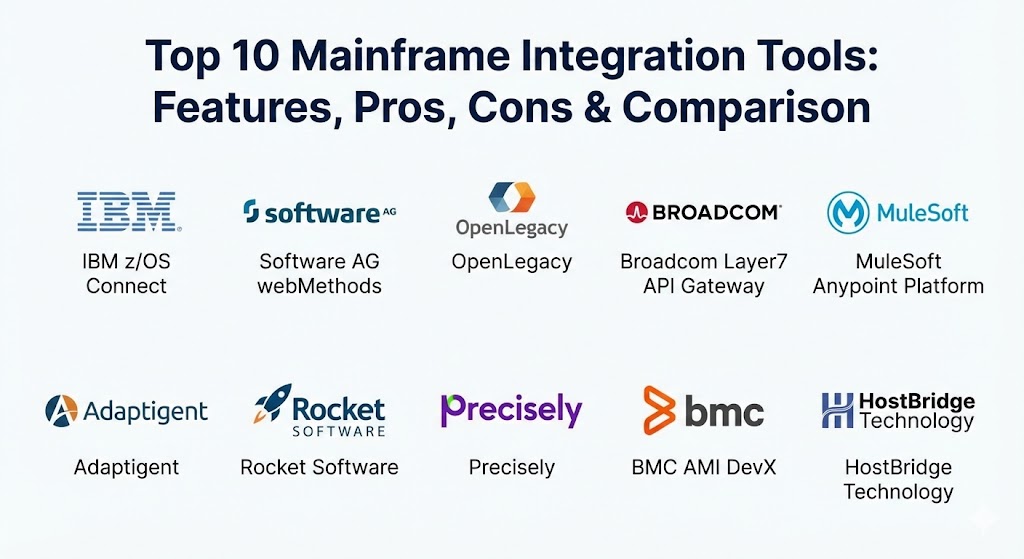
Top 10 Mainframe Integration Tools
1 — IBM z/OS Connect
IBM z/OS Connect is the industry standard for creating RESTful APIs on the z/OS platform. It provides a unified gateway that allows web and mobile applications to interact with CICS, IMS, and non-programmatic assets using standard JSON.
- Key features:
- Native z/OS deployment for minimal latency.
- Powerful API Editor for mapping legacy data to JSON.
- Integrated security with RACF, Top Secret, and ACF2.
- Support for high-speed OpenAPI 3.0 standards.
- Built-in transformation of COBOL/PL/I data structures.
- Operational monitoring through IBM Z Common Data Provider.
- Liberty-based architecture for enterprise-grade scalability.
- Pros:
- Unmatched performance as it runs directly on the mainframe.
- Seamless integration with the broader IBM Z ecosystem and DevOps toolchains.
- Cons:
- Highly proprietary to the IBM ecosystem; limited cross-platform flexibility.
- Requires specialized z/OS skills to manage and configure properly.
- Security & compliance: Full support for AT-TLS encryption, SSO (Single Sign-On), and granular audit logs. GDPR and HIPAA compliant via native z/OS security features.
- Support & community: Extensive enterprise support, vast documentation, and a massive global community of IBM Z experts.
2 — Software AG webMethods
The webMethods platform by Software AG is a powerhouse for hybrid integration. It excels at connecting on-premises mainframe assets with cloud SaaS applications like Salesforce, AWS, and SAP.
- Key features:
- Universal messaging for high-throughput data exchange.
- Out-of-the-box adapters for CICS, IMS, and Natural/Adabas.
- Graphical “no-code” mapping interface for developers.
- Hybrid deployment models (On-prem, Cloud, or Edge).
- Integrated API Management lifecycle tools.
- Event-driven architecture support (EDA).
- Robust B2B and EDI integration capabilities.
- Pros:
- Exceptional at multi-vendor environments where the mainframe is just one part of the puzzle.
- Significantly reduces the need for custom COBOL coding for integration tasks.
- Cons:
- Can be a heavy and complex platform for simple integration needs.
- Licensing costs are generally at the high end of the market.
- Security & compliance: SOC 2, HIPAA, and ISO 27001 compliant. Features robust encryption and audit trails.
- Support & community: High-tier enterprise support, formal training programs, and an active developer portal.
3 — OpenLegacy
OpenLegacy takes a “microservices-first” approach to mainframe integration. It bypasses complex middleware by generating digital services directly from the mainframe code, significantly accelerating time-to-market.
- Key features:
- Automated API generation from COBOL, CICS, and IMS.
- Direct-to-Legacy connectivity that reduces “hops” and latency.
- Native support for Kubernetes and Docker deployments.
- Low-code/No-code development environment.
- Multi-cloud compatibility (AWS, Azure, GCP).
- Automated parsing of legacy metadata.
- Support for mainframe, AS/400, and Tandem systems.
- Pros:
- Extremely fast deployment; what used to take weeks now takes hours.
- Low overhead as it doesn’t require “heavy” middleware on the mainframe.
- Cons:
- May lack the deep monitoring features of platform-native tools like IBM z/OS Connect.
- Newer architecture may require a shift in how traditional IT teams view integration.
- Security & compliance: Supports SSO, standard encryption, and maps legacy security protocols to modern OAuth/OpenID.
- Support & community: Rapidly growing community, excellent onboarding documentation, and professional services available.
4 — Broadcom Layer7 API Gateway
Formerly CA Technologies, the Broadcom Layer7 suite provides a highly secure gateway specifically designed to manage, secure, and monitor APIs that interact with legacy systems.
- Key features:
- Centralized API security and threat protection.
- Advanced identity bridging for legacy-to-cloud security mapping.
- Support for mainframe protocols like MQ, CICS, and DB2.
- High-performance XML and JSON transformation.
- Visual policy manager for complex security rules.
- Integration with Broadcom’s Mainframe Operational Intelligence.
- Multi-tenancy support for large-scale enterprise environments.
- Pros:
- Strongest focus on security and policy management in the category.
- Excellent for highly regulated industries like banking and government.
- Cons:
- Can have a steep learning curve for security policy configuration.
- Integration with non-Broadcom tools can sometimes be a challenge.
- Security & compliance: FIPS 140-2, SOC 2, HIPAA, and PCI DSS. Advanced audit logs and forensics.
- Support & community: Extensive enterprise support and a large network of legacy security experts.
5 — MuleSoft Anypoint Platform (Salesforce)
MuleSoft has revolutionized the integration space with its “API-led connectivity” vision. Their mainframe connectors allow organizations to treat the mainframe as just another node in the “Application Network.”
- Key features:
- Dedicated IBM i and z/OS connectors.
- Anypoint Exchange for reusable integration assets.
- DataWeave transformation engine for complex data mapping.
- CloudHub for fully managed cloud integration.
- Visual design environment (Anypoint Studio).
- Built-in governance and API management.
- Support for legacy MQ and file-based transfers.
- Pros:
- Large ecosystem with thousands of pre-built connectors for other apps.
- Promotes a highly reusable, modular architecture that prevents technical debt.
- Cons:
- The mainframe-specific connectors often require an additional cost/license.
- High resource consumption for the Mule runtime in some on-prem scenarios.
- Security & compliance: FedRAMP, HIPAA, SOC 2, and GDPR compliant. Native edge security.
- Support & community: Industry-leading community and documentation; vast pool of certified developers.
6 — Adaptigent (formerly GT Software)
Adaptigent’s Adaptive Integration Engine is specifically engineered to handle the complexities of the most demanding mainframe environments without requiring changes to the underlying legacy code.
- Key features:
- No-code creation of REST and SOAP APIs.
- High-speed, low-latency transaction processing.
- Support for CICS, IMS, and obscure legacy protocols.
- Drag-and-drop data mapping and orchestration.
- Intelligent caching for improved performance.
- Direct access to VSAM and DB2 data.
- Dynamic workload balancing across mainframe regions.
- Pros:
- Requires absolutely zero changes to existing COBOL programs.
- Very efficient MIPS usage, reducing operational costs.
- Cons:
- Narrower focus compared to broad platforms like webMethods or MuleSoft.
- Brand recognition is lower outside the specialized mainframe community.
- Security & compliance: SSO, encryption, and deep audit logging. Varies based on implementation.
- Support & community: Highly personalized customer support and specialized engineering services.
7 — Rocket Software (Rocket Modernization Suite)
Rocket Software focuses on data virtualization and terminal emulation modernization. They provide a unique way to access mainframe data without having to move it.
- Key features:
- Data virtualization for real-time access to VSAM, IMS, and DB2.
- Rocket BlueZone for web-based terminal access.
- Automation of mainframe-based “green screen” processes.
- API-enablement for legacy terminal screens.
- Integrated data discovery and cataloging.
- Low-impact data replication for analytics.
- Support for Z, i, and VMS platforms.
- Pros:
- Best for data-heavy integrations where moving the data is impractical.
- Excellent tools for modernizing the actual user experience of legacy apps.
- Cons:
- Can be seen as a “bridge” technology rather than a full cloud-native shift.
- UI for some legacy admin tools can feel outdated.
- Security & compliance: SSO, 256-bit encryption, and comprehensive audit trails.
- Support & community: Long-standing reputation in the industry; strong professional services arm.
8 — Precisely (formerly Syncsort)
Precisely is the leader in data integrity and high-speed data integration. Their tools are essential for moving mainframe data into modern analytics platforms like Snowflake or Databricks.
- Key features:
- High-speed Change Data Capture (CDC).
- Connect CDC for real-time mainframe-to-cloud sync.
- Native support for complex mainframe data formats (EBCDIC).
- Low-impact data extraction that protects MIPS.
- Seamless integration with Kafka and Hadoop.
- Data quality and lineage tracking.
- Automated schema mapping.
- Pros:
- The gold standard for data movement and replication for Big Data.
- Very high performance for batch and real-time data streaming.
- Cons:
- Not designed for real-time “request-response” application logic (APIs).
- Focus is almost exclusively on the data layer, not the application layer.
- Security & compliance: SOC 2, HIPAA, and GDPR. Strong encryption during data transit.
- Support & community: Robust technical support and a wealth of data management documentation.
9 — BMC AMI DevX (formerly Compuware)
BMC focuses on the “DevOps” side of integration, ensuring that mainframe code can be developed, tested, and integrated using modern CI/CD pipelines (Jenkins, Git, etc.).
- Key features:
- Integration with modern IDEs (VS Code, Eclipse).
- Automated testing for mainframe integration points.
- Seamless integration with Jira and Git.
- Visualization of complex legacy application call maps.
- Automated code analysis for integration readiness.
- High-speed debugging across platforms.
- Mainframe-as-a-Service capabilities.
- Pros:
- Bridges the culture gap between mainframe “dinosaurs” and cloud developers.
- Essential for maintaining high code quality in an integrated environment.
- Cons:
- Focused on the developer experience rather than the runtime integration gateway.
- Requires a commitment to the full BMC AMI ecosystem for maximum value.
- Security & compliance: ISO, HIPAA, and GDPR support. Strong audit logs for developer activity.
- Support & community: Strong enterprise support with a focus on modernization consulting.
10 — HostBridge Technology
HostBridge provides a unique approach by using JavaScript on the mainframe to orchestrate and expose complex terminal-based transactions as high-performance APIs.
- Key features:
- Use of standard JavaScript for mainframe orchestration.
- Direct integration with CICS via the Link3270 bridge.
- High-performance execution within the CICS environment.
- Discovery tools to map existing terminal “macros.”
- Minimal MIPS overhead compared to screen scraping.
- No changes required to legacy COBOL code.
- Native support for standard JSON/REST.
- Pros:
- Leverages modern skillsets (JavaScript) to solve legacy problems.
- Much faster and more reliable than traditional screen scraping.
- Cons:
- Requires the use of their specific JavaScript engine on z/OS.
- Smaller company compared to the titans like IBM or Broadcom.
- Security & compliance: RACF/ACF2 integration, SSO, and encrypted transport.
- Support & community: Highly specialized and responsive support team; detailed technical blog.
Comparison Table
| Tool Name | Best For | Platform(s) Supported | Standout Feature | Rating (Gartner/TrueReview) |
| IBM z/OS Connect | z/OS Native APIs | IBM z/OS | Native Mainframe Performance | 4.7 / 5 |
| Software AG | Hybrid Integration | Cross-platform, Cloud | 100+ Enterprise Adapters | 4.5 / 5 |
| OpenLegacy | Microservices Speed | Kubernetes, Docker, Z | Automated API Generation | 4.6 / 5 |
| Broadcom Layer7 | API Security | IBM Z, Unix, Cloud | Advanced Identity Bridging | 4.4 / 5 |
| MuleSoft | App Networks | SaaS, On-Prem, IBM Z | Connector Ecosystem | 4.8 / 5 |
| Adaptigent | No-Code Modernization | IBM Z, iSeries, Cloud | Zero Legacy Code Changes | 4.3 / 5 |
| Rocket Software | Data Virtualization | IBM Z, iSeries, VMS | Virtual Real-Time Access | 4.4 / 5 |
| Precisely | Data Sync / CDC | IBM Z, Cloud, Kafka | High-Speed EBCDIC Sync | 4.5 / 5 |
| BMC AMI DevX | Mainframe DevOps | IDEs, IBM Z | CI/CD Mainframe Bridge | 4.6 / 5 |
| HostBridge | CICS Orchestration | IBM z/OS (CICS) | JavaScript on z/OS | 4.2 / 5 |
Evaluation & Scoring of Mainframe Integration Tools
To determine which tool offers the best return on investment, we use a weighted scoring rubric that reflects the reality of modern enterprise IT.
| Category | Weight | Evaluation Criteria |
| Core Features | 25% | Protocol support (REST/JSON), API lifecycle, and legacy data mapping. |
| Ease of Use | 15% | No-code interfaces, automated code generation, and developer onboarding. |
| Integrations | 15% | Ecosystem depth, support for modern clouds, and legacy database adapters. |
| Security & Compliance | 10% | Mapping modern (OAuth) to legacy (RACF) security, encryption, and logs. |
| Performance | 10% | Latency, MIPS efficiency, and handling of high-concurrency transactions. |
| Support & Community | 10% | Documentation quality, global 24/7 availability, and user forums. |
| Price / Value | 15% | License costs vs. saved dev hours and reduced MIPS consumption. |
Which Mainframe Integration Tool Is Right for You?
The decision-making process for mainframe integration is complex because it involves balancing “state-of-the-art” aspirations with “mission-critical” stability.
- Solo Users vs. SMB: It is rare for solo users or SMBs to interact with mainframes. If you are a consultant helping a client, OpenLegacy or Adaptigent are excellent because they provide quick results without needing a massive infrastructure footprint.
- Mid-Market vs. Enterprise: Enterprises with high-volume transactions should look at IBM z/OS Connect for native performance. Mid-market firms looking to connect their mainframe to a variety of SaaS apps like Salesforce will find the most value in MuleSoft or Software AG.
- Budget-Conscious vs. Premium: If your main goal is reducing costs, Adaptigent and HostBridge help by minimizing MIPS usage. If budget is secondary to speed and reusability, MuleSoft offers a premium, highly scalable application network.
- Feature Depth vs. Ease of Use: For deep security and policy management, Broadcom Layer7 is the choice. For the easiest developer experience where a cloud developer can “ignore” that they are even talking to a mainframe, OpenLegacy is the clear winner.
- Integration and Scalability Needs: If you are building a massive data lake or real-time analytics engine, Precisely is necessary. For application-to-application integration, the choice lies between IBM (platform-native) and Software AG (vendor-neutral).
Frequently Asked Questions (FAQs)
1. Is “Mainframe Integration” the same as “Mainframe Migration”?
No. Integration allows the mainframe to stay in place while communicating with new systems. Migration involves moving data and code off the mainframe entirely—a process that is significantly riskier and more expensive.
2. Can these tools handle COBOL and PL/I?
Yes. Most tools like IBM z/OS Connect and Adaptigent have built-in parsers that read COBOL copybooks and automatically map those data structures to JSON or XML for modern developers.
3. What is the impact on MIPS (operational cost)?
Integration can increase MIPS usage. However, tools like OpenLegacy and HostBridge are designed to be efficient, often processing integration logic off-mainframe or using specialized “zIIP” engines to reduce costs.
4. How do these tools handle mainframe security (RACF/ACF2)?
Top-tier tools provide “Identity Bridging.” This means they can take a modern OAuth token from a mobile app and map it to a specific RACF user ID on the mainframe, ensuring end-to-end security.
5. Do I need to learn COBOL to use these tools?
Generally, no. Modern integration tools are designed so that a Java or Python developer can interact with the mainframe using standard APIs without ever seeing a line of COBOL code.
6. What is Change Data Capture (CDC)?
CDC is a technique used by tools like Precisely to monitor database logs (DB2, IMS) and instantly sync any changes (like a new bank transaction) to a cloud database or analytics engine.
7. Is screen scraping still a viable integration method?
Screen scraping is generally discouraged due to its fragility. Modern tools like HostBridge or Rocket Software provide much more stable API-based or terminal-bridge-based alternatives.
8. How do these tools help with DevOps?
Tools like BMC AMI DevX allow mainframe code to be included in the same CI/CD pipelines as cloud code, enabling faster releases and more reliable integration testing.
9. Can mainframes participate in a Microservices architecture?
Yes. By using OpenLegacy or MuleSoft, mainframe functions can be encapsulated as individual microservices that live within a Docker or Kubernetes environment.
10. What is the biggest mistake companies make in mainframe integration?
The biggest mistake is trying to build custom, “home-grown” integration scripts. These are difficult to maintain, lack security, and become a massive bottleneck as the organization scales.
Conclusion
The mainframe is not a relic of the past; it is a foundation for the future. In 2026, the key to digital transformation is not found in abandoning the mainframe, but in unlocking its power through sophisticated integration. Whether you prioritize the native performance of IBM z/OS Connect, the speed and agility of OpenLegacy, or the massive connectivity of MuleSoft, the right tool will turn your legacy system into a modern asset. Choosing the “best” tool requires an honest assessment of your current technical debt, your team’s skills, and your long-term cloud strategy.