Introduction
Fitness coaching platforms are specialized software-as-a-service (SaaS) solutions designed to help personal trainers, gym owners, and online coaches manage their clients and business operations. These tools go beyond simple workout logging; they provide a comprehensive ecosystem that includes exercise libraries with video demonstrations, nutrition tracking, client communication hubs, billing and payment processing, and advanced performance analytics. By centralizing these functions, coaching platforms enable professionals to scale their business beyond the limitations of one-on-one, in-person hours.
The importance of these tools lies in their ability to improve client retention and results through data-driven coaching. Real-world use cases include a solo trainer managing 100 online clients simultaneously, a boutique studio providing “homework” workouts to members, or a professional sports team tracking the recovery and strength metrics of elite athletes. When evaluating a platform, users should look for a robust mobile app experience, ease of workout creation, seamless integration with wearables (like Apple Watch or Oura), and high levels of security to protect sensitive health data.
Best for: Independent personal trainers looking to scale, boutique fitness studios, online coaching businesses, and corporate wellness coordinators who need to track engagement and health outcomes across a large workforce.
Not ideal for: Hobbyists or “casual” gym-goers who just want to track their own personal lifts (who would be better served by simple consumer apps), or traditional gym facilities that focus solely on “dumb” iron and have no digital or coaching component in their business model.
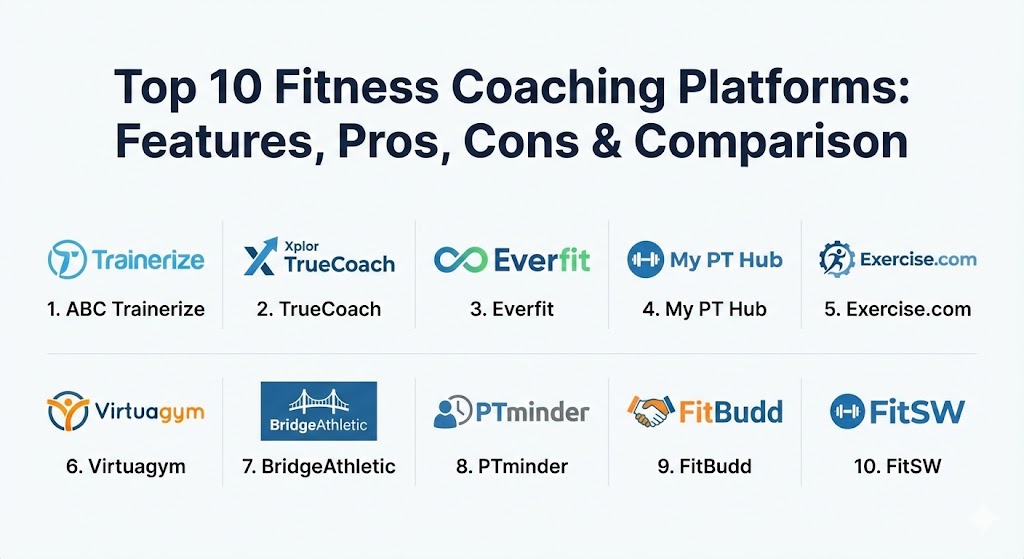
Top 10 Fitness Coaching Platforms
1 — ABC Trainerize
ABC Trainerize is widely considered the industry benchmark for personal training software. It is designed to help trainers and clubs increase member engagement through mobile-first fitness, nutrition, and habit coaching.
- Key features:
- Extensive library of exercises with high-definition video demonstrations.
- Automated “Programs” that deliver content to clients on a set schedule.
- Integrated habit tracking to monitor lifestyle changes outside the gym.
- In-app messaging with support for automated messages and group chats.
- Seamless integration with Apple Health, Fitbit, MyFitnessPal, and Withings.
- On-demand video workouts and live-streaming capabilities.
- Comprehensive business features including billing and client sign-ups.
- Pros:
- Exceptionally intuitive user interface for both the coach and the client.
- Huge ecosystem of integrations makes it the best choice for data aggregation.
- Cons:
- The cost can scale quickly as your client list grows.
- Some users find the nutrition tracking less robust than dedicated calorie-counting apps.
- Security & compliance: GDPR compliant, SSL encryption, and SOC 2 Type II certified.
- Support & community: Top-tier documentation, a dedicated “Trainerize Education” portal, and a massive community of professionals sharing best practices.
2 — TrueCoach
TrueCoach (by Xplor) focuses on the core relationship between the coach and the client. It is known for its “clean” approach, stripping away the bloat to focus on high-quality programming and effective communication.
- Key features:
- “Program Builder” that allows for rapid workout creation and templating.
- Real-time client messaging with file-sharing capabilities.
- Video exercise library with the ability to upload custom movements.
- Performance tracking with “Personal Best” (PB) alerts for clients.
- Simple, email-based notification system that doesn’t require clients to constantly check the app.
- Built-in payments via Stripe integration.
- Pros:
- Often cited as the best platform for “boutique” coaches who want a high-touch, premium feel.
- Extremely fast for coaches to build out a month’s worth of programming.
- Cons:
- Lacks some of the “gamification” features found in competitors.
- The mobile app for clients is somewhat limited compared to the web experience.
- Security & compliance: HIPAA and GDPR compliant; uses AES-256 encryption for data at rest.
- Support & community: Excellent customer support with fast response times and a comprehensive help center.
3 — Everfit
Everfit is a modern, sleek platform that has rapidly gained popularity due to its heavy focus on automation and high-end design. It is built for coaches who want to automate the “boring stuff” to focus on actual coaching.
- Key features:
- Powerful “Autoflow” feature for delivering content, messages, and habits.
- Visual workout builder with a drag-and-drop interface.
- Comprehensive nutrition tracking with macro-breakdowns and meal photos.
- Community “Leaderboards” and “Challenges” to boost client engagement.
- Dedicated “Studio” version for managing multiple trainers and a large client base.
- Integration with major wearables for real-time health data sync.
- Pros:
- The “Autoflow” feature is industry-leading for coaches running 12-week challenges.
- The user interface is arguably the most modern and aesthetically pleasing in 2026.
- Cons:
- The sheer number of features can make the initial setup feel daunting.
- Custom branding options are locked behind higher-priced tiers.
- Security & compliance: SOC 2 Type II, GDPR, and HIPAA compliant.
- Support & community: High-quality video tutorials, active Facebook group for users, and 24/7 chat support.
4 — My PT Hub
My PT Hub is an all-in-one software for personal trainers and fitness professionals. Its differentiator is the “unlimited everything” model, offering a vast array of features at a relatively flat price point.
- Key features:
- Access to over 7,500 exercises with videos.
- Custom branded app options to put your own logo in the App Store.
- Nutrition database with over 600,000 food items.
- Detailed financial reporting and automated invoice generation.
- Document signing and waiver management integrated into the onboarding.
- Calendar and booking system for managing in-person sessions.
- Pros:
- Excellent value for money, especially for trainers with a high volume of clients.
- The nutrition database is one of the largest available in a coaching platform.
- Cons:
- The interface can feel a bit “cluttered” due to the massive number of icons and options.
- Mobile app performance can occasionally lag on older devices.
- Security & compliance: GDPR compliant and uses bank-level SSL encryption.
- Support & community: Offers “My PT Hub Academy” for training and has a strong presence on social media.
5 — Exercise.com
Exercise.com is the go-to solution for established fitness businesses and influencers who want a fully custom, white-labeled app experience. It is less of a “standard app” and more of a custom software build tailored to your business.
- Key features:
- Completely white-labeled mobile apps (iOS and Android).
- Integrated e-commerce for selling workout plans, memberships, and products.
- Custom assessment tools to track client progress over time.
- Robust scheduling for personal training, classes, and gym access.
- Advanced business reporting and marketing automation tools.
- Integration with thousands of apps via Zapier.
- Pros:
- Unrivaled for brand consistency; your clients never see a third-party brand.
- The most powerful e-commerce capabilities in the fitness coaching niche.
- Cons:
- Significantly more expensive than other platforms on this list.
- Implementation takes longer as it involves a custom setup process.
- Security & compliance: HIPAA, GDPR, and SOC 2 compliant.
- Support & community: Each account gets a dedicated success manager for onboarding and ongoing support.
6 — Virtuagym
Virtuagym is a comprehensive solution that serves both individual coaches and large-scale health clubs. It stands out for its 3D-animated exercise videos and robust club management features.
- Key features:
- Unique 3D-animated exercise library with over 5,000 movements.
- Integrated membership management and access control for physical gyms.
- Point of Sale (POS) system for selling supplements and gear.
- Gamified “Rewards” system to keep members motivated.
- Advanced nutrition software with a built-in barcode scanner.
- Challenge and community wall features for social engagement.
- Pros:
- The 3D animations are incredibly clear for demonstrating proper form.
- The best “hybrid” tool for someone who owns a physical gym but also coaches online.
- Cons:
- The 3D aesthetic isn’t for everyone; some prefer real human videos.
- The software is extremely deep, which leads to a steep learning curve.
- Security & compliance: ISO 27001 certified, GDPR compliant, and HIPAA ready.
- Support & community: Regional support teams (Europe/US) and a very detailed online manual.
7 — BridgeAthletic
BridgeAthletic (often referred to as “Bridge”) is the premier platform for strength and conditioning coaches, professional sports teams, and tactical (military/police) organizations.
- Key features:
- “Exos” integrated methodology and programming.
- Advanced “Block” builder for complex periodization and strength cycles.
- Team-based views to monitor multiple athletes on one screen.
- Integration with GPS trackers and velocity-based training (VBT) devices.
- Robust offline mode for training in remote locations or basements.
- Individualized “RPE” (Rate of Perceived Exertion) and load calculations.
- Pros:
- The absolute best tool for serious performance and strength athletes.
- Scientific and data-driven approach to load management and recovery.
- Cons:
- Overkill for a trainer primarily focused on general weight loss or aesthetics.
- The UI is geared toward “serious” training and lacks “lifestyle” features.
- Security & compliance: FIPS 140-2, HIPAA, and GDPR compliant.
- Support & community: High-level technical support and a community of elite S&C coaches.
8 — PTminder
PTminder is a business-centric platform that excels at the administrative side of personal training. It is designed to save trainers time on paperwork so they can focus on coaching.
- Key features:
- Automated online booking and calendar management.
- Payment processing with support for packages and recurring memberships.
- Client progress tracking with “Before & After” photo comparisons.
- Daily dashboard showing revenue, upcoming sessions, and tasks.
- Professional invoice and receipt generation.
- SMS and email reminders to reduce no-shows.
- Pros:
- Extremely strong on the “business” side; arguably the best for managing cash flow.
- Very affordable for solo trainers starting their business.
- Cons:
- The workout programming features are basic compared to Trainerize or TrueCoach.
- Lacks deep integration with wearable health devices.
- Security & compliance: PCI DSS compliant for payments and GDPR compliant for data.
- Support & community: Responsive live chat and a helpful library of “how-to” articles.
9 — FitBudd
FitBudd is a relatively new entrant that has gained massive traction by focusing specifically on helping online coaches grow their revenue through high-converting storefronts.
- Key features:
- One-click “Storefront” creation to sell coaching packages.
- Built-in CRM to manage leads and convert them into clients.
- Intuitive workout and diet plan builders.
- Zoom and Google Meet integration for live coaching calls.
- Automated check-in forms to monitor client compliance.
- Native mobile app for iOS and Android.
- Pros:
- Excellent for “fitness influencers” who need a bridge between social media and coaching.
- The “Lead Management” feature is a game-changer for growing a business.
- Cons:
- The exercise library is smaller than some of the veteran platforms.
- Customization of the workout interface is somewhat limited.
- Security & compliance: GDPR compliant and uses encrypted cloud storage.
- Support & community: Known for high-touch onboarding and personalized business advice for new coaches.
10 — FitSW
FitSW is a highly versatile and budget-friendly platform that offers a surprising amount of depth. It is a favorite for trainers who need a reliable, multi-platform tool without a high monthly fee.
- Key features:
- Tools for tracking workouts, nutrition, and body metrics in one place.
- Automated graphs and charts to visualize client progress.
- Multi-client task management to assign habits and check-ins.
- Integrated “Blog” feature for coaches to share educational content.
- Support for live video sessions and recorded video libraries.
- Public profile page for trainers to attract new clients.
- Pros:
- One of the most affordable platforms on the market for what it offers.
- Very consistent experience across Web, iOS, and Android.
- Cons:
- The user interface feels a bit dated and “boxy” compared to Everfit.
- The mobile app can feel slightly less premium for the end-client.
- Security & compliance: HIPAA and GDPR compliant.
- Support & community: Active blog, video tutorials, and a responsive help desk.
Comparison Table
| Tool Name | Best For | Platform(s) Supported | Standout Feature | Rating (Gartner/TrueReview) |
| ABC Trainerize | Scaling Businesses | iOS, Android, Web, Watch | Wearable Ecosystem | 4.8 / 5 |
| TrueCoach | Boutique Coaching | iOS, Android, Web | Programming Speed | 4.7 / 5 |
| Everfit | Automation & Design | iOS, Android, Web, Watch | Autoflow Workflows | 4.9 / 5 |
| My PT Hub | High Volume PTs | iOS, Android, Web | Unlimited Client Model | 4.5 / 5 |
| Exercise.com | White-Label Apps | iOS, Android, Web | Custom Business Logic | 4.8 / 5 |
| Virtuagym | Hybrid Gym Owners | iOS, Android, Web | 3D Exercise Videos | 4.4 / 5 |
| BridgeAthletic | Elite Performance | iOS, Android, Web | S&C Periodization | 4.7 / 5 |
| PTminder | Admin & Billing | iOS, Android, Web | Financial Reporting | 4.6 / 5 |
| FitBudd | Online Growth | iOS, Android, Web | Coaching Storefronts | 4.5 / 5 |
| FitSW | Budget Conscious | iOS, Android, Web | All-in-One Versatility | 4.4 / 5 |
Evaluation & Scoring of Fitness Coaching Platforms
The following rubric provides a weighted look at how these platforms are evaluated in a professional context.
| Category | Weight | Evaluation Criteria |
| Core Features | 25% | Workout builder quality, exercise library, and nutrition tracking capabilities. |
| Ease of Use | 15% | How quickly a trainer can program a week of workouts and how easily a client can log them. |
| Integrations | 15% | Connectivity with Apple Health, Fitbit, Garmin, and payment processors like Stripe. |
| Security & Compliance | 10% | HIPAA/GDPR status, data encryption, and account security (2FA). |
| Performance | 10% | App stability, load times, and offline functionality. |
| Support & Community | 10% | Training resources, response times, and peer-to-peer communities. |
| Price / Value | 15% | Pricing structure relative to the features and client limits provided. |
Which Fitness Coaching Platform Is Right for You?
Choosing a platform is a strategic business decision. Here is how to navigate the landscape:
Solo Users vs. SMB vs. Enterprise
- Solo Trainers: If you are just starting, FitSW or PTminder offer the lowest barrier to entry. If you are focused on online growth from day one, FitBudd is designed for you.
- Small/Medium Businesses (SMBs): If you have a team of 3–10 trainers, Everfit or Trainerize provide the administrative oversight and automation needed to keep the business running smoothly.
- Enterprise/Custom: For large gym chains or high-profile influencers, Exercise.com is the only real choice for a fully branded experience.
Budget-Conscious vs. Premium
- Budget: My PT Hub is the winner for those who want a flat monthly cost regardless of how many clients they have.
- Premium: TrueCoach and Everfit charge a premium, but they provide a “luxury” experience for your clients that can justify higher coaching rates.
Feature Depth vs. Ease of Use
If your coaching involves complex Olympic lifting and scientific periodization, BridgeAthletic is the depth leader. If you just need a place to send a client their “Chest Day” workout and check their weight, TrueCoach is the speed leader.
Frequently Asked Questions (FAQs)
1. Is my clients’ health data safe on these platforms?
Most industry-leading platforms use AES-256 encryption and are HIPAA or GDPR compliant. This ensures that sensitive information like body weight, heart rate, and health history is protected against unauthorized access.
2. Can I use these apps for nutrition coaching as well?
Yes, most top platforms (like Trainerize and Everfit) include nutrition modules. Some allow for direct calorie/macro tracking, while others focus on “habit-based” nutrition or meal photo journaling.
3. Do these platforms take a percentage of my coaching revenue?
Generally, no. Most platforms charge a monthly subscription fee. However, if you use their integrated payment processors (like Stripe), you will still pay standard credit card processing fees (usually around 2.9% + $0.30).
4. How long does it take to move my clients from one platform to another?
Most platforms offer migration tools or support. However, moving workout history can be difficult. It’s best to finish a client’s current “block” of training before moving them to a new system.
5. Can I upload my own exercise videos?
Yes, every major platform allows you to upload custom videos. This is highly recommended as it builds a stronger personal brand and allows you to teach movements exactly how you want them performed.
6. Do these apps work without an internet connection?
Most client apps allow users to see their workout for the day offline, but they usually require a connection to “sync” the results back to the coach. BridgeAthletic has a particularly strong offline mode.
7. Can I white-label these apps with my own branding?
To varying degrees. Most offer “custom branding” (logos/colors). Truly white-labeled apps (your own name in the App Store) are usually reserved for higher-tier plans or specialized services like Exercise.com.
8. Do these platforms help with client acquisition?
Some platforms like FitBudd have built-in CRM tools to help convert leads. Others provide “public profile” pages that can be found via search engines, but they aren’t a replacement for active marketing.
9. What happens if I cancel my subscription?
Typically, you lose access to the administrative dashboard, and your clients lose access to the app. Most platforms allow you to export your client data (CSV) before you cancel, but you will lose the formatted “workout history.”
10. Do I need a coaching certification to use these platforms?
No, the software companies do not require proof of certification. However, for legal and insurance reasons, you should always be certified and insured before coaching clients through any digital medium.
Conclusion
The “best” fitness coaching platform is the one that removes the most friction from your specific workflow. If you are a data junkie who loves automation, Everfit will feel like a superpower. If you are a traditional strength coach who values simplicity and high-quality programming, TrueCoach is your best ally.
Remember that these platforms are tools, not a replacement for good coaching. The value of the software lies in its ability to free you from administrative drudgery so you can spend more time doing what you do best: changing lives through fitness. Choose a tool that fits your current client volume but provides the scalability you’ll need as your business grows.