Introduction
Telemedicine platforms are secure, HIPAA-compliant software solutions that enable healthcare providers to consult with patients remotely via video, audio, or text-based communication. Unlike standard video conferencing tools, dedicated telemedicine software includes essential clinical features like e-prescribing, digital intake forms, virtual waiting rooms, and integrated billing systems. This infrastructure is vital for ensuring “continuity of care,” especially for patients in rural areas, those with mobility challenges, or individuals managing chronic conditions that require frequent check-ins.
When choosing a platform, providers must look for more than just high-definition video. Key evaluation criteria include interoperability (how well the tool talks to existing EHRs), patient accessibility (the ease of joining a call without complex downloads), security certifications (HITRUST, SOC 2, and HIPAA compliance), and automated clinical workflows that reduce the “paperwork” burden on clinicians. As the market matures, the differentiation between platforms often lies in their specialty-specific features—such as tailored templates for mental health or AI-driven diagnostic tools for primary care.
Best for: Healthcare providers of all sizes—from solo therapists and rural clinics to massive multi-state hospital systems and enterprise-level insurers. It is particularly beneficial for primary care, mental health, dermatology, and chronic disease management.
Not ideal for: Emergency medical situations requiring physical intervention (e.g., trauma, acute respiratory distress) or medical specialties that rely heavily on complex, in-person physical examinations that cannot yet be replicated by remote sensors.
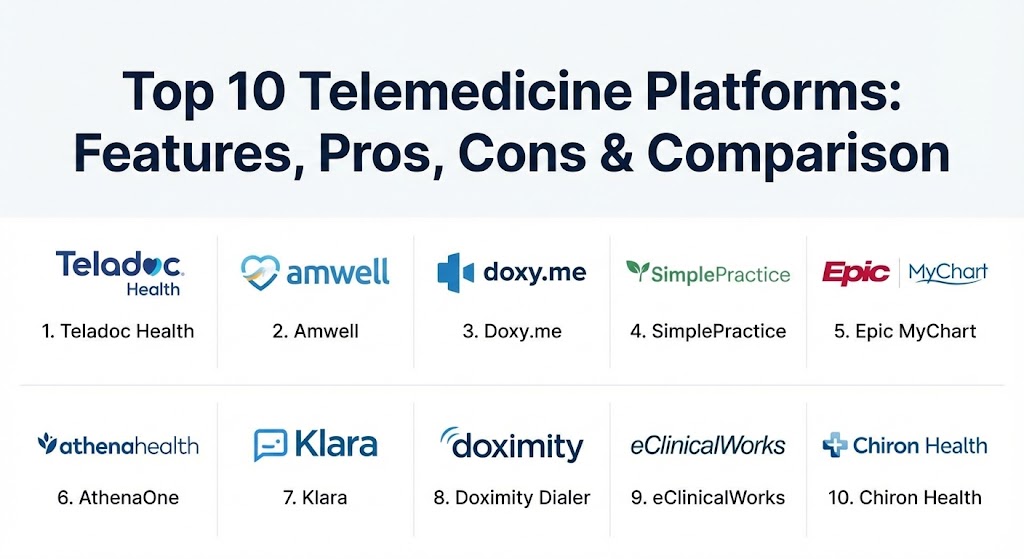
Top 10 Telemedicine Platforms
1 — Teladoc Health
Teladoc Health is widely recognized as the global leader in virtual healthcare. In 2026, its platform has expanded into a comprehensive “Whole-Person Care” ecosystem, serving everything from urgent care to complex chronic condition management via its Solo enterprise platform.
- Key features:
- Integrated “Solo” platform for unified inpatient and outpatient virtual care.
- AI-powered patient triage and automated care routing.
- Comprehensive chronic condition management (diabetes, hypertension) with RPM.
- Global provider network with multi-lingual support in over 20 languages.
- Native e-prescribing and lab integration within the provider workflow.
- Advanced analytics dashboard for population health management.
- Pros:
- Unmatched scalability, making it the top choice for massive health systems.
- Seamless integration with major insurance plans and employer benefits.
- Cons:
- The enterprise-level pricing can be prohibitive for solo practitioners.
- The vast array of features can lead to a steeper learning curve for staff.
- Security & compliance: HIPAA, HITRUST, SOC 2 Type II, GDPR, and ISO 27001.
- Support & community: 24/7 enterprise-grade technical support, dedicated account managers, and an extensive clinical knowledge base.
2 — Amwell (Converge)
Amwell’s “Converge” platform is designed to be the single point of entry for all virtual care. It focuses heavily on the hospital workflow, providing a white-labeled experience that allows health systems to maintain their own branding throughout the patient journey.
- Key features:
- Highly customizable “white-label” interface for consistent branding.
- Embedded virtual visits that sync directly with major EHRs like Epic and Cerner.
- Specialized “Telemedicine Carts” for hospital-based acute care settings.
- AI-driven “Amwell Companion” for patient engagement and follow-up.
- Multi-specialty support including telestroke, telepsychiatry, and pediatrics.
- Integrated payment processing and insurance eligibility verification.
- Pros:
- Superior hospital-grade hardware integrations for in-patient use cases.
- Excellent at reducing “digital friction” for patients through browser-based access.
- Cons:
- Requires significant configuration to get the most out of the platform.
- Some users report occasional latency issues during high-traffic periods.
- Security & compliance: HIPAA, HITRUST, SOC 2, and GDPR compliant.
- Support & community: Comprehensive onboarding teams, 24/7 technical assistance, and regular webinars for best practices.
3 — Doxy.me
Doxy.me has carved out a massive market share by prioritizing extreme simplicity and accessibility. It is the go-to solution for providers who want a “no-download” experience for their patients, emphasizing a lightweight, browser-based approach.
- Key features:
- No app download or account creation required for patients.
- Virtual waiting rooms with customizable videos and text.
- Personal “Room URL” that remains the same for every patient.
- Integrated “Doxy.me Check-in” for automated patient queues.
- Screen sharing and secure file transfer capabilities.
- Free tier available with essential HIPAA-compliant video features.
- Pros:
- The most patient-friendly platform on the list; if you can use a link, you can see a doctor.
- High value for money, especially for solo practitioners and small clinics.
- Cons:
- Lacks some of the deep EHR integration found in enterprise platforms.
- Dependent on the user’s browser performance and internet stability.
- Security & compliance: HIPAA, GDPR, and PIPEDA compliant; signs a Business Associate Agreement (BAA) even on the free tier.
- Support & community: Robust help center, community forums, and live chat support for premium users.
4 — SimplePractice
Designed specifically for health and wellness professionals—particularly therapists and mental health counselors—SimplePractice is an all-in-one practice management tool that includes telemedicine as a core feature.
- Key features:
- Seamlessly integrated scheduling, billing, and clinical documentation.
- Client portal for self-service booking and secure messaging.
- Automated appointment reminders via text, email, and phone.
- Integrated insurance filing and “Superbill” generation.
- Paperless intake forms and customized clinical templates.
- Mobile app for providers to manage their practice on the go.
- Pros:
- Eliminates the need for multiple software subscriptions by combining EHR and Telehealth.
- Specifically tailored workflows for behavioral health specialists.
- Cons:
- Not designed for multi-specialty medical clinics or hospital systems.
- Limited customization for those who only want a standalone video tool.
- Security & compliance: HIPAA compliant, HITRUST certified, and PCI DSS for payments.
- Support & community: Extensive video library, “SimplePractice Learning” courses, and responsive email/chat support.
5 — Epic MyChart (Virtual Visits)
Epic is the “gold standard” of EHR systems for large hospitals. Its MyChart patient portal provides a deeply integrated virtual visit experience that ensures every second of the consultation is recorded directly into the patient’s permanent record.
- Key features:
- Direct “single-sign-on” access for patients through their existing MyChart account.
- Real-time documentation that surfaces the patient’s full history during the call.
- Integration with “MyChart Care Companion” for home vitals monitoring.
- Automated post-visit summaries and patient instructions.
- Support for “Share Everywhere,” allowing patients to share their records with any provider.
- AI-powered “Emmie” assistant for scheduling and pre-visit check-ins.
- Pros:
- Zero data silos; virtual visits are an extension of the physical clinic record.
- Extreme reliability backed by the world’s largest healthcare IT infrastructure.
- Cons:
- Only available to organizations already using the Epic EHR ecosystem.
- High implementation cost and complexity.
- Security & compliance: Comprehensive HIPAA, SOC 2, and ISO certifications.
- Support & community: World-class enterprise support and the “UserWeb” community for peer-to-peer knowledge.
6 — AthenaOne (athenaTelehealth)
Athenahealth’s athenaTelehealth is a fully embedded solution within their cloud-based EHR and practice management suite. It is built to minimize “toggling” between screens, allowing providers to chart while they consult.
- Key features:
- Embedded video window directly within the AthenaOne documentation screen.
- Automated patient outreach via text and email with join links.
- Integrated insurance eligibility checks performed before the visit starts.
- One-click billing that captures the telehealth visit details automatically.
- Mobile-optimized patient experience with no app download required.
- Network-informed insights that surface care gaps during the virtual encounter.
- Pros:
- Excellent for maximizing “schedule density” through automated reminders.
- Streamlined revenue cycle management for telehealth claims.
- Cons:
- Restricted to AthenaOne users; not sold as a standalone telehealth tool.
- Customization options for the video interface are somewhat limited.
- Security & compliance: HIPAA compliant and SOC 2 certified.
- Support & community: 24/7 technical support, dedicated Success Managers, and “Athenahealth Marketplace” for add-ons.
7 — Klara
Klara is a “messaging-first” patient engagement platform. While it offers high-quality video visits, its real strength lies in centralizing all patient communication—texting, messaging, and document sharing—into one collaborative inbox.
- Key features:
- Centralized communication hub for the entire care team.
- Password-free patient access via secure text links.
- Automated workflows for intake, pre-op instructions, and follow-up.
- Voicemail transcription that turns patient calls into actionable messages.
- Integrated file and photo sharing for remote triage.
- Team collaboration tools with internal tagging and reassignment.
- Pros:
- Drastically reduces phone call volume for front-office staff.
- Improves patient adherence through simple, SMS-based communication.
- Cons:
- The messaging-heavy approach may not suit practices that prefer traditional video focus.
- Can feel “noisy” for providers if notifications aren’t properly managed.
- Security & compliance: HIPAA compliant with end-to-end encryption.
- Support & community: Comprehensive onboarding, dedicated success coaching, and a detailed help center.
8 — Doximity Dialer Video
Doximity is the professional network for physicians, and its “Dialer Video” tool has become an essential “BYOD” (Bring Your Own Device) utility for doctors who need to call patients from their personal phones without revealing their private numbers.
- Key features:
- Allows doctors to call patients’ phones while displaying the office number.
- One-click video upgrade from a standard voice call.
- No patient app download; works via a secure web link sent by SMS.
- Integration with Epic Haiku and other mobile EHR apps.
- Support for “no-reply” texting to send quick updates to patients.
- Virtual background and noise cancellation for professional home calls.
- Pros:
- Extremely high physician adoption due to its simplicity and mobile-first design.
- Almost 100% uptime, making it a reliable backup for integrated systems.
- Cons:
- Limited to verified healthcare professionals only.
- Lacks integrated billing and comprehensive clinical documentation tools.
- Security & compliance: HIPAA compliant; no video data or patient info is stored on the phone.
- Support & community: Backed by the Doximity network; offers quick email support and a massive peer community.
9 — eClinicalWorks (Healow)
The Healow platform (Health and Online Wellness) is the patient-facing side of the eClinicalWorks EHR. It provides a structured, data-driven approach to virtual care for medium to large independent practices.
- Key features:
- Fully integrated with the eClinicalWorks EHR for real-time charting.
- Support for multi-device consultations (Smartphone, Tablet, PC).
- Integrated RPM that pulls data from wearables (Apple Watch, Fitbit).
- Automated patient check-in and co-pay collection via Healow Pay.
- AI-powered “Healow Scribe” for automated medical note-taking.
- Virtual waiting rooms with patient education content.
- Pros:
- Strong emphasis on patient-generated health data from connected devices.
- Very efficient for clinics that require rigorous documentation and coding.
- Cons:
- The user interface can feel cluttered and complex for new staff.
- Integration with third-party (non-eCW) systems is limited.
- Security & compliance: HIPAA compliant and HITRUST certified.
- Support & community: 24/7 support via the “https://www.google.com/search?q=my.eclinicalworks.com” portal and annual user conferences.
10 — Chiron Health (by Magellan Health)
Chiron Health focuses on making telemedicine “just another appointment” for small to mid-sized practices. It is particularly noted for its robust insurance rules engine that helps providers navigate the complexities of telehealth reimbursement.
- Key features:
- “Chiron Rules Engine” for automated insurance eligibility checks.
- Native integrations with Athenahealth, Kareo, and Allscripts.
- Automated patient payments and co-pay calculations.
- White-labeled patient experience with custom logos and colors.
- Automated email and text reminders for upcoming visits.
- Simple, HIPAA-compliant “one-click” video connectivity.
- Pros:
- Simplifies the “reimbursement nightmare” through proactive eligibility checks.
- Very high ease-of-use rating for both clinical staff and patients.
- Cons:
- Not as feature-rich in clinical AI as Teladoc or Amwell.
- Reliability can be dependent on the underlying browser technology.
- Security & compliance: HIPAA compliant with full BAA support.
- Support & community: Responsive live chat support, personalized demos, and practice marketing toolkits.
Comparison Table
| Tool Name | Best For | Platform(s) Supported | Standout Feature | Rating (Gartner/TrueReview) |
| Teladoc Health | Large Health Systems | Web, iOS, Android | Global Care Network | 4.6 / 5 |
| Amwell | Hospital Branding | Web, Mobile, Kiosks | Hospital-Grade Hardware | 4.5 / 5 |
| Doxy.me | Solo Practitioners | Web-Based (Any) | No-Download Link | 4.7 / 5 |
| SimplePractice | Mental Health/Wellness | Web, iOS, Android | All-in-One Practice Mgmt | 4.8 / 5 |
| Epic MyChart | Epic EHR Users | Web, iOS, Android | Deep Clinical Integration | 4.7 / 5 |
| AthenaOne | Athena EHR Users | Web, Mobile | Automated Check-in | 4.4 / 5 |
| Klara | Patient Engagement | Web, SMS-Based | Messaging-First Inbox | 4.6 / 5 |
| Doximity Dialer | Mobile Physicians | iOS, Android | Private Caller ID | 4.5 / 5 |
| eClinicalWorks | Data-Driven Clinics | Web, iOS, Android | Wearables/RPM Integration | 4.3 / 5 |
| Chiron Health | Billing/Reimbursement | Web, Mobile | Insurance Rules Engine | 4.4 / 5 |
Evaluation & Scoring of Telemedicine Platforms
To help you determine which platform provides the best value, we have evaluated the market using a weighted rubric based on the current 2026 industry standards.
| Criteria | Weight | Evaluation Highlights |
| Core Features | 25% | Assessment of video quality, e-prescribing, and virtual waiting rooms. |
| Ease of Use | 15% | Focus on “no-download” access for patients and intuitive charting for providers. |
| Integrations | 15% | The ability to sync data bi-directionally with major EHR systems. |
| Security & Compliance | 10% | Verification of HIPAA, HITRUST, and SOC 2 data protection standards. |
| Performance | 10% | Uptime reliability, latency handling, and connection stability. |
| Support & Community | 10% | Availability of 24/7 technical help and peer learning networks. |
| Price / Value | 15% | Comparative analysis of monthly fees vs. revenue-generating capabilities. |
Which Telemedicine Platform Is Right for You?
Selecting the right tool depends largely on your current digital infrastructure and the volume of remote patients you intend to see.
- Solo Users vs. Enterprise: If you are a solo practitioner, Doxy.me offers the lowest barrier to entry. If you are a large hospital system, the enterprise suites from Teladoc or Amwell are necessary for managing high patient volumes and complex multi-departmental workflows.
- Budget-Conscious vs. Premium: SimplePractice is a cost-effective choice for those who need to run an entire business on one tool. In contrast, Epic MyChart is a premium, high-investment solution that offers deep data longevity.
- Feature Depth vs. Ease of Use: Practices that value speed and mobility above all else should look at Doximity Dialer. However, if you need deep diagnostic data and RPM, eClinicalWorks provides much more significant feature depth.
- Integration Needs: If you already use an EHR like Athena or Epic, your best move is usually to stick with their native virtual visit modules to ensure data continuity and reduce administrative “double-entry.”
- Security Requirements: While all tools on this list are HIPAA-compliant, organizations in the government or public sector may require the additional HITRUST and SOC 2 Type II certifications found in Teladoc and Amwell.
Frequently Asked Questions (FAQs)
1. Is telemedicine as secure as an in-person visit?
Yes, provided you use a dedicated platform. These tools use end-to-end encryption and adhere to HIPAA standards, ensuring that patient data is protected in transit and at rest, unlike standard consumer apps like FaceTime.
2. Do patients need to download an app to see me?
Not necessarily. Tools like Doxy.me, Klara, and Amwell use browser-based technology (WebRTC), allowing patients to join a call simply by clicking a link in a text message or email.
3. Can I prescribe medication through these platforms?
Yes. Most professional telemedicine platforms integrate with e-prescribing networks (like Surescripts), allowing you to send prescriptions directly to a patient’s local pharmacy during the session.
4. How do I get paid for virtual visits?
Telemedicine platforms often include integrated billing. Many now feature “Insurance Rules Engines” (like Chiron Health) that automatically verify a patient’s coverage for telehealth before the visit begins.
5. What equipment do I need to get started?
At a minimum, you need a computer or tablet with a webcam, a microphone, and a stable internet connection. Many providers also use external “Telemedicine Kits” for remote vitals (blood pressure, oxygen).
6. Can I see multiple patients at once (group therapy)?
Yes, several platforms like Doxy.me (Professional version) and Amwell support group conferencing, which is essential for family therapy or group counseling sessions.
7. Does telemedicine work for older patients who aren’t tech-savvy?
Platforms that offer “no-download” and “no-login” access are highly successful with seniors. If a patient can open a text message and tap a link, they can successfully navigate a virtual visit.
8. What is the difference between Telemedicine and Telehealth?
While often used interchangeably, “Telemedicine” specifically refers to remote clinical services (doctor-patient visits), whereas “Telehealth” is a broader term covering non-clinical services like provider training and administrative meetings.
9. Can I integrate my telemedicine platform with my existing EHR?
Most mid-to-high-level platforms offer HL7 or FHIR-based integrations. However, native solutions (like Epic or Athena) offer the deepest, most seamless “single-record” integration.
10. What happens if the internet cuts out during a visit?
Most platforms include a “reconnect” button or an automated fallback to a standard phone call. It is a best practice to have a backup communication method (like Doximity Dialer) ready to go.
Conclusion
The telemedicine landscape of 2026 is no longer just about “making do” with remote video; it is about providing a high-quality, data-driven clinical experience that rivals in-person care. Whether you prioritize the absolute simplicity of Doxy.me, the enterprise power of Teladoc, or the integrated workflow of Epic, the “best” tool is the one that removes barriers for your patients while empowering your clinical staff. By focusing on security, interoperability, and ease of use, you can ensure that your virtual practice is both sustainable and clinically effective.