Introduction
A Long-Term Care Management System is an integrated suite of software tools designed specifically for the post-acute and long-term care industry. These systems serve as the “central nervous system” for facilities, managing everything from Electronic Health Records (EHR) and Medication Administration Records (eMAR) to billing, staff scheduling, and regulatory compliance. Unlike general hospital EHRs, LTC systems are built to handle the unique longitudinal nature of elderly care, where residents may stay for years rather than days.
The importance of these systems cannot be overstated. In a highly regulated environment, a robust LTC platform ensures that facilities remain compliant with CMS (Centers for Medicare & Medicaid Services) requirements, reduces the risk of medication errors, and optimizes reimbursement through accurate clinical documentation. Real-world use cases include automating the MDS (Minimum Data Set) submission process, tracking resident fall risks via AI analytics, and providing families with real-time updates through secure portals. When evaluating a system, users should look for interoperability (the ability to “talk” to pharmacies and labs), mobile accessibility for floor staff, and strong reporting capabilities for both clinical outcomes and financial health.
Best for: Skilled Nursing Facilities (SNFs), Assisted Living Facilities (ALFs), Continuing Care Retirement Communities (CCRCs), and large-scale memory care organizations. It is ideal for clinical directors, administrators, and CFOs who need high-level oversight of multi-site operations.
Not ideal for: Private duty home care agencies that do not operate physical facilities (who may prefer specialized home-health software) or small independent living communities that do not provide medical services and only require basic rent collection and maintenance tools.
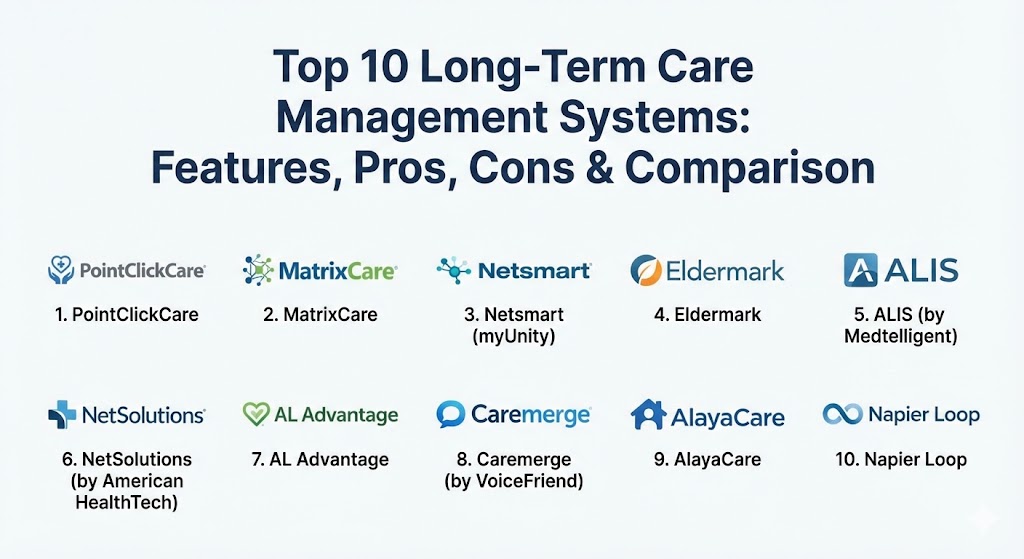
Top 10 Long-Term Care Management Systems Tools
1 — PointClickCare
PointClickCare is widely recognized as the market leader in the North American LTC space. It offers an enterprise-grade, cloud-based platform that connects clinical, financial, and operational data across the entire continuum of care.
- Key features:
- Comprehensive EHR specifically designed for the longitudinal care of seniors.
- Integrated eMAR and ePrescribing for seamless medication management.
- Advanced MDS analytics and reimbursement optimization tools.
- A massive partner marketplace for third-party integrations (pharmacy, labs, wound care).
- Robust “Family Portal” to enhance transparency and resident engagement.
- Clinical decision support (CDS) to flag potential health risks early.
- Multi-facility management dashboards for regional administrators.
- Pros:
- The most widely recognized system, making it easier to find staff who are already trained on the platform.
- Industry-leading compliance engine that updates automatically with changing state and federal regulations.
- Cons:
- The high level of complexity can lead to a steep learning curve for non-technical staff.
- Pricing is generally at the premium end of the spectrum, which may be a barrier for smaller facilities.
- Security & compliance: HIPAA, SOC 2 Type II, and HITRUST certified. Features role-based access, audit logs, and data encryption at rest and in transit.
- Support & community: Extensive documentation through the PointClickCare University; offers structured onboarding and a very active user community/annual summit.
2 — MatrixCare
MatrixCare is a powerhouse in the LTC industry, particularly favored by Life Plan Communities (CCRCs). It excels at managing residents as they transition between different levels of care (independent living to skilled nursing).
- Key features:
- Unified clinical and financial platform for multi-setting providers.
- Mobile-first “Point of Care” documentation for CNA and nursing efficiency.
- Life Plan Community module for managing diverse resident contracts.
- AI-driven predictive analytics for identifying high-risk clinical events.
- Integrated marketing and CRM for occupancy management.
- Advanced Revenue Cycle Management (RCM) with automated claim scrubbing.
- Pros:
- Exceptional at managing the “full spectrum” of care within a single campus.
- Strong focus on reducing clinician burnout through streamlined, “fewer click” workflows.
- Cons:
- Some users report that the financial modules can be less intuitive than the clinical modules.
- Implementation for large CCRCs can be a lengthy process requiring significant IT resources.
- Security & compliance: HIPAA, SOC 2, and redundant cloud backups. Supports SSO and multi-factor authentication.
- Support & community: Personalized onboarding and highly praised customer service; features a robust online knowledge base and training webinars.
3 — Netsmart (myUnity)
Netsmart’s myUnity is an integrated EHR platform designed for the full “Continuum of Care,” including behavioral health, hospice, and long-term care. It is a top choice for organizations that operate across multiple healthcare sectors.
- Key features:
- Person-centered care planning that follows the resident across settings.
- Interoperability focused, with strong connections to the broader healthcare ecosystem.
- Configurable workflows tailored to specific facility types (SNF vs. ALF).
- Integrated telehealth and secure messaging for remote physician visits.
- Comprehensive billing engine for Medicare, Medicaid, and private pay.
- Outcome-based reporting for value-based care initiatives.
- Pros:
- Excellent for large providers that need one platform for LTC, behavioral health, and home care.
- Highly flexible and configurable; the system can be adapted to very specific internal processes.
- Cons:
- The sheer flexibility of the tool can make the initial configuration daunting.
- Navigation within the software can sometimes feel dated compared to newer, “app-like” competitors.
- Security & compliance: HIPAA, HITRUST, and SOC 2. Employs advanced encryption and granular user permissions.
- Support & community: Enterprise-level support with dedicated account managers and a focus on “strategic partnership” rather than just software vending.
4 — Eldermark
Eldermark is highly regarded in the assisted living sector for its focus on risk management and clinical accuracy, particularly in medication administration and resident assessments.
- Key features:
- Eldersmart: An integrated suite covering clinical, marketing, and business office needs.
- E-MAR: A top-tier electronic medication administration record system.
- Direct Care: Real-time task management for floor staff on mobile devices.
- Risk Management Dashboard: Identifies residents at high risk for falls or cognitive decline.
- Occupancy and CRM tools focused on the “lead-to-move-in” journey.
- Integrated billing and payroll management.
- Pros:
- Highly specialized for assisted living; it doesn’t feel like a “watered-down” nursing home tool.
- Known for having an exceptionally fast and responsive customer support team.
- Cons:
- Less focus on complex Skilled Nursing Facility (SNF) requirements like MDS 3.0.
- Integration with third-party EHRs in the broader hospital space can be more limited than larger vendors.
- Security & compliance: HIPAA, SOC 2, and redundant cloud backups. Regular security audits and role-based access.
- Support & community: Personalized onboarding and a focus on “Customer Success.” Strong training resources for frontline caregivers.
5 — ALIS (by Medtelligent)
ALIS (pronounced “Alice”) is a holistic assisted living software solution that is widely praised for its modern interface and user-friendly design. It is built specifically to bridge the gap between clinical care and community management.
- Key features:
- Simplified resident management and assessment tools.
- Holistic care planning that includes social and wellness goals.
- Integrated eMAR with barcode scanning for medication safety.
- Marketing and lead tracking tailored for senior living sales teams.
- Integrated billing and invoicing for complex resident rent structures.
- Staff management and compliance tracking for state certifications.
- Pros:
- One of the most intuitive and modern user interfaces in the LTC market.
- Very affordable for mid-sized communities; offers great value for the features provided.
- Cons:
- Not designed for high-acuity skilled nursing settings; lacks deep clinical modules for SNFs.
- Advanced custom reporting can be more difficult to generate than in enterprise-level systems.
- Security & compliance: HIPAA compliant, secure data hosting, and detailed audit trails.
- Support & community: Highly praised for its implementation process and ongoing technical support; provides regular product updates based on user feedback.
6 — NetSolutions (by American HealthTech)
NetSolutions is a comprehensive EHR and financial suite developed by American HealthTech. It is a “best-of-breed” solution specifically tailored for skilled nursing facilities and small to mid-sized chains.
- Key features:
- Deep clinical documentation for SNFs, including wound care and nutrition.
- Integrated financial management with a focus on SNF-specific RCM.
- Quality Measures dashboard to help facilities track and improve their 5-star ratings.
- Automated workflow for MDS submission and assessment scheduling.
- General Ledger and Accounts Payable integrated with resident billing.
- Secure communication platform for interdisciplinary teams.
- Pros:
- A very “safe” and reliable choice for SNFs that prioritize compliance and clinical depth.
- The integration between the clinical and financial sides is exceptionally tight.
- Cons:
- The user interface can feel somewhat legacy/Windows-based compared to newer web platforms.
- Mobile accessibility for caregivers is not as advanced as PointClickCare or MatrixCare.
- Security & compliance: HIPAA, role-based access controls, and encrypted data storage.
- Support & community: Solid documentation and professional services for onsite training and optimization.
7 — AL Advantage
AL Advantage is a specialized care management software designed “by caregivers for caregivers.” It is best known for its simplicity and focus on meeting state-specific compliance requirements for assisted living.
- Key features:
- Extremely simplified resident assessments and care plans.
- State-specific compliance reporting and audit preparation tools.
- Easy-to-use medication logs and ADL (Activities of Daily Living) tracking.
- Census and billing tools for independent and assisted living.
- Family notification system for significant health events.
- Task management for floor staff on any device.
- Pros:
- Likely the easiest system on this list to learn; perfect for facilities with high staff turnover.
- Very low cost, making it ideal for small, family-owned assisted living homes.
- Cons:
- Lacks advanced features like AI predictive analytics or deep hospital interoperability.
- The feature set is too limited for skilled nursing or large multi-state enterprises.
- Security & compliance: HIPAA compliant (varies by deployment), secure hosting, and basic audit logs.
- Support & community: Offers live demos and high-touch support for small facility owners.
8 — Caremerge (by VoiceFriend)
Caremerge, now part of VoiceFriend, is a “Resident Engagement” leader that has expanded into clinical management. It is designed to create a vibrant community through better communication.
- Key features:
- Leading resident and family engagement platform with social “feeds.”
- Clinical task management and documentation for assisted living.
- Activity and wellness tracking to reduce resident isolation.
- Calendar management and digital signage for communities.
- Integrated voice and text messaging for staff and families.
- Simple EHR capabilities for low-acuity settings.
- Pros:
- Unmatched in its ability to connect residents, families, and staff socially.
- Excellent for facilities where “lifestyle” and “wellness” are as important as clinical care.
- Cons:
- Not a full-scale EHR for high-acuity medical environments.
- Facilities may still need a separate, deeper financial system for complex SNF billing.
- Security & compliance: HIPAA compliant, encrypted messaging, and SOC 2 alignment.
- Support & community: Strong focus on “Community Success” and resident outcome improvements.
9 — AlayaCare
While AlayaCare is often associated with home care, its modern, cloud-native architecture is increasingly used in the LTC space for organizations that manage “aging in place” programs or residential home care.
- Key features:
- Modern, mobile-first design for both caregivers and admins.
- Electronic Visit Verification (EVV) and GPS-based scheduling.
- Advanced data insights and predictive modeling for resident decline.
- Remote Patient Monitoring (RPM) integration for home-based residents.
- Flexible billing for complex Medicaid and private-pay scenarios.
- Robust API for custom integrations with third-party software.
- Pros:
- The most “future-proof” architecture on the list; easy to integrate with AI and IoT devices.
- Exceptional for mobile-focused teams and hybrid residential care models.
- Cons:
- Lacks some of the “built-in” SNF features like native MDS 3.0 processing.
- Transitioning a traditional brick-and-mortar SNF to AlayaCare requires significant custom setup.
- Security & compliance: SOC 2 Type II, HIPAA, and GDPR compliant. High-level encryption.
- Support & community: Known for very fast support response times and a modern, digital-first support portal.
10 — Napier Loop
Napier Loop is an international software solution for nursing home management that provides fully featured EMR services. It is popular for its comprehensive “all-in-one” approach for global providers.
- Key features:
- Comprehensive EMR with a focus on geriatric specialty care.
- Integrated appointment scheduling and resource management.
- Inventory management and meal planning modules.
- Patient portal and mobile-friendly bedside charting.
- Financial suite covering payroll, billing, and general ledger.
- Multi-currency and multi-language support for international chains.
- Pros:
- Truly all-in-one; includes modules like inventory and laundry management that others miss.
- High value for multi-national organizations needing global standardization.
- Cons:
- Support in the North American market is less extensive than legacy vendors like PointClickCare.
- The interface can be cluttered due to the massive number of integrated modules.
- Security & compliance: ISO 27001, HIPAA, and GDPR. Employs strong data sovereignty controls.
- Support & community: Global support network with professional services available for large-scale digital transformations.
Comparison Table
| Tool Name | Best For | Platform(s) Supported | Standout Feature | Rating (TrueReviewnow) |
| PointClickCare | Enterprise SNF/ALF | Web, Mobile | Partner Marketplace | 4.7 / 5 |
| MatrixCare | Large CCRCs | Web, Mobile | Mobile Care Apps | 4.6 / 5 |
| Netsmart (myUnity) | Multi-Sector Providers | Web, Windows | “Continuum” Support | 4.4 / 5 |
| Eldermark | Assisted Living Risk | Web, Mobile | eMAR Security | 4.6 / 5 |
| ALIS | Mid-Sized ALFs | Web, Mobile | User Experience | 4.7 / 5 |
| NetSolutions | Small-Mid SNFs | Windows, Web | SNF-Specific Billing | 4.3 / 5 |
| AL Advantage | Small Care Homes | Web | Extreme Ease of Use | 4.6 / 5 |
| Caremerge | Resident Engagement | Web, Mobile | Family Connectivity | 4.4 / 5 |
| AlayaCare | Home/Mobile-Led LTC | Web, Mobile, API | Cloud-Native Data | 4.8 / 5 |
| Napier Loop | Global / All-in-One | Web, Mobile | Inventory Management | 4.5 / 5 |
Evaluation & Scoring of Long-Term Care Management Systems
Choosing a system is a high-stakes decision. The following weighted scoring rubric reflects the criteria most critical to long-term care success in 2026.
| Criteria | Weight | Evaluation Notes |
| Core Features | 25% | Presence of EHR, eMAR, MDS handling, and specialized LTC billing. |
| Ease of Use | 15% | Training time required for CNAs and high-turnover floor staff. |
| Integrations | 15% | Connectivity to pharmacies, diagnostic labs, and external hospital EMRs. |
| Security & Compliance | 10% | HIPAA/HITRUST status and audit readiness for state/federal surveys. |
| Performance | 10% | Software uptime, speed of data entry, and mobile sync reliability. |
| Support & Community | 10% | Speed of technical response and availability of structured learning. |
| Price / Value | 15% | TCO (Total Cost of Ownership) relative to efficiency gains. |
Which Long-Term Care Management System Tool Is Right for You?
The “best” tool depends entirely on your organizational profile and long-term strategy.
- Solo Users vs. SMBs: For small assisted living homes (less than 50 beds), AL Advantage or ALIS are the winners. They provide the necessary compliance and billing without the crushing overhead of an enterprise system.
- Mid-Market & Regional Chains: If you operate 5–20 facilities, Eldermark or NetSolutions offer the perfect balance of administrative oversight and clinical depth.
- Enterprise & CCRCs: For organizations with 50+ facilities or complex Life Plan Communities, PointClickCare and MatrixCare are the only solutions with the scale and partner ecosystem to manage your complexity.
- Budget-Conscious vs. Premium: If you are operating on razor-thin margins, AL Advantage is the most affordable. If you want a “digital transformation” partner to drive better 5-star ratings, the premium investment in PointClickCare or Netsmart is justified.
- Feature Depth vs. Ease of Use: If you have high staff turnover, prioritize Ease of Use (ALIS). If you have a stable, highly trained clinical team, prioritize Feature Depth (MatrixCare).
- Integration and Scalability: Large health systems that need to communicate with hospitals should prioritize Netsmart or PointClickCare, as they lead the industry in data exchange.
Frequently Asked Questions (FAQs)
1. What is the difference between an LTC Management System and a Hospital EHR?
Hospital EHRs are built for acute, short-term stays (days). LTC systems are longitudinal, focusing on the chronic, daily management of a resident’s health over months or years, including ADL tracking and MDS reporting.
2. Are these systems cloud-based or on-premise?
In 2026, almost all leading systems (PointClickCare, MatrixCare, AlayaCare) are cloud-based (SaaS), allowing access via web browsers and mobile apps without needing on-site servers.
3. Do these systems help with state compliance audits?
Yes. A key feature of systems like Eldermark and AL Advantage is “survey readiness,” which generates organized, accurate reports that state auditors require during their unannounced visits.
4. Can I use these tools on an iPad or tablet?
Most modern platforms offer “Point of Care” apps designed specifically for tablets and smartphones, allowing caregivers to document care right at the resident’s bedside.
5. How much does an LTC management system cost?
Pricing is typically based on “Price per Bed per Month.” It can range from as low as $5/bed/month for simple systems to $30+/bed/month for enterprise suites with all modules enabled.
6. Do these systems integrate with my pharmacy?
Most enterprise systems (PointClickCare, MatrixCare, Netsmart) have native interfaces with major LTC pharmacies (like Omnicare or PharMerica) to automate the eMAR process.
7. Is training included in the cost?
Usually, there is an upfront “Implementation Fee” that covers the initial training. Ongoing training is often provided through online “Universities” included in the monthly subscription.
8. Can families see their loved one’s data?
Yes, most systems now include a “Family Portal” where authorized relatives can see photos, activity calendars, and non-sensitive health updates, significantly reducing phone calls to the nursing station.
9. How long does implementation take?
For a small assisted living facility, it can take 4–6 weeks. For a large multi-site skilled nursing enterprise, a full rollout can take 6–12 months.
10. What is a common mistake when choosing a system?
The most common mistake is buying “too much software.” Facilities often pay for advanced modules (like AI analytics) that their staff doesn’t have the time or training to actually use.
Conclusion
Selecting a Long-Term Care Management System is a decision that will define your facility’s operational success for the next decade. In 2026, the focus has shifted from simply “storing data” to “acting on it.” The best system for your facility is the one that your staff will actually use, that your CFO can afford, and that ensures your residents receive the highest quality of care possible. There is no universal winner; only the right fit for your specific community.