Introduction
Veterinary Practice Management Software is a specialized suite of digital tools designed to centralize a clinic’s clinical, administrative, and financial operations. Its primary purpose is to streamline the complex workflows inherent in veterinary care, ensuring that medical teams can focus on their patients rather than on paperwork. In a real-world setting, this means a technician can instantly sync diagnostic results from an in-house lab directly into a pet’s digital record, or a receptionist can manage a dynamic schedule that balances emergency walk-ins with routine wellness checks.
The importance of a robust VPMS cannot be overstated. With rising client expectations and the increasing complexity of multi-specialty care, these tools provide the necessary infrastructure for data accuracy, revenue capture, and staff retention. When evaluating a system, practices should prioritize interoperability (the ability to sync with lab and imaging equipment), ease of use (to combat staff burnout), cloud vs. on-premise deployment, and automated client engagement features.
Best for: Veterinary professionals ranging from solo mobile practitioners to massive multi-location corporate groups and specialty/emergency hospitals. It is the backbone for any practice aiming to optimize workflows, improve medical record accuracy, and enhance the pet owner’s experience through digital portals and automated reminders.
Not ideal for: Very occasional hobbyist breeders or organizations that do not provide medical services (e.g., basic pet grooming-only businesses). In such cases, a simple appointment scheduler or a general business CRM may be more cost-effective than a full-scale clinical PIMS.
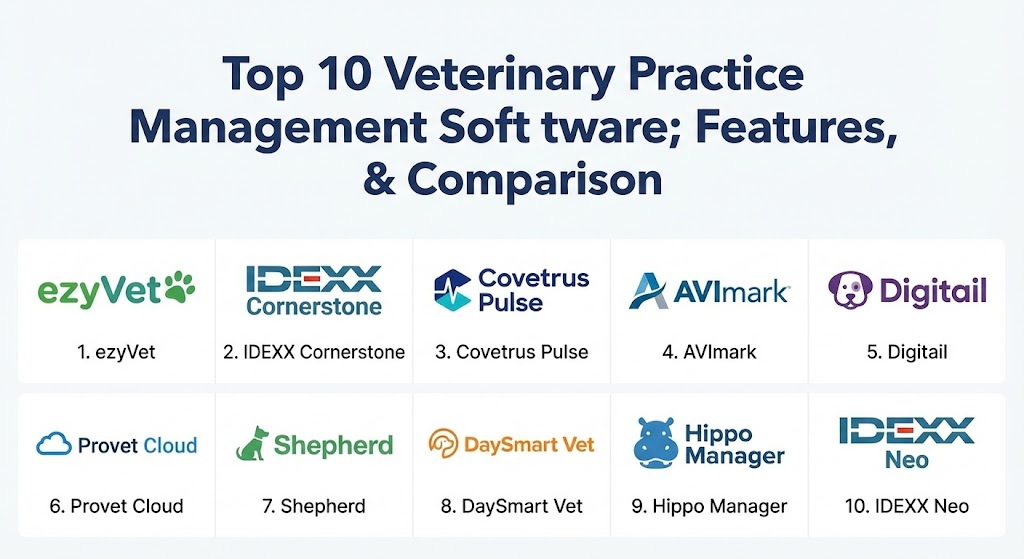
Top 10 Veterinary Practice Management Software Tools
1 — ezyVet
ezyVet is a high-performance, cloud-native solution known for its immense flexibility and deep clinical functionality. Designed to cater to everything from small clinics to large-scale specialty hospitals, it offers a “best-of-breed” approach to veterinary management.
- Key features:
- Highly customizable clinical templates and “Smart Text” shortcuts.
- Deep, two-way integration with IDEXX, Antech, and Zoetis diagnostics.
- Automated billing that captures every charge directly from the medical record.
- Multi-location management with centralized reporting and inventory.
- Robust client portal for online booking and document sharing.
- Integrated “Vet Radar” for digital whiteboard and treatment flowsheets.
- Pros:
- Unrivaled configurability allows hospitals to mirror their exact physical workflows digitally.
- Excellent for high-volume emergency and specialty settings that require complex data tracking.
- Cons:
- The high level of customization results in a steeper learning curve for new staff.
- Implementation costs and timelines can be significant compared to simpler rivals.
- Security & compliance: ISO 27001, GDPR, SSO integration, and SOC 2 Type II compliance.
- Support & community: 24/7 global support with localized teams; extensive “ezyVet Academy” for self-paced staff training.
2 — IDEXX Cornerstone
Cornerstone remains one of the most trusted and feature-rich server-based systems in the industry. As an IDEXX product, it offers the tightest possible integration with the world’s leading diagnostic and imaging ecosystem.
- Key features:
- Comprehensive medical records with built-in “Compliance Assessment” tools.
- Seamless integration with IDEXX Reference Labs and in-house analyzers.
- Advanced inventory management with automatic reordering logic.
- Integrated payment processing and PetHealth insurance claims.
- Robust reporting suite with over 150 pre-built business reports.
- “Smart-Link” technology that ensures lab results are automatically billed.
- Pros:
- Unmatched reliability and depth of features for established, high-volume hospitals.
- Benefit of a single vendor for software, lab diagnostics, and hardware support.
- Cons:
- Primarily a Windows-based desktop system, lacking the modern “anywhere” mobility of cloud apps.
- Requires on-site server maintenance and manual backup protocols.
- Security & compliance: Role-based access controls, AES-256 encryption for backups, and audit logs.
- Support & community: One of the largest user communities in the industry; extensive phone and remote-access support.
3 — Covetrus Pulse
Formerly known as eVetPractice, Covetrus Pulse is the industry’s first “Veterinary Operating System” (vOS). It is a cloud-based platform designed to unify all aspects of a practice—from medical records to distribution and supply chain.
- Key features:
- Integrated supply chain management directly linked to Covetrus distribution.
- Native AI “Scribe” that captures client conversations and drafts SOAP notes.
- Customizable dashboard for real-time tracking of clinic KPIs.
- Built-in two-way texting and client communication modules.
- Mobile-friendly design that works on tablets for bedside care.
- Integrated wellness plan management and automated reminders.
- Pros:
- Simplifies the procurement process by linking inventory directly to the vendor’s catalog.
- The modern, browser-based UI is easy for new hires to navigate with minimal training.
- Cons:
- Some reporting modules are perceived as less flexible than legacy systems.
- Heavily optimized for the Covetrus ecosystem, which may not suit all supply strategies.
- Security & compliance: PCI-DSS, HIPAA-ready architecture, SOC 2, and end-to-end data encryption.
- Support & community: Proactive onboarding specialists; responsive 24/7 chat and phone support.
4 — AVImark
AVImark, a Covetrus-owned legacy system, is celebrated for its stability and “one-screen” design. It is one of the most widely used PIMS in North America, particularly in established independent clinics.
- Key features:
- Unique “one-window” interface that minimizes clicking between screens.
- Advanced search and “List Builder” for targeted marketing campaigns.
- Integration with over 50 third-party vendors (labs, imaging, payments).
- Comprehensive dental charting and specialized treatment plans.
- Integrated whiteboard and appointment calendar with color-coding.
- Built-in rapport-building tools for tracking client preferences.
- Pros:
- Extremely stable and fast; works efficiently even on older computer hardware.
- No dependency on a constant internet connection for core clinical work.
- Cons:
- The user interface looks dated compared to 2026’s cloud-native competitors.
- Lacks native “out-of-the-box” mobile and remote access capabilities.
- Security & compliance: Local database encryption, audit trails, and multi-level password protection.
- Support & community: Massive, long-standing user base; vast library of community-generated training videos.
5 — Digitail
Digitail is a modern, cloud-first PIMS that prioritizes the “pet parent” experience. It is often cited as the most “app-like” system, making it a favorite for startups and tech-savvy clinics.
- Key features:
- Native client mobile app for chats, medical records, and booking.
- “Tails AI” assistant for automated SOAP note generation and case summaries.
- Visual “Patient Flow Board” to track a pet’s status in real-time.
- Integrated telemedicine and virtual consultation modules.
- Automated check-in kiosks and digital consent forms.
- Seamless integration with major labs (IDEXX, Antech, Zoetis).
- Pros:
- Exceptional user experience for both the clinical team and the pet owners.
- Rapid development cycle with frequent updates based on community feedback.
- Cons:
- Some advanced inventory features are still maturing compared to legacy platforms.
- Being cloud-only makes the clinic vulnerable if internet service is interrupted.
- Security & compliance: SOC 2 Type II, GDPR, ISO 27001, and secure SSO integration.
- Support & community: High marks for responsive chat-based support and an active “Digitailers” community.
6 — Provet Cloud
Provet Cloud is a globally popular platform that balances high-end clinical tools with ease of use. It is particularly strong in managing multi-site enterprise groups.
- Key features:
- Advanced “Provet Pay” for integrated, automated payment reconciliation.
- Specialized modules for equine and large animal practice workflows.
- Drag-and-drop appointment scheduling with automated buffer times.
- Multi-site dashboards for centralized financial and clinical oversight.
- Integrated lab machine interfacing for real-time result syncing.
- Patient feedback and NPS (Net Promoter Score) automation.
- Pros:
- Very scalable; one of the best for groups managing 10+ locations.
- Strong focus on reducing administrative burden through smart automation.
- Cons:
- Implementation can be complex due to the depth of the available configuration.
- The mobile browser experience, while good, lacks a native “staff app” for some functions.
- Security & compliance: GDPR (global standard), SOC 2, HIPAA, and daily off-site cloud backups.
- Support & community: Excellent onboarding documentation and dedicated account managers for enterprise clients.
7 — Shepherd
Shepherd was designed “by vets, for vets,” focusing on clinical workflow speed. Its unique selling point is that it forces a medical-first approach, where the medical record is the invoice.
- Key features:
- “SOAP-to-Invoice” technology that eliminates forgotten charges.
- Integrated TranscribeAI for real-time dictation of clinical notes.
- Simple, clean design that reduces “click fatigue” for doctors.
- Built-in two-way SMS and email for seamless client updates.
- Integrated IDEXX and Antech lab workflows.
- Native treatment sheets and digital whiteboards.
- Pros:
- Drastically reduces time spent on documentation, helping vets go home earlier.
- Transparent, simple pricing that includes most features as standard.
- Cons:
- Lacks some of the niche enterprise reporting found in older systems.
- No native modules for large animal or complex equine specialty care yet.
- Security & compliance: Cloud-based encryption, audit logs, and SOC 2 compatibility.
- Support & community: Known for highly personalized, US-based customer support and training.
8 — DaySmart Vet
Formerly known as Vetter Software, DaySmart Vet is a streamlined, affordable cloud solution that is a top choice for mobile vets and small-to-mid-sized general practices.
- Key features:
- Fully mobile-responsive design that works perfectly on any device.
- Integrated two-way texting and automated appointment reminders.
- Simple, intuitive medical record templates with photo uploads.
- Integrated payment processing through DaySmart Pay.
- Online booking widget for clinic websites.
- Support for multi-location and house-call workflows.
- Pros:
- One of the most affordable and predictable pricing models on the market.
- Very fast to implement; a clinic can be “up and running” in a matter of days.
- Cons:
- Not designed for complex, high-volume emergency or university settings.
- Inventory management is effective but lacks some advanced forecasting tools.
- Security & compliance: HIPAA-ready, SOC 2, and PCI-compliant integrated payments.
- Support & community: Responsive 24/7 technical support and a library of easy-to-follow training guides.
9 — Hippo Manager
Hippo Manager lives up to its name by being “big and powerful” yet surprisingly simple. It is a cloud-based system that offers an all-inclusive price for unlimited users and data storage.
- Key features:
- All-inclusive pricing (unlimited users, unlimited training, unlimited data).
- Easy-to-use “Patient Dashboard” with one-click access to history.
- Integration with major labs and imaging providers.
- Built-in telemedicine and secure video conferencing.
- Integrated pharmacy and prescription management.
- Robust reporting for tracking inventory and practice growth.
- Pros:
- Excellent value for money; you don’t get “nickeled and dimed” for adding staff.
- Very intuitive interface that requires almost zero training for tech-literate staff.
- Cons:
- The user interface is functional but doesn’t feel as “modern” as Digitail or ezyVet.
- Lacks some of the deep AI-driven automation found in newer 2026 competitors.
- Security & compliance: HIPAA, PCI-DSS, and regular third-party security audits.
- Support & community: Award-winning customer service; famous for having very patient onboarding trainers.
10 — IDEXX Neo
Neo is IDEXX’s cloud-based alternative to Cornerstone. It is designed for small-to-mid-sized practices that want IDEXX’s power but with the simplicity and “pay-as-you-go” nature of the cloud.
- Key features:
- Modern, clean browser-based interface for any device.
- Built-in IDEXX lab integration with real-time result alerts.
- Simplified, icon-based navigation for rapid charting.
- Integrated client communication via SMS and email.
- “SmartFlow” integration for advanced hospital workflow tracking.
- Easy data migration tools from older legacy systems.
- Pros:
- Combines the clinical depth of the IDEXX brand with a lightweight, modern UI.
- Ideal for smaller practices that want to avoid the “bloat” of legacy systems.
- Cons:
- Not as configurable as its older brother, Cornerstone.
- Some enterprise reporting features are still being ported over from the desktop version.
- Security & compliance: Cloud-native encryption, HIPAA-compliant storage, and SOC 2.
- Support & community: Direct access to IDEXX’s world-class support network; strong online help portal.
Comparison Table
| Tool Name | Best For | Platform(s) Supported | Standout Feature | Rating (G2 / TrueReview) |
| ezyVet | Specialty / Large Hospitals | Cloud (Web) | Advanced Configurable Workflows | 4.7 / 5 |
| Cornerstone | High-Volume / IDEXX Users | Windows (Server) | Deep Diagnostic Ecosystem | 4.6 / 5 |
| Covetrus Pulse | vOS / General Practice | Cloud (Web) | Integrated Supply Chain | 4.0 / 5 |
| AVImark | Established / On-Prem | Windows (Server) | “One-Window” Interface | 4.1 / 5 |
| Digitail | Tech-Savvy / Pet Owners | Cloud (Web + App) | Tails AI Assistant | 4.8 / 5 |
| Provet Cloud | Enterprise Groups | Cloud (Web) | Multi-Site Scalability | 4.5 / 5 |
| Shepherd | Clinician Efficiency | Cloud (Web) | SOAP-to-Invoice Logic | 4.8 / 5 |
| DaySmart Vet | SMB / Mobile Vets | Cloud (Web) | Simplicity & Mobile Access | 4.6 / 5 |
| Hippo Manager | Budget-Conscious | Cloud (Web) | All-Inclusive Pricing | 4.4 / 5 |
| IDEXX Neo | SMB / Cloud Migration | Cloud (Web) | Lightweight IDEXX Integration | 4.2 / 5 |
Evaluation & Scoring of Veterinary Practice Management Software
The following scores reflect the industry consensus for performance in the 2026 veterinary technology market.
| Category | Weight | Evaluation Criteria |
| Core Features | 25% | Clinical records, billing, inventory, and diagnostic integration. |
| Ease of Use | 15% | Staff learning curve, interface speed, and design modernism. |
| Integrations | 15% | Depth of two-way sync with labs, imaging, and SaaS third-parties. |
| Security | 10% | Data encryption, audit logs, and compliance with privacy standards. |
| Reliability | 10% | System uptime, performance under load, and backup redundancy. |
| Support | 10% | Onboarding quality, phone/chat availability, and community resources. |
| Price / Value | 15% | Transparency of pricing and ROI for the specific clinic size. |
Which Veterinary Practice Management Software Tool Is Right for You?
Choosing a PIMS is not a “one-size-fits-all” decision; it depends heavily on your clinic’s DNA.
- Solo Users vs SMB vs Enterprise: Solo and mobile vets should prioritize DaySmart Vet or Shepherd for their lightweight, mobile-first nature. Mid-sized clinics (SMBs) will find the best balance in Digitail or Hippo Manager. Large enterprise groups and specialty hospitals should look toward ezyVet or Provet Cloud for their robust multi-site reporting.
- Budget-conscious vs Premium Solutions: If you want a fixed cost with no surprises, Hippo Manager is hard to beat. For those willing to invest in a premium “operating system” to drive massive efficiency gains, Covetrus Pulse or ezyVet are the top contenders.
- Feature Depth vs Ease of Use: If your team is struggling with “click-fatigue,” AVImark or Shepherd offer the most streamlined recording processes. If you need every possible data point for research and specialty care, the depth of Cornerstone or ezyVet is worth the added complexity.
- Integration and Scalability Needs: If you are “all-in” on IDEXX diagnostics, stick with Cornerstone or Neo. If you plan to scale from one location to ten, ensure you choose a cloud-native platform like Provet Cloud that can aggregate your data into a single corporate view.
Frequently Asked Questions (FAQs)
1. Is cloud-based or server-based software better for a vet clinic?
In 2026, cloud-based is the industry standard due to remote access and automatic updates. However, server-based (like AVImark) is still preferred by clinics with unreliable internet or those who want total local control over their data.
2. How long does it take to switch to a new VPMS?
A typical transition takes 3 to 6 months. This includes data migration, staff training, and parallel testing. Simpler cloud systems (like DaySmart Vet) can sometimes be implemented in just a few weeks.
3. Will my old data be lost during a migration?
Most vendors offer “Data Conversion” services. While core data like client names and patient history usually transfer well, complex items like custom inventory lists or historical imaging may require manual verification.
4. Does the software include a patient portal for pet owners?
Most modern cloud systems (Digitail, ezyVet, Pulse) include a native portal. This allows owners to view lab results, pay invoices, and book appointments from their smartphones.
5. How much should I expect to pay?
Cloud systems typically cost between $200 and $600 per month per location. Enterprise systems or those with advanced modules (like ezyVet) may have significant upfront implementation fees ranging from $5,000 to $20,000+.
6. Can these systems help with controlled drug logging?
Yes, most have integrated controlled substance logs. However, for maximum compliance, many clinics integrate their PIMS with a specialized hardware solution like Cubex.
7. Do I need specialized hardware to run these tools?
Cloud-native tools run in any modern web browser (Chrome/Edge/Safari). Server-based tools like Cornerstone require a dedicated server, a local network, and Windows-based workstations.
8. Is technical support included in the monthly price?
For most cloud systems, 24/7 chat/email support is included. Some legacy server systems require an additional annual “Support & Maintenance” contract.
9. Can I use the software for equine or large animal practices?
Yes, but you must choose carefully. ezyVet and Provet Cloud have specialized modules for “ambulatory” (on-the-road) work, whereas some simpler systems are strictly for small animal clinics.
10. How does AI improve veterinary software in 2026?
AI is primarily used for “Ambient Scribing” (listening to the exam and drafting the notes) and “Diagnostic Assistance” (analyzing patient history to suggest potential differential diagnoses).
Conclusion
Selecting a Veterinary Practice Management Software is one of the most critical business decisions a clinic owner will make. The “best” system isn’t the one with the most icons—it’s the one that makes your staff smile and your patients safer. Whether you choose the clinical powerhouse of ezyVet, the diagnostic synergy of Cornerstone, or the pet-owner-first approach of Digitail, ensure that your choice scales with your vision for the future of care.