Introduction
A Pathology Laboratory Information System (LIS) is a specialized software platform designed to manage the end-to-end workflow of a pathology laboratory. This includes everything from specimen accessioning and tracking to result entry, reporting, and archiving. Unlike a general hospital EHR, a pathology LIS is built to handle the unique nuances of anatomic and clinical pathology, such as tissue processing, slide management, and complex synoptic reporting.
The importance of an LIS lies in its ability to reduce human error, ensure regulatory compliance (such as CLIA and CAP standards), and significantly decrease turnaround times (TAT). In 2026, the key real-world use cases involve integrating AI for image analysis, managing molecular diagnostics, and facilitating “telepathology” for remote consultations. When choosing an LIS, users must evaluate the software based on its digital pathology readiness, interoperability with existing EHRs, ease of use for technicians, and the depth of its data analytics capabilities.
Best for: Hospital-based pathology departments, independent reference laboratories, and academic research centers that require high-volume processing, strict audit trails, and seamless integration with broader clinical health systems.
Not ideal for: Small, non-diagnostic research facilities that do not handle human specimens for clinical decision-making, or primary care clinics that do not perform internal laboratory testing and only require a simple results portal.
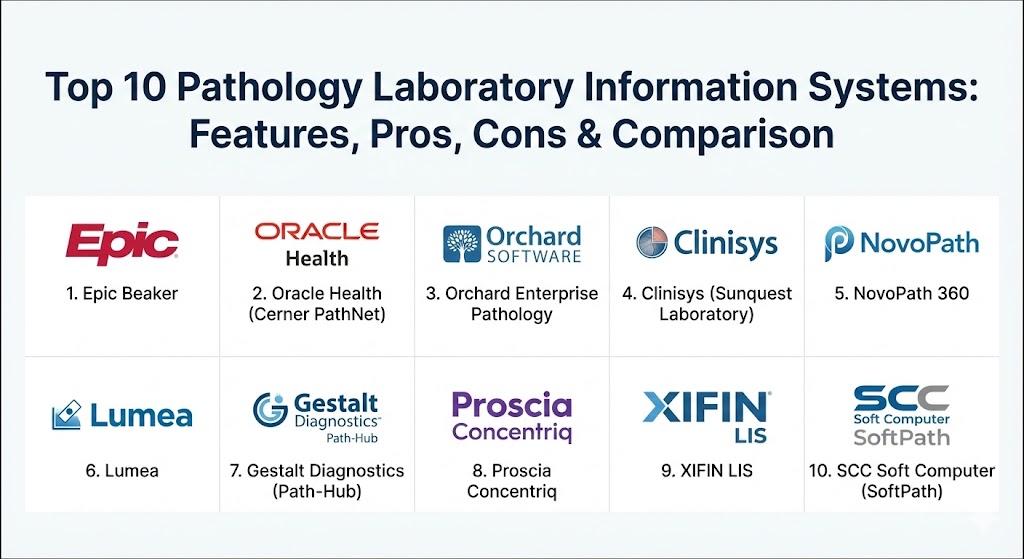
Top 10 Pathology Laboratory Information Systems
1 — Epic Beaker
Epic Beaker is a comprehensive LIS that operates within the broader Epic EHR ecosystem. It is designed to bridge the gap between clinical data and laboratory results, providing a “single source of truth” for patient information across both anatomic and clinical pathology.
- Key features:
- Unified patient record across the entire Epic healthcare system.
- Integrated specimen tracking with barcode verification at every stage.
- Advanced synoptic reporting templates based on CAP standards.
- Native integration with digital pathology imaging platforms.
- Real-time dashboard for monitoring lab TAT and volume.
- Automated billing triggers that sync directly with hospital financial modules.
- Pros:
- Eliminates the need for complex interfaces between the EHR and the LIS.
- Provides an unmatched level of clinical context for pathologists reviewing cases.
- Cons:
- Extremely high cost of implementation and maintenance.
- Primarily suited for organizations already using the Epic EHR.
- Security & compliance: HIPAA, SOC 2, ISO 27001, and full support for CAP/CLIA audit logging.
- Support & community: Industry-leading enterprise support; a massive “UserWeb” community for peer-to-peer troubleshooting and template sharing.
2 — Oracle Health (Cerner PathNet)
Following Oracle’s acquisition of Cerner, PathNet has evolved into a cloud-integrated LIS that focuses on automation and scalability. It is built to support the high-throughput needs of large-scale medical centers.
- Key features:
- Cloud-first architecture for improved data accessibility and disaster recovery.
- Automated instrument interfacing for high-volume clinical labs.
- Specialized modules for microbiology, blood bank, and molecular diagnostics.
- Voice-enabled dictation integration for anatomic pathology transcription.
- Predictive analytics for workload balancing and inventory management.
- Seamless data flow into the Oracle Health (Cerner) Millennium platform.
- Pros:
- Excellent scalability for multi-site laboratory networks.
- Strong emphasis on automation, reducing manual data entry for technicians.
- Cons:
- The transition to Oracle Cloud infrastructure has caused occasional migration hurdles for legacy users.
- The user interface can feel complex and requires significant training.
- Security & compliance: FedRAMP, HIPAA, GDPR, and advanced encryption for data at rest and in transit.
- Support & community: Global 24/7 support network; extensive documentation and formalized training programs.
3 — Orchard Enterprise Pathology
Orchard Software has long been a favorite for mid-market and independent labs. Their Enterprise Pathology solution is a highly flexible LIS that excels in configurability and specialized pathology workflows.
- Key features:
- Highly configurable workflow engine that adapts to specific lab protocols.
- Integrated “Case Coordination” for managing complex, multi-specialty cases.
- Robust decision support rules to automate reflex testing.
- Support for digital pathology image management and AI integration.
- Comprehensive outreach and portal tools for independent lab clients.
- Detailed management reporting for financial and operational metrics.
- Pros:
- Known for being more user-friendly and “nimble” than the massive EHR-integrated systems.
- Exceptional customer service and a focus on laboratory-specific needs.
- Cons:
- Requires dedicated IT resources to manage the high level of customization.
- Integration with non-Orchard billing systems can sometimes require custom scripting.
- Security & compliance: HIPAA, SOC 2 Type II, and regular third-party vulnerability assessments.
- Support & community: High-quality domestic support; active user groups and a dedicated online client portal.
4 — Clinisys (Sunquest Laboratory)
Clinisys (formerly Sunquest) is a global leader in lab software. Their platform is designed for end-to-end diagnostic management, from the point of care to the final pathology report.
- Key features:
- Multi-disciplinary support including Anatomic Pathology, Genetics, and Clinical Lab.
- Smart specimen management to reduce labeling and routing errors.
- Advanced molecular pathology module for genomic data management.
- Integrated quality control monitoring for laboratory instrumentation.
- Scalable architecture supporting thousands of daily accessions.
- Direct connectivity to a wide range of third-party clinical analyzers.
- Pros:
- Deep industry experience results in a very stable and clinically sound product.
- Excellent handling of complex molecular and genetic testing data.
- Cons:
- Legacy components of the UI can feel dated compared to newer cloud-native competitors.
- Implementation timelines can be lengthy due to the software’s depth.
- Security & compliance: HIPAA, ISO 13485, and extensive support for international data privacy standards.
- Support & community: Robust enterprise-level support with dedicated technical account managers.
5 — NovoPath 360
NovoPath 360 is a cloud-native, SaaS-based LIS that focuses heavily on anatomic pathology. It is designed to be lean, fast, and accessible from anywhere, making it a top choice for modern digital labs.
- Key features:
- 100% web-based interface that requires no local server installation.
- Built-in digital pathology viewer and AI-assisted slide analysis.
- Automated synoptic reporting with dynamic, visually rich report formats.
- Direct client portal for physicians to order tests and view results.
- Real-time tracking of every tissue block and slide throughout the lab.
- API-first approach for easy integration with external EHRs and billing systems.
- Pros:
- Extremely fast deployment and easy updates due to the SaaS model.
- The reporting engine produces some of the most professional and readable pathology reports in the industry.
- Cons:
- As a cloud-native tool, it is reliant on constant high-speed internet connectivity.
- May lack some of the “legacy” clinical lab features needed for huge multi-discipline hospitals.
- Security & compliance: HIPAA, SOC 2, and data encryption using modern TLS standards.
- Support & community: Modern support via chat and video; excellent video-based training library.
6 — Lumea
Lumea is a disruptive force in the pathology LIS space, focusing on the “Digital Journey” of the specimen. It integrates unique hardware and software to ensure data integrity from the moment of biopsy.
- Key features:
- Proprietary BxBoard technology to track specimens from the clinic to the lab.
- Digital-first workflow designed to eliminate manual slide scanning steps.
- AI-ready platform with native integrations for leading diagnostic algorithms.
- Integrated telepathology for immediate intraoperative consultations.
- Modern, minimalist user interface that reduces “screen fatigue” for pathologists.
- Real-time billing and insurance verification at the point of accession.
- Pros:
- Uniquely addresses the “pre-analytical” phase of pathology (biopsy handling).
- Significantly improves pathologists’ efficiency through a streamlined digital viewer.
- Cons:
- Most effective when using Lumea’s proprietary hardware, which adds to the cost.
- Smaller user base compared to giants like Epic or Oracle.
- Security & compliance: HIPAA, ISO 27001, and secure cloud hosting on AWS.
- Support & community: High-touch, personalized support; rapid response times for technical issues.
7 — Gestalt Diagnostics (Path-Hub)
Gestalt’s Path-Hub is a fully integrated digital pathology platform that acts as an LIS or sits on top of an existing LIS to modernize the diagnostic process.
- Key features:
- Vendor-neutral image management (supports all major slide scanners).
- Integrated AI algorithm orchestration for automated screening.
- Centralized “Cockpit” for pathologists to manage all digital cases.
- Seamless integration with legacy LIS platforms via HL7 and FHIR.
- Voice-command enabled navigation for hands-free digital microscopy.
- Advanced analytics on pathologist performance and diagnostic accuracy.
- Pros:
- The best option for labs looking to “go digital” without replacing their entire legacy LIS.
- Exceptional interoperability; it plays well with almost any existing tech stack.
- Cons:
- If used as a standalone LIS, it may lack some traditional clinical chemistry modules.
- High bandwidth and storage requirements for managing whole-slide images.
- Security & compliance: HIPAA, SOC 2, and GDPR compliant.
- Support & community: Expert-led implementation and a focus on workflow consulting.
8 — Proscia Concentriq
Proscia Concentriq is an enterprise-grade platform that powers the digital transformation of pathology labs. It is widely used by both clinical diagnostic labs and global pharmaceutical companies.
- Key features:
- AI-powered triage to prioritize urgent cases automatically.
- Massive scalability for high-volume, multi-national organizations.
- Open API for custom development and third-party AI integration.
- Advanced collaboration tools for global peer review and consultation.
- Unified view of patient data, images, and historical reports.
- Automated metadata extraction from scanned slide images.
- Pros:
- Industry leader in AI integration and digital workflow orchestration.
- Very strong for research-heavy environments and large academic centers.
- Cons:
- Focused primarily on the digital/imaging side; often needs to be paired with a core LIS.
- The high-end feature set comes with a premium price tag.
- Security & compliance: HIPAA, GDPR, ISO 27001, and SOC 2.
- Support & community: Enterprise-grade support; very active in the digital pathology research community.
9 — XIFIN LIS
XIFIN LIS is a cloud-based solution that is particularly strong in the independent lab and molecular diagnostic market. It is known for its heavy emphasis on financial performance and billing integration.
- Key features:
- Unified LIS and Revenue Cycle Management (RCM) platform.
- Advanced molecular and NGS (Next-Gen Sequencing) workflow support.
- Integrated physician and patient portals for result delivery.
- Automated compliance checking for medical necessity and billing.
- Real-time business intelligence for tracking lab profitability.
- Support for multi-disciplinary testing (AP, CP, Genetics).
- Pros:
- The best choice for labs that are highly focused on their financial bottom line.
- Cloud architecture allows for easy multi-site management.
- Cons:
- The focus on billing can make the clinical interface feel slightly secondary.
- Reporting customization can be rigid compared to NovoPath or Orchard.
- Security & compliance: HITRUST, HIPAA, SOC 2, and PCI-DSS (for payments).
- Support & community: Professional enterprise support with a strong focus on financial training.
10 — SCC Soft Computer (SoftPath)
SCC Soft Computer is a veteran in the LIS space, offering one of the most powerful and comprehensive suites of laboratory software in the world.
- Key features:
- Highly integrated modules for every imaginable lab specialty (SoftPath, SoftLab, SoftBank).
- Extremely high concurrency support for thousands of simultaneous users.
- Advanced automation for histology and cytology processing.
- Robust rules engine for complex logic-based routing and reporting.
- Deep historical data archiving and retrieval capabilities.
- Integrated multi-site reporting and workload statistics.
- Pros:
- Unmatched depth of features; if a lab needs a specific obscure function, SCC likely has it.
- Extremely reliable for massive, mission-critical hospital networks.
- Cons:
- The interface is often cited as being complex and “clunky” by modern standards.
- Implementation is a massive undertaking that can take over a year.
- Security & compliance: HIPAA, SOC 2, and rigorous internal quality control standards.
- Support & community: Global support network; annual user conferences and formal training academies.
Comparison Table
| Tool Name | Best For | Platform(s) Supported | Standout Feature | Rating (Gartner/Review) |
| Epic Beaker | Integrated Health Systems | Web-based / Local | Unified EHR integration | 4.6 / 5 |
| Oracle Health | High-Volume Hospitals | Cloud / Hybrid | AI Workload Balancing | 4.2 / 5 |
| Orchard Enterprise | Independent/Mid-Market | Windows / Web | Extreme Configurability | 4.5 / 5 |
| Clinisys | Molecular / High-Volume | Windows / Cloud | Advanced Genetics Module | 4.4 / 5 |
| NovoPath 360 | Modern Anatomic Labs | SaaS / Cloud-native | Professional Reporting | 4.7 / 5 |
| Lumea | Digital Transformation | Cloud / Hardware | Pre-analytical Tracking | 4.8 / 5 |
| Gestalt Path-Hub | Digital Retrofitting | Web / Cloud | Vendor-Neutral Viewing | 4.5 / 5 |
| Proscia Concentriq | AI-Driven Research | Cloud / Hybrid | AI Case Triage | 4.6 / 5 |
| XIFIN LIS | Molecular / RCM Focus | SaaS / Cloud | Integrated Billing | 4.3 / 5 |
| SCC SoftPath | Massive Enterprises | Windows / Local | Feature-Rich Modules | 4.0 / 5 |
Evaluation & Scoring of Pathology Laboratory Information Systems
To provide a fair assessment, each tool was evaluated based on the following weighted rubric reflecting the priorities of 2026 pathology practices.
| Category | Weight | Evaluation Criteria |
| Core Features | 25% | Accessioning, specimen tracking, AP/CP support, and synoptic reporting. |
| Ease of Use | 15% | UI/UX design, mobile accessibility, and learning curve for technicians. |
| Integrations | 15% | EHR connectivity (HL7/FHIR), analyzer interfaces, and billing/RCM. |
| Security & Compliance | 10% | HIPAA/GDPR, audit trails, and data encryption. |
| Performance | 10% | System uptime, page load speeds, and concurrency handling. |
| Support & Community | 10% | Documentation quality, support response time, and user forums. |
| Price / Value | 15% | Total cost of ownership vs. operational efficiency gains. |
Which Pathology Laboratory Information System Is Right for You?
Selecting an LIS is a generational decision for a lab. The “right” choice depends on your volume, your existing infrastructure, and your future digital goals.
- Solo Users vs. SMB: If you are a small private practice or a boutique lab, NovoPath 360 or DrChrono (for basic needs) provide the best value with low IT overhead.
- Mid-Market Labs: For labs that need professional-grade features but want to stay independent of a giant EHR, Orchard Software offers the perfect balance of power and agility.
- Large Enterprises: Hospital networks should almost always look at Epic Beaker or Oracle Health to minimize data silos, while high-volume reference labs may prefer the raw power of SCC Soft Computer.
- Budget-Conscious Labs: Cloud-native SaaS models like XIFIN or NovoPath allow for lower upfront capital expenditure by moving to a monthly operational expense model.
- Digital and AI-Focused Labs: If your goal is to be 100% digital with AI-assisted diagnostics, Lumea, Proscia, or Gestalt Diagnostics are the clear front-runners.
Frequently Asked Questions (FAQs)
1. What is the difference between an LIS and a LIMS?
An LIS is patient-centric and used for clinical diagnostics (pathology, blood bank), whereas a LIMS (Laboratory Information Management System) is sample-centric and used for research, manufacturing, and environmental testing.
2. How long does a typical LIS implementation take?
For a cloud-based SaaS system like NovoPath, it can take 3-6 months. For an enterprise hospital system like Epic Beaker, the process can take 12-24 months.
3. Do these tools handle billing directly?
Some, like XIFIN, have integrated RCM. Others provide an interface to external billing software. It is crucial to verify if the LIS can handle “complex” pathology billing like CPT 88305.
4. Can I use my existing microscopes with a digital LIS?
Yes, but to get the full benefit, you will need to add a whole-slide scanner. The LIS will then ingest the digital images produced by that scanner.
5. How does AI integrate into a pathology LIS?
Modern LIS platforms have open APIs that allow AI algorithms to “read” the digital slide, flagging potential areas of interest or performing cell counts for the pathologist to review.
6. Is cloud-based storage safe for pathology data?
Yes. Modern cloud providers (AWS, Azure) are generally more secure than local server rooms, provided the LIS vendor follows HIPAA and SOC 2 protocols.
7. What is “Synoptic Reporting”?
Synoptic reporting uses standardized templates (often from the CAP) to ensure that every pathology report contains all the essential elements needed for clinical decision-making.
8. Can an LIS help with CAP/CLIA inspections?
Absolutely. A good LIS automatically tracks instrument maintenance, staff competencies, and quality control, making the preparation for an audit significantly easier.
9. What is FHIR integration?
FHIR (Fast Healthcare Interoperability Resources) is the modern standard for exchanging health data. It allows different systems to “talk” to each other much more efficiently than older HL7 standards.
10. Do I need a dedicated IT team to manage these tools?
For on-premise systems (SCC, Epic), yes. For SaaS systems (NovoPath, XIFIN), the vendor handles the heavy IT lifting, allowing the lab to function with minimal local IT support.
Conclusion
Choosing a Pathology Laboratory Information System is a transformative step for any diagnostic facility. In 2026, the best systems are those that move beyond simple data storage and become active participants in the diagnostic process through AI, digital imaging, and seamless interoperability. While giants like Epic and Oracle dominate the large-scale hospital market, specialized players like NovoPath, Lumea, and Orchard provide the agility and clinical depth that modern independent labs require. Your choice should ultimately align with your laboratory’s volume, budget, and long-term vision for digital pathology.