Introduction
A Healthcare EMR (Electronic Medical Record) System is a digital version of a patient’s paper chart. It contains the medical and treatment history of patients within one practice. While the terms EMR and EHR (Electronic Health Record) are often used interchangeably, an EMR is traditionally focused on the clinical data within a single provider’s office, whereas an EHR is designed to be shared among all clinicians involved in a patient’s care. These systems are critical because they reduce medical errors by providing “at-a-glance” access to allergies, medications, and history, while also automating the heavy administrative burden of insurance claims and scheduling.
In the real world, EMR systems are used for everything from tracking a child’s vaccination schedule to coordinating complex oncology treatments across multiple specialists. They enable telehealth visits, provide patient portals for self-scheduling, and use AI to predict which patients are at high risk for readmission. When evaluating an EMR, users should look for interoperability (the ability to share data with other systems), usability (how many clicks it takes to finish a note), specialty-specific templates, and compliance with strict data privacy laws.
Best for: Large hospital systems requiring massive scalability, multi-specialty clinics that need unified billing, and independent providers looking to reduce paperwork through automation. It is also essential for organizations moving toward “value-based care” models where data reporting is tied to reimbursement.
Not ideal for: Very small, “cash-only” wellness practices that do not deal with insurance or complex medical histories, or providers who are not ready to invest the significant time and capital required for digital implementation and staff training.
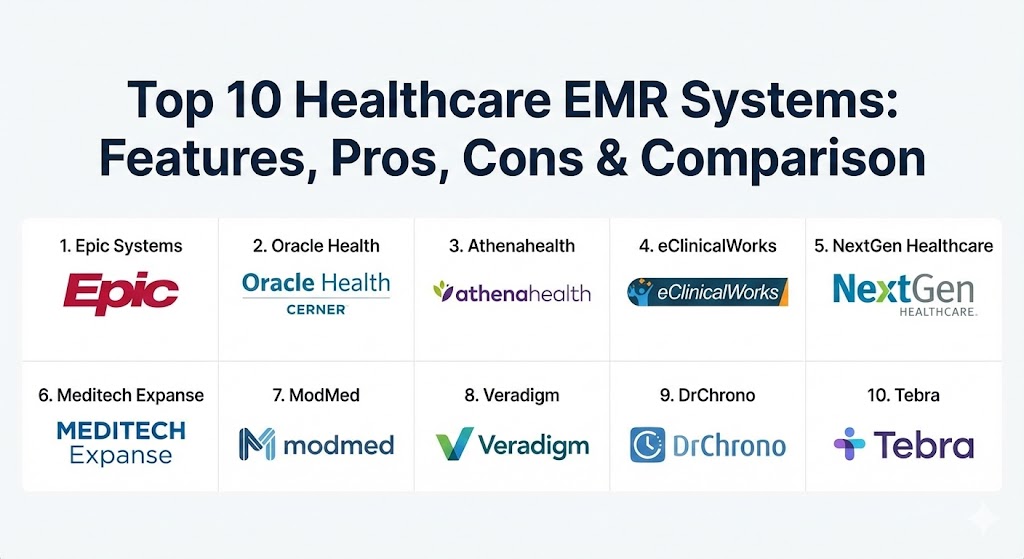
Top 10 Healthcare EMR Systems Tools
1 — Epic Systems
Epic is widely considered the gold standard for large-scale healthcare organizations and academic medical centers. It is famous for its “one patient, one record” philosophy, ensuring that a patient’s data remains consistent across every department in a massive hospital network.
- Key features:
- MyChart Patient Portal: The industry-leading tool for patient engagement and self-service.
- Care Everywhere: A powerful interoperability platform that shares records across different systems.
- Specialty-Specific Modules: Deeply customized workflows for everything from cardiology to transplants.
- Epic Cosmos: A massive de-identified research database for clinical discovery.
- Revenue Cycle Management: Integrated billing and claims processing (Resolute).
- App Orchard: A marketplace for third-party integrations and custom apps.
- Pros:
- Unrivaled stability and depth of clinical functionality for complex organizations.
- Superior interoperability that makes data exchange seamless between Epic-using facilities.
- Cons:
- Prohibitively expensive implementation and maintenance costs for smaller groups.
- A notoriously steep learning curve that requires weeks of intensive staff training.
- Security & compliance: HIPAA, GDPR, ISO 27001, and SOC 2 compliant. Features robust role-based access control and end-to-end encryption.
- Support & community: High-tier enterprise support; “UserWeb” provides a massive library of community-shared templates and best practices.
2 — Oracle Health (Formerly Cerner)
Following its acquisition by Oracle, this platform has pivoted toward cloud-native architecture and the integration of advanced AI. It remains a primary competitor to Epic, particularly for large enterprises and government health agencies.
- Key features:
- Millennium Platform: A comprehensive enterprise-wide electronic health record.
- HealtheIntent: A data-neutral population health management platform.
- Oracle Clinical Digital Assistant: Uses generative AI to automate clinical note-taking.
- Dynamic Documentation: Predictive text and voice-to-text integration to speed up charting.
- Advanced Interoperability: Strong support for FHIR and HL7 standards.
- Cloud Infrastructure: Leverages Oracle Cloud for enhanced speed and reliability.
- Pros:
- Strongest presence in government and global markets (e.g., U.S. Department of Defense).
- Rapidly evolving AI capabilities that significantly reduce “pajama time” for doctors.
- Cons:
- The user interface can feel cluttered and click-heavy compared to modern cloud rivals.
- Ongoing transition pains from the Oracle acquisition can sometimes impact support responsiveness.
- Security & compliance: HIPAA, FedRAMP (essential for government contracts), and SOC 1/2/3.
- Support & community: Global 24/7 support; extensive training through the Oracle Health Learning Framework.
3 — Athenahealth
Athenahealth is a cloud-native leader that focuses heavily on the “digital front door” and administrative efficiency. It is a favorite for ambulatory practices and mid-sized hospital groups that want a streamlined, modern experience.
- Key features:
- athenaClinicals: An intuitive EMR that focuses on reducing documentation time.
- athenaCollector: A powerful revenue cycle management (RCM) service.
- Athena Marketplace: One of the most robust third-party app ecosystems in healthcare.
- Epocrates Integration: Built-in clinical decision support and drug information.
- Network-wide Insights: Uses data from its entire user base to improve billing success.
- Patient Engagement Tools: Automated reminders, self-scheduling, and mobile check-in.
- Pros:
- The cloud-based model means no local servers to maintain and automatic updates.
- Exceptionally high “clean claim” rate due to its built-in rules engine.
- Cons:
- Ongoing subscription costs can be higher than competitors over time.
- Customization is somewhat limited compared to the “blank slate” approach of Epic.
- Security & compliance: HIPAA, SOC 2 Type II, and HITRUST certified.
- Support & community: Dedicated “Customer Success Managers” and a vibrant online marketplace community.
4 — eClinicalWorks (eCW)
eClinicalWorks is one of the most widely used EMRs in the United States, particularly among small to mid-sized independent practices. It is known for its “Healow” ecosystem, which focuses on mobile patient care.
- Key features:
- Healow (Health and Online Wellness): A suite of apps for patients and providers.
- Sunoh.ai: An AI-powered ambient listening tool for automated charting.
- Virtual Assistant (Eva): Helps providers find data and navigate the chart via voice command.
- Population Health Tools: Dashboards for tracking HEDIS and quality metrics.
- Cloud-based or On-premise: Offers flexibility in deployment.
- Multilingual Support: One of the best options for practices serving diverse populations.
- Pros:
- Very affordable entry point for small practices.
- The Healow app provides one of the best patient experiences on the market.
- Cons:
- Customer support is often cited as being slow to respond to technical tickets.
- The software can feel “bloated” with too many menus and options for simple tasks.
- Security & compliance: HIPAA, HITRUST, and ISO 27001 compliant.
- Support & community: Large annual user conferences and an extensive “eCW University” training portal.
5 — NextGen Healthcare
NextGen is a highly scalable EMR that shines in its ability to handle multi-specialty workflows. It offers a broad suite of tools that integrate clinical care with complex financial management.
- Key features:
- NextGen Mobile: Full EMR functionality optimized for smartphones and tablets.
- Ambient Assist: AI-powered documentation that transcribes patient visits.
- NextGen Share: A high-speed health information exchange (HIE) platform.
- Integrated RCM: Sophisticated billing tools designed for high-volume clinics.
- Specialty-Specific Content: Pre-built templates for over 25 specialties.
- Telehealth Integration: Seamlessly integrated virtual visit capabilities.
- Pros:
- Excellent for multi-location practices that need centralized data but different specialty views.
- Strong focus on regulatory compliance and MIPS/MACRA reporting.
- Cons:
- Implementation is complex and usually requires a professional consultant.
- Initial training costs can be a significant hurdle for smaller teams.
- Security & compliance: HIPAA, SOC 2, and ONC-certified.
- Support & community: Robust client advisory board and a dedicated success team for larger accounts.
6 — Meditech Expanse
Meditech is a veteran in the industry, but its “Expanse” platform is a modern, web-native solution designed for community hospitals and medium-sized health systems.
- Key features:
- Web-Native Interface: The entire system is accessible via a web browser.
- Touch-Enabled Design: Built from the ground up to work on tablets.
- Traverse Interoperability: Connects Meditech sites with external systems.
- High-Value Data Exchange: Integrated lab, pharmacy, and imaging workflows.
- Patient Health Portal: A clean, simplified view for patient record access.
- Cloud Hosting: Options for fully managed cloud deployment.
- Pros:
- Much more affordable than Epic or Oracle while offering similar enterprise features.
- The mobile-first design is a favorite among nurses and bedside clinicians.
- Cons:
- Lacks the massive “brand name” ecosystem of third-party apps found in Epic or Athena.
- Reporting tools can be more rigid than competitors.
- Security & compliance: HIPAA, ISO 27001, and SOC 2 Type II.
- Support & community: Known for long-term customer loyalty and direct access to senior technical staff.
7 — ModMed (Modernizing Medicine)
ModMed (specifically their EMA platform) is unique because it is built by specialty-specific doctors. It is the premier choice for dermatology, ophthalmology, and orthopedics.
- Key features:
- EMA (Electronic Medical Assistant): An adaptive learning engine that remembers provider preferences.
- Specialty-Specific Knowledge Base: No generic templates; everything is tailored to the niche.
- Native iPad App: Designed specifically for tablet-based charting in the exam room.
- Integrated ModMed Pay: A specialized payment processing system for patient collections.
- Visual Charting: Draw directly on anatomical diagrams to document findings.
- Analytics Dashboards: Real-time visibility into specialty-specific performance metrics.
- Pros:
- Documentation speed is unmatched for the specialties they support.
- Virtually zero “generic” data entry—the system “speaks” the doctor’s language.
- Cons:
- If your specialty is not supported (e.g., General Practice), this is not the tool for you.
- Pricing is premium, reflecting the specialized nature of the software.
- Security & compliance: HIPAA, SOC 2 Type II, and PCI DSS (for payments).
- Support & community: Specialist-to-specialist support teams who understand clinical workflows.
8 — Veradigm (Formerly Allscripts)
Veradigm offers an “open” platform approach, aiming to prevent vendor lock-in. It is particularly strong in the ambulatory market and for practices that value big-data insights.
- Key features:
- Sunrise EHR: An integrated enterprise solution for acute and ambulatory care.
- Veradigm Network: Connects clinicians, insurers, and life sciences companies.
- Open APIs: Allows practices to build their own custom integrations easily.
- Professional EHR: Tailored for small to mid-sized independent practices.
- Practice Fusion Integration: A user-friendly option for solo practitioners.
- Comprehensive Analytics: Deep-dive tools for financial and clinical auditing.
- Pros:
- The “Open” architecture is excellent for organizations with a high degree of technical skill.
- Strong background in e-prescribing (originally founded as an e-Rx company).
- Cons:
- The product lineup can feel fragmented due to numerous historical acquisitions.
- Support responsiveness has been inconsistent for some smaller clients.
- Security & compliance: HIPAA, SOC 1/2, and ISO 27001.
- Support & community: Extensive online training portals and a dedicated Client Advisory Board.
9 — DrChrono
DrChrono is the pioneer of the “Mobile EHR,” having been the first to build a native app for the iPad. It is highly popular among younger, tech-forward clinicians and smaller, agile practices.
- Key features:
- iPad/iPhone Optimization: The most polished mobile charting experience.
- Customizable Medical Forms: Drag-and-drop form builder for any workflow.
- Integrated Telehealth: High-definition video visits built directly into the schedule.
- Full RCM Services: Option to outsource all billing to DrChrono experts.
- Cloud-Native: No hardware to manage; works everywhere.
- Live Patient Check-in: Tablet-based kiosks for the waiting room.
- Pros:
- Extremely fast setup; a practice can be live in a fraction of the time of an enterprise system.
- Very intuitive for users comfortable with Apple’s ecosystem.
- Cons:
- Lacks the deep “population health” complexity required for massive hospital systems.
- Support for Android devices is limited or nonexistent.
- Security & compliance: HIPAA, SOC 2, and FIPS 140-2 encryption.
- Support & community: Excellent video tutorials and a responsive “help center” model.
10 — Tebra (Formerly Kareo)
Tebra is the result of a merger between Kareo and PatientPop. It is designed specifically for “independent practices” that want to grow their patient base while managing clinical care.
- Key features:
- Growth Suite: Tools for digital marketing, SEO, and online reviews.
- Clinical Dashboard: A simplified, easy-to-read view of the daily schedule and charts.
- Integrated Billing: Easy-to-use tools for insurance eligibility and collections.
- Two-Way Messaging: Secure communication between patients and staff.
- Smart Charting: Uses “Same as Last Time” logic to speed up routine visits.
- Telemedicine: Built-in virtual care platform.
- Pros:
- The best option for providers who also want help with marketing and growing their practice.
- One of the most user-friendly interfaces in the entire industry.
- Cons:
- Not designed for hospital environments or complex inpatient workflows.
- Advanced modules (like marketing) come with significant additional costs.
- Security & compliance: HIPAA, SOC 2 Type II, and PCI compliant.
- Support & community: Guided onboarding and a very helpful live-chat support system.
Comparison Table
| Tool Name | Best For | Platform(s) Supported | Standout Feature | Rating (Gartner) |
| Epic Systems | Large Enterprises | Windows, Web, iOS | Interoperability (Care Everywhere) | 4.3 / 5 |
| Oracle Health | Government / Global | Cloud, Windows | AI Clinical Digital Assistant | 4.1 / 5 |
| Athenahealth | Ambulatory Groups | Cloud (SaaS) | Claims Rules Engine | 3.9 / 5 |
| eClinicalWorks | Mid-market | Cloud, On-premise | Healow Patient Ecosystem | 4.0 / 5 |
| NextGen | Multi-Specialty | Windows, iOS, Android | Ambient Assist AI | 4.1 / 5 |
| Meditech Expanse | Community Hospitals | Web-native, Tablets | Touch-first Design | 4.2 / 5 |
| ModMed | Surgical Specialties | Native iPad, Cloud | Specialty Learning Engine | 4.4 / 5 |
| Veradigm | Open Ecosystems | Windows, Web | Open API Connectivity | 3.8 / 5 |
| DrChrono | Mobile-first Clinics | iOS, Web | Apple-Optimized Charting | 4.3 / 5 |
| Tebra | Independent Practices | Web, iOS | Practice Growth Suite | 4.2 / 5 |
Evaluation & Scoring of Healthcare EMR Systems
To help you decide, we have evaluated these systems based on a weighted scoring rubric that reflects the priorities of modern medical providers.
| Category | Weight | Key Considerations |
| Core Features | 25% | Charting speed, e-prescribing, lab integration, and specialty templates. |
| Ease of Use | 15% | Number of clicks to complete a task, UI cleanliness, and mobile access. |
| Integrations | 15% | App marketplace, API openness, and HIE connectivity. |
| Security & Compliance | 10% | HIPAA, SOC 2, and data encryption standards. |
| Performance | 10% | System uptime, page load speeds, and cloud reliability. |
| Support | 10% | Training quality, responsiveness of help desks, and user community. |
| Price / Value | 15% | Total cost of ownership vs. administrative time saved. |
Which Healthcare EMR Systems Tool Is Right for You?
The “best” EMR is entirely subjective and depends on your organizational structure and goals. Use the following guide to narrow your search:
- Solo Users vs. SMBs: If you are a single provider or a small group, look at Tebra or DrChrono. These tools prioritize ease of use and quick implementation without the “bloat” of enterprise software.
- Mid-Market vs. Enterprise: For systems with 50+ providers or multiple locations, Athenahealth or NextGen are the leaders. They offer the scalability needed without the massive infrastructure requirements of a hospital-grade system.
- Hospitals & Academic Centers: If you are a major health system, the choice is usually between Epic and Oracle Health. Epic wins on interoperability, while Oracle Health is making massive strides in AI and global reach.
- Budget-Conscious vs. Premium: If cost is the primary driver, eClinicalWorks and Veradigm offer competitive pricing. If speed and documentation quality are your priorities, a premium specialty system like ModMed is often worth the extra investment.
- Integration Needs: If you plan on using many niche third-party tools (like advanced diagnostic AI or specialized billing services), Athenahealth or Epic have the best marketplaces to support you.
Frequently Asked Questions (FAQs)
1. What is the difference between EMR and EHR?
An EMR (Electronic Medical Record) is a digital version of a patient’s chart within a single practice. An EHR (Electronic Health Record) is designed to be shared across multiple providers and systems for a total view of the patient.
2. How long does it take to implement a new EMR system?
For a small practice, it can take 30–60 days. For a large hospital system using Epic or Oracle, the process can take 12–18 months and involve hundreds of staff members.
3. Are EMR systems HIPAA compliant?
All top-tier EMR systems are built to be HIPAA compliant. However, compliance also depends on how your staff uses the system (e.g., not sharing passwords or leaving screens unlocked).
4. Can I access my EMR from my smartphone?
Most modern systems like DrChrono, NextGen, and ModMed have native mobile apps. Others have web-native interfaces that can be accessed via a mobile browser.
5. How much do EMR systems typically cost?
Cloud-based systems usually charge per provider per month (ranging from $200 to $700+). Large hospital systems pay millions in upfront licensing and implementation fees.
6. Can I switch from one EMR to another?
Yes, but data migration is often the most difficult part of the process. It is vital to ensure your new vendor can import your legacy data without losing clinical history.
7. Do EMR systems work for all medical specialties?
Some systems are “generalists” (Epic, Athena), while others are “specialists” (ModMed). Always verify that the EMR has the specific templates required for your niche.
8. What is “Interoperability”?
Interoperability is the ability of different EMR systems to talk to each other and share patient data securely, which is critical for coordinated care and patient safety.
9. Will an EMR reduce the number of medical errors?
Yes. By providing automated alerts for drug interactions, clear access to allergy data, and legible clinical notes, EMRs significantly reduce the risk of human error.
10. What happens if the EMR system goes down?
Most cloud-based EMRs have redundant servers to ensure 99.9% uptime. Many practices also keep “downtime procedures”—paper backups or offline copies—for emergency use.
Conclusion
Selecting a Healthcare EMR system is one of the most consequential decisions a medical leader can make. It is not just a software purchase; it is a long-term partnership that will dictate your staff’s daily happiness, your practice’s financial health, and ultimately, the quality of care your patients receive. Whether you choose the enterprise power of Epic, the specialty focus of ModMed, or the mobile agility of DrChrono, ensure that the tool aligns with your specific workflow. The “best” system isn’t the one with the most features; it’s the one that your providers will actually use to deliver better medicine.