Introduction
Drug Discovery Platforms are integrated software and hardware environments that streamline the process of identifying new medicines. They use a combination of physics-based modeling, generative AI, and high-throughput automation to predict how molecules will interact with biological targets. Instead of the traditional “trial and error” approach in a physical lab, these platforms allow researchers to simulate millions of scenarios in a virtual environment (in silico) before moving the most promising candidates to the “wet lab.”
The importance of these platforms cannot be overstated. They allow scientists to explore a “chemical space” of $10^{60}$ potential molecules—a feat impossible for human researchers alone. Beyond speed, they improve the quality of candidates, identifying potential toxicity issues or metabolic hurdles long before human trials begin. When evaluating these tools, industry experts look for “predict-first” capabilities, end-to-end integration (from biology to chemistry), and the ability to handle complex modalities like biologics and protein degraders.
Best for: Biopharmaceutical companies of all sizes, academic research institutes, and contract research organizations (CROs) looking to accelerate their R&D pipelines and reduce the “cost per successful molecule.”
Not ideal for: Small laboratories focused on generic drug manufacturing or organizations that lack the computational infrastructure or data science expertise to interpret advanced AI outputs.
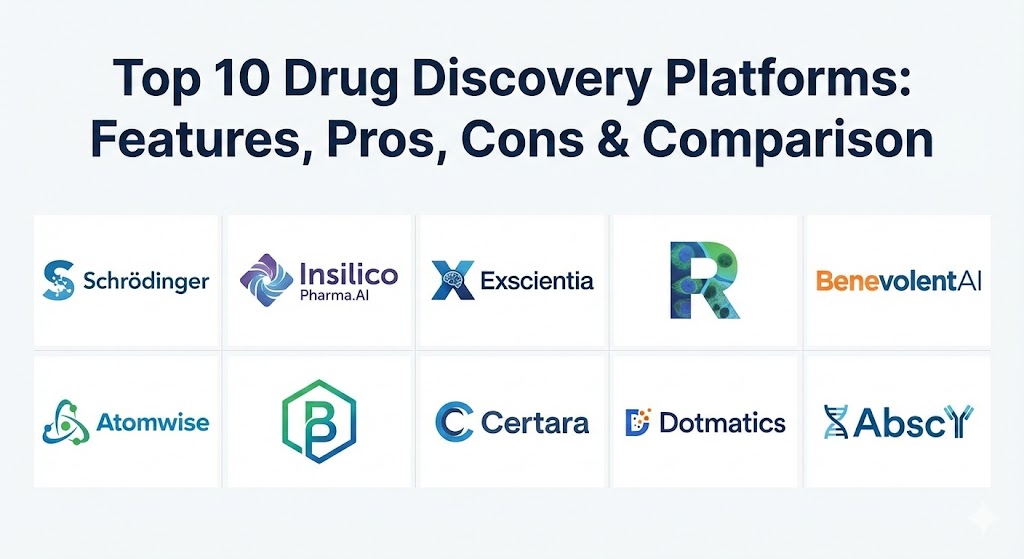
Top 10 Drug Discovery Platforms
1 — Schrödinger
Schrödinger is arguably the most established name in computational drug discovery. Its platform combines advanced physics-based simulations with machine learning to provide high-accuracy predictions of molecular properties and binding affinities.
- Key features:
- Maestro Interface: A powerful 3D workspace for molecular modeling and visualization.
- FEP+ (Free Energy Perturbation): Industry-leading physics-based simulation for predicting binding affinity.
- Active Learning: AI-driven cycles that prioritize which molecules to synthesize next.
- Predictive Toxicology: Advanced modules to screen for safety issues early.
- Maestro AI: A new conversational interface that allows for natural language commands.
- Multi-modal Support: Handles small molecules, biologics, and materials science.
- Pros:
- Highly accurate “physics+AI” approach that solves data scarcity problems.
- Decades of proven scientific leadership and a massive user community.
- Cons:
- High cost of licensing can be prohibitive for smaller startups.
- Requires significant computational resources and expertise to master.
- Security & compliance: ISO 27001, SOC 2 Type II, GDPR, and HIPAA compliant. Enterprise-grade encryption and audit logs.
- Support & community: World-class technical support, extensive training through Schrödinger Academy, and a global community of users.
2 — Insilico Medicine (Pharma.AI)
Insilico Medicine’s Pharma.AI is an end-to-end generative AI platform that spans the entire drug discovery process, from target identification to clinical trial design. It gained fame for advancing an AI-discovered drug to Phase II trials in record time.
- Key features:
- PandaOmics: AI-driven target identification using massive multi-omics datasets.
- Chemistry42: Generative chemistry engine that designs novel, synthesizable molecules.
- InClinico: Predictive analytics for clinical trial success and design.
- Generative Biologics: Specialized tools for antibody and protein design.
- Self-Organizing Maps: Advanced visualization of chemical space and off-target risks.
- Multi-parameter Optimization: Balances potency, solubility, and safety simultaneously.
- Pros:
- True end-to-end capability that reduces early R&D time by up to 70%.
- Strong emphasis on experimental validation with a massive internal pipeline.
- Cons:
- The platform’s “black box” nature can sometimes make AI reasoning hard to explain to traditional biologists.
- Best used as a full suite; standalone modules may feel less integrated.
- Security & compliance: SOC 2, GDPR, and HIPAA compliant. Offers flexible deployment on AWS, Azure, or private cloud.
- Support & community: High-touch enterprise onboarding, regular updates with “launch” events, and detailed scientific documentation.
3 — Exscientia (DMTL Platform)
Exscientia focuses on the “Design-Make-Test-Learn” (DMTL) cycle. Their platform integrates generative AI with automated laboratory robotics to create a continuous, autonomous feedback loop for drug design.
- Key features:
- Centaur Design: AI-driven generative design that focuses on precise Target Product Profiles (TPPs).
- Automated Robotics: Integrated lab automation that synthesizes and tests molecules 24/7.
- Precision Medicine Integration: Uses patient tissue samples to train models for higher clinical relevance.
- Active Learning Algorithms: Dramatically reduces the number of physical compounds needed for synthesis.
- High-Throughput Assays: Rapid biological testing that feeds data directly back into the AI.
- Pros:
- Synthesis-aware AI ensures that the designed molecules can actually be made in a lab.
- Proven track record with multiple AI-designed molecules currently in clinical trials.
- Cons:
- Highly proprietary; the full “automated lab” experience is mostly accessible via collaboration.
- Not a traditional “software-only” buy; involves significant operational integration.
- Security & compliance: SOC 2 Type II, HIPAA, and GDPR. Built on a hardened AWS infrastructure.
- Support & community: Strong partner-focused support; less of an open “user community” and more of a collaborative enterprise model.
4 — Recursion Pharmaceuticals (Recursion OS)
Recursion takes an image-based approach to drug discovery. Their “Recursion OS” uses automated microscopy and machine learning to analyze how cells change in response to thousands of different compounds and genetic perturbations.
- Key features:
- Phenics Engine: Large-scale biological imaging and phenomics analysis.
- Automation Stack: Massive robotic platforms that conduct millions of experiments weekly.
- Lowe Learning: Proprietary AI models trained on one of the world’s largest biological datasets.
- Genentech/Roche Collaboration: Deep integration with world-class pharma R&D units.
- Target Identification: Unbiased discovery of new drug targets through phenotypic screening.
- Pros:
- Data-driven approach that doesn’t rely on existing (and often biased) biological hypotheses.
- Incredible scale—capable of generating petabytes of proprietary biological data.
- Cons:
- Extremely capital-intensive; the platform is better suited for deep partnerships than solo licenses.
- High complexity in interpreting high-dimensional phenotypic data.
- Security & compliance: ISO 27001, GDPR, and HIPAA. Data residency controls for global pharmaceutical partners.
- Support & community: Deeply technical enterprise support; extensive white papers and scientific publications.
5 — BenevolentAI
BenevolentAI uses a massive “Knowledge Graph” to find hidden connections between diseases, targets, and drugs. It is designed to unravel the complexities of “untreatable” diseases by mapping out entire biological mechanisms.
- Key features:
- The Knowledge Graph: Integrates billions of data points from literature, clinical trials, and omics.
- Target Identification: AI-driven scoring for the most promising biological targets.
- Mechanism of Action (MoA) Analysis: Deep dives into how a drug interacts with cellular pathways.
- Lead Optimization: Refines molecules for both efficacy and safety.
- Natural Language Processing: Scans millions of research papers to find overlooked insights.
- Pros:
- Excellent for finding “novel biology” and re-purposing existing drugs.
- Strong focus on explaining the “why” behind AI predictions.
- Cons:
- High reliance on the quality of external literature/data sources.
- Complexity of the knowledge graph can require specialized training.
- Security & compliance: GDPR, HIPAA, and SOC 2. Secure data silos for multi-client partnerships.
- Support & community: High-quality scientific support and a strong presence in the UK/European biotech ecosystem.
6 — Atomwise (AtomNet)
Atomwise was one of the first companies to apply Convolutional Neural Networks (CNNs) to molecular recognition. Their platform, AtomNet, treats the interaction between a drug and a protein like an image recognition task.
- Key features:
- AtomNet: Deep learning CNN that predicts binding affinity from structure.
- Virtual Screening: Can screen 10 million compounds daily without physical synthesis.
- AIMS (AI Molecule Screening): A massive project that has successfully identified novel scaffolds across 300+ targets.
- Synthesizable Library: Access to over 15 quadrillion synthesizable molecules.
- Structure-Based Discovery: High accuracy for targets with known 3D protein structures.
- Pros:
- Extremely fast and scalable; can explore a vast chemical space very quickly.
- High success rate in identifying structurally novel “hits” where traditional methods fail.
- Cons:
- Performance is significantly better for targets with existing structural data.
- Less focus on end-to-end “omity” (biology/omity integration) compared to Insilico.
- Security & compliance: Varies by deployment; standard cloud security (AWS/Azure) and GDPR compliance.
- Support & community: Active academic collaboration program and robust documentation for industrial partners.
7 — Benchling (R&D Cloud)
While not an AI discovery engine itself, Benchling is the essential data foundation. It is a cloud-based informatics platform that integrates ELN (Electronic Lab Notebook) and LIMS (Laboratory Information Management System) specifically for biotech R&D.
- Key features:
- Integrated ELN/LIMS: Centralized repository for all experimental data and samples.
- Molecular Biology Suite: Advanced tools for plasmid design and protein analysis.
- Workload Management: Tracks tasks and R&D performance across teams.
- Workflow Automation: Connects directly to lab instruments for automated data capture.
- Collaborative Notebooks: Real-time sharing of experiments and templates.
- Pros:
- The most user-friendly and modern interface in the life sciences space.
- Reduces time spent on manual data capture by up to 60%.
- Cons:
- Does not have the built-in AI “design” capabilities of tools like Schrödinger.
- Can become expensive as you add more users and specialized modules.
- Security & compliance: SOC 2 Type II, HIPAA, GDPR, and ISO 27001. High-level encryption and audit trails.
- Support & community: Excellent “Learning Labs” and a massive community of thousands of innovative industry peers.
8 — Certara (Certara.AI & D360)
Certara is the leader in Model-Informed Drug Development (MIDD). Their D360 platform and newer Certara.AI initiatives focus on using modeling and simulation to predict how a drug will behave in a human body.
- Key features:
- D360 Informatics: Scientific data management and analysis workbench.
- PBPK Modeling: Predicts drug distribution and metabolism in humans.
- Dynamic Data Subsets: Allows scientists to analyze series of compounds without manual intervention.
- Certara.AI: Specialized LLMs for regulatory submissions and literature screening.
- Target Product Profile (TPP) Assessment: Checks feasibility against market competitors early.
- Pros:
- Critical for clinical candidate selection and regulatory success.
- Saving researchers hundreds of hours annually on data analysis and report writing.
- Cons:
- The UI of legacy products can feel more technical/traditional than modern SaaS.
- Deep focus on “early development” rather than “novel hit discovery.”
- Security & compliance: ISO 27001, SOC 2, and FDA-compliant audit logs.
- Support & community: Highly resourceful technical team and a strong reputation for “finding a solution” for complex projects.
9 — Dotmatics
Dotmatics provides a unified scientific R&D platform that integrates data from disparate sources into a single dashboard. It is designed to act as the “connective tissue” for large, multi-disciplinary research teams.
- Key features:
- Scientific Data Management System (SDMS): Centralized management of research data.
- Vortex: Advanced data visualization and analysis tool.
- Studies Notebook: A focused ELN for chemistry and biology.
- Automation Integration: Connects lab hardware with digital workflows.
- Collaborative Management: Streamlines communication between departments.
- Pros:
- Excellent for large-scale data centralization across multiple sites.
- Highly customizable for specific team workflows.
- Cons:
- Known for a steep learning curve and lengthy implementation times.
- Pricing can be unpredictable with significant increases upon renewal.
- Security & compliance: SOC 2, GDPR, and HIPAA. Granular access controls for sensitive data.
- Support & community: Extensive documentation but sometimes criticized for the time required for customization support.
10 — Absci (Integrated Drug Creation)
Absci is a pioneer in generative AI for biologics. Their platform specifically targets the creation of better antibody-based therapies, combining AI models with a high-throughput “synthetic biology data engine.”
- Key features:
- Generative Antibody Design: AI-led de novo design of novel therapeutic proteins.
- Synthetic Biology Data Engine: High-speed wet lab that validates AI designs in real-time.
- Oracle/AMD Infrastructure: Leverages massive GPU power for molecular dynamics simulations.
- Lead Optimization: Refines antibody-antigen interactions for higher precision.
- Cell Line Development: Simultaneously optimizes the therapeutic and the production cell line.
- Pros:
- Specifically designed for the “next generation” of complex biologic drugs.
- Extremely high-resolution molecular dynamics simulations.
- Cons:
- Primarily focused on biologics; not the best choice for small molecule discovery.
- Early-stage status means less long-term clinical validation than Schrödinger.
- Security & compliance: ISO 27001, SOC 2, and HIPAA. Built on high-security bare-metal instances.
- Support & community: Collaborative enterprise support; highly technical engineering partnerships.
Comparison Table
| Tool Name | Best For | Platform(s) Supported | Standout Feature | Rating (G2 / Gartner) |
| Schrödinger | Physics-based Accuracy | Web, Desktop, Cloud | FEP+ Binding Affinity | 4.8 / 5 |
| Insilico Medicine | End-to-End Generative AI | SaaS, AWS, Azure | PandaOmics Target ID | 4.7 / 5 |
| Exscientia | Automated Lab Feedback | Enterprise / Partner | Synthesis-Aware AI | N/A |
| Recursion | Phenotypic Discovery | Enterprise / Partner | Image-based Phenomics | N/A |
| BenevolentAI | Novel Biology Discovery | Enterprise / Partner | Biomedical Knowledge Graph | N/A |
| Atomwise | Large-scale Hit Discovery | Web, Cloud | AtomNet CNN Engine | 4.5 / 5 |
| Benchling | Data Foundation / ELN | Cloud (SaaS) | R&D Informatics Cloud | 4.9 / 5 |
| Certara | Clinical Selection/MIDD | Desktop, Cloud | PBPK Modeling / D360 | 4.6 / 5 |
| Dotmatics | Data Centralization | Cloud, On-Prem | Vortex Data Visualization | 4.5 / 5 |
| Absci | Generative Biologics | Cloud (OCI/AMD) | Antibody Design Engine | N/A |
Evaluation & Scoring of Drug Discovery Platforms
When choosing a platform, the weight of each category often shifts depending on whether you are doing early discovery or late-stage development. The following rubric reflects the requirements of a modern “AI-First” biotech.
| Category | Weight | Evaluation Criteria |
| Core Features | 25% | Physics accuracy, AI-generative power, target ID capabilities, and multi-modality support. |
| Ease of Use | 15% | UI/UX design, “Maestro-like” visualization, and availability of no-code AI tools. |
| Integrations | 15% | Ecosystem connectivity, API depth, and ease of linking with wet-lab automation. |
| Security & Compliance | 10% | Data sovereignty, ISO/SOC 2 status, and HIPAA/GDPR readiness for clinical data. |
| Performance | 10% | Computation speed, scalability (GPUs), and predictive accuracy (FEP+ benchmarks). |
| Support & Community | 10% | Access to expert consultants, documentation quality, and training resources. |
| Price / Value | 15% | TCO (Total Cost of Ownership) relative to time-to-candidate acceleration. |
Which Drug Discovery Platform Is Right for You?
The drug discovery landscape is diverse, and the “correct” platform is a strategic decision rather than a simple software purchase.
- Solo Users vs. SMBs: Small biotechs often cannot afford $500k+ annual licenses for full platforms. Benchling is a must-have for basic data management. For discovery, Atomwise or Quetext (in other categories) or pay-per-use modules in Schrödinger are more accessible.
- Mid-Market vs. Enterprise: Scaling biotechs should look toward Insilico Medicine (Pharma.AI) for its speed and modularity. Large Pharma usually maintains a portfolio of tools, using Schrödinger for high-accuracy chemistry and Dotmatics or Benchling to unify global data.
- Budget-conscious vs. Premium: If you have the budget, Schrödinger remains the “safe” gold standard. If you need to disrupt a specific niche with AI, Exscientia or Absci offer premium, high-value collaborative models.
- Feature Depth vs. Ease of Use: Schrödinger is deep but technical. Benchling is the easiest to adopt across a diverse team. Insilico strikes a balance with its “automated reasoning” dashboards.
- Security and Compliance Requirements: If your work involves patient tissue data or clinical trials, Certara and Benchling have the most robust compliance frameworks for those specific regulatory hurdles.
Frequently Asked Questions (FAQs)
1. What is “In Silico” drug discovery?
In Silico refers to experiments conducted via computer simulation rather than in a physical test tube (In Vitro) or a living organism (In Vivo). It allows for much faster screening of potential drug candidates.
2. How much does drug discovery software cost?
Pricing is rarely public. It can range from $20,000 for single-user tool licenses to millions for enterprise-wide platform access and collaborative “as-a-service” models.
3. Does AI replace human scientists in drug discovery?
No. These platforms are “force multipliers.” They handle the data crunching and molecular design, but human experts are required to set Target Product Profiles (TPPs) and interpret complex biological outcomes.
4. Can these platforms discover drugs for rare diseases?
Yes. In fact, many AI startups (like Atomwise) focus on rare/orphan diseases because the computational cost is lower than traditional methods, making the search for cures economically viable.
5. What is “Free Energy Perturbation” (FEP)?
FEP is a physics-based calculation used to predict exactly how tightly a drug molecule will bind to a target protein. It is one of the most accurate tools for ranking drug candidates.
6. How do platforms handle data privacy?
Most use “multi-tenant” cloud security with SOC 2 compliance. For high-security work, many offer “private cloud” or on-premises deployments where your data never leaves your internal network.
7. Is a knowledge graph better than a deep learning model?
They serve different purposes. A knowledge graph (BenevolentAI) is great for finding new targets by linking existing data. Deep learning (Atomwise) is better for designing molecules once a target is found.
8. Can I use these tools for vaccine development?
Yes. Many platforms were used during the COVID-19 pandemic to rapidly screen for anti-viral compounds and to design stable spike protein antigens.
9. What is the typical implementation time?
SaaS tools like Benchling take 6-12 weeks. Large-scale enterprise platforms like Dotmatics or Schrödinger can take 6-18 months for full global integration.
10. What is a common mistake when choosing a platform?
Choosing a tool based on “AI hype” rather than scientific validation. Always look for published clinical candidates or peer-reviewed benchmarks like FEP+ accuracy.
Conclusion
The “Holy Grail” of drug discovery—the ability to design a safe, effective drug from scratch on a computer—is closer than ever. Choosing the right platform means balancing scientific depth with operational ease. For high-accuracy small molecule work, Schrödinger is unrivaled. For those seeking an end-to-end generative AI experience, Insilico Medicine is the leader. Meanwhile, foundations like Benchling ensure that no matter how much AI you use, your data remains organized and auditable. Ultimately, the winners in the next decade of pharma will be the companies that effectively integrate these digital platforms into their human scientific excellence.