Introduction
A Clinical Data Management System (CDMS) is a specialized software solution used by pharmaceutical, biotech, and medical device companies to collect and manage the vast amounts of data generated during clinical trials. At its core, a CDMS provides a structured environment for Electronic Data Capture (EDC), data validation, query management, and reporting. Its primary goal is to ensure that the data used for regulatory submissions is accurate, complete, and compliant with global standards such as 21 CFR Part 11 and GxP.
The importance of a CDMS cannot be overstated. In an era of increasing regulatory scrutiny, a robust system acts as a shield against data integrity issues that could lead to trial failures or rejected drug applications. Modern CDMS tools are designed to handle multi-source data ingestion—integrating everything from traditional site-entered data to ePRO (electronic Patient-Reported Outcomes), lab results, and wearable device telemetry. When evaluating these systems, organizations look for scalability, ease of study build, integration capabilities, and a user interface that minimizes site burden.
Best for: Large pharmaceutical companies (Sponsors), Contract Research Organizations (CROs), and mid-sized biotech firms managing complex, multi-center, or global clinical trials. It is essential for data managers, clinical research associates (CRAs), and biostatisticians who require high-integrity datasets for analysis.
Not ideal for: Individual researchers running small-scale, non-regulated observational studies where a simple spreadsheet or basic survey tool might suffice. It may also be overkill for very early-stage pilot studies where regulatory submission is not the immediate objective and budget is extremely limited.
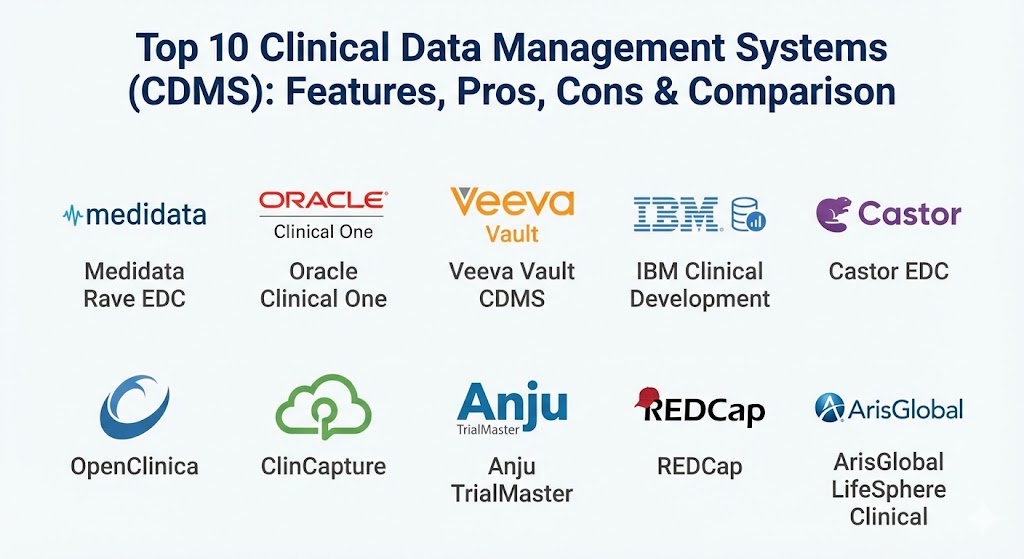
Top 10 Clinical Data Management Systems (CDMS) Tools
1 — Medidata Rave EDC
Medidata Rave is widely considered the “gold standard” in the clinical trial industry. As part of the Medidata Clinical Cloud, Rave EDC provides a robust, scalable environment designed to handle the most complex global trials with thousands of patients and sites.
- Key features:
- Intelligent data validation with automated edit checks to reduce manual queries.
- Deep integration with the broader Medidata ecosystem (eCOA, RTSM, Imaging).
- Scalable architecture that supports Phase I through Phase IV studies.
- Centralized monitoring and risk-based analytics for proactive trial oversight.
- Comprehensive data extraction tools supporting CDISC ODM standards.
- High-definition data visualizations for real-time study health checks.
- Flexible workflow configurations for multi-center, multi-country trials.
- Pros:
- Unmatched industry reputation; most CROs and sites are already trained on Rave.
- Extremely stable and reliable, even under the load of massive data volumes.
- Cons:
- High total cost of ownership; licensing and implementation can be expensive.
- Often requires specialized “Rave developers” or programmers for complex study builds.
- Security & compliance: Fully compliant with 21 CFR Part 11, GDPR, HIPAA, and ISO 27001. Features advanced audit logs, SSO, and multi-factor authentication.
- Support & community: Extensive documentation, Medidata Academy for certifications, and a global 24/7 support infrastructure.
2 — Oracle Clinical One
Oracle Clinical One is a unified platform that aims to eliminate the silos between EDC, RTSM, and data management. It is built on a modern cloud architecture designed for agility and speed.
- Key features:
- Unified environment that allows for study build once and reuse across modules.
- Automated discrepancy management to streamline the data cleaning process.
- Real-time data access with built-in advanced analytics and reporting.
- Strong integration with safety systems like Oracle Argus.
- Rapid study startup capabilities with drag-and-drop form builders.
- Support for decentralized trial elements (eSource, Direct-to-Patient).
- Pros:
- Excellent for large-scale enterprise sponsors who need a deep, integrated ecosystem.
- Reduces the time spent on data reconciliation between different point solutions.
- Cons:
- Steep learning curve for administrators new to the Oracle Health Sciences suite.
- Smaller organizations may find the feature set and price point overwhelming.
- Security & compliance: SOC 2 Type II, HIPAA, and GxP compliant. Oracle’s cloud infrastructure provides world-class data redundancy and encryption.
- Support & community: Robust enterprise support, comprehensive user guides, and an active user community through Oracle’s global events.
3 — Veeva Vault CDMS
Veeva Vault CDMS is a modern, cloud-native solution that has rapidly gained market share by focusing on user experience and efficiency. It is part of the Veeva Vault Clinical suite, creating a seamless flow from clinical operations to data management.
- Key features:
- Fast study build timelines with a modern, intuitive interface for designers.
- “Vault Connections” for automated data synchronization with CTMS and eTMF.
- Dynamic, real-time reporting without the need for complex data exports.
- Configurable data models that adapt to various therapeutic areas.
- Native mobile support for site users and monitors.
- Integrated medical coding and query management workflows.
- Pros:
- The most modern and user-friendly interface in the top-tier enterprise category.
- Frequent cloud updates ensure users always have access to the latest innovations.
- Cons:
- Best utilized within the Veeva ecosystem; standalone value is high but integration is the real draw.
- Relative newcomer compared to Medidata and Oracle, though adoption is surging.
- Security & compliance: Compliant with 21 CFR Part 11, GDPR, and HIPAA. ISO 27001 certified data centers with granular role-based access.
- Support & community: High-quality documentation, dedicated customer success managers, and a strong presence at industry conferences.
4 — IBM Clinical Development
IBM Clinical Development offers a versatile and scalable platform that leverages the power of IBM’s cloud and AI capabilities to optimize the trial lifecycle.
- Key features:
- AI-assisted data validation to identify trends and anomalies early.
- Modular approach allowing users to pick EDC, ePRO, or medical coding.
- Global platform supporting multiple languages and localized regulatory needs.
- Integrated dashboards for site performance and patient enrollment tracking.
- Advanced reporting engine with customizable templates and SAS exports.
- Pros:
- Backed by IBM’s reputation for data security and enterprise-level stability.
- Highly flexible pricing and deployment options for various study sizes.
- Cons:
- The user interface can feel more technical and less “modern” than Veeva or Castor.
- Implementation may require more heavy lifting compared to “plug-and-play” rivals.
- Security & compliance: GDPR, HIPAA, and 21 CFR Part 11 compliant. Utilizes IBM’s highly secure data centers with end-to-end encryption.
- Support & community: 24/7 technical support, on-demand training modules, and a dedicated professional services team.
5 — Castor EDC
Castor EDC is a user-friendly, cloud-based system that has become a favorite among small-to-mid-sized biotechs and academic researchers for its ease of setup and affordability.
- Key features:
- Low-code eCRF builder that allows users to build a study in weeks rather than months.
- Seamless integration with EHR/EMR systems and wearable devices via API.
- Integrated eConsent and ePRO modules for decentralized trial support.
- Real-time dashboards for study metrics and data entry progress.
- Native mobile app for patient data entry and tracking.
- Pros:
- One of the lowest barriers to entry in terms of cost and technical complexity.
- Excellent site adoption rates due to the intuitive design.
- Cons:
- May lack some of the ultra-advanced “logic-heavy” features required for massive Phase III global trials.
- Reporting capabilities, while good, are less exhaustive than enterprise giants like Oracle.
- Security & compliance: ISO 27001, GDPR, HIPAA, and 21 CFR Part 11 compliant. Hosted on secure, regional servers.
- Support & community: Fast response times from technical support and a wealth of online tutorials.
6 — OpenClinica
OpenClinica is built on open standards and is widely used for its flexibility and strong focus on community-driven innovation. It offers both an enterprise cloud and an open-source version.
- Key features:
- Drag-and-drop eCRF design using standard CDASH templates.
- Real-time data validation and automated query generation.
- Support for “eSource” to capture data directly into the system at the site.
- Collaborative study build environment for cross-functional teams.
- Integrated randomization and medical coding modules.
- Pros:
- Highly cost-effective, particularly for academic and investigator-initiated trials.
- Transparent, open-standards approach prevents vendor lock-in.
- Cons:
- The open-source version requires significant in-house IT expertise for validation and hosting.
- The enterprise cloud UI, while improved, is less “glossy” than Veeva.
- Security & compliance: Compliant with 21 CFR Part 11, GDPR, and HIPAA. Strong audit trail and data versioning.
- Support & community: Dedicated Customer Success Managers for enterprise clients and a very active developer community.
7 — ClinCapture
ClinCapture provides a “Virtual Data Capture” (VDC) technology designed to streamline remote and decentralized clinical trials. It is known for its fast deployment and intuitive workflows.
- Key features:
- Rapid study build engine with pre-validated form libraries.
- Integrated ePRO and eConsent for remote patient engagement.
- Real-time data insights with custom dashboard views.
- Private cloud infrastructure for enhanced data privacy and performance.
- Simple, browser-based access for site users with no software installation required.
- Pros:
- Very high value-to-cost ratio; provides enterprise features at a more accessible price.
- Designed for speed—ideal for fast-moving early-phase trials.
- Cons:
- Brand recognition is lower than the “Big Three” (Medidata, Oracle, Veeva).
- Integration ecosystem is growing but slightly smaller than its largest competitors.
- Security & compliance: 21 CFR Part 11, HIPAA, and GDPR compliant. SOC 2 Type II certified infrastructure.
- Support & community: Personalized support with quick turnaround times and a helpful online knowledge base.
8 — Anju TrialMaster
Anju Software’s TrialMaster is a mature, battle-tested CDMS that offers deep functionality and is particularly popular among mid-market sponsors and large CROs.
- Key features:
- Advanced data cleaning tools with multi-level review workflows.
- Integrated IVRS/IWRS and medical coding (MedDRA/WHODrug).
- Sophisticated ad-hoc reporting and data visualization tools.
- Support for hybrid trials with paper and electronic data entry.
- Highly configurable dashboards tailored to different user roles (Manager, Monitor, Site).
- Pros:
- Extremely reliable and well-regarded for its data integrity and reporting depth.
- Very competitive pricing model for the level of enterprise features provided.
- Cons:
- The administrative interface can feel somewhat dated compared to modern SaaS startups.
- Initial setup and configuration can be complex for very simple studies.
- Security & compliance: Fully compliant with global regulations including GxP, HIPAA, and GDPR. Robust audit logging and encryption.
- Support & community: Global 24/7 support, dedicated training, and a strong professional services team.
9 — REDCap (Research Electronic Data Capture)
REDCap is the titan of the academic research world. While not traditionally viewed as a commercial CDMS, its widespread use in clinical research makes it an essential mention.
- Key features:
- Free to use for non-profit organizations that join the REDCap Consortium.
- Simple eCRF creation with intuitive data entry forms.
- Integrated survey module for patient-reported data.
- Longitudinal data collection support for follow-up studies.
- Large library of shared instruments and forms from the research community.
- Pros:
- Zero licensing cost for eligible academic institutions.
- Massive global community; if you have a problem, someone has likely solved it on a forum.
- Cons:
- Requires significant manual effort for “validation” to meet 21 CFR Part 11 for commercial use.
- Lacks many of the high-end automation and “unified suite” integrations found in commercial tools.
- Security & compliance: Compliance depends on how the institution hosts and validates the instance; supports HIPAA-compliant workflows.
- Support & community: Primarily community-supported through a massive network of thousands of institutions.
10 — ArisGlobal LifeSphere Clinical
ArisGlobal’s LifeSphere platform focuses on “cognitive automation,” using AI and machine learning to drive efficiency across the clinical lifecycle.
- Key features:
- AI-driven data cleaning to automate the identification of errors.
- Unified platform across Clinical, Safety, Regulatory, and Medical Affairs.
- Modern, responsive UI designed for ease of use across devices.
- Built-in signal detection and risk management capabilities.
- Scalable SaaS deployment on high-performance cloud infrastructure.
- Pros:
- Excellent for organizations looking for a “future-proof” AI-first strategy.
- Tight integration with safety/PV systems is a unique and powerful differentiator.
- Cons:
- The AI features require a clean dataset and proper configuration to be effective.
- Implementation can be resource-intensive due to the platform’s breadth.
- Security & compliance: ISO 27001 certified, GDPR compliant, and 21 CFR Part 11 ready. SSO and role-based security.
- Support & community: Global 24/7 support, online training academy, and an annual user conference for networking and insights.
Comparison Table
| Tool Name | Best For | Platform(s) Supported | Standout Feature | Rating (TrustRadius / G2) |
| Medidata Rave | Global Enterprise | Cloud (Web) | Industry-Standard Robustness | 4.5 / 5 |
| Oracle Clinical One | Unified Trials | Cloud (Web) | Deep Oracle Ecosystem | 4.3 / 5 |
| Veeva Vault CDMS | Life Science Orgs | Cloud (Web/Mobile) | Modern UI & Workflow | 4.7 / 5 |
| IBM Clinical Dev | Data-Driven Teams | Cloud (Web) | AI-Assisted Insights | 4.2 / 5 |
| Castor EDC | Biotechs / Mid-Market | Cloud (Web/Mobile) | Rapid Study Build | 4.6 / 5 |
| OpenClinica | Academic / Mid-Market | Cloud / On-Prem | Open Standards Support | 4.4 / 5 |
| ClinCapture | Fast Growth Orgs | Private Cloud | Virtual Data Capture | 4.3 / 5 |
| Anju TrialMaster | High Volume CROs | Cloud (Web) | Reporting Depth | 4.1 / 5 |
| REDCap | Academic Research | On-Prem / Cloud | Free Consortium Model | 4.8 / 5 |
| ArisGlobal | AI-First Strategy | Cloud (SaaS) | Cognitive Automation | 4.0 / 5 |
Evaluation & Scoring of Clinical Data Management Systems (CDMS)
To help organizations make an informed choice, we have evaluated the general performance of CDMS tools using a weighted rubric based on industry requirements.
| Category | Weight | Evaluation Focus |
| Core Features | 25% | eCRF builder, query management, data validation, medical coding. |
| Ease of Use | 15% | Intuitive UI for sites and data managers, mobile accessibility. |
| Integrations | 15% | APIs, EHR/EMR connectivity, lab/imaging integration, CTMS/eTMF flow. |
| Security & Compliance | 10% | 21 CFR Part 11, GDPR, HIPAA, audit trails, encryption standards. |
| Performance & Reliability | 10% | Uptime, system speed during data entry, scalability for large trials. |
| Support & Community | 10% | 24/7 helpdesk, onboarding quality, user forums, training certifications. |
| Price / Value | 15% | Licensing costs, implementation fees, and ROI on study build time. |
Which Clinical Data Management Systems (CDMS) Tool Is Right for You?
Choosing a CDMS is a high-impact decision that affects every stakeholder in the clinical trial process. Use this guide to narrow down your options:
- Solo Researchers & Academic Centers: If you are working on a budget and have strong IT support, REDCap or the open-source version of OpenClinica are the logical starting points. They offer high flexibility for research-oriented data collection.
- Biotech Startups & SMBs: If you need to move fast and don’t have a large internal IT team, Castor EDC or ClinCapture are excellent. They offer rapid setup and intuitive designs that make site adoption a breeze.
- Mid-Market Sponsors & CROs: Anju TrialMaster and OpenClinica Enterprise provide a sweet spot of deep feature sets and competitive pricing, making them ideal for organizations scaling their pipelines.
- Global Enterprise Sponsors: If budget is secondary to robustness and global regulatory acceptance, Medidata Rave, Oracle Clinical One, or Veeva Vault CDMS are the top contenders. These tools provide the “all-in-one” ecosystems that large pharma companies require to manage hundreds of simultaneous trials.
- Security & Compliance Priorities: For organizations with extremely sensitive data or those operating in multiple jurisdictions with strict data residency laws, Veeva and IBM offer some of the most advanced cloud security frameworks in the industry.
Frequently Asked Questions (FAQs)
1. Is a CDMS the same as an EDC?
Technically, no, but the terms are often used interchangeably today. Electronic Data Capture (EDC) is the component used for entering data. A CDMS is the broader system that manages that data through cleaning, validation, and final export for analysis.
2. Can I use these tools for medical device trials?
Yes. Most modern CDMS tools are designed to be therapeutic-area agnostic. Systems like Castor and ClinCapture are frequently used for medical device trials due to their flexibility and ease of integration with device telemetry.
3. Do these systems work offline?
Most modern systems are cloud-based and require an internet connection for real-time syncing. However, some (like Medidata and Veeva) have mobile apps or specific modules that allow for offline data capture, which then syncs once a connection is re-established.
4. How long does it take to build a study in a CDMS?
This varies wildly. A simple study in a tool like Castor might take 2–4 weeks. A complex global Phase III study in Medidata Rave could take 3–6 months to build, validate, and launch.
5. Are CDMS tools integrated with lab data?
Yes, high-end CDMS tools support automated lab data ingestion via standard formats like CDISC. This eliminates the need for site staff to manually enter lab results from paper reports.
6. Do I need a programmer to use these systems?
For “low-code” systems like Castor or OpenClinica, a non-technical study designer can often handle the build. For enterprise systems like Rave, you typically need a specialized programmer to write custom edit checks and logic.
7. Can a CDMS help with patient recruitment?
Indirectly, yes. Some platforms (like OpenClinica or IBM) have modules that integrate with EHR systems to help identify eligible patients, while others integrate with patient portals to streamline the enrollment process.
8. What is “Data Locking” in a CDMS?
Data locking is the process of preventing further edits to a dataset once it has been cleaned and verified. This is a critical regulatory milestone before the data is handed over to biostatisticians for final analysis.
9. How do these tools handle protocol amendments?
Modern cloud-based CDMS tools allow for mid-study amendments. You can update forms or validation rules without taking the system offline, though significant changes still require careful versioning and validation.
10. Is training required for site staff?
Absolutely. Regulatory agencies require proof that anyone using the system has been properly trained. Most CDMS vendors provide built-in training modules and “e-certificates” to automate this compliance requirement.
Conclusion
The selection of a Clinical Data Management System is no longer just an IT decision; it is a strategic business decision. Whether you prioritize the battle-tested robustness of Medidata, the modern cloud efficiency of Veeva, or the agile accessibility of Castor, the goal remains the same: high-quality, inspection-ready data that can withstand regulatory scrutiny. As clinical trials become increasingly data-heavy and patient-centric, the “best” tool will be the one that provides the cleanest path from patient observation to meaningful medical insight.