Introduction
Academic credentialing platforms are specialized software-as-a-service (SaaS) ecosystems designed to bridge the gap between educational institutions, learners, and employers. At their core, these platforms allow universities, colleges, and professional bodies to issue tamper-proof digital versions of degrees, transcripts, and micro-credentials. Unlike a simple PDF, these digital credentials contain rich metadata, often anchored by blockchain or cryptographic signatures, allowing for instant verification without the need for manual registrar intervention.
The importance of these tools cannot be overstated. In a landscape where “resume fraud” is a multi-billion dollar problem, these platforms restore trust. They provide learners with a portable “digital wallet” of their skills, while offering employers a “single source of truth” for candidate verification. Real-world use cases span from traditional four-year universities automating transcript requests to corporate training departments issuing “stackable” badges for upskilling. When choosing a platform, evaluation criteria typically focus on interoperability (Open Badges standards), security protocols, ease of integration with existing Student Information Systems (SIS), and the user experience for the learner.
Best for: Higher education institutions (Registrars and Provosts), professional certification bodies, bootcamps, large-scale corporate L&D departments, and government education agencies seeking to modernize their data infrastructure.
Not ideal for: Small, non-accredited hobbyist courses or local community groups where a simple, non-verified PDF certificate suffices and the cost of an enterprise credentialing engine cannot be justified.
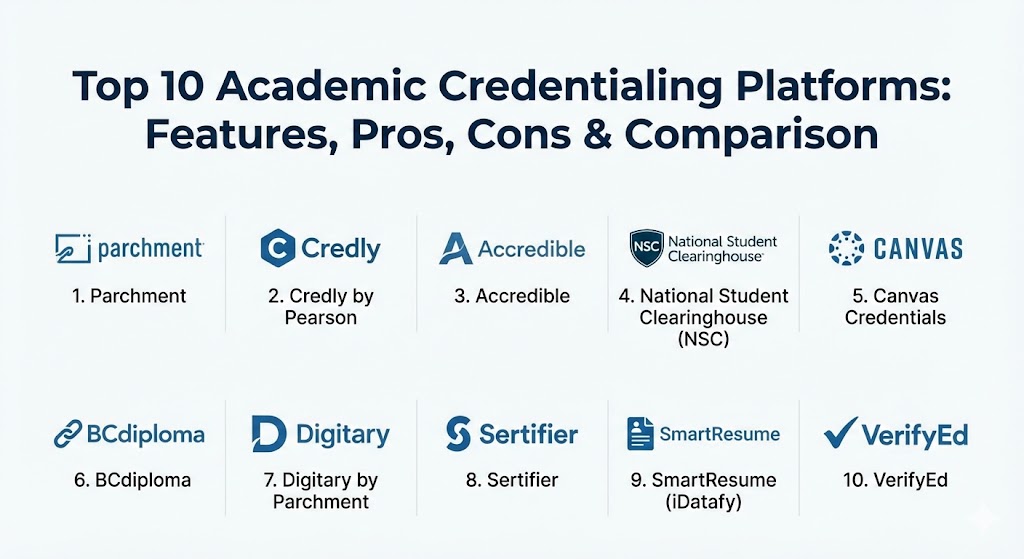
Top 10 Academic Credentialing Platforms
1 — Parchment
Parchment is widely considered the industry leader in academic record exchange. It provides an all-in-one platform for issuing and receiving transcripts, diplomas, and certificates for thousands of institutions globally.
- Key features:
- Unified “Parchment Send” and “Parchment Receive” network for seamless transcript exchange.
- Award-winning digital and physical diploma fulfillment services.
- Deep integration with major Student Information Systems (SIS) like Ellucian and Oracle PeopleSoft.
- Comprehensive data analytics for enrollment and graduation tracking.
- Automated workflow for third-party verification requests.
- High-fidelity “Secure Blue Ribbon” PDF technology for digital security.
- Pros:
- Unmatched network effect; if you are a major US university, your partners are likely already on Parchment.
- One of the few platforms that handles both digital and high-quality physical print fulfillment.
- Cons:
- The user interface for administrators can feel slightly dated compared to newer, “fintech-style” platforms.
- Implementation can be complex due to the depth of SIS integration required.
- Security & compliance: FERPA, GDPR, HIPAA, and SOC 2 Type II compliant. Uses advanced cryptographic seals for PDFs.
- Support & community: Extensive documentation, dedicated implementation managers for enterprise accounts, and a large annual user conference.
2 — Credly (by Pearson)
Credly is the world’s largest digital credentialing network, focusing heavily on digital badges and the “skills-based” economy. Since its acquisition by Pearson, it has expanded its reach into every major corporate and academic vertical.
- Key features:
- Robust digital badging system based on the Open Badges standard.
- Integrated “Labor Market Insights” that show earners which jobs require their specific skills.
- One-click sharing to LinkedIn, Twitter, and professional portfolios.
- Enterprise-class analytics to track badge earner engagement and sharing rates.
- Automated badge issuance triggered by LMS completion.
- Comprehensive API for custom integrations.
- Pros:
- The most recognized name in digital badging; employers are familiar with the “Credly badge.”
- Excellent mobile-first experience for learners to manage their “skills wallet.”
- Cons:
- High price point for smaller institutions; primarily an enterprise solution.
- Less focused on “formal” academic transcripts compared to Parchment.
- Security & compliance: ISO 27001, ISO 27701, GDPR, and SOC 2. Earner-centric privacy controls are built-in.
- Support & community: World-class customer success team, detailed onboarding packages, and a massive global user base.
3 — Accredible
Accredible is a highly polished, feature-rich platform that allows organizations to issue digital certificates and badges from a single, centralized dashboard. It is a favorite among professional associations and mid-market universities.
- Key features:
- “Spotlight” directories that allow employers to search for credential holders directly.
- Advanced certificate designer with hundreds of templates and branding options.
- Automated name-change and credential expiration management.
- Comprehensive reporting on how and where credentials are being shared.
- Seamless integrations with LMS platforms like Moodle, Canvas, and Thinkific.
- Recipients do not need to create an account to view or share their credentials.
- Pros:
- Exceptionally easy to use for both administrators and students.
- Very strong social sharing features that boost an institution’s organic brand visibility.
- Cons:
- Advanced features like API access are restricted to higher-tier pricing plans.
- The platform is very “badge-centric,” which might not appeal to those needing traditional, long-form academic records.
- Security & compliance: SOC 2, GDPR, FERPA, and end-to-end data encryption.
- Support & community: 24/5 live chat support, a rich knowledge base, and dedicated success managers for larger accounts.
4 — National Student Clearinghouse (Myhub)
As a non-profit organization, the National Student Clearinghouse (NSC) is the primary source for postsecondary enrollment and degree verification in the United States. Its “Myhub” platform provides a central location for students to access all their records.
- Key features:
- Direct access to verified degree and enrollment data for over 97% of US students.
- “Myhub” learner portal where students can organize all their academic achievements in one place.
- Automated transcript ordering and fulfillment services.
- High-security verification for employers and credit providers.
- Longitudinal data research and reporting for participating institutions.
- Pros:
- High level of trust; it is the “de facto” official source for US higher education verification.
- Low cost for students compared to some private commercial platforms.
- Cons:
- Primarily focused on the US market; limited utility for international institutions.
- The platform can feel more like a government database than a modern user experience.
- Security & compliance: Strict FERPA compliance and robust data security protocols.
- Support & community: Standard academic support; extensive resources for registrars and financial aid offices.
5 — Canvas Credentials (formerly Badgr)
Integrated directly into the Instructure (Canvas) ecosystem, Canvas Credentials is a leading platform for micro-credentials and pathways within the classroom environment.
- Key features:
- Native integration with Canvas LMS, allowing badges to be awarded automatically upon module completion.
- “Pathways” feature that allows students to see how their badges “stack” toward a larger goal.
- Support for the Open Badges 2.0 and 3.0 standards.
- Digital “Backpack” for learners to store badges from any issuer.
- Leaderboards and gamification elements to drive student engagement.
- Pros:
- If your institution already uses Canvas, this is the most seamless way to implement micro-credentialing.
- Free version (Canvas Badges) is available for individual instructors.
- Cons:
- Features outside of the Canvas environment can feel less robust than standalone platforms.
- Customization of certificates is limited compared to Accredible.
- Security & compliance: GDPR, FERPA, and SOC 2. Benefit from Instructure’s broader security infrastructure.
- Support & community: Supported by the massive Canvas Community and global Instructure support network.
6 — BCdiploma
BCdiploma is a pioneer in blockchain-based credentialing. It focuses on decentralization, ensuring that a learner’s degree is permanent and tamper-proof without relying on the longevity of the software vendor.
- Key features:
- Patent-pending blockchain technology that ensures data is “notary-sealed” and immutable.
- No database dependency; the credential exists on the blockchain forever.
- White-labeling options to keep institutional branding at the forefront.
- Multilingual support for global student bodies.
- Dynamic credentials that can be updated (e.g., adding honors) while maintaining the original seal.
- Pros:
- Maximum security and longevity; even if BCdiploma were to shut down, the records remain verifiable.
- Highly impressive “wow factor” for institutions wanting to be seen as tech leaders.
- Cons:
- Blockchain technology can be a “hard sell” for more conservative academic administrations.
- Integration with legacy SIS can be more manual than with Parchment.
- Security & compliance: GDPR, high-level cryptographic security, and ISO 27001.
- Support & community: High customer satisfaction; responsive European-based support team.
7 — Digitary (by Parchment)
Digitary, now part of the Parchment family, is a major player in the international market, particularly in Europe, Australia, and New Zealand. It specializes in secure, official digital records.
- Key features:
- Secure learner-controlled platform for sharing official transcripts and degrees.
- Support for “Mychals” (Australia/NZ) and other regional identity frameworks.
- Seamless cross-border credential verification.
- Cryptographically signed documents that meet legal standards for “official” records.
- Pros:
- Excellent for institutions with a high volume of international students.
- Very strong focus on student agency—the learner is in total control of who sees what.
- Cons:
- Less emphasis on “gamified” badges than Credly or Accredible.
- As it integrates further with Parchment, some regional users are wary of product consolidation.
- Security & compliance: GDPR, FERPA, and Australian Privacy Principles.
- Support & community: Dedicated regional support teams in multiple time zones.
8 — Sertifier
Sertifier is an agile, modern credentialing platform that has quickly gained ground due to its focus on data-driven insights and ease of use.
- Key features:
- “Smart Badge” designer with AI-driven skill suggestions.
- Recipient tracking that shows exactly who shared their credential and where.
- Built-in skills mapping to align credentials with industry standards.
- Automated issuance via API or Zapier integrations.
- Customizable learner portals for institutions.
- Pros:
- Very affordable pricing for mid-sized training providers.
- The AI features for skill mapping are unique and highly useful for curriculum design.
- Cons:
- Smaller brand name recognition compared to Credly.
- Fewer deep SIS integrations compared to the “Big Two” (Parchment/NSC).
- Security & compliance: GDPR compliant, encryption at rest/transit.
- Support & community: Fast email and chat support; growing library of video tutorials.
9 — SmartResume (iDatafy)
SmartResume is a unique “career network” platform that uses verified academic data to create a certified resume for learners, essentially eliminating “resume padding.”
- Key features:
- Institutions create a “SmartResume” for the learner based on verified records.
- Direct “Certified Talent Pipeline” for employers to find pre-verified candidates.
- Blockchain-secured credential entries.
- Focus on “equity” by allowing employers to search by skills rather than just pedigree.
- Pros:
- Provides immediate “ROI” for the student by connecting them directly to jobs.
- Completely eliminates the need for an employer to call a registrar to verify a degree.
- Cons:
- Success depends on the size of the employer network on the platform.
- Not a traditional “credentialing platform” for those just wanting to issue diplomas.
- Security & compliance: SOC 2, HIPAA, and GDPR compliant.
- Support & community: High-touch onboarding for partner universities.
10 — VerifyEd
VerifyEd is a blockchain-based platform that prides itself on being “built by educators for educators,” focusing on simplicity and long-term trust.
- Key features:
- Simple, no-code environment for issuing blockchain-verified certificates.
- “Digital Wallet” app for students to store all their achievements.
- Automated expiration alerts for professional certifications.
- “Verified Professional Profiles” that aggregate all of a person’s achievements.
- Pros:
- Extremely fast setup; an institution can be issuing credentials in under 24 hours.
- Very transparent pricing and “green” blockchain implementation (low energy usage).
- Cons:
- Still a relatively new player; fewer enterprise features than Parchment.
- The ecosystem of integrations is still growing.
- Security & compliance: GDPR and UK Data Protection Act compliant.
- Support & community: Highly personal support; active engagement with the UK education sector.
Comparison Table
| Tool Name | Best For | Platform(s) Supported | Standout Feature | Rating (Gartner/TrueReview) |
| Parchment | US Higher Ed / Transcripts | Web, SIS Integrated | Massive exchange network | 4.7 / 5 |
| Credly | Skills-based Badging | Web, Mobile, API | Labor Market Insights | 4.8 / 5 |
| Accredible | Ease of Use / All-in-one | Web, LMS Integrated | Spotlight Directories | 4.6 / 5 |
| NSC (Myhub) | Official US Verification | Web | 97% US Student Coverage | N/A |
| Canvas Credentials | Canvas Users | Web, Mobile | Pathways & LMS Native | 4.5 / 5 |
| BCdiploma | Immortality / Blockchain | Web, White-label | No-database dependency | 4.6 / 5 |
| Digitary | International Records | Web, Mobile | Global Interoperability | 4.4 / 5 |
| Sertifier | Growth-Stage Providers | Web, API | AI Skill Mapping | 4.7 / 5 |
| SmartResume | Employment ROI | Web | Certified Talent Pipeline | N/A |
| VerifyEd | Rapid Deployment | Web, Mobile App | Educator-focused UX | 4.8 / 5 |
Evaluation & Scoring of Academic Credentialing Platforms
To help you decide, we have evaluated the top players using a weighted scoring rubric that reflects the priorities of modern educational administrators.
| Category | Weight | Evaluation Criteria |
| Core Features | 25% | Badge/certificate design, bulk issuance, multi-language support, and transcript management. |
| Ease of Use | 15% | Administrative dashboard intuitiveness, student “wallet” experience, and sharing simplicity. |
| Integrations | 15% | Native connectors for SIS (Ellucian, Oracle) and LMS (Canvas, Blackboard, Moodle). |
| Security & Compliance | 10% | FERPA/GDPR status, blockchain/cryptographic usage, and audit logging. |
| Performance | 10% | Verification speed, platform uptime, and high-volume issuance handling. |
| Support | 10% | Implementation quality, technical support response time, and user documentation. |
| Price / Value | 15% | Transparency of pricing, ROI for learners, and scalability costs. |
Which Academic Credentialing Platform Is Right for You?
Choosing a platform is not a one-size-fits-all decision. Your choice will depend on your institution’s specific goals.
Solo Users vs SMB vs Mid-Market vs Enterprise
- Individual Educators/Small Bootcamps: Start with the free tier of Canvas Badges or Accredible’s trial. You need ease of use and low cost more than deep SIS integration.
- Mid-Market Training Providers: Sertifier or Accredible offer the best balance of professional features and affordable entry points.
- Large Enterprises/Universities: Parchment and Credly are the standard. They offer the security and scalability required for handling hundreds of thousands of learners.
Budget-Conscious vs Premium Solutions
If budget is the primary driver, VerifyEd or Sertifier offer high value at a lower price point. If you need a “premium” brand name that employers recognize instantly, the investment in Credly or Parchment is often justified by the trust it builds with graduates.
Feature Depth vs Ease of Use
If you need deep, complex transcript management, you must choose Parchment or NSC, even if the UI is more complex. If you want a “plug and play” system for digital badges that looks beautiful and is easy to share on LinkedIn, Accredible wins on ease of use.
Security and Compliance Requirements
For institutions in the EU, BCdiploma or Digitary offer the strongest alignment with GDPR and local data residency needs. For US-based schools, the National Student Clearinghouse is the gold standard for regulatory compliance.
Frequently Asked Questions (FAQs)
1. Are digital credentials as legally valid as paper diplomas?
Yes. Modern digital credentials use cryptographic signatures or blockchain anchors that make them legally verifiable and, in many cases, more trusted than a physical copy which can be easily forged with a high-quality printer.
2. What happens to a student’s credential if the platform company goes out of business?
This is a major concern. Platforms like BCdiploma and VerifyEd use decentralized blockchain technology, meaning the credential exists independently of the company. Other platforms like Parchment allow learners to download “Secure PDFs” that remain valid even if the platform is inaccessible.
3. Do these platforms integrate with our current database (SIS)?
Most enterprise tools (Parchment, NSC) have native integrations with major SIS like Ellucian and Oracle. Mid-market tools usually offer a robust API or “CSV upload” features for those without direct connectors.
4. How do employers verify these credentials?
Typically, the employer clicks a link or scans a QR code provided by the candidate. This takes them to a secure verification page where the platform confirms the data is authentic and hasn’t been altered.
5. How much do these platforms cost?
Pricing varies wildly. Some are based on the number of “active learners,” while others charge per credential issued. Expect anywhere from $500/year for small providers to $50,000+/year for large university systems.
6. Can students share these badges on LinkedIn?
Yes, this is a core feature of all top-tier platforms. Credly and Accredible, in particular, allow for “one-click” sharing that populates the LinkedIn “Licenses & Certifications” section automatically.
7. Is blockchain necessary for academic credentialing?
It is not “necessary,” but it is a powerful tool for ensuring immutability. While centralized databases (like Parchment) are currently the standard, blockchain is becoming more popular for its “lifetime” durability.
8. What are “Open Badges”?
Open Badges is a global technical standard for digital badges. It ensures that a badge earned on one platform can be recognized and stored in a “backpack” or “wallet” provided by another platform.
9. Can we issue traditional transcripts through these tools?
Yes. While some are badge-focused, platforms like Parchment, Digitary, and National Student Clearinghouse are specifically built for the high-security requirements of official academic transcripts.
10. How long does it take to implement a platform?
A simple SaaS-based platform can be ready in days. A full university integration with an SIS and historical data migration typically takes 3 to 6 months.
Conclusion
The shift toward academic credentialing platforms is more than just a technological upgrade; it is a fundamental change in how we value and verify human achievement. Whether you are a large-scale university seeking to automate decades of records or a niche training provider looking to boost your brand on social media, there is a tool designed for your specific needs.
Ultimately, the “best” tool isn’t the one with the most features, but the one that your learners will actually use and that employers in your industry will trust. As we move further into 2026, the institutions that embrace these digital-first standards will be the ones that provide the most value to their graduates in an increasingly competitive global job market.