Introduction
Financial Risk Management software refers to a suite of digital tools designed to identify, analyze, and mitigate potential losses in an organization’s financial portfolio. By utilizing complex mathematical models and real-time data feeds, these systems allow risk officers to simulate “what-if” scenarios, calculate exposure limits, and ensure compliance with international standards like Basel III, Basel IV, and IFRS 9. The primary goal is to provide a clear, quantifiable view of risk so that stakeholders can make informed decisions rather than reactive ones.
Key real-world use cases include a bank calculating its $Value at Risk (VaR)$ across global branches, an energy firm hedging against fluctuating fuel prices, or a corporate treasury managing foreign exchange (FX) exposure during a period of currency instability. When evaluating FRM tools, users should prioritize data integration capabilities, the sophistication of their simulation engines (such as Monte Carlo or historical simulations), the speed of stress testing, and the robustness of their regulatory reporting modules.
Best for: Commercial and investment banks, hedge funds, asset management firms, insurance providers, and large corporate treasuries. It is particularly essential for Chief Risk Officers (CROs) and compliance teams who must satisfy rigorous external audits and regulatory inquiries.
Not ideal for: Small local businesses with simple cash flows, personal investors, or firms with minimal exposure to market fluctuations. For these users, basic accounting software or standard treasury management modules are often sufficient.
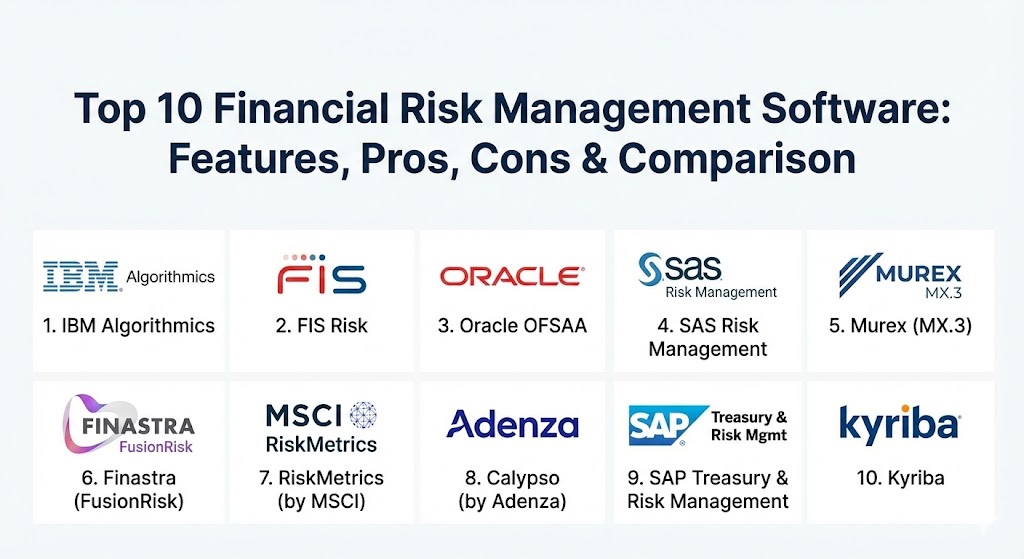
Top 10 Financial Risk Management Software Tools
1 — IBM Algorithmics
IBM Algorithmics is a heavyweight in the risk management world, known for its deep analytical capabilities and its ability to handle massive, complex portfolios. It provides an enterprise-wide view of risk, allowing institutions to align their risk-taking with their strategic goals.
- Key features:
- Advanced $Value at Risk (VaR)$ and $Expected Shortfall (ES)$ calculations.
- Sophisticated credit risk analytics including Potential Future Exposure (PFE).
- Comprehensive stress testing and “what-if” scenario modeling.
- Regulatory capital management for Basel III/IV compliance.
- Managed data services to ensure high-quality input for models.
- High-performance computing (HPC) support for rapid calculations.
- Pros:
- Unmatched depth in mathematical modeling and simulation accuracy.
- Highly scalable for global institutions with millions of daily transactions.
- Cons:
- Extremely high total cost of ownership (TCO).
- Requires a team of specialized quantitative analysts to manage and interpret data.
- Security & compliance: SOC 2, GDPR, HIPAA, and ISO 27001 compliant. Features robust SSO and end-to-end data encryption.
- Support & community: Extensive enterprise support; dedicated account managers; access to the vast IBM Knowledge Center and global user groups.
2 — FIS Risk (formerly SunGard)
FIS Risk offers a modular approach to risk management, catering to both financial institutions and corporate treasuries. It focuses on providing a unified view of market, credit, and liquidity risk.
- Key features:
- Real-time limits management and monitoring.
- Cross-asset class coverage (equities, fixed income, FX, and commodities).
- Integrated liquidity risk and ALM (Asset Liability Management) tools.
- Automated regulatory reporting templates.
- Cloud-native deployment options for increased agility.
- Interactive risk dashboards for C-suite visibility.
- Pros:
- Modular design allows firms to purchase only the components they need.
- Excellent at aggregating data from disparate front-office systems.
- Cons:
- Integration between different FIS modules can sometimes be cumbersome.
- The user interface can feel dated in certain legacy modules.
- Security & compliance: SOC 1/2/3, GDPR, and ISO 22301. Strong focus on data residency and multi-tenant security.
- Support & community: 24/7 global support; extensive documentation; regular regional user conferences.
3 — Oracle Financial Services Analytical Applications (OFSAA)
Oracle’s OFSAA is an integrated suite of applications that covers everything from risk management and performance to compliance and customer insight. It is built on top of the powerful Oracle database ecosystem.
- Key features:
- Enterprise-wide credit risk management and loss forecasting.
- Advanced market risk analytics with sensitivity analysis.
- Operational risk management with integrated loss event tracking.
- Financial crime and anti-money laundering (AML) integration.
- Unified data model that reduces data silos across the bank.
- AI-driven predictive modeling for early warning signs.
- Pros:
- Deep integration with existing Oracle infrastructure, making it ideal for Oracle-heavy firms.
- Exceptionally strong in data governance and lineage tracking.
- Cons:
- Requires significant hardware resources and a complex implementation phase.
- The platform’s sheer size can lead to a steep learning curve for new users.
- Security & compliance: FedRAMP, SOC 2, GDPR, and FIPS 140-2. State-of-the-art identity management.
- Support & community: Robust Oracle Support portal; massive global community of developers and partners; premium “Platinum” support available.
4 — SAS Risk Management
SAS is a global leader in analytics, and its risk management suite is widely praised for its statistical power and its ability to handle unstructured data through AI and machine learning.
- Key features:
- Real-time risk sensing and automated alerting.
- Governance and orchestration of the entire model lifecycle (ModelOps).
- Visual risk analytics with drag-and-drop reporting.
- IFRS 9 and CECL (Current Expected Credit Loss) compliance tools.
- Fraud detection powered by machine learning.
- Scenario-based capital planning and stress testing.
- Pros:
- Industry-leading statistical and predictive modeling capabilities.
- Highly flexible and customizable to unique business requirements.
- Cons:
- Licensing costs are substantial and can be difficult for mid-market firms to justify.
- Requires proficiency in SAS programming for advanced customizations.
- Security & compliance: ISO 27001, SOC 2, and HIPAA. Comprehensive audit logs and role-based access control.
- Support & community: World-class customer support; very active SAS Communities forum; extensive free and paid training courses.
5 — Murex (MX.3)
Murex is a premier solution for capital markets, offering a platform (MX.3) that integrates trading, risk management, and post-trade processing into a single framework.
- Key features:
- Cross-asset risk engine with real-time $VaR$ and sensitivities.
- Counterparty Credit Risk (CCR) and CVA (Credit Valuation Adjustment) tools.
- Integrated collateral management and margining.
- High-performance “greeks” calculation for options portfolios.
- Native support for complex derivatives and structured products.
- Regulatory compliance for FRTB (Fundamental Review of the Trading Book).
- Pros:
- Eliminates the “gap” between trading and risk by using the same data for both.
- Excellent for managing exotic and highly complex financial instruments.
- Cons:
- One of the most complex systems to implement in the industry.
- Very high maintenance requirements for internal IT teams.
- Security & compliance: ISO 27001, SOC 2, and GDPR. Built for high-security banking environments.
- Support & community: High-touch enterprise support; dedicated client delivery teams; restricted but highly specialized user community.
6 — Finastra (FusionRisk)
Finastra’s FusionRisk is designed to provide mid-tier and large banks with a unified view of risk, focusing heavily on liquidity and balance sheet management.
- Key features:
- Integrated Asset Liability Management (ALM) and Funds Transfer Pricing (FTP).
- Real-time liquidity monitoring and stress testing.
- Regulatory reporting for local and international mandates.
- API-first architecture for easy connection to fintech ecosystems.
- Dynamic balance sheet simulation.
- Scenario analysis for interest rate risk in the banking book (IRRBB).
- Pros:
- More accessible and faster to deploy than the “mega-suites” like IBM or Oracle.
- Great focus on user experience and dashboard clarity.
- Cons:
- May lack the “exotic” derivative support found in Murex.
- Integration with non-Finastra core banking systems can vary in difficulty.
- Security & compliance: SOC 2, ISO 27001, and GDPR. Cloud security managed via Azure partnerships.
- Support & community: Finastra “Community” portal; 24/7 technical support; extensive documentation for developers.
7 — RiskMetrics (by MSCI)
RiskMetrics is an industry standard for multi-asset class risk analytics, particularly favored by asset managers and hedge funds for portfolio construction and risk reporting.
- Key features:
- Extensive library of historical market data and factor models.
- Multi-asset class $VaR$ and stress testing.
- ESG (Environmental, Social, and Governance) risk integration.
- Portfolio “look-through” capabilities for fund-of-funds.
- Performance attribution alongside risk analytics.
- Outsourced reporting services for institutional investors.
- Pros:
- The “gold standard” for reporting to institutional clients and regulators.
- Exceptional data quality and historical back-testing capabilities.
- Cons:
- Less focused on operational or credit risk; primarily a market risk tool.
- Can be expensive for smaller hedge funds.
- Security & compliance: SOC 2, GDPR, and ISO 27001. Rigorous data privacy standards for investment data.
- Support & community: Expert-led support; detailed methodology papers; widely used by professional risk associations globally.
8 — Calypso (by Adenza)
Calypso is another front-to-back office powerhouse that has recently merged with AxiomSL to form Adenza. It is known for its strength in treasury and capital markets.
- Key features:
- Centralized clearing and collateral management.
- Real-time credit and market risk limits.
- Integrated regulatory reporting (AxiomSL’s specialty).
- Support for treasury operations, including cash and liquidity management.
- Automated workflow orchestration for risk mitigation.
- High-fidelity scenario engine for market shocks.
- Pros:
- Extremely strong in clearing and margin calculations.
- Now offers one of the best integrated regulatory reporting modules in the world.
- Cons:
- Implementation can be long and resource-intensive.
- The platform is powerful but can be “overkill” for simpler treasuries.
- Security & compliance: SOC 2, ISO 27001, and HIPAA. Strong emphasis on secure cloud delivery.
- Support & community: 24/7 global support; professional services for implementation; access to Adenza’s user community.
9 — SAP Treasury and Risk Management
For corporations already running SAP S/4HANA, the SAP Treasury and Risk Management module provides a seamless way to manage financial risks without leaving the ERP environment.
- Key features:
- Fully integrated FX, interest rate, and commodity risk management.
- Automated hedge accounting and documentation (IFRS 9/US GAAP).
- Real-time cash position and liquidity forecasting.
- Direct integration with SAP’s accounting and payment modules.
- Credit risk monitoring for counterparties and customers.
- Market data integration via standard interfaces.
- Pros:
- Unrivaled integration with corporate financial statements and ERP data.
- Familiar interface for existing SAP users, reducing training time.
- Cons:
- Not as specialized in complex “bank-level” risk (e.g., CVA/DVA) as Algorithmics or Murex.
- Dependent on the broader SAP ecosystem to be truly effective.
- Security & compliance: ISO 27001, SOC 1/2, GDPR, and HIPAA. Benefits from SAP’s massive security R&D.
- Support & community: Global SAP support; vast network of consultants; “SAP Community” is one of the world’s largest.
10 — Kyriba (Enterprise Liquidity Management)
Kyriba has redefined the treasury space with a cloud-native platform that excels in liquidity risk and FX management, making it a favorite for mid-market and large global corporations.
- Key features:
- Real-time global cash visibility and liquidity forecasting.
- Automated FX exposure identification and hedging workflows.
- Bank connectivity via a massive pre-built network.
- Integrated supply chain finance and working capital tools.
- Fraud prevention and payment security modules.
- Comprehensive reporting for executive-level risk oversight.
- Pros:
- Best-in-class user interface; very easy to navigate and use.
- Fast implementation times compared to traditional on-premise systems.
- Cons:
- Lacks the deep “quant-heavy” modeling features of SAS or IBM.
- Primarily focused on liquidity and FX, not comprehensive market/credit risk for banks.
- Security & compliance: SOC 2 Type II, ISO 27001, and GDPR. Features advanced payment encryption.
- Support & community: Excellent onboarding; 24/7 support; “Kyriba Academy” for user training and certification.
Comparison Table
| Tool Name | Best For | Platform(s) Supported | Standout Feature | Rating (Gartner Peer Insights) |
| IBM Algorithmics | Enterprise-wide Quant Risk | On-Prem, Cloud, Hybrid | High-Fidelity Simulation | 4.6 / 5 |
| FIS Risk | Modular Banking Risk | Cloud-Native, SaaS | Unified Risk Dashboard | 4.4 / 5 |
| Oracle OFSAA | Data-Heavy Institutions | On-Prem, Cloud | Unified Data Model | 4.3 / 5 |
| SAS Risk Mgmt | Predictive & AI Risk | Cloud, On-Prem | ModelOps Integration | 4.7 / 5 |
| Murex (MX.3) | Capital Markets/Trading | On-Prem, Cloud | Front-to-Back Integration | 4.5 / 5 |
| Finastra Fusion | Mid-to-Large Banks | Cloud, SaaS | Liquidity/ALM Focus | 4.2 / 5 |
| MSCI RiskMetrics | Asset Managers | SaaS, Cloud | Multi-Asset Factor Models | 4.8 / 5 |
| Calypso (Adenza) | Clearing & Collateral | Cloud, On-Prem | Integrated Reg Reporting | 4.4 / 5 |
| SAP Treasury | Corporate ERP Users | S/4HANA (Cloud/On-Prem) | Native ERP Integration | 4.1 / 5 |
| Kyriba | Corporate Liquidity/FX | SaaS (Cloud-Native) | Cash Visibility & FX Mgmt | 4.6 / 5 |
Evaluation & Scoring of Financial Risk Management Software
Choosing a risk platform is a high-stakes decision. The following weighted rubric reflects the priorities of modern financial organizations.
| Category | Weight | Evaluation Criteria |
| Core Features | 25% | Precision of VaR/Stress testing, asset class coverage, and simulation depth. |
| Ease of Use | 15% | Dashboard clarity, report builder intuitiveness, and mobile accessibility. |
| Integrations | 15% | Connectivity to core banking, trading systems, and external market data feeds. |
| Security & Compliance | 10% | Regulatory reporting accuracy (Basel/IFRS) and data encryption. |
| Reliability | 10% | Calculation speed, system uptime, and disaster recovery capabilities. |
| Support | 10% | Quality of documentation, speed of support, and global availability. |
| Price / Value | 15% | Total cost of ownership relative to the reduction in potential losses. |
Which Financial Risk Management Software Tool Is Right for You?
The “perfect” tool depends entirely on your organizational profile and the specific risks you need to mitigate.
- Solo Users & Very Small Businesses: You likely do not need these tools. Focus on strong internal controls and basic treasury features within your accounting software (e.g., QuickBooks or Xero).
- SMB & Mid-Market Corporations: If your primary risks are FX and liquidity, Kyriba is the gold standard for ease of use and rapid ROI. If you need deeper accounting integration, Gaviti (for receivables) or a modular version of SAP may be appropriate.
- Mid-Tier Banks: Finastra FusionRisk offers a great balance between feature depth and implementation speed, particularly for liquidity and balance sheet management.
- Large Global Banks: You require the “power players.” IBM Algorithmics, Oracle OFSAA, or Murex are necessary to handle the sheer volume and complexity of a global multi-asset portfolio.
- Asset Managers & Hedge Funds: MSCI RiskMetrics is almost non-negotiable for providing the risk transparency required by sophisticated institutional investors.
- Budget-Conscious vs. Premium: If budget is no object and you need the best analytics, go with SAS or IBM. If you need value and efficiency, Kyriba or Finastra are often more cost-effective.
Frequently Asked Questions (FAQs)
1. What is the difference between $Value at Risk (VaR)$ and $Expected Shortfall (ES)$?
$VaR$ tells you the maximum loss you might expect over a certain period with a given confidence level (e.g., 95%). $ES$ (also called Tail VaR) tells you the average loss you might expect beyond that $VaR$ threshold, providing a better view of “extreme” events.
2. Is cloud-based risk management software secure enough for banks?
Yes. Modern SaaS providers like FIS and Finastra use dedicated, highly secure instances on AWS or Azure that often exceed the security capabilities of a bank’s internal data center.
3. How long does a typical implementation take?
For enterprise suites (IBM, Oracle, Murex), expect 12 to 24 months. For SaaS-native tools like Kyriba, implementation can often be completed in 3 to 6 months.
4. Can these tools handle ESG risks?
Many modern platforms, most notably MSCI RiskMetrics, are integrating Environmental, Social, and Governance (ESG) data to help firms understand climate-related risk and transition risks.
5. Do these systems replace the need for quantitative analysts?
No. While they automate the calculations, you still need “quants” to validate the models, choose the right assumptions, and interpret the results in the context of the current market.
6. What is “ModelOps” in risk management?
ModelOps (Model Operations) is the practice of managing the lifecycle of financial models—from development and testing to deployment and monitoring—to ensure they remain accurate over time.
7. Can I integrate my own custom Python or R models?
Yes, platforms like SAS and IBM allow you to wrap custom-coded models into their enterprise governance framework.
8. Why is “Data Lineage” so important for compliance?
Regulators want to see exactly where a risk number came from. Data lineage tools (like those in Oracle) track the data from its source to the final report, proving it hasn’t been tampered with.
9. How do these tools help with Basel IV compliance?
They include standardized templates and automated calculation engines that ensure your capital adequacy ratios are calculated according to the latest global banking regulations.
10. What is “Stress Testing” in this context?
Stress testing involves simulating extreme but plausible negative events (like a 2008-style crash or a pandemic) to see if the organization has enough capital to survive the shock.
Conclusion
Financial risk management is no longer a “back-office” function; it is a strategic advantage. The tools listed above represent the peak of financial engineering, designed to turn uncertainty into a measurable variable. When choosing a platform, remember that the most complex tool isn’t always the best. The “winner” is the one that integrates seamlessly with your data, provides clear visibility to your executives, and scales with your organization’s growth. By investing in the right FRM software, you aren’t just protecting your assets—you are ensuring your organization’s longevity.