Introduction
Product feedback and roadmap tools are specialized platforms designed to centralize user suggestions, prioritize them based on business value, and communicate the future direction of a product through visual timelines. These tools move product management away from “gut feelings” and toward data-driven decision-making. By aggregating feedback from multiple channels into a single repository, teams can identify high-impact opportunities that align with their long-term vision.
The importance of these tools lies in their ability to foster transparency and reduce wasted development cycles. Key real-world use cases include closing the “feedback loop” with customers (notifying them when their requested feature is live), managing complex internal stakeholder expectations, and prioritizing a backlog based on actual revenue impact. When evaluating these tools, users should look for robust integration capabilities, flexible prioritization frameworks (like RICE or Kano), public vs. private roadmap options, and sophisticated sentiment analysis.
Best for: Product Managers (PMs), User Researchers, Product Marketing Managers (PMMs), and Customer Success teams. These tools are most effective for B2B and B2C SaaS companies, mid-market organizations, and enterprises managing multiple product lines.
Not ideal for: Very early-stage startups with only a handful of users, or developers working on internal-only utility scripts where the “customer” is just the person sitting at the next desk. In these cases, a simple spreadsheet or a Trello board usually suffices.
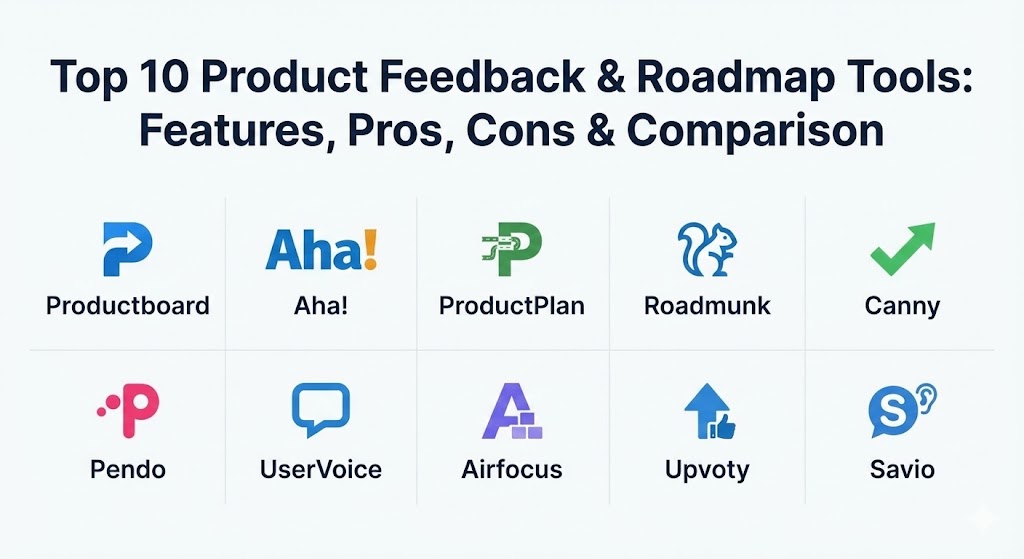
Top 10 Product Feedback & Roadmap Tools
1 — Productboard
Productboard is often cited as the gold standard for customer-centric product management. It is designed to help teams understand what users need, prioritize what to build next, and rally everyone around a shared roadmap.
- Key features:
- Centralized “Insights” repository that links feedback directly to features.
- Flexible prioritization matrices using custom drivers and scores.
- Dynamic, presentation-ready roadmaps that update in real-time.
- “Customer Board” for sharing planned features with a public audience.
- Robust integrations with Slack, Intercom, Zendesk, and Jira.
- Automated feedback categorization using AI-driven sentiment analysis.
- Portal for collecting votes and comments on potential future ideas.
- Pros:
- Excellent at creating a direct link between a feature and the specific customer quote that inspired it.
- Highly professional UI that makes it easy to present strategy to executives.
- Cons:
- The pricing is significantly higher than many competitors, making it an enterprise-leaning choice.
- The learning curve can be steep due to the sheer number of features and views.
- Security & compliance: SOC 2 Type II, GDPR, ISO 27001, and SSO integration (SAML).
- Support & community: Extensive documentation, a dedicated “Productboard Academy,” 24/7 priority support for enterprise, and a vibrant community of PMs.
2 — Aha!
Aha! is a comprehensive product development suite that focuses heavily on strategy and “the big picture.” It is the preferred choice for large organizations that need to link high-level corporate goals to granular feature releases.
- Key features:
- Strategic planning modules for defining vision, goals, and initiatives.
- Detailed roadmap views (Timeline, Kanban, and List) for every stakeholder.
- Integrated “Ideas Portal” for community-driven feedback and voting.
- Visual mock-up and wireframing tools built directly into the platform.
- Capacity planning to ensure teams are not over-committed.
- Custom workflows that adapt to any development methodology (Agile, Waterfall, etc.).
- “Aha! Develop” integration for a seamless handoff to engineering.
- Pros:
- Unrivaled for strategic depth; it ensures that no feature is built unless it supports a business goal.
- Massive amount of customization; you can tailor almost every field and workflow.
- Cons:
- The interface can feel “heavy” and cluttered, which may overwhelm smaller teams.
- Initial setup is time-consuming and often requires a dedicated administrator.
- Security & compliance: ISO 27001, SOC 2 Type II, HIPAA (with BAA), and GDPR. 256-bit encryption for all data.
- Support & community: High-touch support with “Product Success Managers,” extensive knowledge base, and regular live training webinars.
3 — ProductPlan
ProductPlan focuses on the “visual” side of roadmapping. It is designed for teams that need to create beautiful, easy-to-understand roadmaps quickly without the complexity of a full product management suite.
- Key features:
- Drag-and-drop roadmap builder with an emphasis on aesthetics.
- “Table View” for quick prioritization and data management.
- Unlimited viewers for free, making it easy to share roadmaps across the company.
- Integration with Jira, Azure DevOps, and GitHub for syncing progress.
- Portfolio views to see multiple product roadmaps in one master timeline.
- Version control to track changes and “snapshots” of past plans.
- Pros:
- Perhaps the easiest tool to learn in this list; you can have a roadmap in 10 minutes.
- The “Unlimited Viewers” model is a huge cost-saver for large organizations.
- Cons:
- Lacks a deep feedback management system; it is more of a “roadmap” tool than a “feedback” tool.
- Limited prioritization frameworks compared to Productboard or Aha!.
- Security & compliance: SOC 2 Type II, SSO, and data encryption.
- Support & community: Good documentation and a helpful blog, though community engagement is lower than niche competitors.
4 — Roadmunk
Roadmunk is a roadmap-first tool that excels at data visualization. It allows users to view the same set of data in multiple ways—from timelines to “swimlanes”—tailored to different audiences.
- Key features:
- “Timeline” view for date-driven roadmaps and “Swimlane” for theme-based plans.
- Feedback Inbox to capture and track user requests.
- Inherent prioritization templates (RICE, Value vs. Effort).
- Secure roadmap publishing for password-protected stakeholder views.
- “Masterview” for aggregating several roadmaps into a corporate-wide view.
- Advanced CSV export/import for legacy data migration.
- Pros:
- The flexibility of switching between Timeline and Swimlane views is industry-leading.
- Very strong for “Product Marketing” roles that need to show high-level themes.
- Cons:
- The feedback management module feels a bit like an add-on rather than a core focus.
- Integrations are functional but not as “deep” as those offered by Productboard.
- Security & compliance: SOC 2 Type II, GDPR, and SSO support.
- Support & community: Comprehensive Help Center and responsive email support.
5 — Canny
Canny is a feedback-centric platform that prioritizes simplicity and community engagement. It is famous for its public-facing feedback boards where users can vote on their favorite features.
- Key features:
- Public or private feedback boards with a clean, modern UI.
- Automated “changelog” feature to announce new releases to users.
- Direct link between feedback and roadmap items.
- Revenue-based prioritization (seeing the $ value behind a request).
- “Status” updates that automatically email users when a feature moves stages.
- Integration with Salesforce, HubSpot, and Slack.
- Pros:
- Excellent for building a community and making customers feel “heard.”
- The “Changelog” feature is a great way to show constant product momentum.
- Cons:
- Roadmap views are quite basic; not suitable for complex, date-driven enterprise plans.
- Can become noisy if you have a massive user base and don’t moderate boards.
- Security & compliance: SOC 2, GDPR, and SSO.
- Support & community: Highly praised support; very active blog and “build-in-public” culture.
6 — Pendo (Feedback Module)
Pendo is primarily known for digital adoption and in-app analytics, but its “Pendo Feedback” module is a powerful way to marry behavioral data with user requests.
- Key features:
- In-app feedback widgets that capture requests while the user is inside the product.
- Ability to segment feedback by “high-value” or “at-risk” customers.
- Correlation between what users say they want and what they actually do (via analytics).
- Prioritization reports that highlight the most requested features by account.
- Automated internal communication to keep Sales and CS updated on requests.
- Pros:
- The best tool for seeing the “truth” behind feedback—e.g., “This person requested X, but they haven’t used feature Y in 3 months.”
- All-in-one platform (Analytics + Guides + Feedback).
- Cons:
- Extremely expensive; usually only viable if you are already using Pendo for analytics.
- The feedback module can feel secondary to the main analytics engine.
- Security & compliance: SOC 2 Type II, HIPAA, ISO 27001, and GDPR.
- Support & community: Global enterprise support, Pendo Neighborhood community, and annual “Pendomonium” conference.
7 — UserVoice
UserVoice is an enterprise-level feedback management system. It is built for companies that receive thousands of requests and need a sophisticated “engine” to process and quantify them.
- Key features:
- Smart moderation tools for merging duplicate requests.
- Advanced analytics to track the ROI of delivered features.
- Multiple private and public portals for different product lines.
- “SmartVote” feature to force-rank user priorities through comparisons.
- Integrated internal feedback capture for Sales and Support teams.
- Robust API for custom feedback integrations.
- Pros:
- Built for scale; it handles high volumes of data better than almost any other tool.
- The “SmartVote” system provides more accurate data than simple upvoting.
- Cons:
- The UI can feel a bit clinical and “old-school enterprise.”
- Pricing is opaque and generally starts at a very high bracket.
- Security & compliance: SOC 2 Type II, GDPR, and SSO (SAML/ADFS).
- Support & community: Full enterprise support with dedicated account management.
8 — Airfocus
Airfocus is a modular product management platform. It allows you to pick and choose the specific features you need, from a “priority poker” tool to advanced roadmap templates.
- Key features:
- “Priority Poker” for collaborative, team-based prioritization.
- Modular architecture—only pay for the modules you use (Roadmaps, Feedback, etc.).
- “Insights” app to aggregate feedback from multiple sources.
- Advanced charting (Bubble charts) to visualize Value vs. Effort.
- Brandable portals for stakeholder engagement.
- Pros:
- The most flexible tool; it grows with you as your needs become more complex.
- “Priority Poker” is a fantastic way to involve the whole team in the planning process.
- Cons:
- Because it is modular, the price can add up quickly as you add functionality.
- The interface, while clean, can be confusing because of its “app-based” structure.
- Security & compliance: SOC 2 Type II, ISO 27001, and GDPR.
- Support & community: Good documentation and personalized onboarding for enterprise teams.
9 — Upvoty
Upvoty is a streamlined, user-friendly feedback tool that focuses on the core basics: boards, roadmaps, and changelogs. It is an excellent middle ground for SMBs.
- Key features:
- Simple public feedback boards with “one-click” voting.
- Clean, visual roadmap view for public or internal use.
- Integrated changelog to keep users in the loop.
- Custom domains and CSS styling for a native brand feel.
- Privacy settings for “Team Only” feedback.
- Intercom and Slack integrations.
- Pros:
- Great balance of features and price; it doesn’t feel like “enterprise bloat.”
- Setup is incredibly fast; literally minutes.
- Cons:
- Lacks advanced strategic planning (capacity, goals, etc.).
- Not suitable for managing complex, multi-year enterprise product suites.
- Security & compliance: GDPR compliant and uses standard cloud encryption.
- Support & community: Small but highly dedicated support team; very transparent roadmap.
10 — Savio
Savio is a “Feedback CRM” designed specifically for teams that get their best feedback from Sales and Customer Success conversations. It focuses on the “Sales-led” growth model.
- Key features:
- Chrome extension to “clip” feedback directly from Help Scout, Intercom, or CRM.
- Ability to filter feedback by “Deal Value” or “Account Size.”
- Closing the loop: automatically email customers when you build their request.
- Simple prioritization based on revenue impact.
- Integration with Jira and Shortcut for dev handoff.
- Pros:
- Perfect for B2B teams where the most important feedback lives in Intercom or Sales notes.
- Keeps the product team focused on features that actually drive revenue.
- Cons:
- No public portal or voting system; it is purely internal.
- Roadmap visualization is minimal compared to ProductPlan or Roadmunk.
- Security & compliance: GDPR compliant and standard SSO support.
- Support & community: Excellent founder-led support and clear technical documentation.
Comparison Table
| Tool Name | Best For | Platform(s) Supported | Standout Feature | Rating (2026) |
| Productboard | Customer-centric PM | Web, Mobile | Insights Repository | 4.8 / 5 |
| Aha! | Large Strategy/Enterprise | Web, Mobile | Strategic Goal Linking | 4.6 / 5 |
| ProductPlan | Visual Presentation | Web | Unlimited Viewers | 4.5 / 5 |
| Roadmunk | Data Visualization | Web | Swimlane vs Timeline Views | 4.4 / 5 |
| Canny | Public Community | Web, SaaS | Automated Changelog | 4.7 / 5 |
| Pendo | Analytics-led Feedback | Web, Mobile | Behavioral Correlation | 4.5 / 5 |
| UserVoice | High Volume/Enterprise | Web | SmartVote Priority system | 4.2 / 5 |
| Airfocus | Collaborative Planning | Web, Mobile | Priority Poker | 4.6 / 5 |
| Upvoty | SMB/Mid-market | Web | Simple, Clean Boards | 4.5 / 5 |
| Savio | Sales-led B2B | Web, Chrome | Revenue Impact Filtering | 4.3 / 5 |
Evaluation & Scoring of Product Feedback & Roadmap Tools
Choosing a tool requires a balanced look at technical capability and team fit. The following table evaluates the category as a whole using our weighted rubric.
| Category | Weight | Score | Evaluation Rationale |
| Core Features | 25% | 9.5/10 | The market is very mature; almost all top tools offer RICE, voting, and Jira sync. |
| Ease of Use | 15% | 7.5/10 | There is a trade-off: higher power (Aha!) usually means lower ease of use. |
| Integrations | 15% | 9.0/10 | Native Jira and Slack integrations are now industry standard. |
| Security & Compliance | 10% | 8.5/10 | SOC 2 is common, though HIPAA is reserved for enterprise tiers. |
| Performance | 10% | 9.0/10 | Most tools are modern SPAs (Single Page Apps) with very low latency. |
| Support & Community | 10% | 8.0/10 | Higher-priced tools offer dedicated success managers; lower tools rely on docs. |
| Price / Value | 15% | 7.0/10 | Prices have risen in 2026; many tools now feel “expensive” for smaller teams. |
Which Product Feedback & Roadmap Tool Is Right for You?
The “right” tool depends on where your feedback comes from and who needs to see your roadmap.
- Solo Users vs SMB: If you are a small team, Upvoty or Canny are your best bets. They are easy to set up and give you a professional presence without the enterprise cost.
- Mid-Market: If you have 5-10 PMs, Productboard or Airfocus provide the right level of complexity to manage cross-functional needs.
- Enterprise: For massive organizations, Aha! or UserVoice are the clear winners. They have the administrative controls and strategic depth required to align hundreds of stakeholders.
- Budget-Conscious: Microsoft Clarity (for behavior) combined with Trello is free, but for a dedicated tool, ProductPlan’s “Unlimited Viewer” model provides the best value for widespread internal sharing.
- Feature Depth vs Ease of Use: If you want a “strategy engine,” get Aha!. If you want a “presentation tool,” get ProductPlan.
- Sales-led B2B: If your roadmap is dictated by what will close the next $50k deal, Savio is specifically designed for you.
Frequently Asked Questions (FAQs)
1. What is the difference between a feedback board and a roadmap?
A feedback board is where users submit ideas and vote. A roadmap is an internal or external plan of what you actually intend to build and when.
2. Do I really need a dedicated tool, or can I use Jira?
Jira is excellent for engineering tasks but poor for customer communication and high-level strategy. Mashing feedback into Jira usually leads to a cluttered backlog that no one understands.
3. Is public roadmapping dangerous?
It can be. Competitors might see your plans. However, most modern tools allow you to show “broad themes” (e.g., “Improving Security”) without giving away specific technical secrets.
4. How do these tools help with “RICE” scoring?
RICE (Reach, Impact, Confidence, Effort) is built into many of these tools. They allow you to assign numbers to these categories and automatically rank your features.
5. Can these tools help reduce churn?
Yes. By using tools like Pendo or Gainsight, you can see what features “at-risk” customers are asking for and prioritize them to keep those clients.
6. Do I need a developer to set these up?
Usually no. Most are SaaS platforms that require simple integrations (API keys) with your existing tech stack.
7. What is “Closing the Feedback Loop”?
It is the process of notifying a user that the feature they requested has been built. This is one of the most powerful ways to build customer loyalty.
8. How much do these tools typically cost?
Small-scale tools start at $50/month. Enterprise platforms can easily exceed $1,000/month for a full team of PMs.
9. Can I use these tools for internal-only roadmaps?
Yes. Almost every tool in this list allows you to keep boards and roadmaps private, accessible only via SSO or internal login.
10. What is the most common mistake in product roadmapping?
Over-promising on specific dates. Most experts recommend using “Now, Next, Later” buckets rather than specific months or quarters to maintain flexibility.
Conclusion
The evolution of Product Feedback and Roadmap tools in 2026 has made it clear: the most successful products are those that are co-created with their users. Whether you choose the strategic depth of Aha!, the customer-centricity of Productboard, or the simplicity of Upvoty, the goal remains the same—to provide clarity in a sea of opinions.