Introduction
A Treasury Management System (TMS) is a specialized software suite designed to automate an organization’s financial operations. At its core, it provides deep visibility into cash positions, manages bank accounts, automates payments, and mitigates financial risks such as foreign exchange (FX) and interest rate volatility. Unlike traditional accounting software, which focuses on historical transactions, a TMS is forward-looking, helping finance teams predict where their cash will be next week, next month, or next year.
The importance of a TMS lies in its ability to centralize fragmented data. Large corporations often operate hundreds of bank accounts across dozens of countries; a TMS pulls all this data into a single “source of truth.” Key real-world use cases include cash positioning, liquidity forecasting, debt and investment management, and hedge accounting. When evaluating these tools, users should look for API-driven bank connectivity, robust security protocols, scalability, and automated compliance reporting.
Best for:
- Multinational Corporations: Organizations managing multiple currencies and international bank accounts.
- High-Growth Enterprises: Companies that have outgrown manual spreadsheets and need automated liquidity oversight.
- Regulated Industries: Banking, insurance, and healthcare sectors that require rigorous audit trails and compliance.
Not ideal for:
- Small Businesses: Mom-and-pop shops or local SMBs with simple cash flows and single-bank relationships.
- Early-Stage Startups: Companies with low transaction volumes where the cost of a TMS exceeds the value of automation.
- Static Entities: Organizations with predictable, domestic-only cash flows that can be managed effectively through an ERP’s basic treasury module.
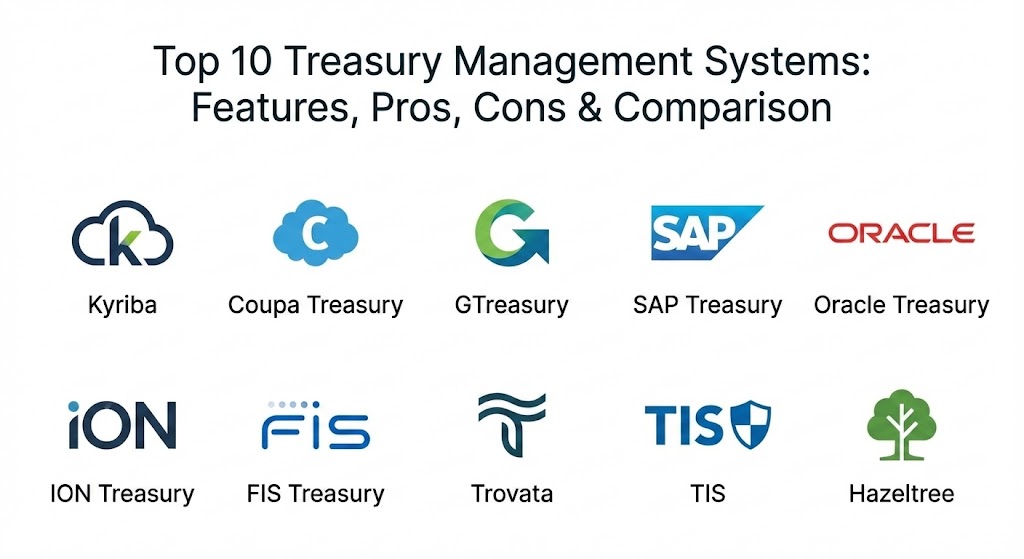
Top 10 Treasury Management Systems Tools
1 — Kyriba
Kyriba is widely recognized as the global leader in cloud-native treasury management. It is designed for large-scale enterprises that require a “platform” approach, integrating treasury, risk, payments, and working capital into one ecosystem.
- Key features:
- Kyriba Connectivity: A massive pre-built network for SWIFT, API, and regional bank connections.
- Proactive Fraud Detection: Real-time AI monitoring of payment patterns to flag anomalies.
- Liquidity Forecasting: Advanced modeling that pulls data from ERPs to predict cash gaps.
- FX Risk Management: Automated exposure tracking and hedge accounting (ASC 815/IFRS 9).
- Supply Chain Finance: Integrated modules to manage dynamic discounting and reverse factoring.
- Multilateral Netting: Simplifies intercompany settlements to reduce transaction costs.
- Pros:
- The most comprehensive cloud-native infrastructure in the industry.
- Superior bank connectivity reduces the time and cost of integration significantly.
- Cons:
- Can be prohibitively expensive for mid-market companies.
- The sheer depth of the platform requires a dedicated team to manage effectively.
- Security & compliance: SOC 1/2 Type II, ISO 27001, GDPR, and HIPAA compliant. Offers multi-factor authentication (MFA) and IP whitelisting.
- Support & community: Extensive online documentation, global 24/7 support, and a vibrant user community (Kyriba Live).
2 — Coupa Treasury (formerly Bellin)
Coupa Treasury, born from the acquisition of Bellin, is a user-centric TMS that focuses on simplicity and deep integration with the broader Coupa Business Spend Management (BSM) ecosystem.
- Key features:
- Integrated Spend Management: Links treasury data directly with procurement and AP.
- Global Cash Visibility: Real-time status of all bank accounts in a clean, intuitive dashboard.
- In-House Bank: Enables centralized payments and intercompany lending.
- Netting & Pooling: Automated tools to optimize cash across subsidiaries.
- Debt & Investment Tracking: Comprehensive ledger for all financial instruments.
- Pros:
- Exceptional user interface that is significantly more modern than legacy systems.
- Best-in-class for companies already using Coupa for procurement or expenses.
- Cons:
- The risk management module is not as deep as FIS or ION.
- Smaller “app” ecosystem compared to Kyriba.
- Security & compliance: SOC 1/2, PCI DSS, and GDPR compliant. High-level encryption for data at rest and in transit.
- Support & community: Strong onboarding support and a growing community within the Coupa BSM platform.
3 — GTreasury
GTreasury is a modular platform that excels in providing deep risk management alongside core cash operations. It is particularly popular with mid-to-large enterprises looking for a customizable solution.
- Key features:
- Ecosystem Integration: “Connect” feature that links with hundreds of banks and ERPs.
- Risk Management: Deep analytics for FX, interest rates, and commodities.
- Hedge Accounting: Full compliance with global accounting standards.
- Visual Cash Positioning: Interactive maps and charts to see global cash distribution.
- Automated Clearing: Streamlined reconciliation of bank statements to the ledger.
- Pros:
- Highly modular; you only pay for the features you actually need.
- Very strong customer retention due to a focus on long-term partnerships.
- Cons:
- Some parts of the legacy UI are still being transitioned to the new cloud design.
- API performance can be inconsistent with older legacy bank connections.
- Security & compliance: SOC 1/2 Type II, ISO 27001, and GDPR compliant.
- Support & community: Excellent documentation and a dedicated client success manager for every account.
4 — SAP Treasury Management
For organizations running on SAP S/4HANA, the SAP Treasury module is often the logical choice. It provides unmatched integration with the general ledger and financial supply chain.
- Key features:
- S/4HANA Integration: Native data sharing between accounting and treasury.
- Cash Management: Real-time liquidity analysis using SAP’s In-Memory database.
- Financial Risk Management: Automated exposure capture from sales and purchase orders.
- In-House Banking: Complete control over internal financing and payments.
- Bank Communication Management: Centralized hub for all outgoing bank files.
- Pros:
- Eliminates the need for complex “third-party” integrations if you are an SAP house.
- The most powerful reporting engine for massive, global data sets.
- Cons:
- Extremely complex to implement; requires specialized SAP consultants.
- Maintenance and licensing costs are among the highest in the market.
- Security & compliance: Top-tier enterprise security, including FedRAMP (for government), SOC, and ISO.
- Support & community: Massive global network of SAP consultants and official support channels.
5 — Oracle Treasury (Fusion Cloud)
Oracle’s treasury offering is built into its Fusion Cloud ERP suite, providing a sophisticated set of tools for organizations that prioritize a unified financial environment.
- Key features:
- Unified Ledger: Cash transactions update the general ledger in real-time.
- Cash Forecasting: Uses machine learning to improve the accuracy of predictions over time.
- Bank Account Management: Automated workflows for opening and closing accounts.
- Investment Management: Tracking of short-term and long-term financial assets.
- Electronic Bank Statements: Multi-format support for automated reconciliation.
- Pros:
- Seamless “Data Flow” from the ERP to the Treasury module.
- Excellent for companies looking to move away from fragmented SaaS silos.
- Cons:
- Can feel “rigid” if your treasury team wants to use specific non-Oracle workflows.
- The mobile experience for treasury-specific tasks is less mature than Kyriba.
- Security & compliance: Oracle’s “Maximum Security Architecture,” SOC 1/2, GDPR, and HIPAA compliant.
- Support & community: Deep enterprise support and a large community of Oracle certified professionals.
6 — ION Treasury (Reval / Wallstreet Systems)
ION Treasury is a conglomerate that owns several major TMS brands (Reval, Wallstreet Systems, IT2). This allows them to offer a solution for every tier of business, from mid-market to the largest global banks.
- Key features:
- Multi-Brand Portfolio: Offers different software (e.g., Reval for SaaS, Wallstreet for High Complexity).
- Global Risk Analytics: Deep modeling for complex derivatives and commodities.
- Treasury-as-a-Service (TaaS): Managed options for companies that want to outsource operations.
- Hedge Compliance: Robust tracking for complex global regulations.
- Automated Liquidity: Dynamic cash pooling and sweeping across regions.
- Pros:
- Unrivaled depth in financial risk and derivative management.
- The ability to migrate between different ION products as your company grows.
- Cons:
- The “conglomerate” model can make support feel disjointed between different products.
- Implementation for the high-end Wallstreet Systems can take over a year.
- Security & compliance: ISO 27001, SOC 2, and PCI DSS compliant.
- Support & community: Large global presence with specialized support for each individual brand.
7 — FIS Treasury (Quantum / Integrity)
FIS is a powerhouse in financial technology, offering the Quantum (enterprise) and Integrity (mid-market) TMS platforms. They are favored by organizations with very high transaction volumes.
- Key features:
- Deep Bank Connectivity: Native integration with FIS’s global payments network.
- Visual Risk Dashboards: High-level executive views of total market exposure.
- Cash Forecasting AI: Uses historical data trends to suggest future cash needs.
- Debt Management: Specialized tools for managing complex corporate debt structures.
- Audit-Ready Reporting: Pre-built templates for all major global financial standards.
- Pros:
- Highly stable and reliable; used by some of the world’s largest financial institutions.
- Exceptional at managing massive volumes of complex payments.
- Cons:
- The user interface for “Integrity” can feel dated compared to cloud-native rivals.
- Cost structure can be opaque with various add-on fees.
- Security & compliance: SOC 1/2 Type II, GDPR, and ISO 27001 compliant.
- Support & community: Professional services are top-notch; strong presence in the banking sector.
8 — Trovata
Trovata is the “new school” of treasury management. It focuses heavily on open banking APIs rather than old-fashioned SWIFT files, allowing for much faster setup and real-time data flow.
- Key features:
- Open Banking APIs: Connects to major banks in minutes, not months.
- Natural Language Search: Find cash data using simple queries (e.g., “Cash in UK accounts”).
- Automated Forecasting: AI-driven predictions based on real-time bank feeds.
- Multi-Bank Visibility: Aggregates all global accounts into a modern SaaS interface.
- Minimal IT Effort: Designed to be “plug-and-play” without long implementation cycles.
- Pros:
- The fastest “Time-to-Value” in the industry.
- Extremely intuitive; requires very little training for the team to be productive.
- Cons:
- Lacks the deep risk and hedge accounting modules found in Kyriba or ION.
- Primary value is in cash visibility; less robust for complex financial instruments.
- Security & compliance: SOC 2 Type II compliant; uses bank-level encryption and tokenized APIs.
- Support & community: Excellent modern documentation and a responsive chat-based support system.
9 — Treasury Intelligence Solutions (TIS)
TIS focuses specifically on the “Bank Connectivity” and “Payments” side of treasury, making it an ideal choice for organizations that need to solve global payment complexity first.
- Key features:
- Payment Hub: A single gateway to thousands of banks globally.
- Bank Fee Analysis: Automatically audits bank fees to find overcharges.
- Connectivity-as-a-Service: Managed bank connectivity so your IT team doesn’t have to.
- Compliance Screening: Checks payments against sanction lists in real-time.
- Cash Visibility: Centralized reporting on all outgoing and incoming flows.
- Pros:
- Best-in-class for solving complex, global bank connectivity issues.
- Greatly reduces the risk of payment fraud through centralized control.
- Cons:
- Not a “full” TMS; lacks modules for debt, investment, or FX risk.
- Usually used in conjunction with an ERP or another TMS.
- Security & compliance: ISO 27001, SOC 1/2, and GDPR compliant.
- Support & community: Known for high-quality customer success and deep technical expertise.
10 — Hazeltree
Hazeltree is a specialized TMS designed for the alternative investment industry—specifically hedge funds, private equity, and asset managers.
- Key features:
- Multi-Broker Visibility: Aggregates cash and collateral held at various prime brokers.
- Treasury Optimization: Automatically identifies the best place to park cash for yield.
- Collateral Management: Tracks margin requirements and collateral movement.
- Sweep Automation: Moves excess cash to money market funds automatically.
- Compliance Monitoring: Ensures investment portfolios stay within regulatory limits.
- Pros:
- The only tool on this list built specifically for the unique needs of asset managers.
- Excellent at managing relationships with multiple prime brokers.
- Cons:
- Not suitable for traditional corporate or manufacturing treasury needs.
- Niche focus means the broader feature set is limited.
- Security & compliance: SOC 2 Type II compliant; specifically tailored for investment firm audits.
- Support & community: High-touch support for the alternative investment community.
Comparison Table
| Tool Name | Best For | Platform Supported | Standout Feature | Rating (Gartner / Peer) |
| Kyriba | Large Multinational | Cloud / SaaS | SWIFT/API Bank Connectivity | 4.6 / 5.0 |
| Coupa Treasury | Coupa Ecosystem Users | Cloud / SaaS | Integrated BSM View | 4.4 / 5.0 |
| GTreasury | Modular Risk Mgmt | Cloud / Hybrid | FX & Hedge Analytics | 4.5 / 5.0 |
| SAP Treasury | SAP House Enterprises | S/4HANA Native | Deep ERP Integration | 4.2 / 5.0 |
| Oracle Treasury | Oracle ERP Users | Fusion Cloud | AI Cash Forecasting | 4.1 / 5.0 |
| ION Treasury | Complex Risk / Banks | Cloud / On-prem | Wallstreet Systems Engine | 4.3 / 5.0 |
| FIS Treasury | High Transaction Vol | Cloud / Hybrid | Quantum Risk Engine | 4.4 / 5.0 |
| Trovata | Mid-Market / Real-time | Cloud / SaaS | Open Banking APIs | 4.8 / 5.0 |
| TIS | Global Payment Hub | Cloud / SaaS | Connectivity-as-a-Service | 4.5 / 5.0 |
| Hazeltree | Asset Managers / PE | Cloud / SaaS | Multi-Broker Aggregation | N/A |
Evaluation & Scoring of Treasury Management Systems
To provide a neutral score, we evaluate these systems against a weighted rubric that reflects the priorities of a modern 2026 finance department.
| Criteria | Weight | Evaluation Focus |
| Core Features | 25% | Cash positioning, forecasting, debt, investment, and risk. |
| Ease of Use | 15% | UI design, mobile accessibility, and team learning curve. |
| Integrations | 15% | Native ERP connectors and API/SWIFT bank connectivity. |
| Security & Compliance | 10% | Encryption, SOC 2, audit trails, and fraud prevention. |
| Performance | 10% | System uptime, calculation speed for risk, and API latency. |
| Support & Community | 10% | Documentation quality and professional services availability. |
| Price / Value | 15% | Implementation cost vs. long-term efficiency gains. |
Which Treasury Management Systems Tool Is Right for You?
Choosing a TMS is not a “one-size-fits-all” decision. It requires a deep understanding of your company’s geographic footprint and financial complexity.
Solo Users vs SMB vs Mid-Market vs Enterprise
- Solo Users / Small SMBs: You do not need a TMS. Stick with your bank’s online portal and a clean spreadsheet.
- Mid-Market ($100M – $500M Revenue): Trovata or Coupa Treasury are ideal. They provide the necessary visibility without a million-dollar implementation project.
- Enterprise ($500M+ Revenue): Kyriba or GTreasury provide the scale needed to manage complex international structures.
- Global Conglomerates: SAP Treasury or Oracle Treasury are often the best choice for total ERP integration and consolidated reporting.
Budget-Conscious vs Premium Solutions
- Budget: Look for “API-First” tools like Trovata. Because they don’t rely on expensive SWIFT connections, their entry costs are much lower.
- Premium: ION Wallstreet or Kyriba are high-investment tools, but they provide a level of risk mitigation (especially in FX) that can save a large company millions of dollars in a single quarter.
Feature Depth vs Ease of Use
If your treasury team is small (1-2 people), Ease of Use is your #1 priority. Go with Coupa or Trovata. If you have a massive treasury department with specialized “Risk Officers,” you need the Feature Depth of FIS Quantum.
Frequently Asked Questions (FAQs)
1. Why use a TMS instead of an ERP’s treasury module?
While ERPs are great for accounting, they often lack the specialized “bank connectivity” and “real-time risk analytics” that a dedicated TMS provides. A TMS is built for the speed of banking, whereas an ERP is built for the speed of accounting.
2. How long does it take to implement a TMS?
A modern SaaS tool like Trovata can be live in a week. An enterprise suite like Kyriba or SAP can take 6 to 12 months for a full global rollout.
3. What is SWIFT connectivity?
SWIFT is a global network that allows banks to communicate. Most TMS platforms use SWIFT to pull bank statements and send payment files securely across international borders.
4. Can a TMS prevent fraud?
Yes. Modern TMS platforms like Kyriba use AI to screen payments against historical patterns and sanction lists, identifying suspicious activity before the money leaves the company.
5. Do I need an IT team to manage a TMS?
With modern cloud-native (SaaS) treasury systems, the IT burden is minimal. However, you will still need IT for the initial integration between the TMS and your internal ERP.
6. What is “Hedge Accounting” in a TMS?
It is a specialized accounting method used to record the results of derivatives (like FX forwards) in a way that reduces the volatility shown on financial statements.
7. Can a TMS help with cash forecasting?
Yes. By pulling historical data from bank feeds and future data from ERP sales/purchase orders, a TMS uses algorithms to predict your cash position 13 weeks (or more) into the future.
8. Is my financial data safe in the cloud?
In 2026, cloud TMS providers use security measures (like 256-bit encryption and SOC 2 audits) that are far more advanced than most companies’ on-premises servers.
9. How much does a TMS typically cost?
Mid-market solutions can start at $20k – $50k per year. Enterprise solutions for global corporations can easily exceed $250k – $500k per year in licensing and fees.
10. Can a TMS manage intercompany loans?
Yes. Most advanced systems have an “In-House Bank” module that tracks loans, calculates interest, and manages netting between different subsidiaries of the same parent company.
Conclusion
A Treasury Management System is no longer just a luxury for the Fortune 500. In 2026, the speed of commerce demands that every growing company has real-time visibility into their cash and risk.
The “best” tool depends on your technical debt and your financial goals. If you are an SAP house, the path of least resistance is SAP Treasury. If you are a tech-native company looking for instant insights, Trovata is your benchmark. And for those who need to manage the world’s most complex liquidity structures, Kyriba remains the gold standard. Ultimately, choosing a TMS is about giving your finance team the tools they need to protect the company’s most vital asset: its cash.