Introduction
A Recommendation System Toolkit is a specialized collection of libraries, frameworks, or cloud services designed to build engines that suggest relevant items to users. These toolkits abstract the complex math behind algorithms like collaborative filtering, matrix factorization, and deep neural networks, allowing developers to focus on data and business logic. By analyzing patterns in historical behavior—clicks, purchases, or watch time—these systems filter massive catalogs into a manageable, personalized selection.
The importance of these toolkits cannot be overstated. In a world of “content fatigue,” they reduce the cognitive load on users, leading to higher engagement, increased average order value (AOV), and improved customer retention. Key real-world use cases include e-commerce product suggestions (“Customers also bought”), streaming media personalization, news feed curation, and even talent matching in HR tech. When evaluating a toolkit, users must look for scalability (can it handle millions of users?), latency (how fast are suggestions served?), and cold-start handling (how does it treat new users or items?).
Best for:
- E-commerce & Retailers: Massive catalogs requiring real-time personalization to drive sales.
- Content Platforms: Streaming services, news outlets, and social media needing to maximize session time.
- Data Scientists & ML Engineers: Teams looking to scale specialized models from research to production.
- Enterprise AI Teams: Large organizations wanting to integrate personalization into existing cloud stacks.
Not ideal for:
- Small Blogs with Static Content: If you have 50 articles, a simple “Related Posts” plugin based on tags is more efficient than a full toolkit.
- Highly Private Environments: Systems where data sharing and tracking are strictly prohibited, making behavioral analysis impossible.
- Budget-Limited Startups: If the cost of managed cloud inference exceeds the revenue lift generated by the recommendations.
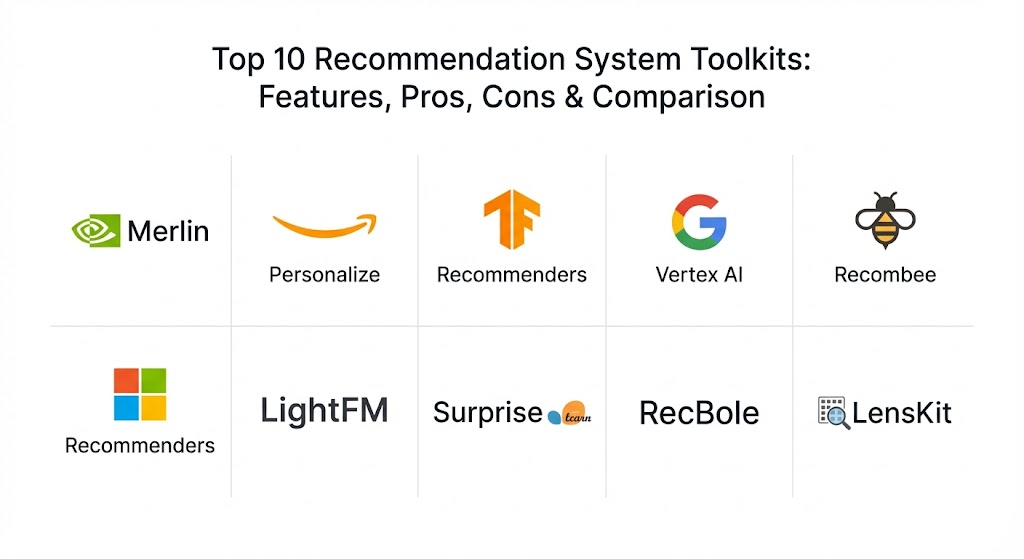
Top 10 Recommendation System Toolkits
1 — NVIDIA Merlin
NVIDIA Merlin is an open-source framework specifically engineered to accelerate the entire recommendation system pipeline—from data preprocessing to model training and inference—using GPU power.
- Key features:
- NVTabular: High-performance feature engineering and data preprocessing for tabular data.
- HugeCTR: A highly optimized GPU-accelerated training framework for large-scale deep learning models.
- Triton Inference Server: Provides low-latency, high-throughput model serving.
- Merlin Models: A library of high-level building blocks for common recommender architectures.
- GPU Acceleration: Massive speedups compared to CPU-based training on billion-scale datasets.
- Multi-GPU Support: Scales seamlessly across multiple GPUs and nodes.
- Pros:
- Unmatched performance for organizations dealing with petabyte-scale data.
- Drastically reduces hardware costs by optimizing GPU utilization.
- Cons:
- Requires specific NVIDIA hardware for maximum efficiency.
- Steep learning curve for teams not familiar with CUDA or GPU orchestration.
- Security & compliance: Supports standard encryption at rest/transit; integration with enterprise-grade security depends on the host infrastructure (e.g., Kubernetes, CSPs).
- Support & community: Backed by NVIDIA; excellent documentation and a growing community of performance-focused ML engineers.
2 — Amazon Personalize
Amazon Personalize is a fully managed AI service that uses the same machine learning technology as Amazon.com to deliver real-time personalized recommendations.
- Key features:
- AutoML Capabilities: Automatically builds, trains, and tunes models based on your data.
- Personalization Recipes: Pre-built models for specific tasks like “Related Products” or “User Personalization.”
- Real-time Updates: Model recommendations evolve instantly as user behavior changes.
- Unstructured Text Support: Uses Natural Language Processing (NLP) to understand item descriptions.
- Batch & Real-time Inference: Supports both scheduled updates and low-latency API calls.
- Cold Start Logic: Specialized algorithms to recommend new items with no prior history.
- Pros:
- Fastest time-to-market; requires no machine learning expertise to start.
- Scales automatically with AWS infrastructure.
- Cons:
- Limited transparency; “black-box” models can be hard to explain to stakeholders.
- Proprietary pricing can become expensive at high volume.
- Security & compliance: GDPR, HIPAA, and SOC compliant; uses AWS IAM for granular access control and KMS for encryption.
- Support & community: Enterprise-grade support through AWS; vast library of tutorials and case studies.
3 — TensorFlow Recommenders (TFRS)
TensorFlow Recommenders is an open-source Python library for building recommender system models, built directly on top of TensorFlow and Keras.
- Key features:
- Two-Tower Architecture: Optimized support for retrieval and ranking models.
- Multi-Task Learning: Can optimize for multiple goals (e.g., clicks and purchases) simultaneously.
- Feature Interaction Modeling: Deep integration with DCN (Deep & Cross Network) for complex feature interactions.
- Seamless TF Integration: Works perfectly with TensorFlow Serving and TF Lite.
- Customizable Loss Functions: Allows researchers to define specialized metrics for their unique goals.
- Pros:
- Extreme flexibility for researchers building bespoke neural architectures.
- Leverages the massive TensorFlow ecosystem for deployment and monitoring.
- Cons:
- Requires deep knowledge of TensorFlow and neural network theory.
- High development overhead compared to managed cloud solutions.
- Security & compliance: Varies / N/A (Standard open-source library).
- Support & community: Massive global community; extensive documentation and research papers from Google Brain.
4 — Google Vertex AI Search & Conversation
Formerly known as Recommendations AI, this is Google Cloud’s premier managed service for omnichannel retail and content discovery.
- Key features:
- Context-Aware Recommendations: Adjusts suggestions based on device, location, and time.
- Vertex AI Integration: Connects seamlessly with the broader Google data analytics stack (BigQuery).
- Generative AI Support: Uses LLMs to summarize why a recommendation was made.
- Omnichannel Support: Syncs data across web, mobile, and physical store interactions.
- Pre-trained Models: Leverages Google’s search algorithms for instant relevance.
- Pros:
- Strongest performance for retail use cases due to Google’s specialized “Discovery” algorithms.
- Easy to integrate for teams already using Google Cloud.
- Cons:
- UI can be overwhelming for beginners.
- Higher cost entry point for smaller startups.
- Security & compliance: HIPAA, SOC 2, and GDPR compliant; uses Google Cloud VPC and IAM.
- Support & community: High-quality enterprise support; deep integration with Google’s developer ecosystem.
5 — Recombee
Recombee is a SaaS-based recommendation engine that offers an intuitive API and a powerful graphical interface for managing recommendation logic.
- Key features:
- Visual Dashboard: Allows non-technical users to set business rules and view analytics.
- Hybrid Filtering: Combines AI-driven insights with manual “boosting” rules.
- Real-time Processing: New interactions affect recommendations within milliseconds.
- A/B Testing Framework: Built-in tools to compare different models in production.
- Multi-language SDKs: Available for Python, Ruby, PHP, Java, and JavaScript.
- Pros:
- The most user-friendly interface in the commercial market.
- Highly transparent pricing and easy integration.
- Cons:
- Less control over the underlying deep learning architecture for advanced researchers.
- Managed nature means you are tied to their infrastructure uptime.
- Security & compliance: SOC 2 Type II and GDPR compliant; supports SSO and audit logs.
- Support & community: Excellent customer success teams; comprehensive documentation for rapid onboarding.
6 — Microsoft Recommenders
Microsoft Recommenders is a collection of open-source scripts and examples in the form of Jupyter notebooks, designed to show how to build and deploy systems on Azure.
- Key features:
- Algorithm Variety: Implementations of SAR, ALS, NCF, and LightGCN.
- Pre-built Utilities: Tools for data splitting, evaluation, and operationalization.
- Spark Support: Scalable implementations for big data environments.
- Azure Machine Learning Integration: One-click deployment to Azure.
- Extensive Benchmarking: Clear comparisons of different algorithms on standard datasets.
- Pros:
- Best educational resource for learning “how things work” under the hood.
- Great for Azure-centric dev teams wanting to build custom solutions.
- Cons:
- More of a “template library” than a standalone product.
- Requires maintenance and setup effort.
- Security & compliance: Inherits Azure’s enterprise security if deployed on Azure ML.
- Support & community: Strong community presence on GitHub; backed by Microsoft Research.
7 — LightFM
LightFM is a popular Python implementation of a number of recommendation algorithms, specifically focused on hybrid models.
- Key features:
- Hybrid Collaborative-Content Filtering: Uses both interactions and metadata.
- Learned Embeddings: Represents users and items in a high-dimensional space.
- Cython Backend: Extremely fast training for a pure Python-accessible library.
- Sparse Matrix Support: Memory-efficient handling of large datasets.
- Cold Start Solution: Uses item features to recommend products that have never been bought.
- Pros:
- Incredible performance for “cold-start” scenarios where data is limited.
- Very lightweight and easy to integrate into existing Python pipelines.
- Cons:
- Mainly limited to matrix factorization; does not support deep neural networks.
- Scaling to billions of rows requires careful memory management.
- Security & compliance: Varies / N/A (Standard open-source).
- Support & community: Widely used in the data science community; plenty of third-party tutorials.
8 — Surprise (Scikit-learn compatible)
Surprise is a Python scikit for building and analyzing recommender systems that deal with explicit rating data.
- Key features:
- Classic Algorithm Suite: SVD, PMF, NMF, and KNN.
- Evaluation Tools: Built-in cross-validation and grid search for hyperparameter tuning.
- Similarity Measures: Cosine, MSD, and Pearson.
- Dataset Handling: Easy loaders for Movielens and custom CSV files.
- Simplicity: Follows the familiar Scikit-learn API structure.
- Pros:
- The gold standard for educational purposes and rapid prototyping.
- Extremely clear documentation and minimal “bloat.”
- Cons:
- Not designed for real-time production serving at scale.
- Limited to explicit data (ratings) rather than implicit clicks/views.
- Security & compliance: Varies / N/A.
- Support & community: Mature project with excellent community support.
9 — RecBole
RecBole is a unified and comprehensive recommendation library based on PyTorch, designed for research and benchmarking.
- Key features:
- Massive Library: Supports 90+ recommendation algorithms.
- Unified Data Format: One standard for all datasets, making comparisons easy.
- Sequential Recommendation: Specialized models for predicting the “next” item in a session.
- Automatic Evaluation: Standard metrics (NDCG, Recall, MRR) computed automatically.
- GNN Support: Native support for Graph Neural Network-based recommendations.
- Pros:
- The most comprehensive library for researchers wanting to stay on the cutting edge.
- Clean, modular design makes it easy to add new models.
- Cons:
- Can be slower than production-hardened libraries like NVIDIA Merlin.
- Primarily focused on research; lacks some “production” deployment features.
- Security & compliance: Varies / N/A.
- Support & community: Active academic community; frequently updated with the latest SOTA models.
10 — LensKit
LensKit is a set of Python tools for experiment-based recommender systems, emphasizing reproducibility and research quality.
- Key features:
- LKPY: Modern Python implementation (formerly Java-based).
- Reproducibility: Designed to make it easy for researchers to share and verify experiments.
- Modular Pipeline: Swap out components like data loaders and evaluators easily.
- Metric Suite: Comprehensive tools for precision, recall, and NDCG.
- Classic Focus: Excellent for traditional collaborative filtering.
- Pros:
- Focus on rigor and transparency makes it ideal for academic publications.
- Very stable and well-vetted code.
- Cons:
- Limited focus on the latest deep learning/transformer architectures.
- Not intended for high-throughput live production environments.
- Security & compliance: Varies / N/A.
- Support & community: Strong academic following; well-maintained by the Boise State research group.
Comparison Table
| Tool Name | Best For | Platform(s) Supported | Standout Feature | Rating (Gartner/Peer) |
| NVIDIA Merlin | Massive GPU Performance | Kubernetes, Cloud | GPU HugeCTR Acceleration | 4.8 / 5.0 |
| Amazon Personalize | Rapid AWS Deployment | AWS | AutoML “Recipes” | 4.4 / 5.0 |
| TF Recommenders | Custom Neural Networks | Any (TF Ecosystem) | Two-tower Architecture | N/A (OSS) |
| Vertex AI Search | Enterprise Retail/Discovery | GCP | Google Search-grade AI | 4.4 / 5.0 |
| Recombee | SaaS Ease of Use | SaaS API | Visual Dashboard | 4.7 / 5.0 |
| MS Recommenders | Learning on Azure | Azure, Spark | SAR/NCF Templates | 4.4 / 5.0 |
| LightFM | Cold Start Scenarios | Python, Any | Hybrid Metadata Support | N/A (OSS) |
| Surprise | Prototyping & Education | Python | Scikit-learn Compatibility | N/A (OSS) |
| RecBole | Research & Benchmarking | PyTorch | 90+ Algorithms | N/A (OSS) |
| LensKit | Reproducible Research | Python | Academic Transparency | N/A (OSS) |
Evaluation & Scoring of Recommendation System Toolkits
To provide a neutral evaluation, we have scored these toolkits based on a rubric that considers both the technical requirements of an engineer and the business needs of an executive.
| Criteria | Weight | NVIDIA Merlin | Amazon Personalize | TF Recommenders | Recombee |
| Core Features | 25% | 10/10 | 8/10 | 10/10 | 8/10 |
| Ease of Use | 15% | 6/10 | 10/10 | 5/10 | 10/10 |
| Integrations | 15% | 8/10 | 10/10 | 9/10 | 8/10 |
| Security/Compliance | 10% | 8/10 | 10/10 | 7/10 | 9/10 |
| Performance | 10% | 10/10 | 8/10 | 9/10 | 8/10 |
| Support/Community | 10% | 9/10 | 10/10 | 10/10 | 8/10 |
| Price / Value | 15% | 9/10 | 7/10 | 10/10 | 7/10 |
| TOTAL SCORE | 100% | 8.60 | 8.70 | 8.70 | 8.30 |
Which Recommendation System Toolkits Tool Is Right for You?
Choosing a toolkit depends on your technical debt, budget, and scale.
1. By Business Stage
- Solo Users & Students: Start with Surprise or LightFM. They are lightweight, run on a laptop, and teach you the fundamentals of matrix factorization without needing a cloud credit card.
- SMBs (Small-Mid Businesses): Recombee is the “set it and forget it” choice. If you have an AWS account, Amazon Personalize is a close second. These tools allow you to generate ROI before you hire your first dedicated ML engineer.
- Mid-Market: If you have 1-3 data scientists, TensorFlow Recommenders or Microsoft Recommenders allow you to build custom logic that fits your unique niche while leveraging enterprise infrastructure.
- Enterprise: NVIDIA Merlin or Google Vertex AI are the heavyweights. They are designed for teams that measure success in millionths of a second (latency) and billions of dollars in uplift.
2. Budget vs. Premium
- Budget-Conscious: Open-source is king. RecBole and Merlin are free to download, but remember that developer time and GPU compute are the hidden costs.
- Premium / Managed: Personalize and Vertex AI charge based on data ingestion and training hours. You pay for the privilege of not having to manage a server at 3 AM.
3. Scalability Needs
If your catalog is 10,000 items, almost any toolkit will work. If your catalog is 100 million items (like YouTube or Amazon), you essentially must use a GPU-accelerated framework like Merlin or a highly distributed Spark-based implementation.
Frequently Asked Questions (FAQs)
1. What is the difference between collaborative filtering and content-based filtering?
Collaborative filtering looks at user behavior (“People who bought X also bought Y”). Content-based filtering looks at item attributes (“Since you liked a sci-fi movie with Tom Cruise, here is another sci-fi movie”).
2. Can these tools handle the “Cold Start” problem?
Yes, but some are better than others. LightFM and Amazon Personalize are specifically praised for their ability to recommend new items using metadata when historical interaction data is missing.
3. Do I need a GPU to run a recommendation system?
For small to medium datasets, a CPU is fine. However, for deep learning models on large datasets, a GPU (and toolkits like NVIDIA Merlin) becomes essential to keep training times under days.
4. How is success measured in recommendation systems?
Technical metrics include NDCG (Normalized Discounted Cumulative Gain), Precision@K, and Recall@K. Business metrics include CTR (Click-Through Rate), Conversion Rate, and Revenue Uplift.
5. Are these tools GDPR compliant?
Open-source libraries are “neutral”; compliance depends on how you store the data. Managed services like Amazon Personalize offer built-in compliance certifications and data residency options.
6. Can I build a recommendation engine in real-time?
Yes. Modern toolkits like Recombee and NVIDIA Merlin support real-time ingestion, meaning as soon as a user clicks a product, their profile—and their suggestions—are updated.
7. Is a recommendation system the same as a search engine?
Search is explicit (user asks for X). Recommendation is implicit (system suggests X based on past behavior). However, tools like Vertex AI are increasingly merging both into a single “Discovery” interface.
8. What is “Matrix Factorization”?
It is a mathematical technique where a large table of user-item interactions is broken down into two smaller tables of “hidden features,” allowing the system to predict missing values (potential likes).
9. How much data do I need to start?
While you can start with a few thousand interactions, the quality of recommendations scales with data. Deep learning toolkits usually require tens of thousands of users and items to outperform simpler models.
10. What is the biggest mistake when starting out?
Over-complicating the model too early. Most businesses see 80% of their uplift from a simple LightFM or Surprise model. Only move to deep learning once you have exhausted the gains from classic algorithms.
Conclusion
Recommendation systems are the invisible navigators of the internet. Choosing the right toolkit—whether it’s the speed of NVIDIA Merlin, the simplicity of Recombee, or the flexibility of TensorFlow Recommenders—is a decision that will shape your user experience for years to come.
The “best” tool doesn’t exist in a vacuum; it exists in the context of your team’s skills, your data volume, and your business goals. Start simple, evaluate with rigor, and remember that at the end of every recommendation is a human being looking for something they love.