Introduction
Knowledge Graph Construction Tools are specialized software platforms designed to automate and streamline the complex process of transforming raw, often unstructured data into a structured knowledge graph. Unlike simple data ingestion, these tools employ advanced techniques like Natural Language Processing (NLP), machine learning, and AI to perform entity extraction, relationship linking, and ontology mapping. They act as the bridge between messy documents, databases, and spreadsheets, and a clean, queryable graph database.
The importance of these tools has skyrocketed with the rise of Large Language Models (LLMs). A robust knowledge graph is now seen as the critical “grounding” truth for AI, enabling Retrieval-Augmented Generation (RAG) to prevent hallucinations and provide accurate, context-aware answers. Key real-world use cases include powering semantic search engines, building advanced recommendation systems, accelerating drug discovery in life sciences, detecting complex fraud rings in finance, and creating 360-degree customer views.
When evaluating these tools, users should prioritize capabilities in unstructured data processing (NLP), ease of ontology management (defining the schema of your world), scalability to handle massive datasets, and integration with popular graph databases.
Best for: Knowledge graph construction tools provide the most significant value to mid-to-large enterprises in data-intensive industries like finance, healthcare, pharmaceuticals, and e-commerce. They are essential for roles like Data Architects, Knowledge Engineers, and AI/ML teams trying to unify disparate data sources into a semantic layer or prepare data for advanced AI applications.
Not ideal for: Small businesses with very limited, highly structured datasets (e.g., a single SQL database) may find these tools overkill; standard BI tools might suffice. Similarly, organizations without the internal resources or budget to manage semantic technologies may struggle with the learning curve required for some high-end platforms.
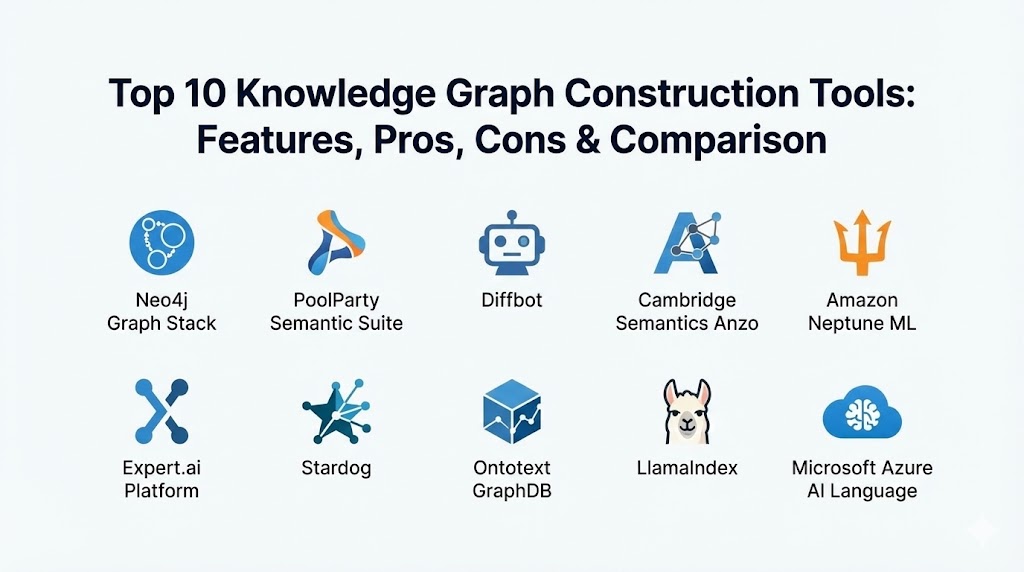
Top 10 Knowledge Graph Construction Tools
Here is a detailed look at the top tools available for constructing knowledge graphs, ranging from enterprise suites to developer-focused platforms.
1 — Neo4j Graph Stack (Data Importer & Graph Data Science)
Neo4j is widely recognized as the market leader in graph databases. While primarily a database, its ecosystem includes powerful tools for construction, specifically the visual “Data Importer” for structured data mapping and the “Graph Data Science (GDS)” library for inferring relationships using ML.
- Key features:
- Visual Data Importer: A no-code UI for mapping CSVs and relational data to graph nodes and relationships.
- Graph Data Science Library: Over 65 algorithms to detect communities and similarity, effectively “constructing” new latent relationships.
- Bloom visualization: Helps explore data during the construction phase to validate schemas.
- Native Vector Indexing: Supports vector search, aiding in semantic linking during construction.
- Cypher Query Language: Powerful language for manual data loading and transformation scripts.
- Pros:
- Seamless integration if you are already committing to the Neo4j database.
- Massive community and extensive learning resources.
- Cons:
- The tools are somewhat disjointed; Data Importer is separate from GDS.
- Stronger on structured data ingestion than native unstructured text extraction without third-party plugins.
- Security & compliance: Enterprise offerings include advanced SSO, Role-Based Access Control (RBAC), and encryption. Compliant with major standards like ISO 27001 and SOC 2.
- Support & community: Excellent. Largest user community in the graph space, extensive documentation, and tiered enterprise support options.
2 — PoolParty Semantic Suite
PoolParty is a world-class semantic technology platform focused heavily on taxonomy management, ontology creation, and text mining. It excels at creating the “knowledge model” first and then using that model to automatically extract structured graphs from unstructured documents.
- Key features:
- Taxonomy & Ontology Management: Best-in-class tools for defining hierarchical and associative relationships.
- Entity Extractor: High-precision NLP that uses your custom taxonomies to tag documents automatically.
- Corpus Management: Tools to analyze document sets and suggest new concepts for your graph.
- Linked Data Principles: Built on W3C standards (RDF, SKOS, OWL), ensuring interoperability.
- GraphEditor: Visual interface for managing the knowledge graph.
- Pros:
- Exceptional for managing complex, domain-specific business logic and vocabularies.
- Strong focus on precision and human-in-the-loop curation for high-quality graphs.
- Cons:
- Can have a steeper learning curve for those unfamiliar with semantic web standards.
- The interface can feel utilitarian compared to newer SaaS offerings.
- Security & compliance: Supports standard enterprise security protocols, including SSO and granular access rights. Suitable for GDPR-compliant workflows.
- Support & community: Strong European base with dedicated support and training through the “PoolParty Academy.”
3 — Diffbot
Diffbot takes a different approach by using advanced computer vision and NLP to automatically structure the web. It is essentially a pre-built, massive knowledge graph of the public web that you can query, but it also offers tools to build custom graphs from your own content.
- Key features:
- Knowledge Graph API: Access to a pre-crawled graph of billions of entities (people, companies, products).
- Automatic Extraction APIs: Use AI to turn articles, product pages, and discussions into structured JSON-LD.
- Natural Language Interface: Query the knowledge graph using standard conversational English.
- Crawlbot: Intelligent crawler that handles complex Javascript-heavy websites to extract structured data.
- Enrichment: Enhance your existing internal data with public facts from Diffbot’s graph.
- Pros:
- Lowest friction way to construct graphs from public web data; almost zero configuration required.
- Excellent for market intelligence and competitive analysis use cases.
- Cons:
- Less control over the underlying ontology compared to tools like PoolParty.
- Can be expensive for high-volume crawling and extraction.
- Security & compliance: Standard encryption and API security. Diffbot focuses on public data, so internal compliance (like HIPAA) is less relevant to their core offering but applicable if using their tools on internal data.
- Support & community: Good documentation and developer-focused support. Smaller community than major database vendors.
4 — Cambridge Semantics Anzo
Anzo is an enterprise-grade “data fabric” platform built on semantic standards. It is designed to virtualize and integrate massive amounts of varied data from across an enterprise into a cohesive knowledge graph without necessarily moving the original data.
- Key features:
- Automated Data Onboarding: Uses AI to profile data sources and suggest mappings to ontologies.
- Massively Parallel Processing (MPP) Graph Engine: Designed for extreme scale and complex analytics on the graph.
- Data Virtualization: Connects to data where it lives (SQL, Data Lakes) and presents it as a graph.
- Ontology Modeling: Visual tools for designing complex enterprise data models.
- Hi-Res Analytics: Allows for exploratory analytics directly on the constructed graph.
- Pros:
- Outstanding scalability for very large enterprise datasets.
- Excellent for handling the reality of messy, hybrid IT environments without forcing data migration.
- Cons:
- A complex, heavy-duty platform that requires significant investment and expertise to implement.
- Overkill for smaller projects or simple graph needs.
- Security & compliance: Highly secure, designed for regulated industries (pharma, finance). Supports Kerberos, LDAP, SSO, and fine-grained access control.
- Support & community: White-glove enterprise support targeted at large corporate deployments.
5 — Amazon Neptune ML
For organizations fully invested in the AWS ecosystem, Neptune ML provides a way to use machine learning to infer missing links and attributes in a graph hosted on Amazon Neptune.
- Key features:
- Deep Graph Library (DGL) integration: Uses graph neural networks (GNNs) to learn from existing data.
- Link Prediction: Automatically suggests likely relationships that are missing in the data.
- Node Classification & Regression: Infers missing properties of data points based on their neighbors.
- Fully Managed: Handles the infrastructure for training and deploying the ML models.
- Integration with SageMaker: Uses AWS SageMaker for the heavy lifting of model training.
- Pros:
- Native integration reduces operational overhead for AWS customers.
- Powerful ability to “complete” a sparse knowledge graph using AI.
- Cons:
- Requires data to already be somewhat structured in Neptune; it’s less about initial extraction from unstructured text.
- Locked into the AWS ecosystem.
- Security & compliance: Inherits AWS security posture, including VPC isolation, IAM roles, KMS encryption, and compliance with HIPAA, PCI, etc.
- Support & community: Backed by standard AWS support tiers and vast documentation.
6 — Expert.ai Platform
Expert.ai focuses heavily on the Natural Language Understanding (NLU) aspect of construction. It combines symbolic AI (rules and knowledge bases) with machine learning to extract deep meaning and relationships from unstructured documents to feed a graph.
- Key features:
- Hybrid AI approach: Combines knowledge-based techniques with LLMs for high accuracy.
- Deep Linguistic Analysis: Performs sentence diagramming, semantic role labeling, and morphological analysis.
- Customizable Knowledge Models: Build domain-specific taxonomies to guide extraction.
- Relationship Extraction: Specifically identifies how distinct entities in a text are connected.
- Low-code Studio: Environment for Subject Matter Experts to tune extraction rules.
- Pros:
- Very high precision for extracting structured data from complex, domain-specific texts (e.g., insurance contracts, medical papers).
- Transparent “glass box” approach allows users to understand why data was extracted.
- Cons:
- Focuses primarily on the extraction phase; requires a separate graph database to store the output.
- Building custom knowledge models can be time-intensive.
- Security & compliance: SOC 2 certified, GDPR compliant. Offers secure cloud and on-premise deployment options.
- Support & community: Professional support and training services for enterprise customers.
7 — Stardog
Stardog is the leading Enterprise Knowledge Graph platform that emphasizes data unification through virtualization and rigorous semantic reasoning. It is designed to connect data silos without creating a new one.
- Key features:
- Virtual Graphs: Map relational databases and other sources to a graph model without moving data.
- Inference Engine: Uses semantic reasoning to automatically infer new relationships based on ontology rules.
- VCS for Knowledge: Version control for models and data, similar to Git for code.
- Entity Resolution: Built-in tools to deduplicate and link entities across diverse sources.
- Voicebox: A generative AI assistant to help users query and model the graph using natural language.
- Pros:
- Powerful reasoning capabilities allow the graph to be “smarter” than the data you put into it.
- Excellent capability to unify existing legacy infrastructure.
- Cons:
- Similar to Anzo, it is an enterprise-grade platform with a commensurate cost and learning curve.
- Reasoning at scale requires careful model design to avoid performance impacts.
- Security & compliance: Robust enterprise security including SSO, encryption, and detailed audit logging. SOC 2 Type II compliant.
- Support & community: Strong enterprise support and a growing developer community around semantic standards.
8 — Ontotext GraphDB
Ontotext GraphDB is a highly performant semantic graph database that includes significant features for graph construction, particularly involving text analysis and linked open data.
- Key features:
- RDF & SPARQL Foundation: Built entirely on standard W3C semantic web technologies.
- Text Mining Plugins: Integrated connectors for NLP services to extract entities directly into the graph.
- Linked Data Integration: Easy connectors to public graphs like DBpedia or GeoNames for enrichment.
- Visual Graph Exploration: Tools to visualize the schema and data during construction.
- Reasoning and Inferencing: Strong support for RDFS and OWL reasoning to materialize new facts.
- Pros:
- Excellent adherence to open standards ensures long-term data portability.
- Very strong performance for managing large-scale RDF datasets.
- Cons:
- The tooling is very developer and data-architect focused, less friendly for business users.
- Requires commitment to the RDF/semantic web stack versus property graphs (though they are converging).
- Security & compliance: Enterprise-grade security features including access control lists (ACLs) and LDAP integration.
- Support & community: deep expertise in semantic technology with responsive support.
9 — LlamaIndex
LlamaIndex is a cutting-edge data framework specifically designed to connect custom data sources to Large Language Models. While often used for vector search, it has powerful capabilities for constructing structured knowledge graphs from unstructured text using LLMs.
- Key features:
- Knowledge Graph Index: Specifically builds a graph structure from documents, extracting triplets (subject, predicate, object).
- LLM-powered Extraction: Uses models like GPT-4 to perform the heavy lifting of identifying relationships in messy text.
- Data Connectors (LlamaHub): Hundreds of connectors to pull data from Notion, Slack, PDFs, etc.
- Graph Store Integrations: Can persist the constructed graph into Neo4j, NebulaGraph, and others.
- Recursive Retrieval: Can traverse the graph during query time for deep context.
- Pros:
- The most modern approach to using Generative AI for graph construction.
- Excellent for developers building RAG applications who need structured context.
- Cons:
- It is a code-framework (Python/Typescript), not a point-and-click GUI tool.
- Reliance on LLMs for extraction can sometimes lead to noisy or inaccurate graph structures that need cleaning.
- Security & compliance: As a framework, security depends on your deployment and the LLM provider you choose (e.g., OpenAI vs. private models).
- Support & community: Extremely active and fast-moving open-source community. Documentation evolves rapidly.
10 — Microsoft Azure AI Language
Formerly known as Text Analytics for Health and other cognitive services, this is a suite of cloud APIs that can be used as building blocks for graph construction, particularly for entity and relation extraction.
- Key features:
- Named Entity Recognition (NER): Identifies people, places, organizations, and dates in text.
- Relation Extraction: Identifies connections between entities (e.g., medication dosage, employee of company).
- Custom NER: Train your own models to extract domain-specific entities.
- Healthcare-specific Models: Pre-trained models for extracting deep medical insights from clinical notes.
- Pre-built Docker Containers: Ability to run the models on-premise for data privacy.
- Pros:
- Pay-as-you-go utility model makes it easy to start without heavy platform investment.
- Strong pre-trained models, especially in healthcare.
- Cons:
- These are just APIs; you must build the “glue” code to take the output and load it into a graph database.
- Less context-aware than a full semantic suite like PoolParty.
- Security & compliance: Enterprise-grade Azure security, including HIPAA compliance for healthcare services.
- Support & community: Backed by Microsoft’s massive support infrastructure and documentation.
Comparison Table
| Tool Name | Best For (Target User/Scenario) | Platform(s) Supported | Standout Feature | Rating |
| Neo4j (Stack) | General purpose graph DB users needing data loading. | Cloud / Self-Hosted | Graph Data Science Library for ML inferencing. | 4.5/5 |
| PoolParty | Taxonomists and knowledge engineers requiring high precision. | Cloud / Self-Hosted | Best-in-class Taxonomy & Ontology management. | 4.4/5 |
| Diffbot | Market researchers needing public web data fast. | SaaS | Automatic extraction from the public web without rules. | 4.3/5 |
| Cambridge Semantics | Large enterprises needing to unify massive data silos. | Cloud / Self-Hosted | Massively parallel processing engine for scale. | 4.6/5 |
| Amazon Neptune ML | AWS shops needing to predict missing links. | AWS Cloud | Graph Neural Networks (GNN) integration. | 4.2/5 |
| Expert.ai | Industries needing precise info from complex documents (insurance/legal). | Cloud / Self-Hosted | Hybrid AI (symbolic + ML) for deep NLU. | 4.3/5 |
| Stardog | Enterprises focused on data virtualization and reasoning. | Cloud / Self-Hosted | Semantic reasoning engine to infer new knowledge. | 4.5/5 |
| Ontotext GraphDB | Organizations committed to W3C Semantic Web standards. | Cloud / Self-Hosted | Strong RDF support and text-mining plugins. | 4.4/5 |
| LlamaIndex | Developers building advanced RAG applications with LLMs. | Open Source Framework | LLM-powered triple extraction for graphs. | 4.7/5 |
| Microsoft Azure AI | Developers needing modular NLP APIs for extraction. | Azure Cloud / Edge | Pre-trained healthcare-specific relation extraction. | 4.3/5 |
(Note: Ratings are estimated based on aggregated industry presence, feature sets, and user sentiment, as specific external review site URLs cannot be linked.)
Evaluation & Scoring of Knowledge Graph Construction Tools
Choosing a tool depends heavily on the stage of construction (ontology design, extraction, or loading) and the data type. We evaluated these tools based on a rubric emphasizing core construction capabilities and usability.
| Criteria | Weight | Neo4j | PoolParty | LlamaIndex | Stardog |
| Core features (NLP/Extraction/Ontology) | 25% | 4.0 | 5.0 | 4.5 | 4.5 |
| Ease of use | 15% | 4.0 | 3.5 | 3.0 | 3.5 |
| Integrations & ecosystem | 15% | 5.0 | 4.0 | 5.0 | 4.0 |
| Security & compliance | 10% | 5.0 | 5.0 | 3.5 | 5.0 |
| Performance & reliability | 10% | 5.0 | 4.5 | 4.0 | 5.0 |
| Support & community | 10% | 5.0 | 4.0 | 5.0 | 4.0 |
| Price / value | 15% | 4.0 | 3.5 | 5.0 | 3.5 |
| Weighted Score | 100% | 4.45 | 4.2 | 4.33 | 4.2 |
Interpretation: Neo4j scores high due to its massive ecosystem and reliability. LlamaIndex scores high on innovation and value for developers but lower on ease of use for business users. PoolParty and Stardog score exceptionally high on core semantic features but are heavier enterprise investments.
Which Knowledge Graph Construction Tool Is Right for You?
The decision path varies greatly depending on your organization’s profile and goals.
Solo Users vs SMB vs Enterprise
- Solo Developers/Researchers: Start with LlamaIndex. It’s open-source, cutting-edge, and allows you to experiment with using LLMs to build graphs on your local machine.
- SMBs: If you have structured data, Neo4j Data Importer with their free AuraDB tier is a great starting point. If you need to scrape web data for market intelligence, look at Diffbot.
- Enterprise: For massive data unification across silos, Cambridge Semantics (Anzo) or Stardog are designed for that scale. For deep, domain-specific text extraction (e.g., Pharma or Legal), PoolParty or Expert.ai are superior choices.
Budget-Conscious vs Premium Solutions
- Budget-Conscious: Utilize open-source frameworks like LlamaIndex combined with pay-as-you-go APIs from Azure AI Language or AWS. This requires more coding but minimizes upfront licensing costs.
- Premium: Full platforms like PoolParty, Stardog, and Anzo come with significant licensing costs but offer end-to-end suites that reduce integration headaches and include enterprise support.
Feature Depth vs Ease of Use
- Ease of Use: Diffbot is the easiest for getting external data turned into a graph. Neo4j Data Importer is the easiest for mapping existing CSVs.
- Feature Depth (Semantic): If you need rigorous ontology management, reasoning, and compliance with semantic standards, PoolParty and Stardog offer the most depth.
Security and Compliance Requirements
For highly regulated industries (HIPAA, FedRAMP, etc.), stick to the established enterprise players: Neo4j Enterprise, Stardog, Cambridge Semantics, and the major cloud providers (AWS/Azure). Be cautious with purely open-source frameworks where security implementation rests entirely on your team.
Frequently Asked Questions (FAQs)
1. What is the difference between a graph database and a knowledge graph construction tool?
A graph database (like Neo4j) is where the data is stored. A construction tool is the software that prepares the data for storage—extracting entities from text, defining the schema, and mapping data sources to that schema.
2. Can LLMs (like ChatGPT) build knowledge graphs automatically?
Yes, to an extent. Frameworks like LlamaIndex use LLMs to read text and extract “triplets” (Subject-Action-Object) to form a graph. However, they often require human supervision to ensure accuracy and adhere to a strict ontology.
3. How long does it take to build a knowledge graph?
It varies from weeks to years. A simple pilot using structured data can be done in weeks. An enterprise-wide graph integrating unstructured documents and multiple legacy systems is a multi-year journey of continuous iteration.
4. Do I need unstructured data (text) to need a knowledge graph?
No. While KGs are amazing for unstructured text, they are equally powerful for connecting highly structured, but siloed, relational databases to find hidden relationships across different departments.
5. What is an ontology and why do I need one?
An ontology is the “schema” or data model of your graph. It defines the types of things that exist (e.g., “Customer,” “Product”) and how they can relate. Without a defined ontology, your graph will be a messy, unusable spaghetti of nodes.
6. Are these tools expensive?
Enterprise platforms (Stardog, Anzo, PoolParty) are significant investments. However, developer frameworks (LlamaIndex) are free, and cloud APIs (Azure, AWS) operate on pay-as-you-go models, making entry affordable.
7. What skill sets are required to use these tools?
It depends on the tool. Some require Python developers (LlamaIndex), others need Data Architects familiar with semantic standards (PoolParty, Stardog), while some are accessible to Data Analysts via no-code UIs (Neo4j Data Importer).
8. Can I just use a vector database instead of a knowledge graph for AI?
Vector databases are great for similarity search but lack explicit reasoning. Knowledge graphs provide deterministic facts and structured relationships. The current industry trend is “GraphRAG,” combining both vector search and knowledge graphs for the best AI results.
9. How do these tools handle data privacy (like PII)?
Enterprise tools include features to detect, redact, or secure Personally Identifiable Information (PII) during the extraction process before it gets loaded into the final graph database.
10. What is the biggest mistake people make when building KGs?
Trying to “boil the ocean.” Don’t try to model your entire business at once. Start with a small, specific use case that delivers immediate business value, deliver it, and then expand the graph.
Conclusion
Building a knowledge graph is no longer an academic exercise; it is a critical infrastructure requirement for modern, data-driven, and AI-ready organizations. The bottleneck is rarely the database itself, but the messy, complex process of construction—turning chaotic data into structured knowledge.
The “best” tool depends entirely on your starting point. If you are drowning in documents, look at NLP-heavy tools like PoolParty or Expert.ai. If you need to unify massive SQL databases, look at virtualization leaders like Stardog or Anzo. If you are a developer building the next generation of GenAI applications, explore LlamaIndex. By selecting the right construction tool, you turn raw data into your organization’s most valuable asset: connectable, understandable knowledge.
